

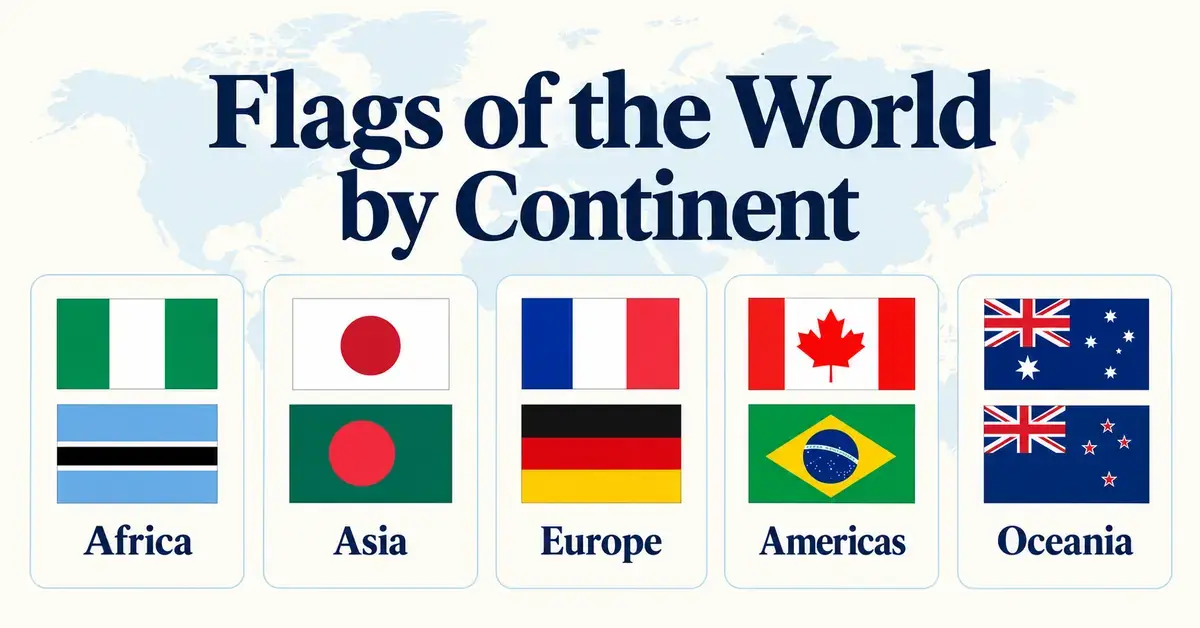
This page is the flag directory for countryflags.ca: a single place to browse the national flags of the world grouped by continent. Use it as a starting point, then follow the links down to the detailed guide for each region. As of October 2026 there are 195 national flags of sovereign states — the 193 member states of the United Nations plus two observer states, the Holy See (Vatican City) and Palestine. Below you will find how those flags are split across the continents, what each region’s flags tend to have in common, and answers to the questions readers ask most.
Key Points
- 195 national flags represent the world’s sovereign states as of October 2026 (193 UN members plus the Holy See and Palestine).
- By continent: Africa 54, Asia 48, Europe 44, the Americas 35, Oceania 14 — the figures add to 195 because each country is assigned to one continent.
- Africa has the most flags; Oceania has the fewest; Antarctica has no sovereign state and no national flag.
- Counts vary between sources because of transcontinental countries, disputed states such as Western Sahara, and whether dependent territories are counted.
- Nepal flies the only non-rectangular national flag, and Denmark’s Dannebrog is the oldest national flag still in continuous use.
How many national flags are there in the world?
There are 195 national flags if you count one flag per sovereign state. That figure comes from the 193 United Nations member states plus the two UN observer states, the Holy See and Palestine, each of which has its own national flag. It is the number most reference works use when they say “the flags of the world”.
The total climbs well past 250 once you add the flags of dependent territories, autonomous regions and constituent countries — for example Greenland, Puerto Rico, Hong Kong, the Cook Islands or Scotland — because many of these have distinct, officially used flags even though they are not independent states. This directory focuses on sovereign-state flags, grouped by continent, and notes territories where they matter.
Flags by continent at a glance
The table below shows how the 195 sovereign-state flags divide across the five continental groupings this site uses, current to October 2026. The counts assign each country to a single continent, which is why they add up to 195 exactly. Antarctica has no sovereign states and therefore no national flag.
Flags at a Glance
| Continent | National flags (sovereign states, Oct 2026) | Signature colours or designs |
|---|---|---|
| Africa | 54 | Pan-African red, gold and green (from Ethiopia) |
| Asia | 48 | Pan-Arab black, white, green and red; Nepal’s unique pennant shape |
| Europe | 44 | Nordic cross; pan-Slavic red, white and blue |
| The Americas | 35 | Central American blue-white-blue; Gran Colombia yellow, blue and red |
| Oceania | 14 | Southern Cross constellation; Union Jack cantons |
| World total | 195 | 193 UN members plus the Holy See and Palestine |
Why continent flag counts vary between sources
Continent flag counts differ because there is no single official rule for assigning every country to a continent. If you compare two reputable lists you will often see Asia given as 48 or 49 and Europe as 44 or 51, even though both agree the world has 195 sovereign states. Three things cause the gap.
- Transcontinental countries. States such as Russia, Turkey, Kazakhstan, Georgia, Azerbaijan, Armenia, Cyprus and Egypt sit across a continental boundary. A list that files Russia under Europe and Turkey under Asia will reach different per-continent totals than one that does the opposite, even though the world total is unchanged.
- Disputed and partially recognised states. Western Sahara is counted as a sovereign member by the African Union (making Africa 55) but is treated as a non-self-governing territory by the United Nations (making Africa 54). Entities such as Kosovo and Taiwan are recognised by some countries and not others, so lists include or omit them depending on their criteria.
- Territories versus countries. Some lists quietly fold in dependencies — Caribbean islands, Pacific territories, overseas regions — while others count only fully independent states.
To keep this directory consistent, we count only the 195 sovereign states, assign each to one continent, and note the main exceptions in the sections below. For how the colours and emblems on these flags are commonly interpreted, see our overview of what flag colours and symbols mean.
Flags of Africa
Africa has the most national flags of any continent: 54 sovereign states as of October 2026 (or 55 if you follow the African Union and include Western Sahara). Many African flags share the pan-African colours — red, gold (yellow) and green — which come from the flag of Ethiopia. Ethiopia became a symbol of African independence because it kept its sovereignty through the colonial era, and Ghana was the first newly independent African state to adopt these colours, on its flag of 1957.
The colours are commonly read as red for the blood and sacrifice of independence struggles, gold for mineral wealth and sunshine, and green for the land and agriculture; a separate red-black-green set, associated with Marcus Garvey, is also called pan-African. Egypt, Sudan and several North African states instead use the pan-Arab palette described under Asia.
Flags of Asia
Asia has 48 national flags, spanning the widest range of flag traditions of any continent. In the west, many Arab states fly the pan-Arab colours — black, white, green and red — first combined in the 1916 Flag of the Arab Revolt and now seen on the flags of Jordan, Kuwait, Palestine, the United Arab Emirates and others.
Asia is also home to the single most distinctive flag in the world. Nepal has the only national flag that is not a rectangle or a square: it is formed from two stacked pennant shapes, carries a white moon and sun, and is usually read as representing the Himalayas. Elsewhere the continent ranges from the simple red disc of Japan to the detailed emblems of India, China and Sri Lanka.
Flags of Europe
Europe has 44 national flags in this scheme (lists that assign more transcontinental states to Europe put the figure higher). Europe is where several of the world’s most-copied flag patterns began. The Nordic cross — an off-centre cross shifted toward the hoist — appears on the flags of Denmark, Sweden, Norway, Finland and Iceland. The pan-Slavic colours of red, white and blue, popularised in the 19th century, run through the flags of Russia, Serbia, Slovakia, Slovenia and others.
Europe also holds a record: Denmark’s flag, the Dannebrog, is widely described as the oldest national flag still in continuous use. Its origin is tied by legend to the year 1219, and its current proportions were formalised in 1893.
Flags of the Americas
The Americas account for 35 national flags — 23 in North America (which here includes Central America and the Caribbean) and 12 in South America. Shared independence histories are written into many of these designs.
North America and Central America
Several Central American flags trace back to the blue-white-blue banner of the United Provinces of Central America, the short-lived federation of the 1820s and 1830s. Guatemala, Honduras, Nicaragua and El Salvador all still carry blue and white in that lineage, while Costa Rica added a red stripe in 1848 to set itself apart. Further north, the United States, Canada and Mexico each use highly individual national designs.
South America
Three South American neighbours — Colombia, Ecuador and Venezuela — share the yellow, blue and red of the flag of Gran Colombia, designed by Francisco de Miranda and first raised in the early 1800s. After Gran Colombia dissolved, each successor state kept the palette while changing the proportions and emblems.
Flags of Oceania
Oceania has the fewest national flags, with 14 sovereign states, but a strong regional identity. Many of its flags feature the Southern Cross, the constellation visible from the southern sky: it appears on the national flags of Australia, New Zealand, Papua New Guinea and Samoa (and, outside the region, on Brazil’s). New Zealand shows four stars; Australia shows five plus a larger Commonwealth Star.
The Union Jack still sits in the canton (upper-hoist corner) of several Oceanic flags, including Australia, New Zealand, Fiji and Tuvalu, reflecting former ties to Britain. Others, such as Papua New Guinea with its Raggiana bird-of-paradise, have moved to designs built around local symbols.
How flags are grouped and designed
Flags cluster into recognisable families, which is why so many look alike. The main groupings are colour-and-symbol traditions — pan-African, pan-Arab, pan-Slavic and the Nordic cross — plus shared-history families such as the former federations in Central America and Gran Colombia. Learning these patterns makes the whole world of flags easier to read, and it explains the common question of why unrelated countries end up with near-identical flags. If that is what brought you here, our flag FAQs tackle look-alike flags and other quick questions directly.
How to use this flag directory
Start with the continent that interests you, using the table above, then open its dedicated guide for the full set of flags, histories and symbol meanings. From any continent you can drill into a single country on our national flag profiles, or explore themed guides such as cross flags, crescent-and-star flags and the most common flag colours. For the big picture of the whole site, the countryflags.ca homepage links to every section.
Every count and claim on this page is checked against primary and reference sources and dated so you can see how current it is; you can read how we verify facts and handle contested symbolism in our editorial policy and sources, and find out who produces the site on the about page. countryflags.ca is a free informational reference — we do not sell flags.
Sources
- United Nations — Member States
- World Population Review — List of Countries by Continent
- WorldAtlas — The Oldest Flags in the World
- WorldAtlas — Flags That Feature the Southern Cross
- WorldAtlas — What Are the Pan-African Colors?
- Encyclopaedia Britannica — Flag of Nepal
- Flags of the World (FOTW) — United Provinces of Central America
- Te Ara: The Encyclopedia of New Zealand — Southern Cross
Frequently Asked Questions (FAQ)
How many national flags are there in the world?
There are 195 national flags of sovereign states as of October 2026: the 193 United Nations member states plus the two UN observer states, the Holy See and Palestine. The number rises above 250 if you also count the flags of dependent territories and autonomous regions.
Which continent has the most flags?
Africa has the most national flags, with 54 sovereign states (55 if Western Sahara is included, as the African Union does). Asia follows with 48, then Europe with 44, the Americas with 35 and Oceania with 14.
What is the only non-rectangular national flag?
Nepal has the only national flag that is not a rectangle or a square. It is made of two stacked pennant shapes and carries a white moon and sun, a design usually read as representing the Himalayas.
Which is the oldest national flag still in use?
Denmark’s flag, the Dannebrog, is widely regarded as the oldest national flag in continuous use, with origins linked by tradition to 1219. Its modern proportions were fixed in 1893.
Why do flag counts per continent differ between sources?
Counts differ because there is no single official rule for assigning countries to continents. Transcontinental states such as Russia and Turkey can be placed in either Europe or Asia, disputed states such as Western Sahara and Kosovo are counted by some sources and not others, and some lists include dependent territories while others count only fully independent states.