

Free, independent flag reference
Country Flags of the World: Meanings, History, Colours & Symbols
What every national flag looks like, what its colours and emblems stand for, and how it came to be. Every fact is checked against official sources before it is published.
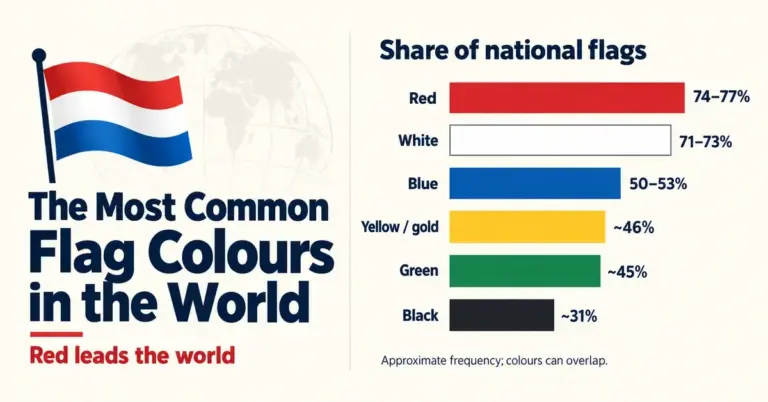
Red, white and blue are the three most common colours on national flags. See the chart →
Browse flags by continent
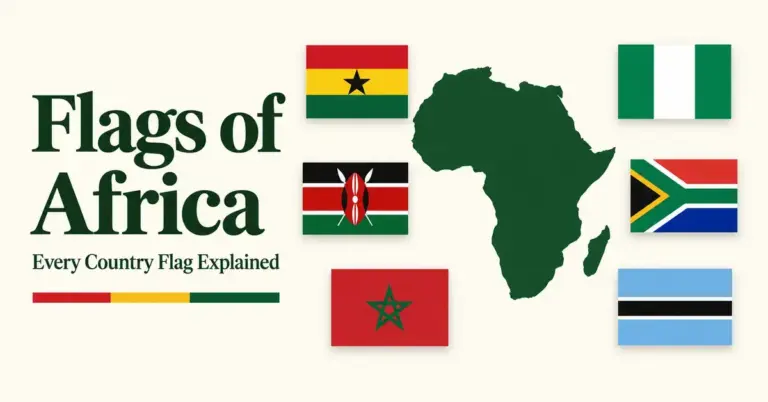
Africa
54 flags · pan-African colours
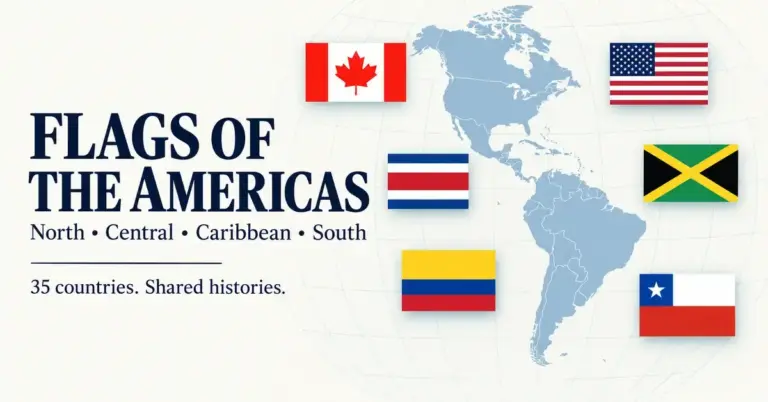
The Americas
35 flags · north to south
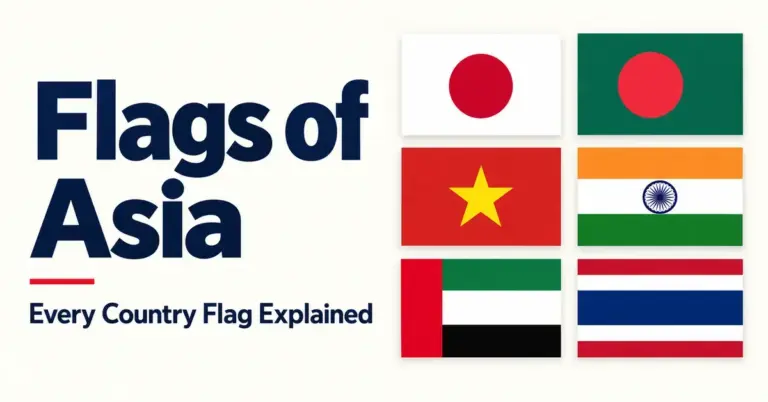
Asia
48 flags · suns, stars and crescents
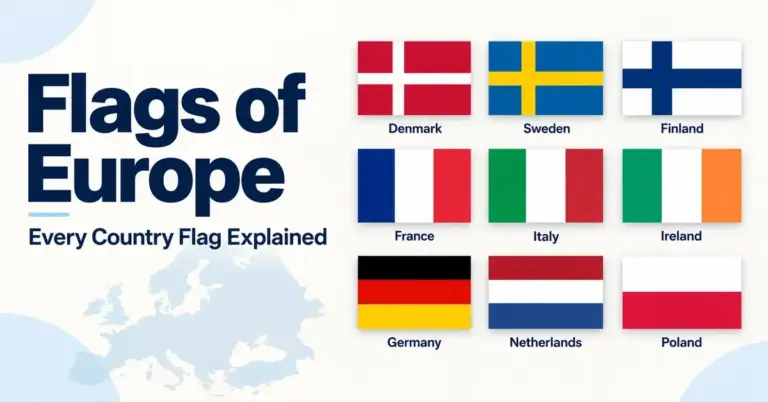
Europe
44 flags · crosses and tricolours
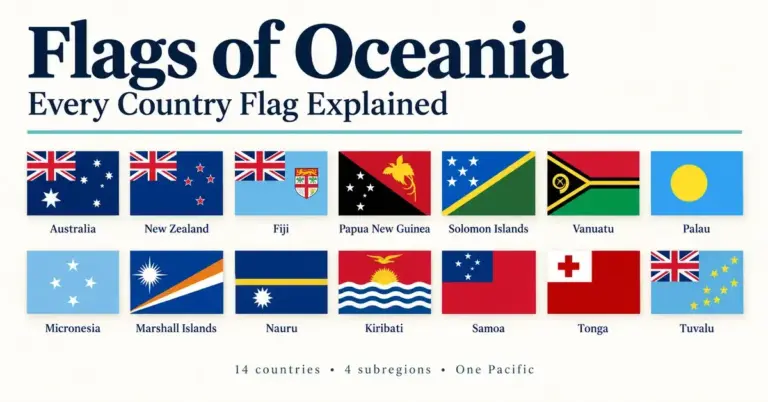
Oceania
14 flags · the Southern Cross
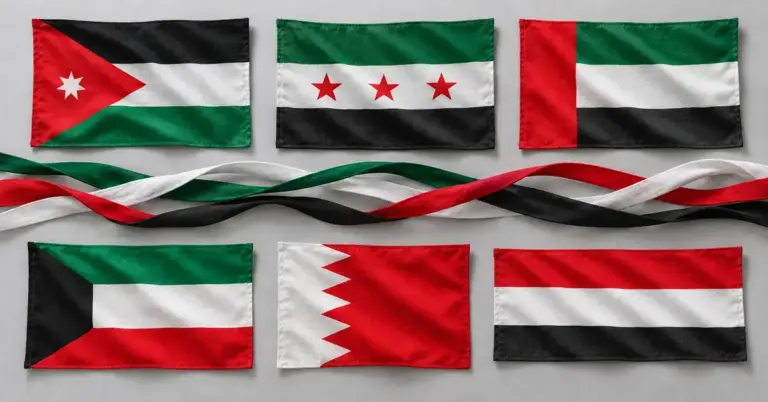
Middle East
17 flags · pan-Arab colours
Flags of Canada
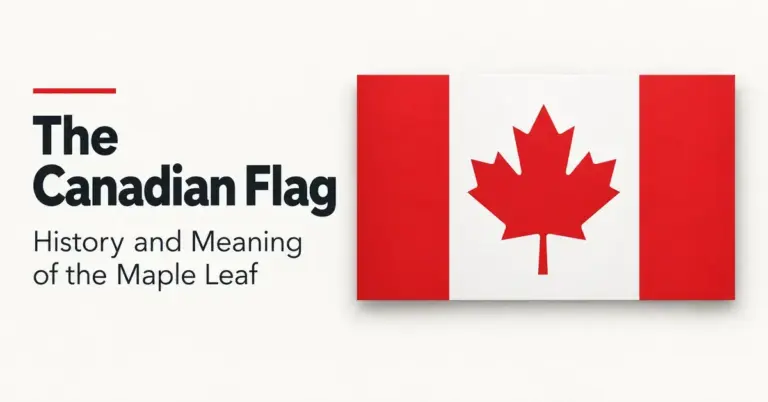
The Maple Leaf flag
History and meaning of the 11-point leaf
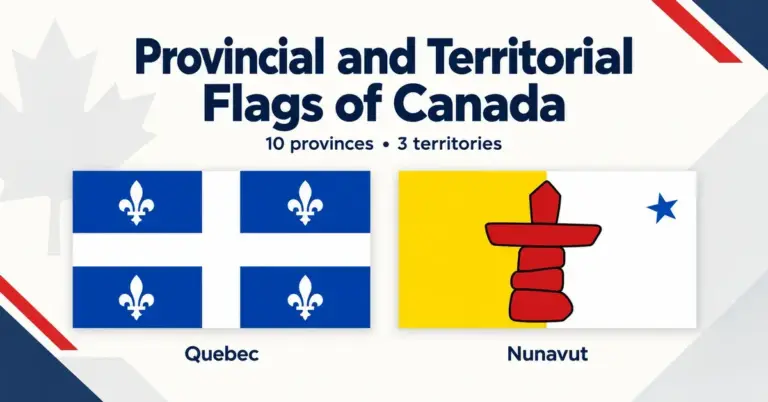
Provincial and territorial flags
10 provinces and 3 territories
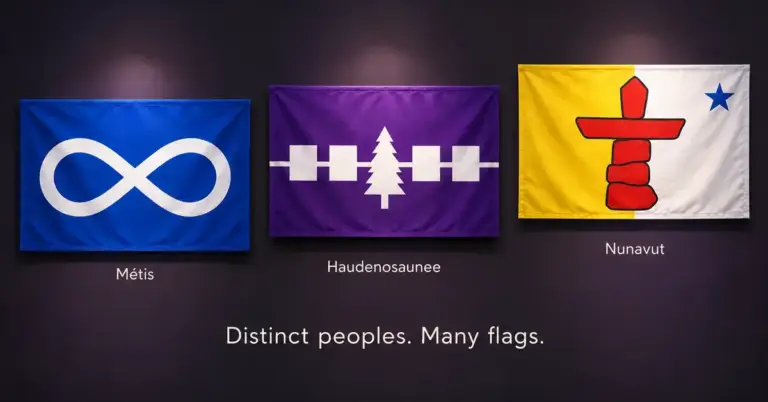
Indigenous flags of Canada
Métis, First Nations and Inuit flags
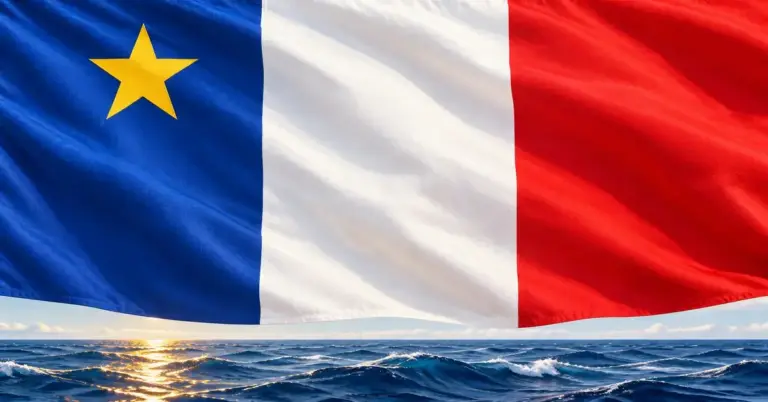
The Acadian flag
The star on the tricolour
Most read guides
Colours
The most common flag colours in the world
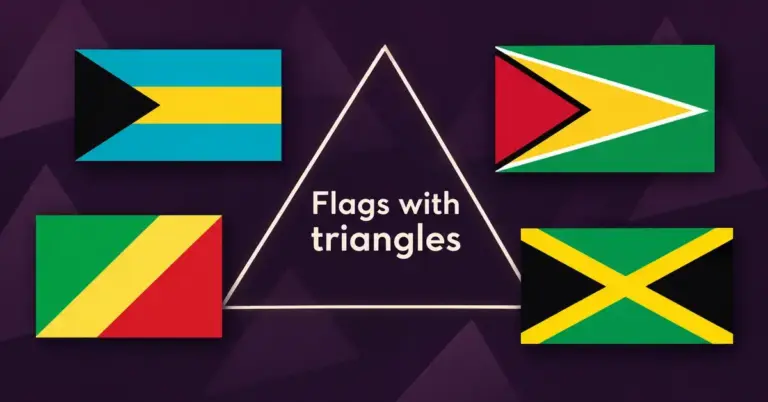
Design
Flags with triangles and what they mean
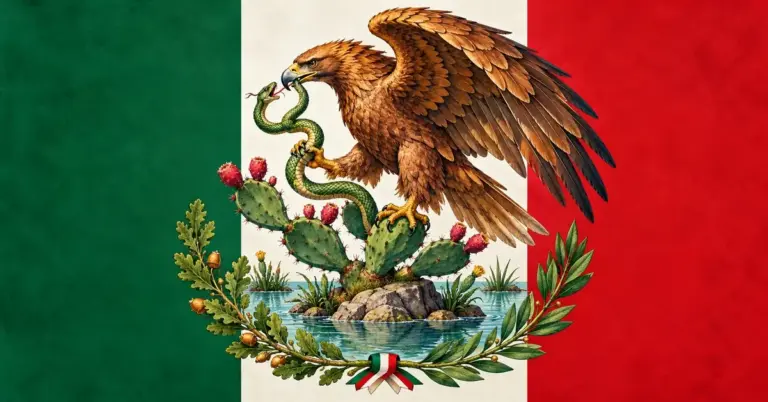
Country profile
The flag of Mexico: eagle, serpent and colours
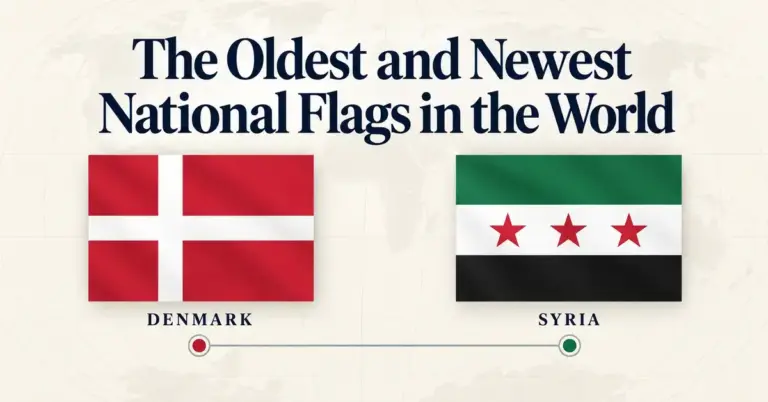
History
The oldest and newest national flags
Latest articles
- The Flag of South Korea (Taegukgi): Meaning of the Taeguk and Trigrams
- Red, White and Blue Flags: Every Country That Uses the Colour Combination
- Tricolour Flags: Which Countries Use Them and What the Three Bands Mean
- The Acadian Flag: Meaning of the Star on the Tricolour
- Indigenous Flags of Canada: Métis, First Nations and Inuit Flags
About this flag reference
Every sovereign country flies a national flag, and behind each design sits a story: a chosen palette, a symbol with meaning, and a history that often stretches back centuries. This site is a free, independent reference that explains what national flags look like, what their colours and emblems stand for, and how each one came to be. It is an informational resource only — we do not sell flags or flag merchandise. Use the search box or browse by region to look up any country, or start with the five topic areas described below.
Key Points
- 193 countries are United Nations member states, and most widely used lists count about 195 once the two observer states are added — each sovereign state has its own national flag.
- Denmark’s Dannebrog is widely recognised as the oldest national flag still in use.
- Nepal has the only non-rectangular national flag — a stacked double-pennant shape, taller than it is wide.
- Red, white and blue are the three most common colours on national flags worldwide.
- This is a free informational reference — we do not sell flags. Use the search box or browse by continent to look up any country.
What you will find here
This site is organised around five pillars, so you can start from whatever question brought you here. Each pillar below leads to a dedicated area of the site that goes far deeper than this overview. If you are new to flags, reading them in order gives you a solid grounding; if you came looking for one country, jump straight to its profile.
Explore the Five Pillars
| Pillar | What you will find |
|---|---|
| Flag colours & symbols | What reds, greens, stars, crescents and crosses stand for, and why the same colour can mean different things in different countries. |
| Flags by continent | Regional flag families — pan-African colours, European tricolours, Nordic crosses, the Southern Cross — grouped so the patterns stand out. |
| National flag profiles | One country at a time: appearance, meaning, history, adoption, proportions and look-alike flags, in a consistent format. |
| The flag of Canada | The Maple Leaf in detail: its 11-point leaf, 2:1 proportions, 1965 adoption and National Flag of Canada Day. |
| Vexillology | The study of flags: key terms, the principles of good flag design, and the history of the field. |
What is a national flag?
A national flag is the official emblem of a sovereign state, usually a rectangular piece of cloth with a distinctive pattern of colours and symbols. It serves as a country’s visual signature — flown on government buildings, carried at sporting events, raised on ships at sea and worn by citizens as a mark of identity. Because flags must be recognised instantly and from a distance, most rely on a small number of bold colours and simple shapes rather than intricate detail.
There is no single global count of countries, which is why the number of national flags depends on the list you use. The United Nations has 193 member states; most widely used lists reach about 195 by adding the two non-member observer states (the Holy See and the State of Palestine), and some government lists count a little higher. Every one of these states has its own national flag, which is what makes the world’s flags such a compact way to learn about geography, history and culture at once.
How flag colours and symbols carry meaning
Flag colours and symbols are rarely decorative — they almost always stand for something, though the exact meaning changes from country to country. The same red can mean the blood of those who fought for independence in one flag and simply courage or revolution in another. This is why reading a flag means looking up that specific country rather than assuming a universal code.
Even so, some broad patterns recur across many national flags:
- Red — frequently courage, revolution, or the sacrifice of those who died for the nation.
- White — often peace, honesty, or purity; sometimes snow or a particular faith.
- Blue — commonly the sky, the sea, rivers, freedom or vigilance.
- Green — land, agriculture and hope, and in many countries an association with Islam.
- Yellow or gold — mineral wealth, the sun, or the land itself.
- Black — often determination, the people, or a remembered past.
Symbols add a second layer of meaning. A crescent and star frequently signals Islamic heritage; a cross usually points to Christian history (the Nordic cross, offset towards the hoist, is a regional family all its own); a sun can represent independence or a new dawn; and stars often stand for states, provinces, islands or ideals. The pillar on flag colours and symbols breaks each of these down with real examples.
How flags differ by continent
Flags cluster into visual families by region, because neighbouring countries often share history, faith and political movements. Recognising these families makes it much easier to place an unfamiliar flag.
- Africa: the pan-African colours — red, gold and green, sometimes with black — appear on many flags as a shared symbol of independence and unity.
- Europe: the horizontal or vertical tricolour (three bands of colour) spread widely after the French tricolour, while the Nordic cross defines the flags of Scandinavia.
- The Americas: blue and white bands run through much of Central America, a legacy of the former United Provinces of Central America, while stars and stripes recur in the north.
- Asia and the Middle East: the pan-Arab colours (red, white, black and green) and the crescent-and-star motif are common threads.
- Oceania: the Southern Cross constellation and, on several flags, the British Union Jack in the corner reflect shared skies and colonial history.
The flags-by-continent pillar lays these regions out side by side so the patterns — and the exceptions — stand out.
Reading a single flag: national flag profiles
The quickest way to understand one country’s flag is to read its full profile. Each national flag profile on this site covers the same core questions so you can compare like with like: what the flag looks like, what each colour and symbol means, when and why it was adopted, how it is constructed and proportioned, and which other flags it resembles. Profiles also note earlier versions, because many national flags have changed more than once.
If you only remember one thing about reading flags, make it this: look up the specific country. Two flags can share an identical palette for completely unrelated reasons, and a profile is where those reasons are explained.
The flag of Canada
Canada’s national flag is a red field with a white square at its centre bearing a single stylised red maple leaf. The design uses an 11-point maple leaf and official proportions of two units wide to one unit tall (2:1), with the centre square framed by two red bands in a 1:2:1 ratio. The colours red and white are Canada’s official national colours.
The flag was approved by Parliament and proclaimed by Queen Elizabeth II, and it was flown for the first time on 15 February 1965, replacing the Canadian Red Ensign after a long national debate known as the Great Flag Debate. That date is now marked each year as National Flag of Canada Day. An early version of the design used a 13-point leaf, but it was simplified to 11 points so the maple leaf stayed clear at a distance and in wind. As a Canadian site, we give the Maple Leaf its own dedicated pillar.
Vexillology: the study of flags
Vexillology is the formal study of flags — their history, symbolism, design and use. The word combines the Latin vexillum (a square flag carried by Roman cavalry) with the Greek ending -logia, meaning “study”. The American scholar Whitney Smith is credited with coining the term in 1957; before that, flags were generally treated as a branch of heraldry.
The field has its own vocabulary worth knowing: someone who studies flags is a vexillologist, someone who designs them is a vexillographer, and the craft of designing flags is vexillography. Good flag design tends to follow a few widely shared principles — keep it simple, use meaningful symbolism, limit the palette to two or three colours, avoid lettering or seals, and make it distinctive. The vexillology pillar explores these ideas and the terminology in depth.
Common misconceptions about world flags
A handful of myths come up again and again, so it is worth clearing them up before you start browsing.
- “A colour always means the same thing.” It does not. Red, white and blue carry different meanings in different countries, and the only reliable guide is that country’s own account.
- “Every flag is a rectangle.” Nepal’s is not: it is the only non-rectangular national flag, formed from two stacked pennants (a “double pennon”) and taller than it is wide.
- “Similar flags must be copies of each other.” Near-identical flags, such as those of Chad and Romania or Indonesia and Monaco, usually developed independently from shared colours and simple proportions rather than one copying the other.
- “A country’s flag never changes.” Many national flags have been redesigned, sometimes repeatedly, after changes of government, independence or unification — which is exactly why historical context matters.
- “Flags of the world” and “flags of countries” are the whole picture. National flags are only part of vexillology, which also covers regional, civil, military, maritime and organisational flags.
How to browse and search the site
You can reach any flag in two ways. Use the search box to type a country name directly, or browse by continent to work region by region; many readers also like to scan alphabetically. Whichever route you take, every page leads back to the five pillars above, so you can move from a single country to the wider patterns and back again without getting lost.
A note on accuracy
This site is an educational, informational reference and is not affiliated with any government. We do not sell flags, poles or merchandise of any kind. We fact-check figures, dates and designs against official and authoritative sources and list them with each topic, but flags, official colours and protocol can change over time, and some symbolism is interpreted differently by different authorities. For legal, ceremonial or official use, always confirm the current design with the relevant national government. If you spot an error, the About and Editorial Policy pages explain how we work and how to get in touch.
Sources
Frequently Asked Questions (FAQ)
How many country flags are there in the world?
It depends on how you count countries. There are 193 United Nations member states, each with its own national flag. Most widely used lists reach about 195 by including the two non-member observer states, and a few government lists count slightly higher, so you will see figures of roughly 195 to 200 national flags.
What is the oldest national flag still in use?
Denmark’s flag, the Dannebrog, is widely recognised as the oldest national flag still in use. Its white Scandinavian cross on a red field has been flown in broadly its current form for centuries, long before most modern national flags existed.
Why do so many flags use red, white and blue?
Red, white and blue are the three most common colours on national flags worldwide. They stand out clearly at a distance, and influential designs — such as revolutionary and colonial-era flags — spread the combination widely, after which newly independent nations often echoed it for their own reasons.
Which country has a flag that is not rectangular?
Nepal has the only non-rectangular national flag. It is made of two stacked triangular pennants, is taller than it is wide, and carries a white moon and sun on a crimson field bordered in blue — a shape unlike any other national flag.
What does vexillology mean?
Vexillology is the study of flags: their history, symbolism, design and use. The term was coined by the American scholar Whitney Smith in 1957, combining the Latin vexillum (a Roman cavalry flag) with the Greek -logia, meaning “study”.