

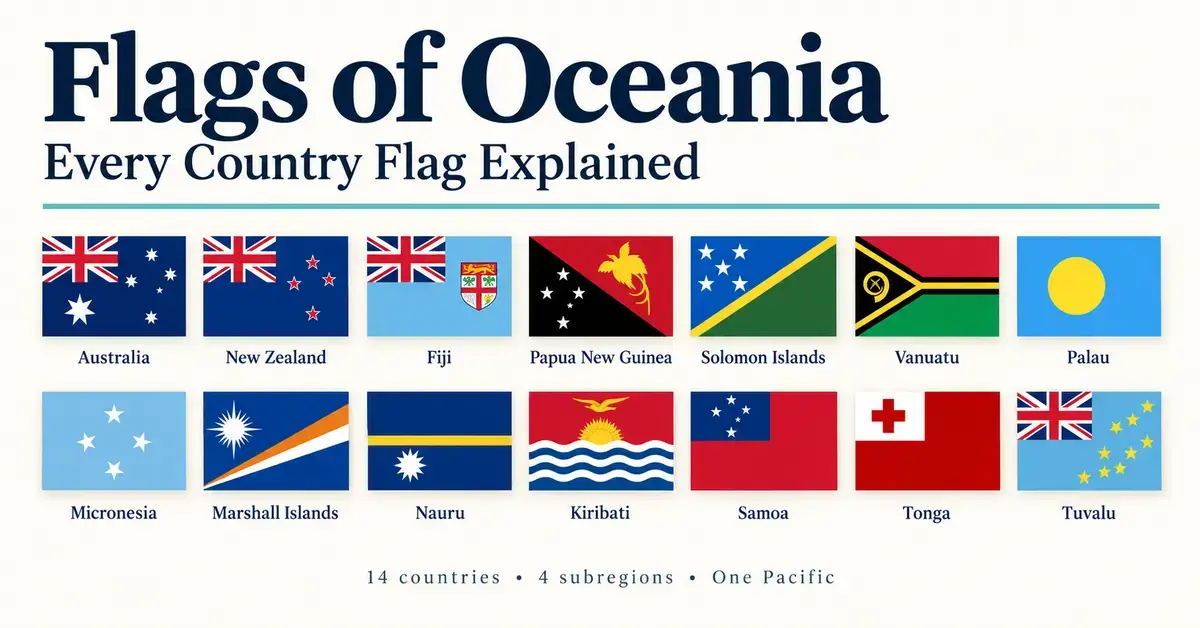
Oceania is the smallest of the world’s continental regions by land and population, yet its flags are among the most varied on any map. This guide explains every national flag of Oceania’s 14 sovereign countries, grouped by the region’s four parts, with the colours, symbols and history behind each one. You will also see why several flags share a British Union Jack in the corner and why the Southern Cross constellation keeps reappearing across the South Pacific.
Key Points
- Oceania has 14 sovereign countries across four subregions: Australasia, Melanesia, Micronesia and Polynesia.
- Four flags carry the Union Jack in the canton: Australia, New Zealand, Fiji and Tuvalu.
- The Southern Cross constellation appears on Australia, New Zealand, Papua New Guinea and Samoa.
- Blue dominates the region’s flags because it represents the Pacific Ocean; stars often stand for individual islands.
- The oldest design is Tonga’s (codified 1875); among the newest is Palau’s (1981).
What and where is Oceania?
Oceania is the region made up of Australasia and the islands of the Pacific Ocean. Geographers usually divide it into four parts: Australasia (Australia and New Zealand), Melanesia, Micronesia and Polynesia. It is defined by water as much as by land, so its flags are full of ocean blues, stars that stand for scattered islands, and symbols drawn from local culture and Christianity.
This article covers the 14 fully independent (sovereign) countries of Oceania. It does not count the many non-sovereign territories and freely associated areas — such as the Cook Islands, Niue, French Polynesia, New Caledonia, Guam and American Samoa — which have their own flags but are governed in association with Australia, New Zealand, France or the United States. Including those pushes the flag count well past 20, which is why published lists sometimes disagree.
A quick glossary of flag terms
Three words appear throughout this guide, so here is what they mean in plain language:
- Canton: the upper-left quarter of a flag, nearest the flagpole. The Union Jack sits in the canton on several Oceania flags.
- Hoist and fly: the hoist is the half nearest the pole; the fly is the free half that flaps in the wind.
- Ensign: a flag based on a plain coloured field with a national flag in the canton. A “blue ensign” is a blue field with the Union Jack in the corner — the starting point for the Australian and New Zealand flags.
All Oceania flags in one table
The table below lists every sovereign Oceania flag with its region, main colours, standout features and the year the current design was adopted. Use it as a quick reference; the sections underneath explain each flag in more detail.
Oceania Flags Compared
| Country | Subregion | Main colours | Standout features | Current design adopted |
|---|---|---|---|---|
| Australia | Australasia | Blue, white, red | Union Jack; seven-pointed Commonwealth Star; Southern Cross (5 white stars) | 1901 (current form 1908) |
| New Zealand | Australasia | Blue, white, red | Union Jack; Southern Cross as 4 red, white-bordered stars | 1902 |
| Papua New Guinea | Melanesia | Red, black, gold, white | Diagonal split; gold bird-of-paradise; Southern Cross | 1971 |
| Fiji | Melanesia | Light blue, white, red | Union Jack; coat-of-arms shield | 1970 |
| Solomon Islands | Melanesia | Blue, green, yellow, white | Yellow diagonal stripe; five white stars | 1977 |
| Vanuatu | Melanesia | Red, green, black, yellow | Yellow Y-shape; boar’s tusk and crossed fern fronds | 1980 |
| Federated States of Micronesia | Micronesia | Light blue, white | Four white stars in a diamond | 1979 |
| Kiribati | Micronesia | Red, blue, gold, white | Frigatebird over rising sun; three white wavy stripes | 1979 |
| Marshall Islands | Micronesia | Blue, orange, white | Widening orange/white diagonal bands; 24-pointed star | 1979 |
| Nauru | Micronesia | Blue, gold, white | Gold stripe for the equator; white 12-pointed star | 1968 |
| Palau | Micronesia | Light blue, yellow | Off-centre yellow full-moon disc | 1981 |
| Samoa | Polynesia | Red, blue, white | Blue canton with Southern Cross (5 white stars) | 1949 |
| Tonga | Polynesia | Red, white | White canton with a red cross | 1875 |
| Tuvalu | Polynesia | Light blue, yellow | Union Jack; nine yellow stars mapping the islands | 1978 (readopted 1997) |
Australasia: Australia and New Zealand
Australasia’s two flags are the region’s best-known, and they are often confused because both are blue ensigns carrying the Union Jack and the Southern Cross. The quickest way to tell them apart is the stars: Australia uses six white stars (one large plus the Southern Cross) and New Zealand uses only four red stars.
Australia
The flag of Australia is a blue ensign with the Union Jack in the canton, a large white seven-pointed Commonwealth Star below it, and the five stars of the Southern Cross in the fly. The winning design was first flown in Melbourne on 3 September 1901, the Commonwealth Star gained its seventh point in 1908, and the design was confirmed in law by the Flags Act 1953 (which received royal assent in 1954). The Commonwealth Star’s seven points stand for the six federating states plus Australia’s territories; the Union Jack reflects the country’s history within the British Empire.
New Zealand
New Zealand’s flag is a blue ensign with the Union Jack and four red, white-bordered stars forming the Southern Cross. It was adopted as the national flag in 1902. New Zealanders voted on whether to replace it in a 2016 referendum, choosing a silver-fern alternative as the challenger the year before; the existing flag won the final vote by 56.6% to 43.2%, so it stayed. Note that New Zealand shows only four stars of the constellation and omits the small fifth star that Australia includes.
Melanesia: bold colours and local symbols
Melanesia’s four flags move away from the blue-ensign look and lean on strong reds, blacks and greens with symbols rooted in local culture — a bird of paradise, a boar’s tusk, island stars and, in Fiji’s case, a surviving Union Jack.
Papua New Guinea
Papua New Guinea’s flag is split diagonally: a red upper triangle holds a golden Raggiana bird-of-paradise, and a black lower triangle carries the five white stars of the Southern Cross. It was adopted on 1 July 1971, before independence, from a design credited to a young student, Susan Karike. Red and black are traditional colours across many Papua New Guinean peoples, the bird-of-paradise is a national emblem, and the Southern Cross links the country to its South Pacific neighbours.
Fiji
Fiji flies a light-blue flag with the Union Jack in the canton and a shield from the national coat of arms in the fly. It dates from independence in 1970. The light blue represents the Pacific Ocean, while the shield shows a British lion and local produce such as sugar cane, bananas and a dove of peace. Fiji’s government debated removing the colonial symbols in 2013–2015 but decided in 2016 to keep the current flag, so the Union Jack remains.
Solomon Islands
The Solomon Islands flag is divided by a thin yellow diagonal stripe: blue in the upper hoist with five white stars, green in the lower fly. It was adopted in 1977. Blue stands for the surrounding water, green for the land, and the yellow line for sunshine. The five stars, arranged in an X pattern, originally represented the country’s districts.
Vanuatu
Vanuatu’s flag places a black triangle at the hoist holding a boar’s-tusk emblem encircling two crossed namele fern fronds, with a yellow Y-shape (a pall) dividing red above from green below. It was adopted in 1980. Red stands for unity and the blood shared by people, green for the land, and black for the ni-Vanuatu people; the boar’s tusk signals wealth and prosperity, and the fern fronds signal peace.
Micronesia: oceans, stars and the equator
Micronesia’s five flags are the region’s most minimalist. Four of them use a blue field for the Pacific and simple geometric shapes — stars, bands, a stripe or a disc — rather than detailed emblems, which makes them elegant but easy to mix up.
Federated States of Micronesia
This flag is a light-blue field with four white five-pointed stars arranged in a diamond. It was adopted in 1979. The blue is the Pacific, and the four stars stand for the federation’s four states: Yap, Chuuk, Pohnpei and Kosrae. An earlier Trust Territory flag used six stars; the design dropped to four after Palau and the Marshall Islands chose not to join.
Kiribati
Kiribati has one of Oceania’s most pictorial flags: a red upper half with a golden frigatebird flying over a rising sun, and a lower half of blue with three white wavy stripes. Adopted in 1979, it is based on the shield of the national coat of arms. The sun’s 17 rays represent the Gilbert Islands and Banaba, the three wavy stripes stand for the Gilbert, Phoenix and Line island groups, and the frigatebird represents power, freedom and local dance.
Marshall Islands
The Marshall Islands flag is a deep-blue field crossed by two widening diagonal bands — orange over white — rising from the lower hoist to the upper fly, with a large white 24-pointed star in the canton. It was adopted in 1979. The blue is the ocean, the bands represent the Ratak (sunrise) and Ralik (sunset) island chains and suggest the equator, and the star’s 24 points stand for the country’s electoral districts.
Nauru
Nauru’s flag is a blue field split by a narrow gold horizontal stripe, with a white 12-pointed star just below the stripe near the hoist. It was adopted at independence on 31 January 1968. The blue is the Pacific, the gold stripe is the equator, and the star’s position below the stripe shows Nauru lying just south of it; the 12 points represent the island’s 12 original tribes, and the white colour nods to phosphate, the island’s historic source of wealth.
Palau
Palau’s flag is a simple light-blue field with a yellow disc set slightly toward the hoist. It was adopted in 1981. The disc is a full moon, considered in Palau the best time for fishing, planting, harvesting and traditional ceremonies, and the blue field represents both the Pacific and the move from foreign rule to self-government. Its off-centre circle often draws comparison with Japan’s flag, but the colours and meaning are entirely Palauan.
Polynesia: crosses, stars and a British corner
Polynesia’s three sovereign flags are strikingly different from one another: Samoa carries the Southern Cross, Tonga a Christian cross, and Tuvalu a Union Jack with a map of stars.
Samoa
Samoa’s flag is a red field with a blue canton holding five white stars of the Southern Cross. The design appeared in 1948 with four stars, and a fifth star was added in 1949; the flag was kept unchanged when Samoa became independent in 1962. Red is commonly read as courage, blue as freedom and white as purity, and the Southern Cross ties Samoa to the wider southern sky.
Tonga
Tonga’s flag is a red field with a white canton bearing a red couped (shortened) cross. It is one of the oldest designs in Oceania: it was first used in 1866 and written into the constitution in 1875. The red cross is a Christian symbol, and the red is associated with the blood of Christ. Tongan law protects the design, so it has not changed since the nineteenth century.
Tuvalu
Tuvalu flies a light-blue flag with the Union Jack in the canton and nine yellow five-pointed stars spread across the fly to map the country’s nine islands. It was first adopted at independence on 1 October 1978. A different, Union-Jack-free design was used briefly in the 1990s, but Tuvalu reverted to the original flag in 1997. The Union Jack marks ties to the United Kingdom and the Commonwealth.
Two motifs to know: the Union Jack and the Southern Cross
Two recurring features explain much of the family resemblance between Oceania flags, and both come from the region’s modern history.
The Union Jack canton
Four Oceania flags carry the British Union Jack in the canton: Australia, New Zealand, Fiji and Tuvalu. Each began as a British colonial ensign, and each kept the Union Jack after independence as a marker of its continuing links with the United Kingdom and the Commonwealth. If you want the background to that corner emblem itself, our overview of what flag colours and symbols commonly mean explains how crosses and composite flags like the Union Jack are built.
The Southern Cross
The Southern Cross is a constellation visible across the Southern Hemisphere, and it appears on the flags of Australia, New Zealand, Papua New Guinea and Samoa. Because the full constellation has four bright stars plus a smaller fifth, flags differ in how many they show: Australia, Papua New Guinea and Samoa show five stars, while New Zealand shows only four. The number and colour of the stars are often the fastest way to tell these flags apart.
How to tell similar Oceania flags apart
The most common mistakes come from flags that share a blue ensign or a plain blue field. Here is how to separate the look-alikes at a glance:
- Australia vs New Zealand: count the stars and check their colour. Australia has six white stars (including the large Commonwealth Star); New Zealand has four red, white-bordered stars and no large star.
- Fiji vs Tuvalu: both are light blue with a Union Jack, but Fiji has a detailed coat-of-arms shield in the fly, while Tuvalu has nine plain yellow stars.
- Federated States of Micronesia vs Nauru: both are mostly blue, but Micronesia shows four stars in a diamond, whereas Nauru has a single gold stripe and one 12-pointed star.
- Palau vs Japan: both place a disc on a plain field, but Palau’s disc is yellow on blue and sits off-centre toward the hoist, while Japan’s is red on white and centred.
For more quick comparisons like these, see our flag FAQs, and browse the wider collection of country flags of the world for other regions. Every date and detail in this guide is checked against official and authoritative sources, in line with how we research and verify flag facts.
Sources
- Flags Act 1953 (Schedule 1) — Australasian Legal Information Institute
- Official result of the second New Zealand flag referendum — Electoral Commission (elections.nz)
- PNG Flag and National Anthem — Embassy of Papua New Guinea
- Flag of Samoa — Government of Samoa
- Fiji flag — The Commonwealth
- Flag of Tonga — Encyclopaedia Britannica
- Flag of Nauru — Encyclopaedia Britannica
- Palau flag description — CIA World Factbook
- Vanuatu flag — WorldAtlas
- Flag of the Marshall Islands — WorldAtlas
- Solomon Islands — Flags of the World
- Kiribati — Flags of the World
- Federated States of Micronesia — Flags of the World
- List of sovereign states and dependent territories in Oceania (used only to cross-check scope)
Frequently Asked Questions (FAQ)
How many flags are there in Oceania?
There are 14 national flags for Oceania’s 14 sovereign countries: Australia, New Zealand, Papua New Guinea, Fiji, Solomon Islands, Vanuatu, the Federated States of Micronesia, Kiribati, the Marshall Islands, Nauru, Palau, Samoa, Tonga and Tuvalu. Counting non-sovereign territories such as the Cook Islands, Niue or French Polynesia raises the total above 20.
Which Oceania flags have the Union Jack?
Four do: Australia, New Zealand, Fiji and Tuvalu. Each was once a British colony and kept the Union Jack in the canton after independence to signal its continuing ties with the United Kingdom and the Commonwealth.
What is the Southern Cross on Pacific flags?
The Southern Cross is a constellation seen across the Southern Hemisphere. It appears on the flags of Australia, New Zealand, Papua New Guinea and Samoa. Australia, Papua New Guinea and Samoa show five stars, while New Zealand shows four, which helps tell the flags apart.
What is the oldest flag in Oceania?
Tonga’s flag is the oldest still in use. Its red field with a white canton and red cross was first flown in 1866 and written into the constitution in 1875, and Tongan law has protected the design ever since.
Why do so many Oceania flags use blue?
Oceania is defined by the Pacific Ocean, so blue is the natural colour for its flags. Countries such as the Federated States of Micronesia, Palau, Nauru, the Marshall Islands, Fiji and Tuvalu all use blue to represent the sea that surrounds them, often with stars standing for individual islands.
