

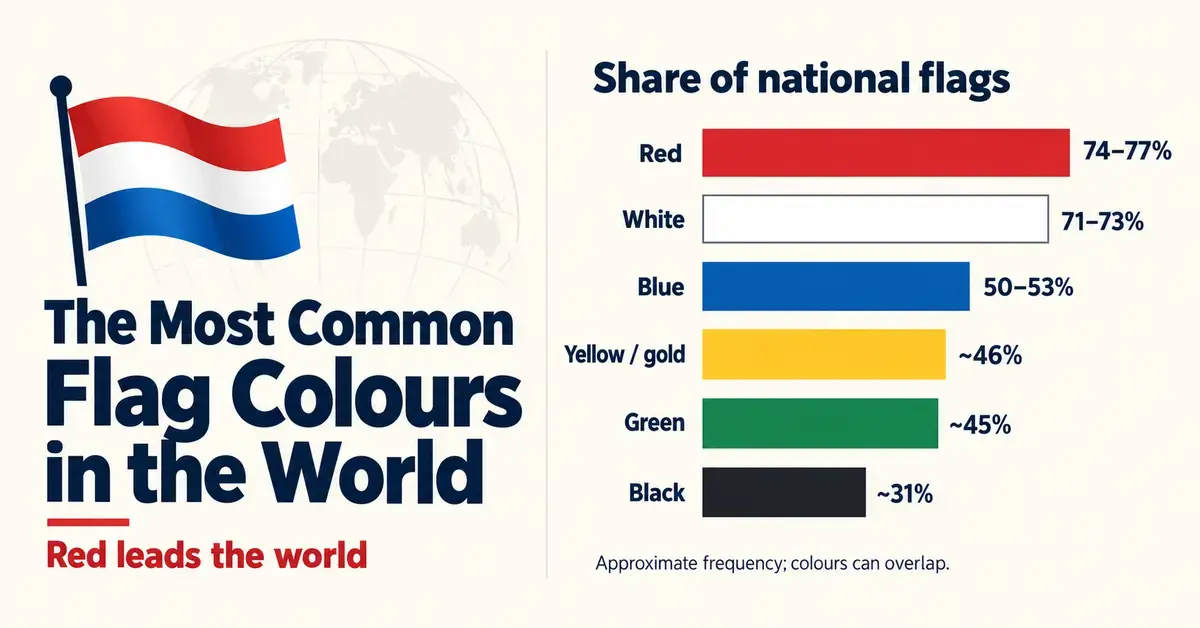
Red is the single most common colour on the world’s national flags — it appears on roughly three out of every four. This guide ranks how often each colour shows up across the world’s national flags, explains why some colours dominate while others barely appear, and gives you the frequency chart that flag fans most often go looking for. Every figure below is a count of real flags, and the sources and dates are listed near the end so you can check them yourself.
Key Takeaways
- Red is the most common flag colour — on about 74–77% of national flags.
- White is second (71–73%) and blue third (50–53%).
- Yellow/gold (~46%), green (~45%) and black (~31%) follow.
- Purple is the rarest colour, on only two flags: Dominica and Nicaragua.
- Jamaica is the only sovereign flag with no red, white or blue (black, green and gold).
- Red, white and blue together is the most common colour combination (~30 flags).
Which colour appears on the most flags?
Red appears on more national flags than any other colour. Guinness World Records lists red on 74% of national flags, with white second (71%) and blue third (50%). A detailed vexillological tally compiled in 2000 by Ivan Sarajcic for the Flags of the World project, covering the 192 independent countries of that year, put red even higher at 77% (148 of 192 flags), again followed by white (73%) and blue (53%); we found no newer full count of today’s flags (checked November 2026).
The two counts differ by only a few points because they were made in different years and included slightly different numbers of countries, but they agree on the ranking: red first, white second, blue third. No mainstream tally has ever shown another colour overtaking red.
How common is each flag colour?
The chart below ranks every colour by the share of national flags it appears on, using the 192-country dataset (2000). It is the quick visual answer to “which colour is on the most flags” and the easiest way to see how steeply frequency drops off after the top three.
Flag Colour Frequency Chart
Share of national flags that include each colour, based on a count of 192 independent countries (Flags of the World / Ivan Sarajcic, 2000). Bars are scaled to the percentages.
| Colour | Flags | Share of flags | Relative frequency |
|---|---|---|---|
| Red | 148 | 77% | ███████████████ |
| White | 140 | 73% | ██████████████ |
| Blue | 102 | 53% | ███████████ |
| Yellow / gold | 89 | 46% | █████████ |
| Green | 87 | 45% | █████████ |
| Black | 59 | 31% | ██████ |
| Orange | 9 | 5% | █ |
| Brown | 9 | 5% | █ |
| Grey | 6 | 3% | █ |
| Purple | 2 | 1% | ▖ |
For comparison, Guinness World Records gives the top three as red 74%, white 71% and blue 50%.
Reading the chart from the top: red and white are near-universal, blue sits just above half, yellow/gold and green cluster in the mid-40s, and black is on roughly a third of flags. After that the numbers collapse — orange, brown and grey each appear on fewer than one flag in twenty, and purple on just two flags in the entire world.
Why is red the most common flag colour?
Red dominates for practical and historical reasons rather than any single rule. Four factors stand out:
- Visibility. Red is bold and easy to see at a distance and against a sky, which mattered when flags were military and naval signals.
- Cheap, stable dye. Red pigments such as madder and later synthetic reds were widely available and held their colour, so red was easy to produce in quantity long before other dyes were.
- Symbolism of blood and sacrifice. Across very different cultures, red is commonly read as the blood shed in revolution, independence or defence of the nation — a meaning many countries chose deliberately.
- Heraldic and revolutionary heritage. European heraldry and the red used by France, the Netherlands, Britain, the United States and later socialist movements spread red designs around the world through trade, empire and political influence.
For a deeper look at what each colour tends to stand for, see our overview of what flag colours and symbols mean. Keep in mind that meanings are described as common, not universal — the same colour can mean different things in different countries.
How often does each of the other top colours appear?
White
White is the second most common flag colour, on about 71–73% of flags. It usually reads as peace, honesty or unity, and it is often used as a background or divider between stronger colours rather than as a statement colour on its own.
Blue
Blue appears on just over half of all flags (50–53%). It is commonly linked to the sky, the sea, freedom and loyalty, and it anchors some of the world’s most recognised designs, from the United States to the Nordic countries.
Yellow and gold
Yellow or gold is on roughly 46% of flags. Tallies often merge the two because a printed “yellow” and a heraldic “gold” are hard to tell apart. It frequently represents sunshine, mineral wealth or a golden future, and it is especially common in African and South American flags.
Green
Green sits close behind yellow at about 45%. It is strongly associated with agriculture, land, hope and — in many countries — Islam. Green has grown more common over the last century as newly independent nations adopted it.
Black
Black rounds out the major colours at roughly 31%. It can signify determination, the people, or past hardship overcome, and it is a defining colour of the pan-African palette of black, red, green and gold.
What is the rarest colour on national flags?
Purple is the rarest colour on national flags — only two in the world use it. In the 192-country dataset, purple appears on just 2 flags (about 1%): Dominica, where a purple Sisserou parrot sits in the central emblem, and Nicaragua, where a tiny purple band appears in the rainbow of the coat of arms. Both uses are small details, not fields of colour.
Purple is scarce for a historical reason: for centuries the dye was extracted in minute quantities from sea snails, making it extraordinarily expensive and strongly tied to royalty. Affordable synthetic purple did not arrive until the mid-1850s, by which time most flag-making traditions were already set. Orange (about 5%), brown (about 5%) and grey (about 3%) are also rare, but none is as scarce as purple.
Which national flag uses none of red, white or blue?
Jamaica is the only sovereign nation whose flag contains none of red, white or blue. Its flag is black, green and gold, arranged as a gold diagonal cross (a saltire) over two green and two black triangles. It was adopted at independence on 6 August 1962.
Jamaica was not always alone. Until 2017, Mauritania’s green flag with its gold crescent and star also avoided all three colours. That year a referendum added a thin red stripe to the top and bottom of the Mauritanian flag, leaving Jamaica as the sole remaining example. Because red, white and blue are by far the three most common flag colours — and the most common colour combination, appearing together on around 30 flags — a flag that uses none of them is genuinely unusual.
Appearance versus area: a colour can be common but cover little
How often a colour appears is not the same as how much flag it covers, and mixing the two is the most common error in flag colour statistics. The same 192-country study also measured each colour’s share of total flag area, and the ranking shifts:
- Red leads on both measures — about 30% of all flag area.
- Blue covers about 21% of area, more than white, even though it is on fewer flags.
- White is on more flags than blue but covers only about 19% of area, because it is so often used in thin stripes and backgrounds.
In other words, white is “common” in the sense of being present on many flags, while blue is “common” in the sense of filling a lot of cloth. Both statements are true; they just answer different questions.
Do flag colours vary by region?
Yes — the global ranking hides strong regional differences. While red leads worldwide, the most common colour changes from one continent to the next:
- Africa: green is unusually dominant here, reflecting both agriculture and the pan-African palette, with red and white close behind.
- The Americas: white is the most widespread colour, appearing on the large majority of flags, often paired with red and blue.
- Asia: white and red lead, both appearing on the great majority of flags.
- Europe: the worldwide order holds almost exactly — red first, then white, then blue.
So a blanket statement like “green is uncommon” is true globally but misleading for Africa, where green is one of the leading colours. Regional context changes the picture.
How have flag colours changed over time?
Flag colour frequencies have shifted gradually as new countries have been founded. Red and blue were even more dominant a century ago and have eased slightly as a share of all flags. Green and black, by contrast, have become noticeably more common, driven largely by the wave of independence across Africa and Asia in the twentieth century and the spread of the pan-African and pan-Arab colour schemes. The top of the ranking — red, then white, then blue — has nonetheless stayed stable throughout.
Where do these figures come from, and when?
The numbers on this page come from two respected tallies, not from memory or guesswork. Guinness World Records records red at 74%, white at 71% and blue at 50%. The fuller colour-by-colour breakdown and the area figures come from a count of 192 independent countries compiled by Ivan Sarajcic for the Flags of the World (FOTW) project in 2000.
Different sources report slightly different percentages for three honest reasons: they include different numbers of countries (typically 192 to 196), they were compiled in different years as flags changed, and they make different choices about borderline cases — above all whether to count yellow and gold as one colour or two. We date every figure so you can see which tally it came from. For more on how we check and source this kind of data, see our editorial policy and sources.
Common mistakes when reading flag colour statistics
Flag colour numbers are easy to misquote. Watch for these traps:
- Confusing “most flags” with “most area.” White is on more flags than blue, but blue covers more flag area. Always check which measure a figure uses.
- Treating one percentage as the only answer. Red is cited as 74% and 77% by different reputable sources; both are right for their dataset and year. A single exact number with no date should be treated with caution.
- Mixing up single colours and combinations. “Red is on 74% of flags” and “red, white and blue appear together on about 30 flags” are two different statistics.
- Yellow versus gold. Counts that separate the two will show lower figures for each than counts that merge them.
- Counting the wrong flags. Some lists quietly add subnational, historical or non-sovereign flags, which inflates the totals.
- Dominica versus the Dominican Republic. The purple flag belongs to Dominica; the Dominican Republic’s flag is red, white and blue. The similar names cause a surprising number of errors.
If you have a quick factual question about flags rather than a full statistical one, our flag FAQs page covers the most common ones, and you can browse the whole reference from the countryflags.ca home page.
Sources
Frequently Asked Questions (FAQ)
Which colour is on the most flags?
Red is on the most national flags — between about 74% and 77% depending on the tally and year — followed by white and then blue. Every mainstream count agrees that red comes first.
How many flags are red?
Roughly three out of four. The Flags of the World count of the 192 independent countries of 2000 found red on 148 of them (77%), while Guinness World Records lists red on 74% of national flags.
What is the rarest colour on a national flag?
Purple is the rarest, appearing on only two flags: Dominica and Nicaragua, and in both cases only as a small detail. It was historically so costly to produce that it rarely entered flag design.
Is there a flag with no red, white or blue?
Yes — Jamaica’s black, green and gold flag is the only sovereign flag that uses none of red, white or blue. It has held that distinction since Mauritania added red to its flag in 2017.
What is the most common colour combination on flags?
Red, white and blue together is the most common combination, appearing on around 30 national flags. Three-colour designs are also the single most common flag format overall.
