

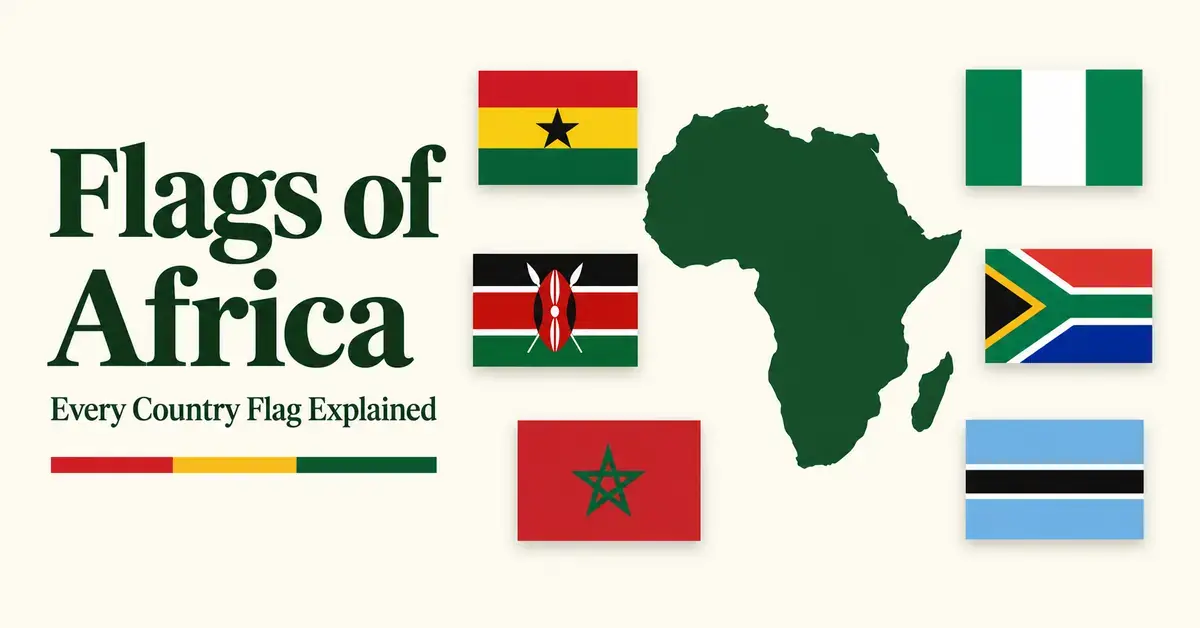
The flags of Africa tell the story of a whole continent in colour: anti-colonial struggle, newly won independence, faith, farming, rivers and wildlife. Africa has 54 countries that are members of the United Nations, so there are 54 national flags to know — plus a few from disputed or partly recognised territories. This guide lists every African country flag in one table, explains why so many share red, gold and green, and walks through the symbols that appear again and again. For the bigger picture of what colours and shapes mean worldwide, see our overview of what flag colours and symbols mean.
Quick Facts
| African countries (UN members) | 54, so 54 national flags |
| African Union members | 55 (includes Western Sahara) |
| Most common palette | Pan-African red, gold and green (from Ethiopia) |
| First to use that palette | Ghana, 1957 (red-gold-green with a black star) |
| Most common symbol | The star (unity and freedom) |
| Newest flag | South Sudan, 2011 |
| Unique flag | Mozambique — the only national flag with a modern rifle |
How many flags does Africa have?
Africa has 54 national flags that belong to sovereign UN member states. That figure rises depending on what you count. The African Union recognises 55 member states, because it also admits the Sahrawi Arab Democratic Republic (Western Sahara), a territory whose status is disputed with Morocco. A handful of self-declared states, most notably Somaliland, fly their own flags but are not recognised internationally. In this guide the main table covers the 54 UN members, and the disputed cases are described separately below so the numbers stay clear.
The spread of African flags is recent by world standards. Most were adopted between the late 1950s and the 1970s, as colonies became independent nations, which is a big reason the designs share so many ideas. Ghana led the way in 1957, and the newest, South Sudan, dates only to 2011.
Every African country flag at a glance
The table below lists all 54 UN member states of Africa in alphabetical order, with a short description of each flag’s design and the meaning most often given to its colours and symbols. Flag meanings are interpretations that can vary between official and popular sources, so treat them as the commonly cited reading rather than a single fixed definition.
| Country | Flag design | What it commonly means |
|---|---|---|
 | Green and white vertical halves with a red crescent and star | Green and white for Islam and peace; the red crescent and star for sacrifice and faith |
 | Red over black with a crossed gold machete, cog-wheel and star | Red for bloodshed, black for Africa; the machete and cog for farm and industrial workers |
 | Green vertical band beside yellow over red horizontal bands | Pan-African palette: green for hope, yellow for wealth, red for courage |
 | Light-blue field split by a black central stripe edged in white | Blue for water and rain; the black and white band for racial harmony |
 | Red over green bands with a central yellow star | Pan-African colours; red for revolution, green for hope, the star for guidance |
 | White saltire over red and green panels, with three red stars on a white disc | Three stars for the motto “unity, work, progress”; red for struggle, green for hope |
 | Blue field with white-red-white stripes and a ring of ten yellow stars | Ten stars for the main islands; blue for the sea and sky, red and white for peace and effort |
 | Green, red and yellow vertical bands with a yellow star on the red | Pan-African colours; the single star for national unity |
 | Four horizontal bands (blue, white, green, yellow) crossed by a red vertical stripe and a yellow star | Blends the Pan-African and French tricolour palettes; the red stripe for the blood shared by all |
 | Blue, yellow and red vertical bands | Blue for sky and hope, yellow for the sun and desert, red for progress and sacrifice |
 | Four horizontal stripes (yellow, white, red, blue) with a green hoist triangle, white crescent and four stars | The four stripes and stars stand for the islands; green and the crescent for Islam |
 | Diagonal bands of green, yellow and red | Pan-African colours; green for forests and farming, yellow for friendship, red for sacrifice |
 | Sky-blue field with a yellow star and a red diagonal stripe edged in yellow | Blue for peace, red for the blood of martyrs, yellow for the country’s wealth |
 | Orange, white and green vertical bands | Orange for the savannah and land, white for peace, green for hope and forests |
 | Light-blue and green panels with a white hoist triangle and a red star | Blue for sea and sky, green for the earth, white for peace, the red star for unity |
 | Red, white and black horizontal bands with the gold Eagle of Saladin | Red for struggle, white for peace, black for the end of oppression; the eagle for strength |
 | Green, white and red bands with a blue hoist triangle and central coat of arms | The silk-cotton tree and six stars appear in the arms; blue for the sea linking the territories |
 | A red triangle spanning the flag, with green and blue triangles and a gold olive wreath | Red for the struggle for freedom, green for agriculture, blue for the sea |
 | Blue flag with a yellow-edged red band carrying a Nguni shield, two spears and a staff | The shield stands for protection; red for past battles, blue for peace, yellow for resources |
 | Green, yellow and red horizontal bands with a blue disc and gold star | The original source of the Pan-African colours; the star for unity and a bright future |
 | Green, yellow and blue horizontal bands | Green for the forests, yellow for the equator and sun, blue for the sea |
 | Red, blue and green bands separated by thin white stripes | Red for the sun and savannah, blue for the river, green for the land; white for unity and peace |
 | Red, gold and green bands with a central black star | The first African flag to use the Pan-African palette (1957); the black star of African freedom |
 | Red, yellow and green vertical bands | Pan-African colours; red for labour and sacrifice, yellow for justice, green for solidarity |
 | Red hoist band with a black star, beside yellow over green bands | Pan-African colours; the black star for African unity |
 | Black, red and green bands with white fimbriations and a central Maasai shield and spears | The shield and spears for the defence of freedom; black for the people, red for blood, green for land |
 | Blue, white and green bands with a black Basotho hat (mokorotlo) at the centre | The hat represents national heritage; blue for rain, white for peace, green for prosperity |
 | Eleven red and white stripes with a blue canton and a single white star | Modelled on the US flag by freed settlers; the eleven stripes recall the signers of its declaration |
 | Red, black (wider) and green bands with a central white crescent and star | The 1951 flag restored in 2011; the crescent and star for Islam |
 | White vertical band beside red over green horizontal bands | White and red recall historic royalty, green the coastal peoples and farmers |
 | Black, red and green bands with a red rising sun on the black stripe | The rising sun for the dawn of hope; black for the people, red for martyrs, green for nature |
 | Green, yellow and red vertical bands | Pan-African colours; green for the land, yellow for purity and wealth, red for sacrifice |
 | Green field with a gold crescent and star and red stripes top and bottom (added 2017) | Green and the gold crescent for Islam; the red stripes for those who died for the country |
 | Red, blue, yellow and green horizontal bands | Red for the struggle, blue for the ocean, yellow for independence, green for farming |
 | Red field with a green five-pointed star (the Seal of Solomon) | Red for the ruling dynasty; the green star for Islam and life |
 | Green, black and yellow bands with a red hoist triangle bearing a star, book, hoe and rifle | The book, hoe and AK-47 stand for education, farming and defence — the only flag with a modern rifle |
 | A white-edged red diagonal, a blue upper triangle with a gold sun and a green lower triangle | The sun for life and energy; blue for the sky and ocean, green for vegetation, red for the people |
 | Orange, white and green horizontal bands with an orange disc | Orange for the Sahara, white for purity, green for the fertile south; the disc for the sun |
 | Green, white and green vertical bands | Green for agriculture and forests, white for peace and unity |
 | A wide blue band over yellow and green, with a gold sun in the corner | Adopted in 2001; the sun for enlightenment, blue for happiness, yellow and green for the economy and hope |
 | Green and yellow bands with a red hoist triangle and two black stars | Pan-African colours; the two stars for the two islands |
 | Green, yellow and red vertical bands with a central green star | Pan-African colours; the star for unity and openness to the world |
 | Five oblique bands of blue, yellow, red, white and green radiating from the hoist | A modern, dynamic design symbolising a young country moving forward |
 | Green, white and blue horizontal bands | Green for farming and the hills, white for unity and justice, blue for the sea and natural harbour |
 | Light-blue field with a single white five-pointed star | The blue echoes the UN; the star’s five points for regions where Somalis live |
 | A green Y-shape joining red, blue, black, white and gold sections | The converging Y for unity in diversity; adopted at the end of apartheid in 1994 |
 | Black, red and green bands with white stripes, a blue hoist triangle and a gold star | The youngest UN member (2011); the star of Bethlehem for the unity of its states |
 | Red, white and black horizontal bands with a green hoist triangle | Pan-Arab colours; green for Islam and agriculture |
 | Green and blue triangles split by a black diagonal band edged in yellow | Green for the land, blue for the sea and lakes, black for the people, yellow for mineral wealth |
 | Five green and yellow stripes with a red canton and a white star | Pan-African colours; the five stripes for the regions, the white star for hope and purity |
 | Red field with a white disc holding a red crescent and star | The crescent and star for Islam; the red recalls Ottoman heritage |
 | Six black, yellow and red stripes with a grey crowned crane on a white disc | Black for the people, yellow for the sun, red for brotherhood; the crane is the national emblem |
 | Green field with an orange eagle and red-black-orange stripes at the fly | Green for nature, red for struggle, black for the people, orange for minerals; the eagle for freedom |
 | Seven green, yellow, red and black stripes with a white hoist triangle, red star and Zimbabwe Bird | The soapstone bird is the national emblem; the red star for the liberation struggle |
Flag images: Wikimedia Commons, public domain.
Two flags fall outside the 54 because of their political status. Western Sahara (the Sahrawi Arab Democratic Republic) uses a black, white and green horizontal flag with a red hoist triangle and a red crescent and star — a Pan-Arab design — and is an African Union member whose sovereignty Morocco contests. Somaliland, which declared independence from Somalia in 1991 but is not recognised by any country, flies a green, white and red flag bearing the Islamic declaration of faith in Arabic and a black star.
Key Points
- Africa has 54 national flags for its 54 UN member states; the African Union counts 55 by including Western Sahara.
- Red, gold and green come from Ethiopia’s flag and were spread by the Pan-African movement; Ghana used them first in 1957.
- A second Pan-African set, red, black and green, comes from Marcus Garvey (1920).
- The star is the most common symbol; crescents mark mainly Muslim nations in North and West Africa.
- Flag colour meanings are commonly cited interpretations, not fixed rules, and some charts are out of date.
Why so many African flags share red, gold and green
Red, gold (yellow) and green dominate African flags because of their link to Ethiopia and to the Pan-African movement. More than a dozen national flags on the continent use this palette, either on its own or combined with a black star or band. If you have ever thought African flags “look alike”, this shared colour family is the main reason. You can explore how these colours work across the world in our guide to what flag colours and symbols mean.
Where the Pan-African colours come from
The red, gold and green scheme traces back to the flag of Ethiopia. Ethiopia was the one African state that kept its independence through the colonial era, apart from a brief Italian occupation, and its victory over Italy at the Battle of Adwa in 1896 made it a symbol of African self-rule. When other territories gained independence, many adopted Ethiopia’s colours in tribute. Ghana became the first to do so in 1957, with a red-gold-green flag and a black star designed by Theodosia Okoh. Benin, Cameroon, Congo, Guinea, Mali, Senegal, Togo and others followed.
The meanings most often attached to the palette are red for the blood shed in the fight for freedom, gold or yellow for mineral wealth and the sun, and green for the land, farming and hope. Individual countries give their own official readings, so the details differ from flag to flag.
The red, black and green set
A second Pan-African palette — red, black and green — comes from Marcus Garvey and the Universal Negro Improvement Association, which adopted those colours in 1920. Here black specifically represents African peoples, red the blood of a shared heritage and green the land. Flags such as Kenya, Malawi, South Sudan and Sudan draw on this red-black-green idea, sometimes alongside the Ethiopian gold.
Common symbols on African flags
Beyond colour, African flags repeat a small set of symbols that carry clear messages about faith, unity and national identity. Recognising them makes almost any African flag easier to read.
Stars
Stars are the most common emblem on African flags, and they usually mean unity or freedom. A single star often stands for national unity, as on the flags of Cameroon, Senegal and Ghana (the “black star of Africa”). Multiple stars can represent regions or islands, as with the four stars of Comoros or the ten of Cabo Verde.
Crescents and Islamic symbolism
The crescent and star mark countries where Islam is the main religion, concentrated across North and West Africa. Algeria, Libya, Mauritania, Tunisia and Comoros all carry a crescent, while Morocco uses a green five-pointed star. Green on these flags is strongly associated with Islam as well as with the land.
Local and cultural emblems
Many flags reach for a distinctly national image. Kenya and Eswatini display traditional shields and spears; Lesotho shows the Basotho mokorotlo hat; Uganda features the grey crowned crane; Zimbabwe carries the soapstone Zimbabwe Bird; and Mozambique’s flag is unique in the world for including a modern rifle, an AK-47, alongside a hoe and an open book.
African flags that stand out
A few African flags break the mould and are worth knowing on their own. Mozambique’s is the only national flag anywhere to show a modern firearm. South Africa’s post-apartheid flag, adopted in 1994, uses a horizontal Y to symbolise diverse groups converging on a shared path. Kenya’s is one of the few to place a weapon-bearing shield at its centre. Seychelles uses five bright bands fanning out from the corner for a deliberately modern, forward-looking feel. Eswatini and Lesotho both put a single cultural object — a shield and a hat — at the heart of the design.
Common mistakes people make with African flags
The biggest mistake is assuming the Pan-African colours always mean the same thing. Red, gold and green recur across dozens of flags, but each country assigns its own official meaning, and the Ethiopian (red-gold-green) and Garvey (red-black-green) sets have different origins. A few other errors come up often:
- Confusing look-alike flags. Guinea, Mali and Senegal all use green-yellow-red vertical bands; Senegal adds a green star. Chad and Romania are almost identical, and Mali and Guinea are mirror images of each other.
- Mixing up Pan-African and Pan-Arab colours. North African flags such as Egypt, Sudan and Libya use red, white, black and green for Pan-Arab reasons, not the Ethiopian Pan-African tradition.
- Using outdated designs. Mauritania added red stripes in 2017, Malawi reverted to its rising-sun flag in 2012, and Libya restored its 1951 flag in 2011. Older charts can be wrong.
- Counting the wrong number of countries. Africa has 54 UN members but 55 African Union members, because the AU also counts Western Sahara.
- Treating colour meanings as official fact. Many “meanings” are popular interpretations; always check a country’s own description for the authoritative version.
We explain how we check these details on our editorial policy and sources page, and you can browse quick answers to more questions on our flag FAQs. For the wider world of flags, start from our guide to country flags of the world.
Sources
Frequently Asked Questions (FAQ)
How many flags are there in Africa?
There are 54 national flags for the 54 African countries that are UN member states. The African Union counts 55 members because it also includes Western Sahara (the Sahrawi Arab Democratic Republic), and a few self-declared states such as Somaliland fly unrecognised flags.
What are the Pan-African colours?
The Pan-African colours are red, gold (yellow) and green, taken from the flag of Ethiopia, the African state that stayed independent through the colonial era. A second set — red, black and green, introduced by Marcus Garvey in 1920 — is also called Pan-African. Both appear on many African flags.
Which African country flag was first to use red, gold and green?
Ghana was the first African nation to adopt the red, gold and green palette, on its independence flag of 1957, which also added a black star. Many other newly independent countries followed Ghana’s example in the years that came after.
Which African flag has a gun on it?
Mozambique’s flag is the only national flag in the world to feature a modern firearm, an AK-47 rifle, shown with a hoe and an open book on a red triangle. Together they represent defence, agriculture and education.
Why do so many African flags look similar?
Many African flags look similar because they share the Pan-African colours of red, gold and green (or red, black and green) and were adopted around the same period of independence. Common symbols such as stars and crescents add to the resemblance, even though each country gives its flag its own meaning.
