

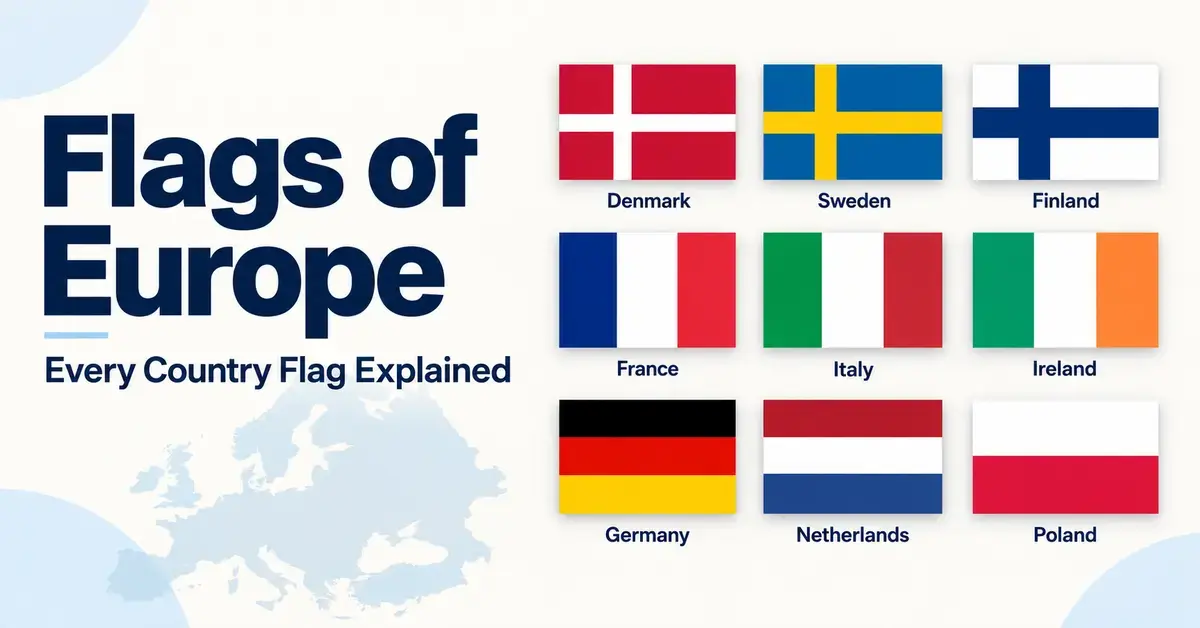
Europe is home to more national flags than any other continent of its size, and together they form a compact visual history of the region: crusades and kingdoms, revolutions and republics, Christianity and shared Slavic heritage. This guide to the flags of Europe lists every widely recognised country flag with a one-line explanation of what it commonly means, then groups the flags into the design families that make them so recognisable — the off-centre Nordic cross and the three-stripe tricolour above all. Flag meanings are often traditional rather than officially fixed, so where interpretations vary we say so.
Key Points
- How many flags: about 44 European countries by the geographic count, roughly 50 if you include transcontinental states such as Russia and Turkey.
- Two dominant design families: the off-centre Nordic cross (Denmark, Sweden, Norway, Finland, Iceland) and the three-band tricolour (France, Italy, Ireland and many more).
- Shared colour sets: the Pan-Slavic red-white-blue links Russia, Serbia, Slovakia, Slovenia, Croatia and Czechia.
- Two square flags: Switzerland and Vatican City are the only national flags that are not rectangular.
- Meanings vary: many colour meanings are traditional rather than official — sources differ by country.
How many flags does Europe have?
There is no single correct number, because it depends on where you draw Europe’s borders and which states you count. The most common figures are 44 sovereign states by the conventional geographic definition and about 50 by a broader political one that includes transcontinental countries such as Russia, Turkey and Kazakhstan.
The difference comes down to a few judgement calls:
- Transcontinental states. Russia and Turkey sit in both Europe and Asia; Kazakhstan has a small western sliver in Europe. They are sometimes counted, sometimes not.
- The Caucasus. Georgia, Armenia and Azerbaijan are geographically borderline and are included or excluded depending on the definition.
- Cyprus. It lies in the eastern Mediterranean, geographically closer to Asia, but is a member of the European Union and is almost always listed as European.
- Partially recognised states. Kosovo has substantial but not universal recognition, and a handful of de facto states have little or none.
For comparison, the European Union has 27 member states, while the Council of Europe counts 46 members. The table below focuses on the sovereign states that are fully or mostly within Europe, with a separate note on the transcontinental cases.
Every European country flag and its meaning
The table lists each flag in plain words — its layout and colours — followed by the meaning most commonly attached to it. Treat the meanings as the widely repeated interpretation; several countries have never fixed an official symbolism, and sources differ. For a deeper look at why particular colours and emblems recur, see our overview of what flag colours and symbols mean.
| Country | Flag and what it commonly means |
|---|---|
| Albania | Black double-headed eagle on red; the eagle derives from the seal of the 15th-century hero Skanderbeg and stands for Albanian sovereignty. |
| Andorra | Blue, yellow and red vertical tricolour with the national arms; the colours nod to neighbours France and Spain, its historic co-princes. |
| Austria | Red-white-red horizontal bands; one of the world’s oldest designs, tied to a legend of a battle tunic left white only where a belt had covered it. |
| Belarus | Red over green with a white-and-red ornamental strip at the hoist; red for the past, green for forests and hope, the pattern drawn from folk embroidery. |
| Belgium | Black, yellow and red vertical tricolour; the colours come from the arms of the historic Duchy of Brabant. |
| Bosnia and Herzegovina | Blue field with a yellow triangle and a line of white stars; the triangle evokes the country’s shape and its three peoples, the stars Europe. |
| Bulgaria | White, green and red horizontal bands, commonly read as peace, the land’s fertility and the courage of its people. |
| Croatia | Red, white and blue (Pan-Slavic) bands beneath the chequered šahovnica shield, the historic emblem of Croatia. |
| Cyprus | White field with a copper-coloured map of the island above two olive branches; the olive stands for peace between its communities, the copper for the island’s ancient name. |
| Czechia | White over red with a blue triangle at the hoist; the white and red are historic Bohemian colours, the blue added for the other lands. |
| Denmark | The Dannebrog: a white Nordic cross on red; by tradition the oldest continuously used national flag, and the model for every other Nordic cross. |
| Estonia | Blue, black and white horizontal bands, commonly read as the sky and sea, the soil and past hardship, and snow and hope. |
| Finland | Blue Nordic cross on white; the blue is usually linked to the country’s lakes and sky, the white to winter snow. |
| France | Blue, white and red vertical tricolour; the blue and red of Paris flank the white of the monarchy, together symbolising the Revolution and its ideals. |
| Germany | Black, red and gold horizontal bands rooted in the 19th-century movement for liberty and national unity. |
| Greece | Nine blue and white stripes with a white cross on blue in the canton; the cross marks Orthodox Christianity and the stripes echo the motto of independence. |
| Hungary | Red, white and green horizontal bands, traditionally read as strength, faithfulness and hope. |
| Iceland | Red Nordic cross outlined in white on blue; the colours are often tied to the island’s volcanic fire, ice and sea. |
| Ireland | Green, white and orange vertical tricolour; green for the Gaelic tradition, orange for the Protestant minority, white for lasting peace between them. |
| Italy | Green, white and red vertical tricolour; inspired by the French model, with local colours whose meanings are traditional rather than official. |
| Kosovo | Blue field with a gold map of the country and six white stars for its main communities (recognition is partial). |
| Latvia | Deep carmine-red with a narrow white band; a medieval legend ties the dark red to a chieftain’s blood-stained sheet. |
| Liechtenstein | Blue over red with a gold crown; the crown was added in 1937 to mark the principality and to tell the flag apart from Haiti’s. |
| Lithuania | Yellow, green and red horizontal bands, commonly read as the sun and prosperity, forests and nature, and the courage of its people. |
| Luxembourg | Red, white and light-blue horizontal bands from the arms of the House of Luxembourg; the blue is lighter than the Netherlands’ flag. |
| Malta | White and red with the George Cross in the canton, awarded to the island by the United Kingdom for bravery in the Second World War. |
| Moldova | Blue, yellow and red vertical tricolour with the national arms; close to Romania’s flag, reflecting shared heritage. |
| Monaco | Red over white horizontal bicolour from the arms of the ruling Grimaldi family (the same colours as Indonesia, in a different proportion). |
| Montenegro | Red field with a gold border and the state arms, a crowned double-headed eagle. |
| Netherlands | Red, white and blue horizontal bands; often called the oldest tricolour, descended from the orange-white-blue of William of Orange. |
| North Macedonia | Red field with a golden sun and broad rays, described as the new sun of liberty. |
| Norway | Red Nordic cross with a white-edged blue cross inside it; the red, white and blue were chosen as colours of liberty on a Danish cross base. |
| Poland | White over red, taken from the white eagle on a red field of the national arms. |
| Portugal | Green and red with the national arms and an armillary sphere recalling the age of maritime exploration. |
| Romania | Blue, yellow and red vertical tricolour drawn from the colours of the historic Romanian principalities. |
| San Marino | White over light blue with the state arms; traditionally the snow of Mount Titano and the surrounding sky. |
| Serbia | Red, blue and white (Pan-Slavic) bands with the state arms, a double-headed eagle and shield. |
| Slovakia | White, blue and red (Pan-Slavic) bands with the arms: a white double cross on three blue hills. |
| Slovenia | White, blue and red (Pan-Slavic) bands with the arms showing Mount Triglav, the country’s highest peak. |
| Spain | Red-yellow-red horizontal bands (the rojigualda) with the national coat of arms toward the hoist. |
| Sweden | Gold Nordic cross on blue; the colours are taken from the national coat of arms. |
| Switzerland | A square red flag with a bold white cross — one of only two square national flags in the world. |
| Ukraine | Blue over yellow, widely read as a blue sky above golden fields of wheat. |
| United Kingdom | The Union Jack, combining the crosses of St George, St Andrew and St Patrick for England, Scotland and Ireland. |
| Vatican City | A square flag of yellow and white with the crossed keys of St Peter beneath a papal tiara; the second of the world’s two square flags. |
Transcontinental and borderline cases. Several states are counted as European under the broader definition: Russia (white-blue-red Pan-Slavic bands), Turkey (a white star and crescent on red), Georgia (a red St George’s cross with four smaller crosses), Armenia (red, blue and orange bands), Azerbaijan (blue, red and green with a white crescent and star) and Kazakhstan (a golden sun, eagle and ornament on sky blue). Whether you include them depends on which map of Europe you are using.
The Nordic cross family
The Nordic cross is the single most distinctive flag family in Europe: a cross laid on its side with the upright shifted toward the flagpole rather than centred. Five sovereign states use it — Denmark, Sweden, Norway, Finland and Iceland — and so do the autonomous Faroe Islands and Åland.
Denmark’s Dannebrog is the template. It is traditionally dated to 1219 and is usually described as the oldest national flag still in use; a battle legend has it falling from the sky. The design spread across the region over the following centuries, with each country choosing its own colours while keeping the off-centre cross. The cross itself is generally understood as a Christian symbol, a reminder of the region’s shared religious history, though the specific colour meanings vary from one country to the next and are often traditional rather than official.
Because the shape is so consistent, you can usually identify a Nordic flag at a glance and then tell the countries apart by colour alone: red and white for Denmark, blue and yellow for Sweden, red-white-blue for Norway and Iceland, and blue and white for Finland.
The tricolour family
The tricolour — three bands of equal size — is Europe’s other great flag family, and the vertical version traces back to the French Tricolore. France raised its blue-white-red flag during the Revolution of the 1790s, pairing the colours of Paris with the white of the monarchy, and the design became a byword for republican liberty across Europe and beyond.
Vertical tricolours in the French mould include Ireland (green-white-orange), Italy (green-white-red), Belgium (black-yellow-red), Romania and Moldova (blue-yellow-red), and Andorra. Many more European flags are horizontal tricolours, a slightly older idea often credited to the Dutch: the Netherlands, Germany, Russia, Hungary, Bulgaria, Estonia, Lithuania and Luxembourg among them.
A word of caution for anyone learning the flags: the vertical tricolours of Ireland and Italy are easy to confuse, as are the horizontal red-white-blue flags of the Netherlands, Luxembourg and Russia. The differences come down to the exact colours and proportions — Ireland’s third band is orange, not red, and Luxembourg’s blue is lighter than the Dutch one.
Pan-Slavic colours, cross flags and crescents
Beyond the Nordic cross and the tricolour, a few smaller families tie European flags together. The Pan-Slavic colours — red, white and blue, taken from the Russian flag at a 19th-century congress of Slavic nations — appear on the flags of Russia, Serbia, Slovakia, Slovenia, Croatia and Czechia, usually with a national emblem added so they can be told apart.
A second thread is the Christian cross as a standalone emblem rather than a Nordic cross. Switzerland’s white cross on red, the Greek cross in the canton, Georgia’s five-cross flag and Malta’s George Cross all belong here, as does the United Kingdom’s Union Jack, which layers three saints’ crosses into one.
Finally, the star and crescent — a symbol long associated with the Ottoman world and with Islam — appears on the flags of Turkey and Azerbaijan at Europe’s south-eastern edge.
Flag Families at a Glance
| Design family | Key feature | European examples |
|---|---|---|
| Nordic cross | Cross with the upright shifted toward the hoist | Denmark, Sweden, Norway, Finland, Iceland (plus Faroe Islands, Åland) |
| Vertical tricolour | Three equal vertical bands, French-inspired | France, Ireland, Italy, Belgium, Romania, Moldova, Andorra |
| Horizontal tricolour | Three equal horizontal bands, often Dutch-inspired | Netherlands, Germany, Russia, Hungary, Bulgaria, Estonia, Lithuania, Luxembourg |
| Pan-Slavic colours | Red, white and blue, usually with an emblem | Russia, Serbia, Slovakia, Slovenia, Croatia, Czechia |
| Standalone cross | A single Christian cross as the main emblem | Switzerland, Greece, Georgia, Malta, United Kingdom |
| Star and crescent | Crescent moon with a star | Turkey, Azerbaijan |
A closer look at the UK and French flags
Two flags repay a closer look because they have shaped so many others. The Union Jack is a composite: the red cross of St George (England) sits over the diagonal white saltire of St Andrew (Scotland) and the diagonal red saltire of St Patrick (Ireland). When Ireland’s cross was added in 1801, the diagonals were deliberately offset — the broad white should sit above the red in the top corner nearest the pole — so that no single saltire dominates. Wales is not separately represented, as it was already united with England.
The French Tricolore is the ancestor of the vertical-tricolour family. Its blue, white and red combined the arms of Paris with the royal white during the Revolution, and as French ideas of citizenship and republic spread, so did the three-stripe format — from Italy and Ireland to flags well outside Europe. Understanding these two designs explains a surprising share of the patterns you see across the rest of the continent.
Common mistakes people make with European flags
Even confident flag-spotters trip over a handful of recurring errors. Avoiding them makes the whole continent easier to read.
- Confusing Ireland and Italy. Both are vertical tricolours with green, white and a third colour. Ireland’s third band is orange and the flag is wider; Italy’s is red.
- Mixing up the red-white-blue horizontals. The Netherlands, Luxembourg and Russia all use red, white and blue bands. Luxembourg’s blue is noticeably lighter, and the stripe order and shade separate the Dutch and Russian versions.
- Assuming colour meanings are official. Many European countries have never fixed an official symbolism. Read the popular meanings as tradition, not law.
- Forgetting the two square flags. Almost every national flag is a rectangle; Switzerland and Vatican City are the exceptions.
- Treating “Scandinavian” and “Nordic” as the same set. The Nordic cross family includes Finland and Iceland, which are Nordic but not strictly Scandinavian.
- Counting Europe’s flags as a fixed number. The total shifts with your definition, so always say whether you mean the geographic or the political count.
How to use this guide
If you are learning the flags, start with the two big families: spot the Nordic cross by its off-centre shape, then the tricolours by their three equal bands. Everything else — the Pan-Slavic trios, the cross flags, the two square flags — becomes a short list of exceptions. For broader background on recurring colours and emblems, our overview guide to flag colours and symbols goes deeper, and the flag FAQs page answers quick questions such as which colour is most common. You can also browse the full reference from our country flags of the world homepage. We explain how every fact here is checked on our editorial policy and sources page.
Sources
- Council of Europe — 46 member states
- European Union — EU countries (27 members)
- Encyclopaedia Britannica — Europe (extent and countries)
- The Flag Institute — flag of Liechtenstein and the crown added in 1937
- The Royal Household — the Union Jack and its three saints’ crosses
- SWI swissinfo.ch — the square Swiss flag
- Encyclopaedia Britannica — flag of Denmark (the Dannebrog and the Nordic cross)
- Encyclopaedia Britannica — flag of France (the tricolour)
Frequently asked questions (FAQ)
How many countries are in Europe?
Most commonly 44 by the geographic definition and about 50 by the broader political one that includes transcontinental states such as Russia, Turkey and Kazakhstan. The European Union has 27 members and the Council of Europe 46, so always say which count you mean.
Which European flags use the Nordic cross?
Five sovereign states — Denmark, Sweden, Norway, Finland and Iceland — plus the autonomous Faroe Islands and Åland. All share an off-centre cross whose upright is shifted toward the flagpole, modelled on Denmark’s Dannebrog.
What is a tricolour flag?
A flag of three equal bands of colour. The vertical form was popularised by the French Tricolore and appears on flags such as Ireland, Italy and Belgium; the horizontal form, often credited to the Dutch, appears on the Netherlands, Germany and many others.
Which European countries have square flags?
Only two: Switzerland, with a white cross on red, and Vatican City, with its yellow-and-white design and the keys of St Peter. Every other national flag in Europe is a rectangle.
Why do several European flags look so similar?
Because many share a design family or a historical source — the Nordic cross, the French-inspired tricolour, or the Pan-Slavic red-white-blue. Countries that start from the same template usually add a different emblem or change the colours and proportions to tell their flags apart.
