

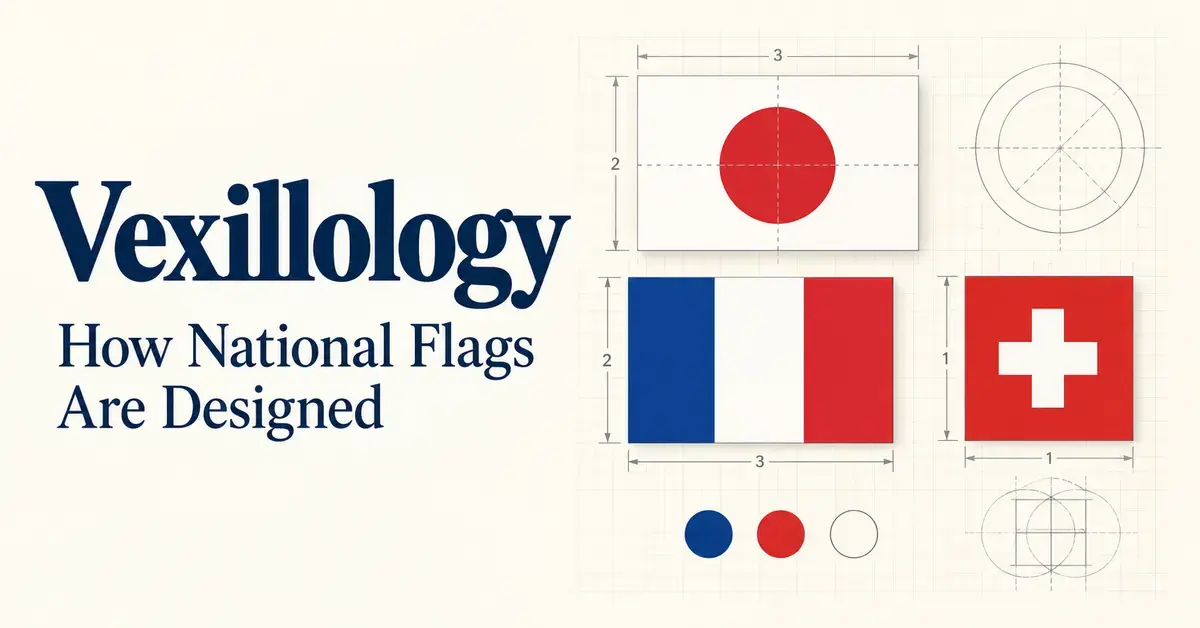
Vexillology is the study of flags — how they are designed, what their colours and symbols mean, where they come from and how they are used. This page is the starting point for the “how and why” of flags on countryflags.ca: what the field is, who shaped it, how a flag is put together, and the simple principles that separate a strong national flag from a cluttered one. Think of it as a map that routes you down to the more detailed guides in this section.
Key Points
- The field covers every side of a flag: its design, history, symbolism and use.
- The term was coined by scholar Whitney Smith, dated to 1957; he founded the Flag Research Center in 1962.
- FIAV links flag associations worldwide and holds an International Congress of Vexillology every two years.
- Good flag design follows five principles: keep it simple, use meaningful symbolism, two or three colours, no lettering or seals, and be distinctive or related.
- The most common flag ratio is 2:3; Switzerland’s flag is square and Nepal’s is the only non-rectangular national flag.
What is vexillology?
It is the scientific and scholarly study of flags of every kind — national, regional, military, maritime, civic and personal. The name comes from the Latin vexillum, a square banner carried by Roman cavalry, combined with the suffix -logy, meaning “study of.” The field covers a flag’s design and construction, its history and meaning, and the rules and etiquette that govern how it is flown.
The International Federation of Vexillological Associations (FIAV) describes the discipline as the creation of a body of knowledge about flags of all types, their forms and functions, together with the theories and principles drawn from that knowledge. In plain terms: flags are treated as objects worth studying carefully, not just decorating with.
Who coined the word “vexillology”?
The American scholar Whitney Smith (1940–2016) coined the term, generally dated to 1957 when he was still a teenager. Sources disagree on when it first appeared in print: the Flags of the World reference project records its debut in The Arab World magazine in October 1958, while Smith himself later wrote that it did not reach print until 1959. He was teased because the word pairs a Latin root with a Greek suffix — a “barbarism” in linguistic terms — a criticism he shrugged off.
Smith did far more than name the subject. In 1962 he founded the Flag Research Center in Massachusetts, the first professional vexillological institute, and launched The Flag Bulletin, the first academic journal devoted to flags. He is widely regarded as the founder of modern vexillology.
Vexillologist, vexillophile or vexillographer?
These three words describe different relationships to flags, and Smith himself proposed the distinctions in a 2001 article.
- Vexillologist — someone who studies flags academically: their history, meaning and rules.
- Vexillophile — an enthusiast who enjoys flags as a hobby, such as collecting or flag-spotting.
- Vexillographer — a person who designs flags (vexillography is the craft of flag design).
The line between the first two is blurry in practice, and some hobbyists objected that the labels were hard to apply. Most people interested in flags are a bit of all three.
Who organises the study of flags?
Flag study is a global field with its own associations. The International Federation of Vexillological Associations (FIAV) is the umbrella body that links national and regional flag organisations around the world. It grew out of an informal group formed in 1965 at the first International Congress of Vexillology in the Netherlands, was organised in Switzerland in 1967, and was formally created in Boston in 1969 when a dozen founding members signed on. FIAV’s membership has grown to several dozen associations and institutions across five continents.
Since 1969, the congress has been held every two years under FIAV’s auspices, where researchers present papers on flag history, design and law. National bodies such as the North American Vexillological Association (NAVA) run their own meetings and publications. This organised community is why flag facts can be checked against serious, peer-reviewed sources rather than folklore.
The anatomy of a flag
Understanding flag design starts with a shared vocabulary for the parts of a flag. A handful of terms do most of the work:
- Hoist — the edge nearest the flagpole, and by extension the half of the flag closest to the pole.
- Fly — the free outer edge that flaps in the wind, and the half of the flag furthest from the pole.
- Field (or ground) — the background, the main area of colour on which everything else sits.
- Canton — a rectangle in the upper hoist corner carrying a distinct design, such as the blue star field on the flag of the United States.
Designers also borrow terms from heraldry. A fimbriation is a thin band of contrasting colour that separates two larger areas — the white lines between the red and blue of the United Kingdom’s Union Flag are a classic example, and they also keep colours from touching in a way that would clash. A saltire is a diagonal cross running corner to corner.
Why flag proportions matter
Flag proportions are written as a ratio of hoist to fly — so 2:3 means the flag is two units tall for every three units wide. The ratio changes how a design reads: the same emblem looks very different on a short, stubby flag than on a long, narrow one.
The most common national-flag ratio is 2:3, followed by 1:2. A few flags break the mould entirely:
- Switzerland flies a square (1:1) national flag — one of only two national flags that are square. A rectangular 2:3 version is used at sea and at events such as the Olympics, where a uniform shape is required.
- Nepal has the only non-rectangular national flag in the world: a double pennant made of two stacked triangles.
- The United States uses a 10:19 ratio in official federal specifications, longer and narrower than most.
Because some countries define more than one acceptable ratio — or none at all — published figures vary slightly between sources.
How are national flags designed?
Good flag design follows a small set of principles rather than personal taste. The most widely used summary is NAVA’s booklet “Good” Flag, “Bad” Flag, compiled by Ted Kaye from the advice of more than twenty vexillologists and vexillographers. Introduced in 2001 and published in print in 2006, it distils flag design into five principles that are now quoted in city and state flag debates across North America.
The Five Principles of Good Flag Design
| Principle | What it means |
|---|---|
| Keep it simple | Simple enough that a child could draw it from memory. |
| Use meaningful symbolism | Colours, shapes and images should relate to what the flag represents. |
| Use two or three basic colours | A small palette of standard colours that contrast well. |
| No lettering or seals | Avoid writing and detailed seals, which fail at a distance and when reversed. |
| Be distinctive or be related | Stand apart from other flags, or resemble one on purpose to show a link. |
Keep it simple
A good flag is simple enough that a child could draw it from memory. Simplicity is what lets a flag stay recognisable when it is tiny, flapping, or seen from a distance — the real conditions in which flags are viewed.
Use meaningful symbolism
Every colour, shape and image should connect to what the flag stands for — the land, the people, their history or values. Meaning is what turns a pattern into a symbol people feel attached to.
Use two or three basic colours
Strong flags stick to two or three standard colours that contrast well. Limiting the palette keeps the design bold and makes it cheap and consistent to reproduce in cloth, print and pixels.
Avoid lettering and seals
Words and detailed seals rarely survive being shrunk, reversed on the back, or seen from afar. As Kaye puts it, a seal represents a government while a flag represents the people — and text in one language excludes everyone who does not read it.
Be distinctive or be related
A flag should either look clearly different from others or deliberately resemble a flag it is linked to — shared history, region or heritage. The Nordic countries, for example, all use an offset cross to signal their connection, while standing apart through colour.
These are guidance, not iron law. Plenty of respected flags break a rule on purpose — but, as the booklet warns, you should depart from the principles only with care and a reason.
Families of flag design
Most national flags fall into a handful of recognisable design families, which is one reason so many look alike at a glance.
- Tricolours and bicolours — two or three stripes, either horizontal (Germany, Russia) or vertical (France, Italy, Ireland). The central band of a horizontal triband is called the fess.
- Nordic (Scandinavian) cross — a cross with its vertical bar shifted toward the hoist, shared by Denmark, Sweden, Norway, Finland and Iceland.
- Canton flags — an emblem set in the upper hoist corner, as on the flags of the United States, Australia and Malaysia.
- Ensigns — flags that place a national symbol in the canton over a coloured field, a tradition rooted in British naval ensigns.
The colours and emblems inside these layouts carry their own meanings, which we cover at overview depth in our companion pillar on flag colours and symbols.
Common mistakes in flag design
Most weak flags fail for the same predictable reasons. Knowing them is the fastest way to judge a design:
- Too complex — fine detail disappears at flag-pole distance and cannot be drawn from memory.
- Lettering and seals — text reverses on the back of the flag and is unreadable when small.
- Too many colours — a crowded palette muddies the design and is costly to reproduce accurately.
- Weak contrast — colours that sit next to each other on the colour wheel blur together, which is exactly the problem a fimbriation is meant to solve.
- Accidental look-alikes — a design so close to another country’s flag that the two are confused, without any shared history to justify it.
These failings explain why a growing number of cities and regions have redesigned their flags in recent years, guided by exactly the principles above.
Where to go next
This overview is the hub for the “Flag Facts & Design” section. From here you can explore the broader collection on the country flags of the world homepage, dig into the meanings behind the palette on our flag colours and symbols pillar, or get quick answers on the flag FAQs page. Every figure on this site is checked against primary and scholarly sources, as set out in our editorial policy and sources.
Sources
- North American Vexillological Association — “Good” Flag, “Bad” Flag (Ted Kaye)
- International Federation of Vexillological Associations (FIAV)
- Flags of the World — What is vexillology?
- Encyclopaedia Britannica — Flag (heraldry and vexillology)
- SWI swissinfo.ch — The Swiss flag is square, except when it isn’t
Frequently Asked Questions (FAQ)
What is vexillology in simple terms?
It is the study of flags — their design, history, symbolism and the rules for using them. The name joins the Latin vexillum (banner) with -logy (study of). It treats flags as serious objects of research, covering everything from a flag’s colours to the etiquette for flying it.
Who invented the word “vexillology”?
The American scholar Whitney Smith coined the word, usually dated to 1957. He went on to found the Flag Research Center in 1962 and the first academic flag journal, and he is widely seen as the founder of the modern field.
What makes a good flag design?
NAVA’s five principles are the common benchmark: keep it simple, use meaningful symbolism, limit the palette to two or three contrasting colours, avoid lettering and seals, and be distinctive or deliberately related to a linked flag. The core test is whether a child could draw the flag from memory.
What is the most common flag shape and ratio?
Almost all national flags are rectangular, and the most common proportion is 2:3 (two units tall to three wide), followed by 1:2. Switzerland’s national flag is square, and Nepal’s is the only non-rectangular national flag, formed of two stacked triangles.
What is the difference between a vexillologist and a vexillographer?
A vexillologist studies flags; a vexillographer designs them. A third term, vexillophile, describes someone who enjoys flags as a hobby. All three were proposed by Whitney Smith, though in practice the roles often overlap.