

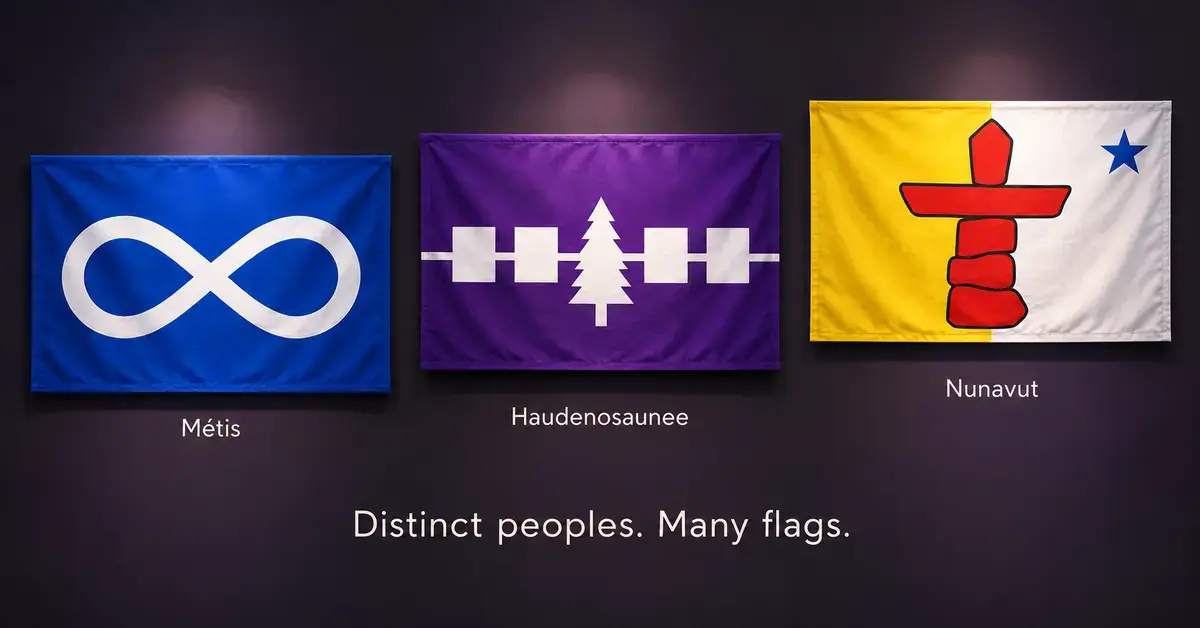
Canada is home to three constitutionally recognised groups of Indigenous peoples — First Nations, Inuit and Métis — and the flags linked to them tell very different stories from the red-and-white maple leaf. Some, like the Métis infinity flag, are older than Canada itself. Others, like the flag of Nunavut and the Survivors’ Flag, are recent and carry carefully chosen symbolism. This guide explains the best-known Indigenous flags of Canada, what their colours and symbols mean, who designed them and where the history is genuinely contested.
Key Points
- Three peoples, many flags: First Nations, Inuit and Métis are distinct peoples — there is no single Indigenous flag of Canada.
- Métis flag: a white infinity symbol on blue (common today) or red; one of the oldest flags native to Canada, recorded from 1815–1816.
- First Nations: 630+ communities, so no one flag — notable designs include the Haudenosaunee, Haida and Mohawk Warrior flags.
- Inuit: the flag of Nunavut (red inuksuk, blue North Star) is the best-known Inuit-designed flag; adopted 1 April 1999.
- Survivors’ Flag: an orange-and-white flag of remembrance for residential-school Survivors, tied to the 30 September Day for Truth and Reconciliation.
Who are Canada’s Indigenous peoples?
Canada’s Constitution recognises three groups of Indigenous (formerly “Aboriginal”) peoples: First Nations, Inuit and Métis. They are distinct peoples with their own histories, languages and territories, and they do not share one common flag.
- First Nations are the many nations who lived across what is now Canada before European contact. The Government of Canada recognises more than 630 First Nations communities, representing over 50 nations and more than 50 Indigenous languages.
- Inuit are the peoples of the Arctic, living mainly across the north in a homeland known as Inuit Nunangat, which spans four regions: the Inuvialuit Settlement Region, Nunavut, Nunavik (northern Quebec) and Nunatsiavut (northern Labrador).
- Métis are a distinct nation that emerged in the 18th and 19th centuries from the children and descendants of First Nations and European (largely French and Scottish) fur-trade families, centred on the Red River and the Prairies.
Because “Indigenous” covers so many peoples, there is no official pan-Indigenous flag of Canada. Instead there are several widely recognised flags, each tied to a specific nation, group or cause.
The Métis flag: the infinity symbol
The Métis flag is a white infinity symbol (a sideways figure eight) on a plain field of either blue or red. It is often called the oldest patriotic flag that is native to Canada, with records of it flying in the early 1800s — decades before the maple leaf and before Canadian Confederation in 1867.
What does the infinity symbol mean?
The infinity symbol has two widely repeated meanings: the joining of two peoples — First Nations and European — into a new nation, and the faith that Métis culture will live on forever. It is important to be honest here: there are no first-hand records explaining why the symbol was first chosen, so these interpretations are the meanings the Métis Nation attaches to it today rather than a documented original intent. Other theories link the shape to Plains sign language, to the figure-eight patterns of Métis dance, or to Scottish and Celtic design brought in by fur-trade fathers.
Blue or red — which Métis flag is correct?
Both the blue and the red versions are authentic and both have flown since the early 1800s. The blue infinity flag is the common modern form: the Métis National Council recognises the blue flag as the official flag of the Métis Nation and secured an official mark for it in 2013 so that it stays collectively owned by Métis citizens. The red version has become rare.
A popular story says red stood for the Hudson’s Bay Company and blue for the rival North West Company, which supposedly gave the flag to the Métis. Historians treat this with caution. Métis lawyer and historian Jean Teillet has called the North West Company “gift” story an urban myth, noting that both companies actually flew red ensigns, and argues the colour simply reflected whatever cloth was available. Treat the company explanation as folklore, not settled fact.
The history behind the Métis flag
The earliest surviving records are from the fur-trade wars on the Prairies. In 1815, Hudson’s Bay Company trader James Sutherland reported a red infinity flag flown by Métis near Qu’Appelle. On 1 June 1816, trader Peter Fidler recorded a blue infinity flag during a Métis action at Brandon House — just weeks before the Battle of Seven Oaks on 19 June 1816. The flag was a military and political standard long before it became the cultural emblem it is now. If you want more Canadian flag history for context, see our guide to the history and meaning of the maple leaf.
First Nations flags
Is there a single First Nations flag?
No. With more than 630 First Nations communities in Canada, there is no one First Nations flag, and no single design could represent them all. Many individual nations, communities and organisations have their own flags, crests and logos, often drawn from local art traditions and the stories of that nation. Below are some of the most widely recognised.
The Assembly of First Nations emblem
The Assembly of First Nations (AFN) is the national advocacy organisation of First Nations chiefs. Rather than a traditional flag, it is best known for its emblem, chosen in 1999 from more than 200 submissions and designed by Frank King of the Kettle and Stony Point First Nation in Ontario. Its elements include an eagle and a bear for strength, a medicine wheel, and seven eagle feathers representing past and future generations. It functions as an organisational symbol, not a flag of all First Nations.
The Haudenosaunee (Iroquois Confederacy) flag
The Haudenosaunee, or Iroquois Confederacy, flag is purple and carries a white design of four connected squares with a central white eastern white pine — the Tree of Peace. The design is taken from the Hiawatha Wampum Belt, which has long symbolised the union of the original Five Nations: the Mohawk, Oneida, Onondaga, Cayuga and Seneca (the Tuscarora later joined as a sixth nation). Purple is considered the colour of the Haudenosaunee because it is the shade of the quahog shell used to make wampum. The flag itself was created in the 1980s, reportedly so the Haudenosaunee national lacrosse team could carry its own colours at an international competition.
The Haida Nation flag
The flag of the Haida Nation of the Pacific Northwest coast shows Raven and Eagle — the two great clans of Haida society — encircled by children, rendered in the bold formline style of Northwest Coast art. The artwork is by the renowned Haida artist G̍uud San Glans Robert Davidson, who in 1987 allowed the Council of the Haida Nation to adopt it as the Nation’s flag and emblem. The first flag was raised in 2003 at the Council’s office in Old Massett on Haida Gwaii.
The Mohawk Warrior (Unity) flag
The Mohawk Warrior flag — also called the Unity flag — shows the profile of a long-haired warrior wearing a single feather against a golden sun on a red field. It was designed in the mid-1970s by Louis Karoniaktajeh Hall, a Mohawk artist and activist from Kahnawà:ke, who said the single feather meant “all of one mind” and intended the design for all Indigenous nations under the Great Law of Peace. The flag became internationally known during the 1990 Oka Crisis and is now one of the most recognisable Indigenous protest symbols in North America. For a wider look at how emblems like these work, see what the symbols on flags mean.
Inuit flags
The flag of Nunavut
The clearest example of an Inuit-designed flag is the flag of Nunavut, the Arctic territory created on 1 April 1999 with a population that is about 85% Inuit. It was designed by Inuk artist Andrew Qappik and proclaimed the same day. A red inuksuk — the traditional stone landmark Inuit build to guide travellers and mark important places — stands at the centre, dividing a gold panel (at the hoist) from a white panel. In the upper fly corner is a blue star representing Niqirtsuituq, the North Star, a fixed guide for navigation and a symbol of the wisdom of community elders. The gold and blue stand for the riches of land, sea and sky, while red represents Canada. As a government flag it also appears in our round-up of Canada’s provincial and territorial flags.
Inuit Tapiriit Kanatami and regional symbols
At the national level, Inuit are represented by Inuit Tapiriit Kanatami (ITK), which speaks for the four regions of Inuit Nunangat. ITK is identified by an organisational logo rather than a single, widely flown pan-Inuit flag, so you should not expect to see one standard “Inuit flag” the way there is a Métis flag. Each region has its own governance and emblems — for example, Nunatsiavut in Labrador and the Inuvialuit Settlement Region in the western Arctic — and the ulu (a traditional curved knife) and the inuksuk recur across Inuit imagery.
The Survivors’ Flag and “Every Child Matters”
The Survivors’ Flag is an orange-and-white flag created by the National Centre for Truth and Reconciliation (NCTR) with input from Survivors across Canada. It honours the roughly 150,000 First Nations, Inuit and Métis children who were forcibly taken from their families and sent to residential schools. The flag carries nine distinct elements; for example, seeds beneath the depicted family represent the spirits of the children who never returned home. It was first unveiled in 2021 and raised on Parliament Hill in 2022.
The colour orange comes from the wider “Every Child Matters” movement and Orange Shirt Day, now marked each 30 September as the National Day for Truth and Reconciliation. The date honours Phyllis Webstad, whose new orange shirt was taken from her on her first day at a residential school — a story that has come to stand for the stripping away of Indigenous children’s culture and identity. These are commemorative flags, not national flags, and they are flown in a spirit of mourning and remembrance.
Flag Comparison
| Flag | Who it represents | Design | Adopted / first recorded |
|---|---|---|---|
| Métis Nation flag | Métis | White infinity symbol on blue (or red) | Recorded 1815 (red) and 1816 (blue) |
| Flag of Nunavut | Inuit-majority territory | Red inuksuk dividing gold and white, blue North Star | 1 April 1999 |
| Haudenosaunee (Iroquois) flag | Six Nations Confederacy | Purple with white Hiawatha Belt and Tree of Peace | 1980s |
| Haida Nation flag | Haida Nation | Raven and Eagle encircled by children | Adopted 1987; first raised 2003 |
| Mohawk Warrior (Unity) flag | Pan-Indigenous / Mohawk Warrior Society | Warrior profile and single feather on a golden sun, red field | Mid-1970s |
| Survivors’ Flag | Residential-school Survivors | Orange and white, nine symbolic elements | Unveiled 2021 |
Common mistakes people make with Indigenous flags
A few misunderstandings come up again and again:
- Treating one flag as “the” Indigenous flag. First Nations, Inuit and Métis are distinct peoples. The Métis infinity flag, for instance, represents the Métis Nation specifically — not First Nations or Inuit.
- Assuming there is one First Nations flag. With 630-plus communities, there is not. The AFN emblem is an organisation’s symbol, not a national flag of all First Nations.
- Stating the Métis colour story as fact. The “red = Hudson’s Bay, blue = North West Company” explanation is disputed folklore, not documented history.
- Confusing an inuksuk with an inunnguaq. A true inuksuk is a stone marker; a figure built to look like a person, with a head, arms and legs, is properly called an inunnguaq. The Nunavut flag shows an inuksuk.
- Calling the Survivors’ Flag a celebration flag. It is a flag of mourning and remembrance for residential-school Survivors and the children who did not come home.
How and when are these flags flown?
Indigenous flags are flown by nations and communities on their own buildings and at cultural events, and increasingly by governments, schools and institutions as a gesture of recognition. Two dates stand out. National Indigenous Peoples Day falls on 21 June, the summer solstice; it was proclaimed in 1996 (originally as National Aboriginal Day) by Governor General Roméo LeBlanc and renamed in 2017. The National Day for Truth and Reconciliation falls on 30 September, when the Survivors’ Flag and “Every Child Matters” flags are especially visible.
Flag etiquette for these flags generally follows the same respectful principles as any other flag — clean condition, dignified display, and lowering to half-mast for mourning. For the national rules, see our guide to the flags of Canada and how Canadian flags are displayed, and for the colonial-era banners that preceded today’s flags, the story of the Canadian Red Ensign.
Sources
- The Métis Museum — The Métis Infinity Flag
- Windspeaker — One Flag, Two Flags, Red Flag, Blue: the Métis flag origin debate
- Métis National Council
- Crown-Indigenous Relations and Northern Affairs Canada — First Nations
- Assembly of First Nations
- Two Row Times — History of the Warrior/Unity Flag
- Council of the Haida Nation
- Government of Nunavut — territorial flag and symbols
- National Centre for Truth and Reconciliation — Survivors’ Flag
- Prime Minister of Canada — Survivors’ Flag raised on Parliament Hill (2022)
- The Canadian Encyclopedia — National Indigenous Peoples Day
Frequently Asked Questions (FAQ)
What is the Métis flag and what does the infinity symbol mean?
The Métis flag is a white infinity symbol on a blue (most common) or red field. The Métis Nation reads the infinity symbol as the joining of two peoples — First Nations and European — and the faith that Métis culture will endure forever. It is one of the oldest flags native to Canada, recorded in the early 1800s.
Is there one flag for all First Nations in Canada?
No. There are more than 630 First Nations communities, each with its own identity, and no single flag represents them all. Well-known designs include the Haudenosaunee (Iroquois Confederacy) flag, the Haida Nation flag and the Mohawk Warrior flag, while the Assembly of First Nations uses an organisational emblem.
What do the symbols on the flag of Nunavut mean?
The red inuksuk stands for the stone markers Inuit use to guide travellers and mark special places. The blue North Star represents navigation and the wisdom of elders. Gold and blue stand for the land, sea and sky, and red represents Canada. The flag was designed by Andrew Qappik and adopted on 1 April 1999.
What is the Survivors’ Flag?
The Survivors’ Flag is an orange-and-white flag created by the National Centre for Truth and Reconciliation with Survivors’ input to honour the roughly 150,000 Indigenous children sent to residential schools. Its nine elements carry specific meanings, and it is flown in remembrance, especially on 30 September.
Why are blue and red both used for the Métis flag?
Both colours have flown since the early 1800s and both are authentic. Blue is the version recognised today by the Métis National Council, while red has become rare. The popular story linking the two colours to rival fur-trade companies is disputed by historians and treated as folklore.
