

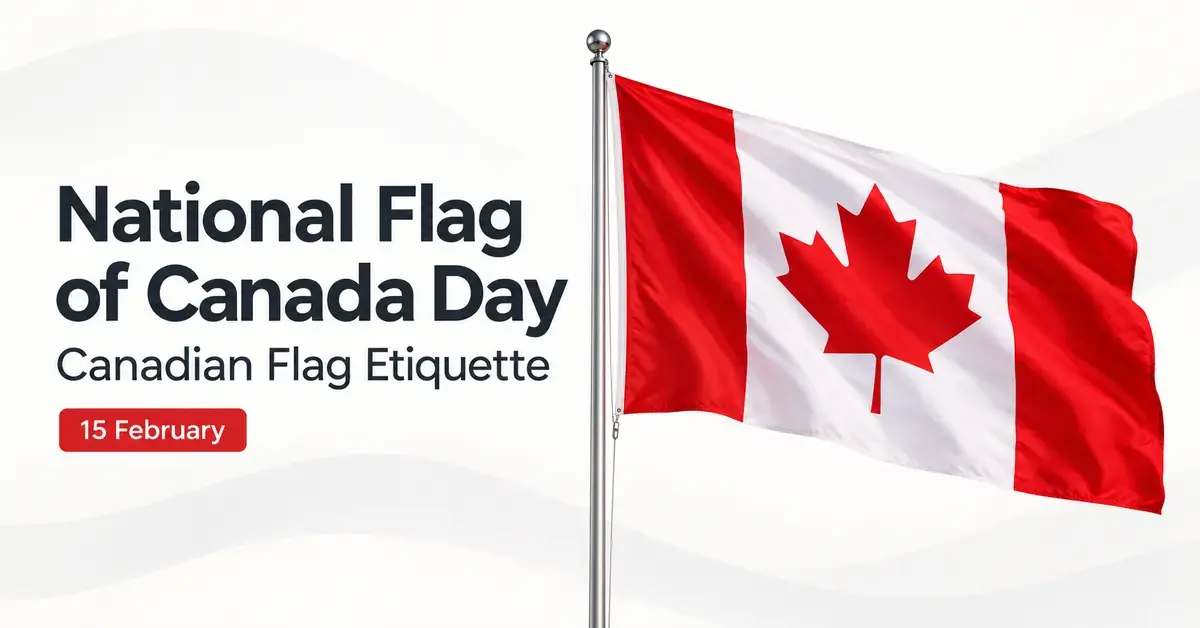
National Flag of Canada Day is observed every year on February 15. It marks the day in 1965 when the red-and-white maple leaf flag was raised for the first time, and it is also a natural moment to learn how the flag should be flown, half-masted and displayed with respect. This guide explains where the day comes from, the story behind the design, and the official etiquette the Government of Canada follows — so you can mark the occasion correctly whether you fly a flag at home, at school or at work.
What is National Flag of Canada Day?
It is an annual observance, not a statutory (paid) holiday. Government buildings, schools and many communities use the day to raise the flag, reflect on its history and hold small ceremonies. Because it is not a public holiday, banks, shops and workplaces stay open as usual.
When is National Flag of Canada Day?
The observance always falls on 15 February. The date never moves, because it is tied to a specific anniversary rather than to a particular weekday.
How did February 15 become Flag Day?
February 15 was chosen because it is the anniversary of the flag’s very first raising. The new maple leaf flag flew for the first time on Parliament Hill at noon on 15 February 1965. More than three decades later, in 1996, the Government of Canada officially declared 15 February as National Flag of Canada Day to commemorate that first raising. The first formal observance took place in 1996.
The story behind the maple leaf flag
Canada did not always have the flag it has today. Before 1965, the Canadian Red Ensign — a red flag bearing the Union Jack and Canada’s coat of arms — served as the country’s de facto national flag. Red and white had a longer pedigree still: they were made Canada’s official colours in 1921.
The Great Flag Debate
In 1964, Prime Minister Lester B. Pearson pushed for a distinctive national flag ahead of Canada’s 1967 centennial. The idea set off a long and heated argument in the House of Commons, remembered as the “Great Flag Debate.” A multi-party parliamentary committee was formed to choose a design, and in late 1964 it settled on the single-leaf concept that inspired the flag used today.
Who designed it
The core idea came from historian George Stanley, then dean of arts at the Royal Military College of Canada. In a 1964 letter he proposed a red-white-red design with a single stylized maple leaf, arguing that one clear leaf would read instantly as Canadian and symbolise unity. The leaf was simplified from 13 points to 11 points — a change credited to designer Jacques St-Cyr, reportedly after tests showed the 11-point version stayed sharpest in wind. Graphic artist George Bist is credited with setting the final proportions.
How the flag was made official
Queen Elizabeth II signed the royal proclamation making the design official on 28 January 1965, and the flag was raised for the first time on Parliament Hill on 15 February 1965 — the moment the annual observance now commemorates.
What the flag looks like
The National Flag of Canada has fixed proportions of 2:1 (twice as long as it is tall). Reading across, it divides 1:2:1 — a red band, a white square in the middle, and another red band — with a stylized red 11-point maple leaf centred in the white square. The colours are red and white; you can read more about what those colours and symbols commonly represent in our guide to what flag colours and symbols mean. The flag and its maple leaf are protected symbols, and official depictions must keep the 2:1 ratio, the red-and-white colours and the 11-point leaf.
Quick Facts
| Observance | National Flag of Canada Day |
|---|---|
| Date | February 15 (annually; not a statutory holiday) |
| Declared | 1996, by the Government of Canada |
| Commemorates | First raising of the flag on Parliament Hill, 15 February 1965 |
| Royal proclamation signed | 28 January 1965, by Queen Elizabeth II |
| Design | Red-white-red (1:2:1) with a central 11-point red maple leaf |
| Proportions | 2:1 (length to height) |
| Colours | Red and white (Canada’s official colours since 1921) |
| Main designer | George Stanley (single-leaf concept) |
How to fly the Canadian flag correctly
The guiding principle of Canadian flag etiquette is dignity: the flag should always be treated with respect and displayed so it can be seen clearly. The rules below follow the official guidance published by the Government of Canada, which federal buildings must observe and which provinces, municipalities, organisations and individuals widely adopt as best practice.
Give the flag its own pole
Where possible, the national flag should fly alone on its own flagpole or mast rather than sharing a pole with another flag. When several flags are flown together, each should ideally have its own pole of matching height.
Position of honour when flying with other flags
When the national flag is displayed alongside others, it takes the “position of honour,” which depends on how many flags there are. Position is always judged from the point of view of an observer facing the display:
- Two flags: the national flag goes on the far left (the observer’s left).
- Three flags: the national flag goes in the centre.
- More than three flags: the national flag returns to the far left.
Order of precedence
When different kinds of flags are flown together, Canada follows a set order of precedence. After the national flag, the sequence is:
- The National Flag of Canada
- Flags of other sovereign nations (in alphabetical order by English name)
- Provincial flags (in the order the provinces joined Confederation)
- Territorial flags (in the order the territories were established)
- Municipal flags
- Banners of organisations
- Historical flags
Only a few flags rank above the national flag: the King’s Personal Canadian Flag, the Governor General’s flag, a Lieutenant Governor’s flag within their own province, and the personal Canadian flags of other members of the Royal Family.
Flying the flag at night
The flag may be flown at any time of day or night and does not need to be lit after dark. There is no rule requiring it to be lowered at sunset.
Keeping the flag in good condition
A flag that has become faded or worn should be replaced. When a flag is no longer in a suitable condition to be flown, it should be disposed of in a dignified way, such as by burning it privately. Nothing should be pinned or sewn onto the flag, and it should not be written or drawn on.
Key Points
- Fly the national flag on its own pole where possible, and keep it in good condition.
- Position of honour: far left with two flags, centre with three, far left again with more than three (as seen by an observer facing the display).
- Order of precedence: national flag first, then other nations (alphabetical), provinces, territories, municipalities, organisations and historical flags.
- It may be flown day or night and does not need to be lit after dark.
- To half-mast, raise the flag to the top first, then lower it so its centre is halfway down the pole.
- Never modify its 2:1 proportions, pin or write on it, use it as a cover, or dip it to the ground as a salute.
Half-masting the National Flag of Canada
Half-masting is the practice of flying the flag partway down the pole as a sign of mourning. On federal buildings, half-masting follows detailed written rules administered by the Department of Canadian Heritage. Some situations require half-masting automatically, while others are decided case by case by the Prime Minister or by heads of Canadian missions abroad. Individuals may also choose to fly their own flag at half-mast to express mourning.
Who and what triggers mandatory half-masting
The table below summarises the main mandatory triggers and how long the flag stays lowered.
| On the death of | Where and for how long |
|---|---|
| The Sovereign, the Governor General or the Prime Minister | All federal buildings in Canada and abroad, including the Peace Tower, from notification of death until sunset on the day of the funeral or memorial service |
| A former Governor General or Prime Minister, the current Chief Justice, or a current federal Minister | Federal buildings across Canada and the Peace Tower, same timing |
| A Lieutenant Governor | Federal buildings in that province and the Peace Tower |
| A Senator or Member of Parliament | Federal buildings in their region or riding, plus the Peace Tower from sunrise to sunset on the day of the funeral or memorial |
Set days of mourning
The rules also fix several days each year when flags on all federal buildings and the Peace Tower are half-masted from sunrise to sunset, including:
- April 28 — National Day of Mourning for workers killed or injured on the job
- June 23 — National Day of Remembrance for Victims of Terrorism
- September 30 — National Day for Truth and Reconciliation
- Second Sunday of September — firefighters; last Sunday of September — police and peace officers
- December 6 — National Day of Remembrance and Action on Violence Against Women
- November 11 — Remembrance Day (sunrise to sunset, with special timing where a ceremony is held at a war memorial)
How to half-mast a flag properly
When lowering the flag to half-mast, first raise it all the way to the top of the pole, then lower it to the half-mast position; reverse the steps when taking it down. The centre of the flag should sit exactly halfway down the mast. Only poles fitted with a halyard (rope) and pulley can be half-masted — a flag fixed to a short staff cannot be. If several flags fly together and one is half-masted for mourning, the whole group is normally half-masted.
When the flag stays at full mast
There are set exceptions. The flag flies at full mast on Victoria Day and on Canada Day, and it is raised to full mast while a visiting foreign head of state or government is received in Parliament, even during a period of mourning.
Common mistakes when displaying the Canadian flag
Most flag errors come from good intentions rather than disrespect. Watching for these keeps a display correct:
- Changing the proportions. Stretching or squashing the flag away from its 2:1 ratio produces an improper representation.
- Flying it upside down or sideways. The flag has a clear top and bottom; hang it so the leaf sits upright.
- Skipping the raise-to-the-top step. A flag meant to be at half-mast must first go all the way up, then come down.
- Trying to half-mast a fixed staff. Without a halyard there is no correct half-mast position, so the flag stays at full staff.
- Leaving a tattered flag up. Replace worn, torn or faded flags rather than letting them fly.
- Using the flag as a cover or wrap. It should not be used as a tablecloth, seat cover, drape over a statue, or packaging.
- Pinning or writing on it. Nothing should be attached to or marked on the flag.
- Dipping it to salute. The national flag is never lowered to the ground to honour a person or thing.
Ways to mark National Flag of Canada Day
There is no single required way to observe 15 February. Common, low-key ways to mark the day include raising a flag correctly at home or in the community, reading about the flag’s history, attending a local ceremony, or teaching children why the flag looks the way it does. Schools and municipalities often hold short flag-raising events. If you enjoy flag facts, our flag FAQs answer common questions about national flags around the world, and the countryflags.ca reference covers meanings, history and symbols across many countries. For how we check and source the facts on this site, see our editorial policy.
Sources
- Government of Canada — National Flag of Canada Day
- Canadian Heritage — Timeline: Canada’s National Flag
- Canadian Heritage — Description of the National Flag of Canada
- Canadian Heritage — Do’s and don’ts when displaying the flag
- Canadian Heritage — Position of honour of the National Flag of Canada
- Canadian Heritage — Rules for half-masting the National Flag of Canada
Frequently Asked Questions (FAQ)
Is National Flag of Canada Day a statutory holiday?
No. February 15 is a national observance, not a statutory or paid holiday. Businesses, schools and government offices stay open, although many mark the day with flag-raising ceremonies.
Why is National Flag of Canada Day on February 15?
Because the maple leaf flag was raised for the first time on Parliament Hill on 15 February 1965. The Government of Canada made the date an official observance in 1996 to commemorate that first raising.
How many points does the maple leaf on the flag have?
Eleven. The design was simplified from an earlier 13-point leaf to an 11-point leaf, which was found to stay clearer when the flag moves in the wind.
Can I fly the Canadian flag at night?
Yes. The national flag may be flown day or night, and it does not need to be illuminated after dark.
Where does the Canadian flag go when flown with other flags?
It takes the position of honour: the observer’s far left with two flags, the centre with three flags, and the far left again when more than three flags are displayed.
