

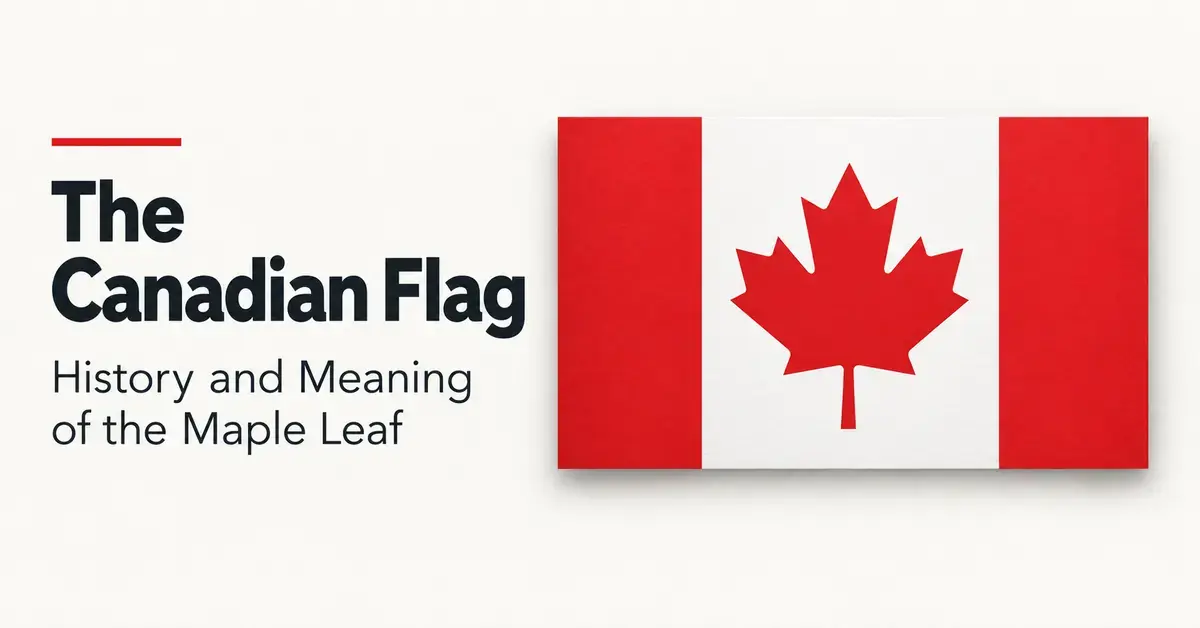
The Canadian flag — a single red maple leaf on a white square, framed by two red bands — is one of the world’s most recognisable national symbols, yet it is surprisingly young. Canada only adopted it in 1964 and first raised it on 15 February 1965, after a bitter parliamentary argument now remembered as the Great Flag Debate. This guide to Canadian flag history and meaning explains where the flag came from, how its design was chosen, why the maple leaf has exactly 11 points, and what its colours and symbol are meant to represent. Every date and figure here is drawn from the Government of Canada and other authoritative records.
Quick Facts
| Official name | National Flag of Canada (the Maple Leaf) |
|---|---|
| Adopted by Parliament | 15 December 1964 (Commons); 17 December 1964 (Senate) |
| Royal proclamation | 28 January 1965, by Queen Elizabeth II |
| First raised | 15 February 1965, Parliament Hill, Ottawa |
| Design concept | George Stanley; final leaf by Jacques Saint-Cyr |
| Proportions | 1:2 (horizontal layout 1:2:1) |
| Colours | Red (Pantone PMS 032) and white |
| Points on the leaf | 11 (simplified from an earlier 13) |
| National Flag of Canada Day | 15 February (declared in 1996) |
What does the Canadian flag look like?
The national flag of Canada is a vertical triband: a white square in the centre carrying a stylised red maple leaf, flanked by two red bands of equal width. Laid out horizontally, the proportions run 1:2:1 — the white centre is a perfect square, twice the width of each red band. The overall flag is twice as wide as it is tall, giving it an official ratio of 1:2.
Only two colours appear on it: red and white. There is no text, no crest and no other charge — just the leaf. That simplicity is deliberate, and it is a large part of why the design reads clearly from a distance and translates well to everything from lapel pins to stadium banners. If you are curious how Canada’s choices compare with the rest of the world, our overview of what flag colours and symbols commonly mean puts the maple leaf in a wider context.
The history of the Canadian flag
Canada did not have a flag of its own design until 1965. For nearly a century after Confederation it relied on British and hybrid flags, and the move to a distinctly Canadian emblem took decades and one famously heated debate to achieve.
Before 1965: the Union Jack and the Red Ensign
Before 1965 Canada had no flag that was both its own and legally its national flag. The Royal Union Flag — the Union Jack — was used before and after Confederation in 1867. Alongside it, the Canadian Red Ensign became the flag most Canadians thought of as their own: a red field with the Union Jack in the upper corner and the shield of Canada on the fly. When King George V granted Canada a coat of arms in 1921, the new shield was added to the Ensign, producing the version widely flown through the first half of the 20th century.
Attempts to create a purpose-built Canadian flag in 1925 and again in 1946 were shelved by Prime Minister William Lyon Mackenzie King, who feared the question was too politically divisive to settle. He was not wrong.
The Great Flag Debate of 1964
The Great Flag Debate was the months-long 1964 argument in Parliament over whether — and how — to replace the Red Ensign with a new national flag. Prime Minister Lester B. Pearson had promised to deliver a Canadian flag in time for the country’s 1967 centennial. His first idea, three red maple leaves on a white ground with blue borders, became known as the “Pearson Pennant” and was strongly opposed.
To break the deadlock, Parliament handed the question to a 15-member committee with a six-week deadline. Opposition leader John Diefenbaker wanted the flag to keep the Union Jack and honour Canada’s British and French founding peoples; Pearson wanted a design that spoke only of Canada. The committee waded through thousands of submitted concepts before narrowing the field to three. Debate in the House of Commons opened on 15 June 1964 and was finally ended by closure on 15 December 1964.
George Stanley’s design
The winning concept came from George Stanley, Dean of Arts at the Royal Military College in Kingston, Ontario. Stanley proposed a single red maple leaf on a white background between two red borders, inspired in part by the college’s own flag. The committee endorsed his concept on 22 October 1964. The leaf itself was then drawn by graphic artist Jacques Saint-Cyr, who refined it into the crisp shape used today. The result is often described as the first flag both adopted by both houses of the Canadian Parliament and proclaimed by the reigning monarch as the national flag.
Adoption and the first raising in 1965
The House of Commons approved Stanley’s design on 15 December 1964 by a vote of 163 to 78, and the Senate followed on 17 December by 38 to 23. Queen Elizabeth II proclaimed it the official national flag on 28 January 1965. The flag was raised for the first time at noon on 15 February 1965 in a ceremony on Parliament Hill in Ottawa, as the Red Ensign was lowered and the maple leaf flag hoisted in its place. At the ceremony Pearson expressed the hope that it would be the flag of a country “united in freedom and justice.”
Why does the maple leaf have 11 points?
The maple leaf on the flag has 11 points for a practical reason: clarity, not symbolism. An earlier version of the leaf had 13 points, but it lost detail and looked blurry when seen from a distance or in strong wind. The design was simplified to 11 points so the shape would stay sharp and instantly readable. The number itself means nothing — it is not tied to provinces, territories or any other count, a common misconception.
A real sugar maple leaf has far more than 11 points, so the flag’s leaf is a stylised emblem rather than a botanical drawing. The reduction is frequently linked to wind-tunnel testing, and whether or not every detail of that story is exact, the official explanation from Canadian Heritage is the same: fewer points made the leaf clearer at a distance and in motion.
What does the maple leaf mean?
The maple leaf stands for Canada itself — its land, its identity and, for many, qualities such as pride, courage and loyalty. The symbol did not start with the flag. The maple leaf had already emerged in the 19th century as an emblem of Canadian identity, appearing on coins, badges and insignia long before 1965.
Its emotional weight grew through military service. The maple leaf was used as the cap badge of the Canadian Expeditionary Force in the First World War, and a single carved maple leaf marks the headstones of many Canadian service members who died in both world wars. By the time it reached the flag, the leaf was already the country’s most widely recognised emblem — which is precisely why it was chosen over symbols tied to colonial history.
Why is the Canadian flag red and white?
Red and white are on the flag because they are Canada’s official national colours, and they had been for more than four decades before the flag existed. The Government of Canada traces the designation to King George V, who named red and white as Canada’s colours on 21 November 1921 in the proclamation of the country’s coat of arms.
The two colours also carry a historic resonance: red and white have long been associated with both England and France, and so they nod to the two European traditions that shaped Canada without privileging either country’s flag. When George Stanley’s design was chosen in 1964, using the established national colours made the new flag feel like a natural continuation rather than a break. For a broader look at how nations use these two colours, see our flag FAQs.
Key Points
- Canada adopted the maple leaf flag in 1964 and first raised it on 15 February 1965.
- It replaced the Union Jack and the Canadian Red Ensign after the 1964 Great Flag Debate.
- George Stanley proposed the single-leaf design; Jacques Saint-Cyr drew the final 11-point leaf.
- The 11 points were chosen for visibility, not symbolism — they do not represent provinces.
- Red and white are Canada’s official colours, designated by King George V in 1921.
- The flag’s proportions are fixed at 1:2, with a white central square and two red bands.
The flag’s official specifications
The national flag’s appearance is standardised so that every official flag looks the same. The proportions are fixed at 1:2 (height to width), with the white centre forming a square equal to half the flag’s length and each red band a quarter.
The colours are defined for reproduction as well. For print, Canadian Heritage specifies the red as Pantone PMS 032, equivalent to CMYK 0/100/100/0, while the federal government’s Federal Identity Program lists a screen red of RGB 255-0-0 (hex #FF0000); the white is simply unprinted white. Precise construction drawings were issued by the Canadian Government Specifications Board in 1971, and in 1984 the National Flag of Canada Manufacturing Standards Act set out manufacturing standards for indoor and outdoor flags alike. Note that published colour values vary between secondary sources, so manufacturers should work from the official Government of Canada specification rather than third-party charts.
National Flag of Canada Day
National Flag of Canada Day is marked every year on 15 February, the anniversary of the flag’s first raising in 1965. The commemoration itself is newer than the flag: 15 February was officially declared National Flag of Canada Day in 1996, on the flag’s 31st anniversary. It is not a statutory holiday, but it is widely observed with flag-raising ceremonies at government buildings, schools and community events across the country.
Common mistakes and misconceptions
Several popular “facts” about the Canadian flag do not hold up, so it is worth clearing them up directly.
- “The 11 points stand for the 10 provinces and something else.” They stand for nothing. The number was chosen for visibility, not to count provinces or territories.
- “Canada always had the maple leaf flag.” It is a modern flag, adopted in 1964 and first flown in 1965. Before that, Canada used the Union Jack and the Canadian Red Ensign.
- “The Red Ensign was Canada’s legal national flag.” Its status is debated; it was the de facto national symbol for decades, but accounts differ on whether it was ever the formal national flag. The maple leaf flag of 1965 was the first design adopted by Parliament and proclaimed by the monarch specifically as the national flag.
- “One person designed the flag.” Credit is shared. George Stanley supplied the single-leaf, two-border concept; Jacques Saint-Cyr drew the final 11-point leaf; and committee member John Matheson is often credited with building the consensus that got it approved.
- “The leaf is a real maple leaf.” It is a stylised emblem. An actual maple leaf has many more than 11 points.
We check claims like these against primary government and historical sources; you can read more about how we research and verify flag facts. For more national flag profiles and the meanings behind them, start from our guide to country flags of the world.
Sources
- Canadian Heritage — The history of the National Flag of Canada
- Canadian Heritage — Timeline: Canada’s National Flag
- The Canadian Encyclopedia — The Great Flag Debate
- The Canadian Encyclopedia — Emblems of Canada
- Parks Canada — The Creation of the National Flag
- Canada.ca — Discover Canada: Canadian Symbols
Frequently Asked Questions (FAQ)
When was the Canadian flag adopted?
Parliament approved the maple leaf design in December 1964 — the House of Commons on 15 December and the Senate on 17 December. Queen Elizabeth II proclaimed it the official national flag on 28 January 1965, and it was first raised on 15 February 1965.
Why does the Canadian flag have 11 points on the maple leaf?
For clarity. An earlier 13-point leaf blurred at a distance and in wind, so it was simplified to 11 points so the shape stays sharp and recognisable. The number does not symbolise anything.
What do the colours of the Canadian flag mean?
Red and white are Canada’s official national colours, designated by King George V in 1921. They also echo colours long associated with both England and France, reflecting Canada’s two founding European traditions.
Who designed the Canadian flag?
The single-leaf, two-border concept came from historian George Stanley. Graphic artist Jacques Saint-Cyr drew the final maple leaf, and MP John Matheson is often credited with guiding the design through Parliament.
What flag did Canada use before 1965?
Canada mainly used the Royal Union Flag (the Union Jack) and the Canadian Red Ensign, a red flag bearing the Union Jack and Canada’s shield. The maple leaf flag replaced them in 1965.
