

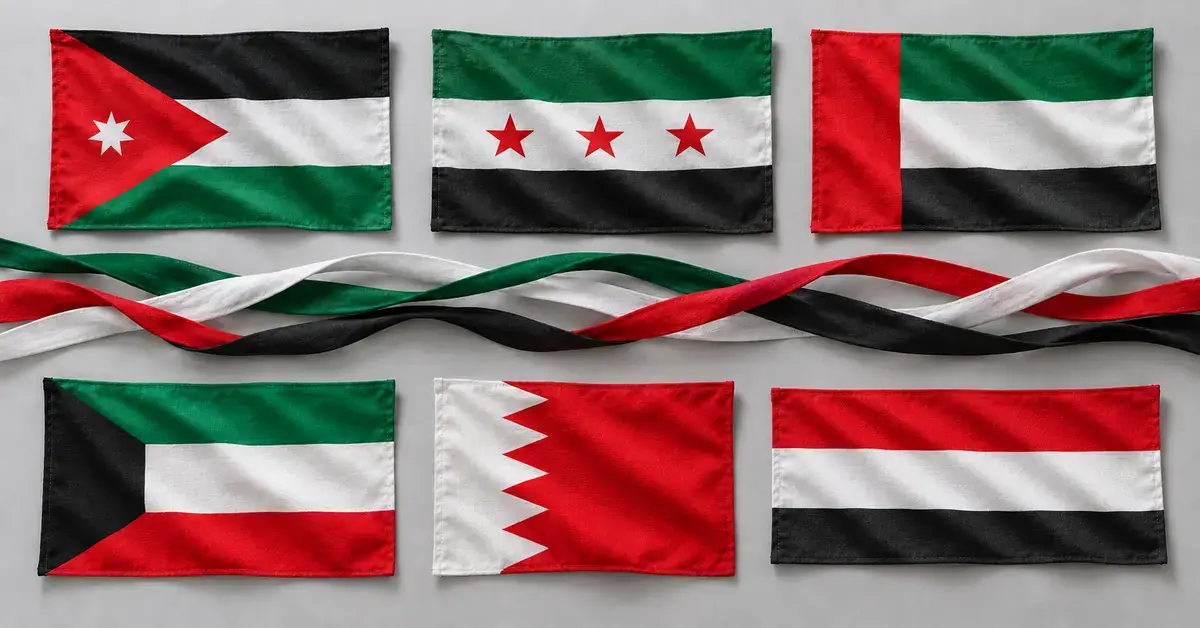
The flags of the Middle East are among the most closely related in the world. Walk from Cairo to Baghdad to Kuwait City and you will see the same handful of colours again and again — red, white, black and green — arranged in slightly different ways, often with a crescent, a star or a line of Arabic script. That family resemblance is not a coincidence: most of these flags grew out of the same early-20th-century Arab independence movements. This guide explains which countries make up the region, why so many of their flags look alike, and what the colours and symbols on each one actually mean.
Key Points
- The Middle East has about 17 country flags, spanning West Asia and North Africa (Egypt).
- Most use the Pan-Arab colours (black, white, green, red) from the 1916 Arab Revolt or the red-white-black Arab Liberation colours.
- Syria adopted a new flag in 2025: green-white-black with three red stars, replacing the two-star Baathist flag.
- Qatar (maroon, nine serrations) and Bahrain (red, five serrations for the Five Pillars of Islam) are the most-confused pair.
- Saudi Arabia’s flag carries the Shahada and a sword, is double-sided, and is never flown at half-mast.
- The clearest outliers are Iran, Turkey, Israel, Cyprus and Lebanon, which follow their own design traditions.
Which countries count as the Middle East?
The Middle East is a cultural and geopolitical region, not an official continent, so the exact list of countries varies by source. It also straddles two continents: most of its states sit in West Asia, while Egypt lies mainly in North Africa. A widely used list contains 17 countries:
- The Arab states: Bahrain, Egypt, Iraq, Jordan, Kuwait, Lebanon, Oman, Palestine, Qatar, Saudi Arabia, Syria, the United Arab Emirates and Yemen.
- The non-Arab states: Iran (Persian), Israel (Hebrew) and Turkey (Turkic).
- Cyprus, an island in the eastern Mediterranean that is often grouped with the region, though geographically and politically it is also part of Europe.
Because the region spans Asia and Africa, it does not fit neatly on a single continent map. For the continent-by-continent view, see our guides to the flags of Asia and the flags of Africa, or browse the full flags of the world by continent directory.
Why do so many Middle East flags look similar?
So many Middle East flags look alike because they share a small set of historical colour schemes. Three design traditions explain almost every flag in the region.
Pan-Arab colours and the Arab Revolt
The most important source is the flag of the Arab Revolt of 1916, which combined four colours — black, white, green and red — each linked to a different era of Arab and Islamic history (commonly associated with the Abbasid, Umayyad, Fatimid and Hashemite dynasties). These became known as the Pan-Arab colours. Jordan, Palestine, Kuwait and the United Arab Emirates all carry designs descended directly from that 1916 banner. You can read more about these shared palettes in our guide to Pan-Arab, Pan-African and Pan-Slavic flag colours.
The Arab Liberation colours (red, white and black)
A second, overlapping tradition is the Arab Liberation Flag, a red-white-black horizontal tricolour first used in Egypt’s 1952 revolution. Egypt, Iraq, Syria and Yemen all use this red-white-black base, usually with a distinguishing emblem or inscription added to the central white band. The shared stripes are why these four flags are so easily confused.
Crescent, star and Arabic calligraphy
The third recurring element is religious and cultural symbolism. The crescent and star — a motif that actually predates Islam and is not an official religious symbol — appears on the flags of Turkey and, in the wider region, on several Asian flags. Arabic calligraphy is another signature: Saudi Arabia and Iraq carry religious phrases in script, and Iran repeats a phrase 22 times along its stripes. For more on these motifs, see our guides to crescent and star flags and what the symbols on national flags mean.
Middle East Flags at a Glance
| Country | Design | Standout feature |
|---|---|---|
| Bahrain | Red field, white hoist band | Five-point serrated edge (Five Pillars of Islam) |
| Cyprus | White field | Copper island map above two olive branches |
| Egypt | Red-white-black tricolour | Golden Eagle of Saladin |
| Iran | Green-white-red tricolour | Stylised “Allah” emblem; takbir 22 times |
| Iraq | Red-white-black tricolour | Takbir in green Kufic script (2008) |
| Israel | White with two blue stripes | Blue Star of David; stripes evoke the tallit |
| Jordan | Black-white-green, red hoist triangle | White seven-pointed star |
| Kuwait | Green-white-red stripes | Black trapezoid at the hoist |
| Lebanon | Red-white-red bands | Green cedar tree |
| Oman | White-red-green with red hoist band | Khanjar dagger and crossed swords |
| Palestine | Black-white-green, red hoist triangle | Pan-Arab colours, no star |
| Qatar | Maroon field, white hoist band | Nine-point serrated edge; very long ratio |
| Saudi Arabia | Green field | White Shahada above a sword |
| Syria (2025) | Green-white-black tricolour | Three red stars |
| Turkey | Red field | White crescent and star |
| United Arab Emirates | Green-white-black with red hoist band | All four Pan-Arab colours |
| Yemen | Red-white-black tricolour | Plain, no emblem |
The red-white-black flags: Egypt, Iraq, Syria and Yemen
These four flags share the Arab Liberation colours — three horizontal bands of red, white and black — and are told apart by what sits (or does not sit) on the white stripe.
Egypt places the golden Eagle of Saladin in the centre of the white band. The red is commonly read as the struggle against occupation before the 1952 revolution, the white as that bloodless revolution, and the black as the end of colonial oppression. The eagle, a symbol linked to the 12th-century ruler Saladin, was restored to the flag in 1984 after a period when a hawk was used instead.
Iraq carries the takbir — the Arabic phrase Allahu Akbar (“God is great”) — in green Kufic script across the centre of the white stripe. The current version was adopted in 2008 as a compromise design that replaced the earlier, handwritten script associated with the Saddam Hussein era. Kufic is an angular calligraphic style that originated in the Iraqi city of Kufa.
Syria adopted a new flag in 2025. Following the fall of the Assad government, the green-white-black tricolour with three red stars — the country’s 1930s independence flag, later used by the opposition — was flown from December 2024 and officially adopted on 13 March 2025. It replaced the red-white-black Baathist flag that had two green stars. The three red stars historically stood for Syrian districts and are now read as a symbol of national unity.
Yemen keeps the plainest design of the group: a simple red-white-black tricolour with no emblem at all, adopted in 1990 when North and South Yemen unified. The red is commonly read as the blood of the independence struggle, the white as a bright future, and the black as the dark days of the past.
The Arab Revolt tricolours: Jordan, Palestine, Kuwait and the UAE
These flags descend most directly from the 1916 Arab Revolt banner and use black, white, green and red in combination.
Jordan has three horizontal stripes — black, white and green — with a red triangle at the hoist (the edge nearest the flagpole). Inside the triangle is a white seven-pointed star, usually explained as a reference to the seven verses of the opening chapter of the Qur’an and to Arab unity.
Palestine uses the same layout as Jordan — black, white and green stripes with a red hoist triangle — but without the star. It has been used since the 1920s and was formally adopted by the Palestine Liberation Organization in 1964. The colours follow the Pan-Arab tradition.
Kuwait arranges the Pan-Arab colours as three horizontal stripes — green, white and red — with a black trapezoid at the hoist. It was adopted in 1961 on independence from Britain.
The United Arab Emirates places a vertical red band at the hoist, followed by three horizontal stripes of green, white and black. Adopted in 1971 when the federation was formed, it deliberately unites all four Pan-Arab colours in one design.
The Gulf’s own designs: Saudi Arabia, Qatar, Bahrain and Oman
Several Gulf states broke away from the shared palette to create instantly recognisable flags of their own.
Saudi Arabia has a green field bearing the Shahada — the Islamic declaration of faith — in white Arabic script, above a horizontal white sword. Because the flag carries a sacred text, it is treated with special care: it is produced double-sided so the writing reads correctly from both sides, and it is never flown at half-mast. Green has long been associated with Islam.
Qatar is a distinctive maroon with a white band at the hoist, separated from the maroon by a nine-point serrated (zigzag) edge. Its proportions are unusually long (a ratio of 11:28), making it the only national flag that is wider than twice its height. The maroon colour is said to have come from red dye that darkened in the desert sun, with the change later made official.
Bahrain looks like a shorter, brighter cousin of Qatar’s flag: red with a white hoist band separated by a serrated edge. The key difference is the number of points — Bahrain’s edge has exactly five, chosen in 2002 to represent the Five Pillars of Islam, while Qatar’s has nine. For other easily-confused pairs, see our guide to flags that look alike.
Oman has three horizontal bands — white, red and green — with a vertical red band at the hoist. In the upper hoist corner sits the national emblem: a khanjar (a traditional curved Omani dagger) in its sheath, crossed over two swords. The emblem has been used by the ruling family since the 18th century.
The outliers: Iran, Turkey, Israel, Cyprus and Lebanon
Five flags in the region stand apart, either because the country is not Arab or because the design follows a different tradition.
Iran has green, white and red horizontal stripes with a red emblem in the centre. The emblem is a stylised form of the word “Allah” built from four crescents and a sword, and its outline is often said to suggest a tulip, a traditional symbol of martyrdom. The phrase Allahu Akbar is repeated 22 times in Kufic script along the inner edges of the green and red stripes — 11 on each — a reference to the 22nd of the month of Bahman, the date the 1979 revolution succeeded.
Turkey flies a red field with a white crescent and a five-pointed star set toward the hoist. The crescent and star are an old symbol associated with the Ottoman Empire and the city of Istanbul; the modern proportions were standardised in 1936. The symbol predates Islam and is cultural as much as religious.
Israel has a white field with two horizontal blue stripes and a blue Star of David (the Magen David, a six-pointed star) in the centre. The stripes evoke the tallit, the traditional Jewish prayer shawl, which is white with blue bands. The flag was officially adopted in 1948, shortly after the state was established.
Cyprus shows a copper-coloured silhouette of the island on a white field, above two crossed green olive branches. The copper colour nods to the island’s name and its ancient copper mines, and the olive branches represent peace between its Greek and Turkish Cypriot communities. Adopted in 1960, it deliberately avoids any symbol linked to Greece or Turkey to stay neutral.
Lebanon has three horizontal bands — red, white, red — with the white band twice as tall as each red one, and a green cedar tree in the centre. The cedar is an ancient national symbol, giving Lebanon its nickname “the Land of the Cedars”; the red is commonly read as sacrifice and the white as peace and the country’s snowy mountains.
Common mistakes when identifying Middle East flags
The most common mistake is relying on an out-of-date Syria flag. Many charts and quizzes still show the red-white-black flag with two green stars, which was replaced in 2025 — the current flag is green-white-black with three red stars. Check the publication date of any reference before trusting it.
Other frequent errors include:
- Confusing Qatar and Bahrain. Count the serrations and look at the colour: Qatar is maroon with nine points and a very long shape; Bahrain is red with five points.
- Mixing up Jordan and Palestine. Both have black-white-green stripes with a red hoist triangle; only Jordan has the white seven-pointed star.
- Assuming every symbol is religious. The crescent and star predate Islam, and Cyprus’s olive branches and Lebanon’s cedar are national rather than religious emblems.
- Treating the colour meanings as fixed. Countries give their own official readings, which often differ, so meanings are best described as “commonly interpreted” rather than universal.
- Forgetting Saudi Arabia’s special status. Its flag is never flown at half-mast and is never used on items where the Shahada could be shown disrespectfully.
Sources
- Encyclopaedia Britannica — Flag of Syria
- The Christian Science Monitor — Syria’s independence flag
- ITV News — Why does Syria have a ‘new’ flag and what does it mean?
- Flags of the World — Flag of Iraq
- Flags of the World — Flag of Qatar
- Flags of the World — Flag of Oman
- WorldAtlas — Flag of Bahrain
- Middle East Eye — The symbolism Middle East flags carry
Frequently Asked Questions (FAQ)
How many countries are in the Middle East?
A widely used list has 17: Bahrain, Cyprus, Egypt, Iran, Iraq, Israel, Jordan, Kuwait, Lebanon, Oman, Palestine, Qatar, Saudi Arabia, Syria, Turkey, the United Arab Emirates and Yemen. Because the Middle East is a cultural region rather than an official continent, some lists leave out Cyprus or add nearby countries.
Why do Middle East flags use the same colours?
Most share the Pan-Arab colours — black, white, green and red — from the 1916 flag of the Arab Revolt, or the red-white-black Arab Liberation colours from Egypt’s 1952 revolution. Those shared roots are why Egypt, Iraq, Syria, Yemen, Jordan, Palestine, Kuwait and the UAE look so alike.
Why did Syria change its flag?
After the Assad government fell in December 2024, Syria returned to its 1930s independence flag — green, white and black with three red stars — which the opposition had used for years. It was flown immediately and officially adopted on 13 March 2025, replacing the previous flag that had two green stars.
What is the difference between the Qatar and Bahrain flags?
Both have a white hoist band separated from a coloured field by a serrated edge. Qatar’s field is maroon, has nine serrations and is unusually long; Bahrain’s field is red and has five serrations, representing the Five Pillars of Islam.
Which Middle East flags are not Arab?
Iran (Persian), Israel (Hebrew) and Turkey (Turkic) are the main non-Arab states, and their flags follow different traditions — Iran’s stylised-Allah emblem, Israel’s Star of David and Turkey’s crescent and star. Cyprus, often grouped with the region, uses a neutral map-and-olive-branch design.
