

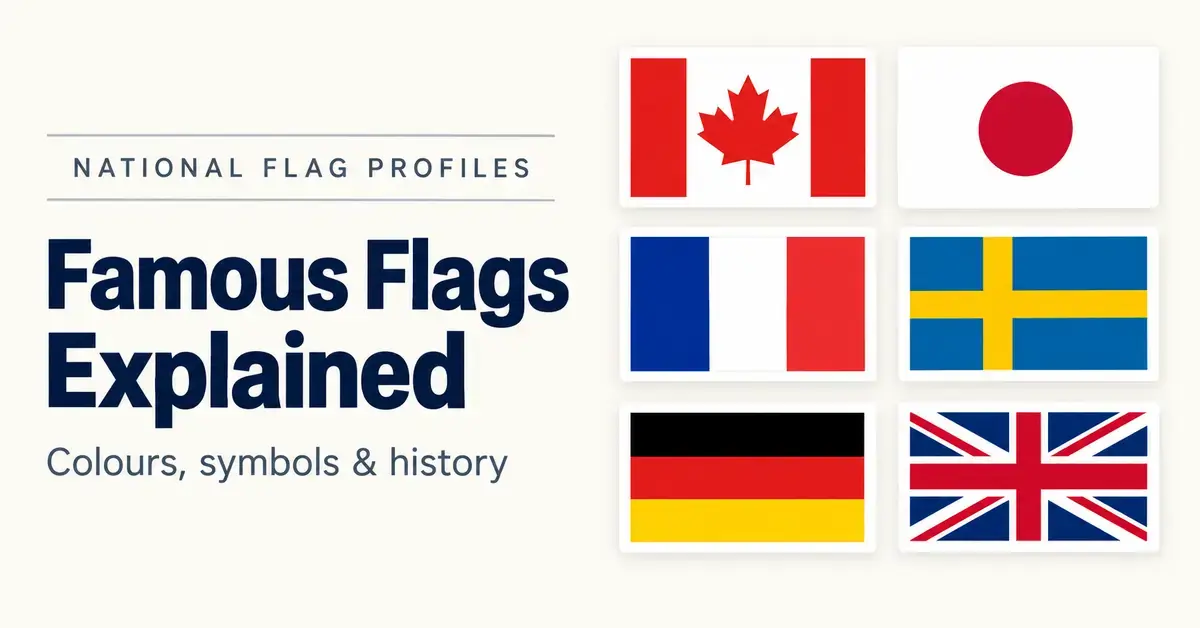
A national flag is a compact code. Every colour, stripe, cross and star is chosen to say something about a country’s land, history or values, and once you know how to read those parts, almost any flag starts to make sense. This page is the hub for our in-depth single-flag profiles: the place to understand the national flag meanings behind the world’s best-known flags and how they came to look the way they do. Below you will find a short guide to reading any flag, full profiles of famous examples, and links down to the detailed pages for each country.
Key Points
- A national flag’s meaning lives in three layers: its colours, its symbols and its history.
- About 195 countries fly a national flag (193 UN member states plus two observer states).
- Colour meanings are usually conventional, not legal — many countries never defined them in law.
- This hub profiles famous flags with one template: design, colours, symbols, history, key facts.
- Similar-looking flags (and a flag versus its related ensigns) are easy to confuse — small details matter.
What a national flag profile covers
A national flag profile is a structured explanation of one country’s flag. Rather than listing trivia, each profile answers the same set of questions in the same order, so you can compare one country with another at a glance. Every profile on countryflags.ca follows a consistent template built from five parts.
- Design — the layout, shape and proportions (for example a horizontal triband, a vertical tricolour or a central emblem).
- Colours — which colours appear and what they are commonly understood to represent.
- Symbols — any crosses, stars, suns, animals, plants or coats of arms, and what each one stands for.
- History — when the flag was adopted, what it replaced and the events that shaped it.
- Key facts — the official ratio, adoption date and other quick reference points.
Reading a flag this way keeps the facts honest. Where a country’s law defines a meaning, we say so; where a meaning is a popular interpretation rather than an official one, we label it clearly. You can read more about how we research and verify these details in our editorial policy and sources.
How to read any national flag
You can decode most flags by working through the same three layers: colours, symbols and history. Start with the colours, because they carry the broadest message. Then look at the symbols, which usually name something specific — a saint, a constellation, a ruling house. Finally, check the history, because the same design can mean different things in different eras.
One rule matters above all: colour meanings are usually conventional, not legally fixed. Many countries never wrote down what their flag’s colours mean, so the “meanings” you read are widely repeated interpretations rather than statements in law. We flag that distinction throughout. For the general grammar of colours and symbols across all flags, see our overview of what flag colours and symbols mean.
Famous flags explained
The profiles below apply that template to six of the world’s most recognised national flags. Each is a condensed version of a fuller country page; the quick comparison table that follows lets you scan their core facts side by side.
United States — the Stars and Stripes
The flag of the United States has 50 white stars on a blue canton and 13 red and white stripes. The 13 stripes stand for the original Thirteen Colonies that declared independence from Britain, and the 50 stars represent the current states. The stripe count has stayed at 13 since the first Flag Resolution of 14 June 1777, while stars have been added as states joined.
The current 50-star design became official on 4 July 1960, after Hawaii became the 50th state in 1959; the arrangement was famously based on a design submitted by a teenage student, Robert G. Heft. No official meaning was assigned to the colours in 1777. The common readings — red for valour, white for purity, blue for vigilance, perseverance and justice — come from the symbolism later attached to the Great Seal of the United States, not from the flag law itself.
United Kingdom — the Union Jack
The Union Jack is a combination of three heraldic crosses representing England, Scotland and Ireland. It layers the red cross of Saint George (England) on a white ground, the diagonal white saltire of Saint Andrew (Scotland) on blue, and the diagonal red saltire of Saint Patrick (Ireland) on white.
The flag grew in two stages. In 1606, after James VI of Scotland also became James I of England, the crosses of Saint George and Saint Andrew were merged. The Saint Patrick saltire was added on 1 January 1801, when the Act of Union joined Ireland to Great Britain, producing the design flown ever since. Wales is not shown separately because, at the time, it was treated as part of England and is covered by the Saint George cross. The Irish saltire is deliberately offset and counterchanged with the Scottish one, which is why the flag has a correct way up.
Japan — the Hinomaru
Japan’s flag is a single red disc centred on a white field, known as the Hinomaru, or “circle of the sun.” The red disc represents the sun, fitting for a country whose name is often rendered as “the land of the rising sun.” White is conventionally associated with honesty and purity, and red with the sun, sincerity and vitality — though these are traditional readings rather than legal definitions.
The design is centuries old and was proclaimed by the Council of State in 1870, but it only became the legally recognised national flag in August 1999, with the Act on National Flag and Anthem. That law sets the proportions — a 2:3 ratio with the disc centred and its diameter equal to three-fifths of the flag’s height. The Hinomaru should not be confused with the Rising Sun flag, which adds rays extending from the disc and is primarily a historic military ensign.
France — the Tricolore
The French flag is a vertical tricolour of blue, white and red, with blue at the hoist (the side nearest the pole). It grew out of the cockade worn during the 1789 Revolution: Parisian revolutionaries wore blue and red, the colours of Paris, and white — associated with the monarchy — was added to mark the union of the people and the crown.
The National Convention decreed the vertical blue-white-red arrangement as the national flag in 1794. The colours are most often linked to Paris (blue and red) and the monarchy (white), and the flag is widely associated with the republican motto liberté, égalité, fraternité. The Tricolore became a template copied around the world, which is one reason so many later flags use three equal bands.
Brazil — Ordem e Progresso
Brazil’s flag is a blue celestial globe on a yellow diamond set on a green field, crossed by a white band reading “Ordem e Progresso” (“Order and Progress”). The green and yellow were inherited from the imperial flag; today they are popularly read as the country’s forests and mineral wealth, though they originally referenced the royal houses of Braganza and Habsburg.
The republican design was adopted on 19 November 1889, four days after the republic was proclaimed. The blue globe depicts the night sky over Rio de Janeiro on that morning, and its stars show the Southern Cross and nearby constellations. The flag began with 21 stars; more were added over time, and it now carries 27 stars for the 26 states and the Federal District. The motto comes from the positivist philosophy of Auguste Comte.
Canada — the Maple Leaf
Canada’s flag is a red field with a white central square bearing a single red, 11-pointed maple leaf, in a 1:2 ratio. It was proclaimed by Queen Elizabeth II on 28 January 1965 and first raised on Parliament Hill on 15 February 1965, the date now marked as National Flag of Canada Day.
The design replaced the Canadian Red Ensign after one of the longest flag debates in the country’s parliamentary history. The maple leaf was already a national emblem — it was the cap badge of the Canadian Expeditionary Force in the First World War. George Stanley’s original leaf had 13 points, but graphic artist Jacques St-Cyr simplified it to 11 so it would stay crisp at a distance and in wind. Canadian statutes describe the layout but do not assign official meanings to the colours; the popular reading of red for autumn leaves and white for winter snow is unofficial.
Flag Comparison
| Flag | Adopted | Main colours | Central symbol | Ratio |
|---|---|---|---|---|
| United States | 1960 (50-star) | Red, white, blue | 50 stars, 13 stripes | 10:19 |
| United Kingdom (Union Jack) | 1801 | Red, white, blue | Three overlaid crosses | 1:2 |
| Japan (Hinomaru) | 1999 (law) | White, red | Red sun disc | 2:3 |
| France (Tricolore) | 1794 | Blue, white, red | Vertical tricolour | 2:3 |
| Brazil | 1889 | Green, yellow, blue, white | Globe, 27 stars, motto | 7:10 |
| Canada | 1965 | Red, white | 11-point maple leaf | 1:2 |
What flag colours and symbols commonly mean
Across many flags, a handful of colours and symbols recur with roughly consistent meanings. These are helpful starting points, but always check the individual country, because the same colour can mean opposite things in two different places.
- Red often stands for blood shed in struggle, courage or revolution.
- White commonly signals peace, purity or honesty.
- Blue frequently represents sky, sea, freedom or vigilance.
- Green usually points to land, agriculture, hope or (in many flags) Islam.
- Gold or yellow often marks mineral wealth, sunshine or the people.
- Stars can count states or regions, or symbolise unity and guidance.
- Crosses and crescents usually carry religious or historical associations.
For the full picture — including colour families, crosses, crescents, stars and animals — our overview of what flag colours and symbols mean covers the cross-flag patterns in depth, and this hub applies them to specific countries.
Common mistakes when reading flag meanings
The biggest mistake is treating popular colour meanings as official. Most countries never codified what their colours represent, so a confident sentence like “blue means freedom” is usually a widely shared interpretation, not law. Reliable profiles separate the two, and so do ours.
- Assuming all tricolours share one origin. France, the Netherlands and many later flags use three bands for different reasons; the pattern spread, but the meanings did not.
- Confusing similar flags. Indonesia and Monaco, or Chad and Romania, are near-identical pairs. Small differences in ratio and shade matter.
- Mixing up a national flag with a related ensign. Japan’s Hinomaru is not the Rising Sun flag; a civil flag, war ensign and state flag can all differ.
- Freezing history. Star counts, crosses and emblems change as borders and governments change — Brazil’s and the United States’ star counts are clear examples.
- Trusting a single unsourced site. Flag facts drift as they are copied. We check each claim against primary or official sources.
How these flag profiles are organised
This hub is the entry point to our growing library of single-country profiles, each built on the same design–colours–symbols–history–key-facts template so you always know where to look. As new country pages are published, they are linked from here, and you can start exploring from the countryflags.ca home page.
Two routes help you find a specific flag quickly. If you want to browse by region, our Flags by Continent hub groups every country by continent. If you are a Canadian reader or want national, provincial and territorial designs in one place, our dedicated Flags of Canada hub goes deeper than the single profile above. For quick, standalone answers to common questions, our flag FAQs hub links out to the relevant pages. This pillar is designed to expand, so expect more countries over time.
Sources
- The Royal Household — Union Jack
- Nippon.com — Hinomaru: the symbolism and history of Japan’s national flag
- Government of Canada — History of the National Flag of Canada
- Encyclopaedia Britannica — Flag of the United States of America
- Encyclopaedia Britannica — Flag of France
- Encyclopaedia Britannica — Flag of Brazil
- United Nations — Member States
Frequently asked questions (FAQ)
How many national flags are there in the world?
The figure most people use is 195, matching the 193 United Nations member states plus two non-member observer states, the Holy See (Vatican City) and Palestine. Counts rise above 250 if you add dependent territories, and into the thousands if you include regional and sub-national flags.
Do flag colours have official meanings?
Usually not. Many countries, including Canada and the United States, describe their flag’s layout in law but never define what the colours mean. The meanings you commonly read are conventional interpretations, so it is best to treat them as “commonly understood to mean” rather than official fact.
Why do so many flags look alike?
Shared history and borrowed designs. The French Tricolore inspired many three-band flags, Pan-African and Pan-Arab colour schemes recur across regions, and crosses or crescents mark shared religious heritage. Small differences in ratio, shade and symbols are what keep similar flags distinct.
What is the difference between a flag’s design and its meaning?
The design is the physical layout — the colours, shapes, ratio and symbols. The meaning is what those elements are understood to represent. A profile describes the design precisely first, then explains the meaning, separating official definitions from popular interpretations.
How often do national flags change?
Less often than you might think, but it does happen when a country changes its name, government or borders. The United States has added stars as states joined, Brazil has adjusted its star count, and Canada replaced the Red Ensign in 1965. Major redesigns are rare and usually follow a significant political event.