

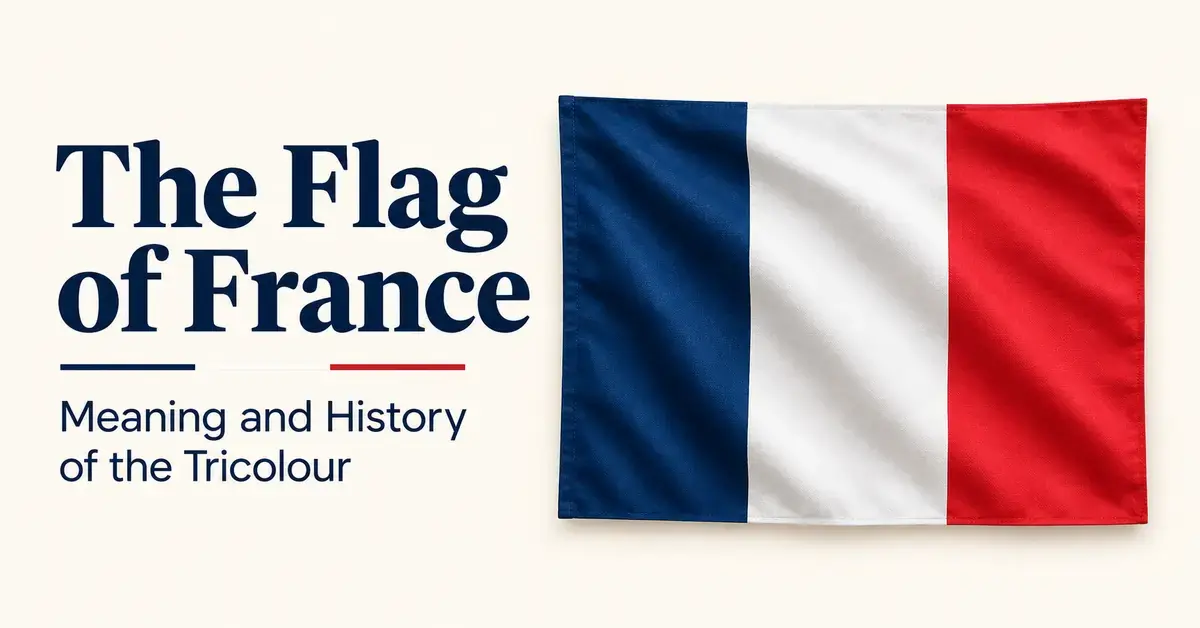
The flag of France — known to the French as le drapeau tricolore, or simply le Tricolore — is three equal vertical bands of blue, white and red, with blue next to the flagpole. It is one of the most recognised flags in the world and the direct ancestor of dozens of other tricolours. This profile explains what the flag of France looks like, the meaning usually given to its colours, how it grew out of the French Revolution, why France quietly darkened its blue in recent years, and why the flag is so easily confused with those of Italy and Ireland.
Quick Facts
| Common names | Le Tricolore; le drapeau tricolore (the tricolour) |
|---|---|
| Design | Three equal vertical bands |
| Colours (hoist → fly) | Blue, white, red |
| Proportions | 2:3 (height to width) |
| National flag adopted | 15 February 1794 (modern blue-white-red order) |
| Constitutional basis | Article 2, Constitution of 1958 |
| Design credited to | Jacques-Louis David (1794) |
| Origin of colours | Blue & red of Paris; white of the French monarchy |
| Recent change | Shade of blue darkened to navy around 2020 |
What does the flag of France look like?
The French flag is a vertical tricolour: three bands of equal width running top to bottom, coloured blue, white and red from the hoist (the edge nearest the pole) to the fly (the free edge). Its official aspect ratio is 2:3, meaning the flag is half as high as it is wide. White sits in the centre, framed by blue on the left and red on the right.
The three bands have not always been equal. The original 1794 specification set them at 30 parts blue, 33 parts white and 37 parts red, a deliberate imbalance meant to make the bands appear equal once the flag was flapping in the wind. That rule was dropped early, and the modern flag uses three strictly equal stripes. The flag’s status is fixed in Article 2 of the Constitution of 1958, which declares that “the national emblem is the blue, white and red tricolour flag”.
What do the colours of the French flag mean?
The short answer is that the colours come from the city of Paris and the French monarchy, not from a list of virtues. Blue and red were the historic colours of Paris, while white was the colour of the king and the royal House of Bourbon. Bringing the three together in 1789 symbolically united the revolutionary capital with the crown.
The official explanation: Paris and the monarchy
Blue and red appear on the coat of arms and livery of Paris and were the natural colours of the city’s revolutionary militia. White was the established colour of the French kings. The tricolour therefore began life less as an anti-royal banner than as a symbol of reconciliation — republican red and blue flanking royal white — which is partly why it survived the fall of the monarchy to become the flag of the whole nation.
The popular “liberty, equality, fraternity” reading
Many people assume the three colours stand for the Republic’s motto — Liberté, Égalité, Fraternité — with blue for liberty, white for equality and red for fraternity. This is a folk interpretation, not an official one. Article 2 of the Constitution names both the flag and the motto but never links the two, and the French state’s own explanation ties the colours to Paris and the monarchy instead. Other popular readings assign the colours to saints — blue to Saint Martin, white to the Virgin Mary and Joan of Arc, red to Saint Denis — but vexillologists regard these meanings as invented after the fact. If you are interested in how colour symbolism works across flags generally, our guide to what flag colours and symbols mean sets out the common patterns.
Where did the tricolour come from?
The French flag was born during the French Revolution, evolving from a hat badge into a national ensign over roughly five years. Its design was later attributed to the painter Jacques-Louis David.
The 1789 cockade
The story starts with a cockade — a rosette of ribbon worn on the hat. In July 1789, Parisian revolutionaries wore a blue-and-red cockade in the city’s colours. The Marquis de Lafayette is traditionally credited with adding white, the royal colour, to create a red, white and blue national cockade that was soon made compulsory. Historians caution that the neat “Paris colours plus the king’s white” story may be tidier than the messy reality, but the cockade is undisputedly the direct source of the flag’s three colours.
From cockade to flag: 1790 and 1794
The first tricolour flag dates to 1790, but its colours ran in the reverse order, with red at the hoist, and it was used only on the navy’s jack and ensign. On 15 February 1794 the National Convention adopted the arrangement we know today — blue at the hoist, then white, then red — as the national flag. This 1794 version is the true ancestor of the modern Tricolore.
Eclipse and return: 1815 to 1830
The tricolour was not permanent from the start. After Napoleon’s final defeat in 1815, the restored Bourbon monarchy brought back the plain white royal flag, and the tricolour fell out of official use. It returned for good with the July Revolution of 1830, which installed the “citizen king” Louis-Philippe — and, fittingly, Lafayette helped champion its comeback. Since then the blue-white-red flag has remained France’s national emblem through every change of regime.
Why did France change the shade of blue?
France has twice adjusted the exact shade of blue on its flag within living memory, without changing the design at all. In 1976, President Valéry Giscard d’Estaing lightened the blue to a brighter cobalt so the flag would sit more comfortably beside the blue of the European flag, which it is often displayed next to. The French navy, however, largely kept the older, darker blue.
Around 2020, President Emmanuel Macron reversed that decision, quietly returning the flags on and behind official buildings to a deeper navy blue. The change was made without announcement and only came to public attention when it was described in the 2021 book Élysée Confidential. The stated aim was to evoke the darker blue of the Revolution and to honour those who fought in the Revolution, the trenches of the First World War and the Resistance. Because the law fixes only the colours “blue, white and red” and not precise shades, both versions remain in use across the country, so you may still see the flag in either a lighter or a darker blue.
How the French tricolour shaped flags worldwide
The French tricolour became a template that spread across Europe and the Americas. As France set up allied “sister republics” after 1795 and as revolutionary and national movements looked to its example through to 1848, the three-equal-vertical-band format was copied again and again. The flags of Italy, Ireland, Romania, Mexico and others belong to this wave of vertical tricolours, even where their individual colours were chosen for local reasons.
- Italy — green, white and red; the design traces to the French-backed Cisalpine Republic of 1797, keeping France’s layout but swapping blue for green.
- Ireland — green, white and orange; dating from 1848 and inspired partly by the French model of uniting rival communities under one banner.
- Romania — blue, yellow and red; the vertical arrangement and proportions follow the French pattern, while the colours are traditionally Romanian.
- Belgium — black, yellow and red; part of the same early-19th-century wave of tricolours, though its colours come from the Duchy of Brabant rather than from France.
Not every vertical tricolour descends from France — the older Dutch flag is often called the first modern tricolour — but no single design did more to popularise the format. You can explore many of these national emblems from our country flags of the world home page.
French, Italian and Irish flags: how to tell them apart
The quickest way to tell these three vertical tricolours apart is the colour at the hoist and the colour at the fly. France is the only one of the three with a blue band, and it sits at the hoist. Italy and Ireland both start with green; the difference is their final band — red for Italy, orange for Ireland.
Three Tricolours Compared
| Flag | Colours (hoist → fly) | Ratio | Easiest way to tell it apart |
|---|---|---|---|
| France | Blue, white, red | 2:3 | Only one with a blue band, and it is at the hoist |
| Italy | Green, white, red | 2:3 | Green (not blue) at the hoist; shares France’s red fly |
| Ireland | Green, white, orange | 1:2 | Orange fly band and a longer, 1:2 flag |
Italy and Ireland are the pair most often mixed up, because both begin with green and sit beside white. Look to the right-hand band: Italy ends in red, Ireland in orange, and the Irish flag is also noticeably longer, at a 1:2 ratio rather than 2:3. France, with its blue hoist, is rarely confused with either once you know to check that first band.
Common mistakes and misconceptions
A few errors come up again and again when people describe the French flag. Clearing them up makes the flag easier to identify and to understand.
- Treating the motto meaning as official. The blue-white-red = liberty-equality-fraternity reading is popular folklore. The official explanation is Paris’s blue and red plus the king’s white.
- Reversing the order. The modern flag runs blue, white, red from the pole outward. The 1790 naval version ran the other way, with red at the hoist, which is sometimes repeated as if it were the current design.
- Assuming the bands were always equal. The 1794 flag used unequal 30:33:37 stripes to look even in the wind; today’s bands are genuinely equal.
- Confusing it with Italy’s flag. Italy’s hoist band is green, not blue — the single most reliable way to separate the two.
- Thinking the shade is fixed. France has used both a lighter cobalt and a darker navy in the past fifty years; the law specifies only the colours, not exact shades.
For more quick answers about world flags, see our flag FAQs hub.
Sources
Frequently Asked Questions (FAQ)
What do the colours of the French flag mean?
Officially, blue and red are the historic colours of Paris and white is the colour of the French monarchy, so the flag united the revolutionary capital with the crown. The popular idea that the colours stand for liberty, equality and fraternity is a folk interpretation, not an official one.
When was the French flag adopted?
The modern blue-white-red arrangement was adopted as the national flag on 15 February 1794. An earlier 1790 version used the colours in reverse order on naval flags. Today the flag is defined in Article 2 of the Constitution of 1958.
Why is the French flag called the Tricolore?
“Tricolore” simply means “three-coloured”, after its three bands of blue, white and red. The French call it le drapeau tricolore or le Tricolore, and the name has become shorthand for the flag itself.
What is the difference between the French and Italian flags?
Both are vertical tricolours ending in a red band, but France’s hoist band is blue while Italy’s is green. Checking that first band nearest the pole is the simplest way to tell them apart.
Why did France change the colour of its flag around 2020?
President Macron quietly switched official flags to a darker navy blue to echo the shade used during the Revolution. The design did not change — only the shade — and because the law fixes only the colours and not exact shades, both lighter and darker blues are still seen.
