

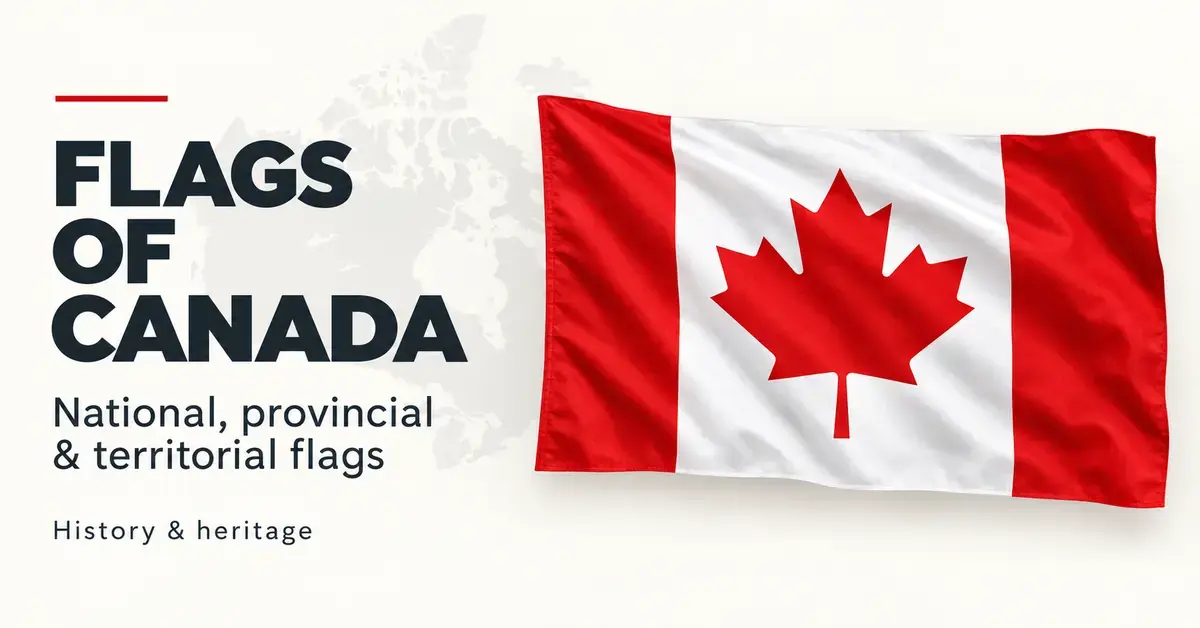
Canada is represented by a single national flag — the red-and-white Maple Leaf — but the wider family of Canadian flags is much larger, taking in ten provincial flags, three territorial flags and the historical banners that flew before 1965. This page is the overview hub for all of them: what the national flag looks like and means, when and how it was adopted, who designed it, the provincial and territorial flags, and the earlier Canadian Red Ensign. Canada’s flags are one chapter in the broader story of the country flags of the world, and each section below answers one common question, so you can jump straight to what you need.
Key Facts
| Official name | National Flag of Canada (the Maple Leaf; French l’Unifolié) |
|---|---|
| Proclaimed | 28 January 1965 by Queen Elizabeth II |
| First raised | 15 February 1965, Parliament Hill, Ottawa |
| Proportions | 1:2 (height to width) |
| Design | Red–white–red vertical bands with a single 11-point red maple leaf on the white centre |
| Colours | Red and white, Canada’s national colours |
| Replaced | The Canadian Red Ensign |
| Flag day | National Flag of Canada Day, 15 February (not a statutory holiday) |
| Related flags | 10 provincial and 3 territorial flags |
What are the flags of Canada?
The flags of Canada fall into three groups: one national flag, the flags of the provinces and territories, and the historical flags that preceded them. Understanding the three groups makes the rest of this guide easier to follow.
- The national flag — the National Flag of Canada, universally known as the Maple Leaf, flown across the country and by Canada abroad since 1965.
- Provincial and territorial flags — each of the ten provinces and three territories has its own official flag, giving 13 sub-national flags in total. Most were adopted in the 1960s, around the time the national flag changed.
- Historical flags — chiefly the Canadian Red Ensign, which served as Canada’s de facto flag for decades, along with the royal and colonial flags that came before it.
The sections below take each group in turn, starting with the flag most readers come here for.
The National Flag of Canada: the Maple Leaf
The National Flag of Canada is a red field with a white square at its centre, inside which sits a single stylised red maple leaf with 11 points. It is often called the Maple Leaf, and in French l’Unifolié (“the one-leafed”). It became Canada’s official flag in 1965, replacing the Canadian Red Ensign.
What does the Canadian flag look like?
The flag uses a vertical red-white-red arrangement known as a “Canadian pale.” The white central band is a square that takes up the middle half of the flag’s width, with a red band one quarter the width on each side. Its official proportions are 1:2, meaning the flag is twice as wide as it is tall. The maple leaf in the centre is stylised rather than botanically accurate, and it has 11 points.
What do the red, white and maple leaf mean?
Red and white are Canada’s national colours, a status widely traced to a 1921 proclamation by King George V that granted Canada its royal arms. Red is commonly linked to the Cross of St George and white to the historic emblem of the French monarchy, reflecting Canada’s two founding European traditions, though sources describe the colours’ symbolism in different ways. For a wider look at how shades and emblems are read on flags, see our guide to what flag colours and symbols mean.
The maple leaf itself had been an informal Canadian emblem since the 1800s and became firmly associated with the country during the First World War, when it appeared on soldiers’ cap badges. The number of points on the flag’s leaf carries no official meaning; the 11-point form was chosen because it stayed crisp and recognisable when the flag was flying, rather than for any symbolic reason.
When was the Canadian flag adopted?
The Maple Leaf flag was proclaimed by Queen Elizabeth II on 28 January 1965 and first raised on Parliament Hill in Ottawa on 15 February 1965. Its adoption followed a fierce national argument now remembered as the Great Flag Debate.
Prime Minister Lester B. Pearson pushed for a distinctly Canadian flag to replace the Red Ensign, which still carried the Union Jack. A parliamentary committee reviewed thousands of submissions and, on 22 October 1964, selected the single-leaf concept. The House of Commons approved the design on 15 December 1964 by a vote of 163 to 78, and the Senate followed two days later. The royal proclamation was signed in January 1965, with 15 February set as the date the flag came into force — the day the Red Ensign was lowered and the Maple Leaf first flew.
Who designed the Canadian flag?
The Canadian flag was a collaboration rather than the work of one person. The single-leaf idea came from George F. G. Stanley, then Dean of Arts at the Royal Military College, who suggested a red-white-red design inspired by the college’s flag. Heraldic artist Alan Beddoe developed an early version with a 13-point leaf, and graphic artist Jacques Saint-Cyr (also written St-Cyr) redrew it with the simpler 11-point leaf used today. Member of Parliament John Matheson is widely credited with building the political consensus that carried the design through the committee and Parliament.
The Canadian Red Ensign and earlier flags
Before 1965, Canada’s most recognisable flag was the Canadian Red Ensign: a red flag with the Union Jack in the upper corner (the canton) and the Canadian shield of arms in the fly. It was never adopted by Parliament as the official national flag, but it served as Canada’s de facto flag for generations.
The Red Ensign was flown by Canadians on land and sea from around 1868 and was authorised for Canadian merchant ships by an Admiralty warrant in 1892. In 1945 an Order in Council approved its use on federal government buildings. The shield it carried changed over time, with successive versions reflecting the arms of 1868, 1921 and 1957; in the 1957 version the maple leaves in the arms were shown in red rather than green. The Red Ensign was officially retired when the Maple Leaf flag was raised on 15 February 1965. Earlier still, the territory that became Canada had flown the flags of France and then of Britain, including the Union Jack, which remains a Canadian royal flag in limited ceremonial use.
Provincial and territorial flags of Canada
Every Canadian province and territory has its own official flag — 13 in total — and most were adopted within a decade of the national flag. They range from banners of a jurisdiction’s coat of arms to highly distinctive emblem flags.
Flags Across Canada
| Jurisdiction | Adopted | Design in brief |
|---|---|---|
| Nova Scotia | Design since 1858 | Blue St Andrew’s cross on white with the royal arms of Scotland; often called Canada’s oldest provincial flag |
| Quebec | 1948 | The Fleurdelisé: white cross on blue with a white fleur-de-lis in each quarter |
| British Columbia | 1960 | Banner of the provincial arms: Union Jack with a crown above a setting sun on wavy blue and white bands |
| Prince Edward Island | 1964 | Provincial arms (lion and oak trees) on a banner framed by a red-and-white border |
| New Brunswick | 1965 | Banner of the provincial arms: a gold lion above a sailing ship on water |
| Ontario | 1965 | Red Ensign style: Union Jack in the canton with the Ontario shield in the fly |
| Manitoba | 1966 | Red Ensign style: Union Jack in the canton with the Manitoba shield (a bison) in the fly |
| Yukon | 1968 | Green, white and blue vertical bands with the territorial arms and a fireweed wreath |
| Alberta | 1968 | Royal blue field with the provincial shield in the centre |
| Saskatchewan | 1969 | Green over gold with the provincial shield and a western red lily |
| Northwest Territories | 1969 | Blue–white–blue vertical bands with the territorial shield on the white centre |
| Newfoundland and Labrador | 1980 | Abstract blue, white, red and gold design by artist Christopher Pratt |
| Nunavut | 1999 | Gold and white divided by a red inuksuk, with a blue star (the North Star) in the corner |
A few stand out. Nova Scotia’s flag, a blue St Andrew’s cross on white charged with the royal arms of Scotland, is based on a design in use since 1858 and is often called Canada’s oldest provincial flag. Quebec’s Fleurdelisé — a white cross on blue with a white fleur-de-lis in each quarter — was first flown in 1948 and was the first provincial flag formally adopted in Canada. Ontario and Manitoba chose red-ensign-style flags in the mid-1960s, keeping the Union Jack and their provincial shields as a deliberate nod to the retired national Red Ensign. The newest is Nunavut’s, adopted in 1999 when the territory was created; designed by Inuit artist Andrew Qappik, it features a red inuksuk and a blue star representing Niqirtsuituq, the North Star.
National Flag of Canada Day
National Flag of Canada Day is marked every year on 15 February, the anniversary of the flag’s first raising in 1965. It was instituted in 1996 on the initiative of Prime Minister Jean Chrétien, through an order in council under Governor General Roméo LeBlanc. It is a day of official recognition rather than a statutory public holiday, so workplaces and schools stay open; it is observed with flag-raisings, ceremonies and educational events.
Common mistakes and misconceptions about Canadian flags
A few beliefs about Canadian flags come up again and again but do not hold up. Clearing them up helps you use the facts above accurately.
- Assuming the Maple Leaf has always been Canada’s flag. It has only been the national flag since 1965; for the century before that, the Red Ensign filled the role in practice.
- Thinking the Red Ensign was Canada’s legislated national flag. Parliament never adopted it as the official flag; it was used de facto and, from 1945, authorised by Order in Council on government buildings.
- Reading meaning into the 11 points. The leaf’s 11 points are a design choice for clarity, not a count of provinces, territories or anything else.
- Believing every provincial flag is very old. Apart from Nova Scotia’s and Quebec’s designs, most provincial and territorial flags date only to the 1960s or later.
- Calling 15 February a day off. National Flag of Canada Day is observed nationally but is not a statutory holiday.
Every date and figure on this page is checked against primary and official sources, in line with our editorial policy. For quick answers to broader questions about world flags, see our flag FAQs.
Sources
- Canadian Heritage (Government of Canada) — History of the National Flag of Canada
- Canadian Heritage — National Flag of Canada Day: Did you know
- Canadian Heritage — Declaration of National Flag of Canada Day
- The Canadian Encyclopedia — National Flag of Canada
- The Canadian Encyclopedia — Red Ensign
- The Canadian Encyclopedia — Provincial and Territorial Emblems
- Legislative Assembly of Nunavut — The Flag of Nunavut
Frequently Asked Questions (FAQ)
What is the Canadian flag called?
Its official name is the National Flag of Canada. It is almost always called the Maple Leaf flag in English and l’Unifolié in French, both referring to the single red maple leaf at its centre.
Why does the maple leaf on the flag have 11 points?
The 11 points have no symbolic meaning. An earlier design used 13 points, but the leaf was simplified to 11 so it would stay clear and recognisable when the flag was moving in the wind.
What flag did Canada use before 1965?
Canada mainly used the Canadian Red Ensign, a red flag with the Union Jack in the upper corner and the Canadian shield in the fly. It was Canada’s de facto flag until the Maple Leaf flag replaced it on 15 February 1965.
How many flags does Canada have?
Alongside the one national flag, each of the ten provinces and three territories has its own official flag — 13 sub-national flags in total — plus historical flags such as the Red Ensign that are no longer in official use.
Is National Flag of Canada Day a public holiday?
No. National Flag of Canada Day falls on 15 February each year and is a day of official recognition, but it is not a statutory holiday, so it is not a day off work or school.