

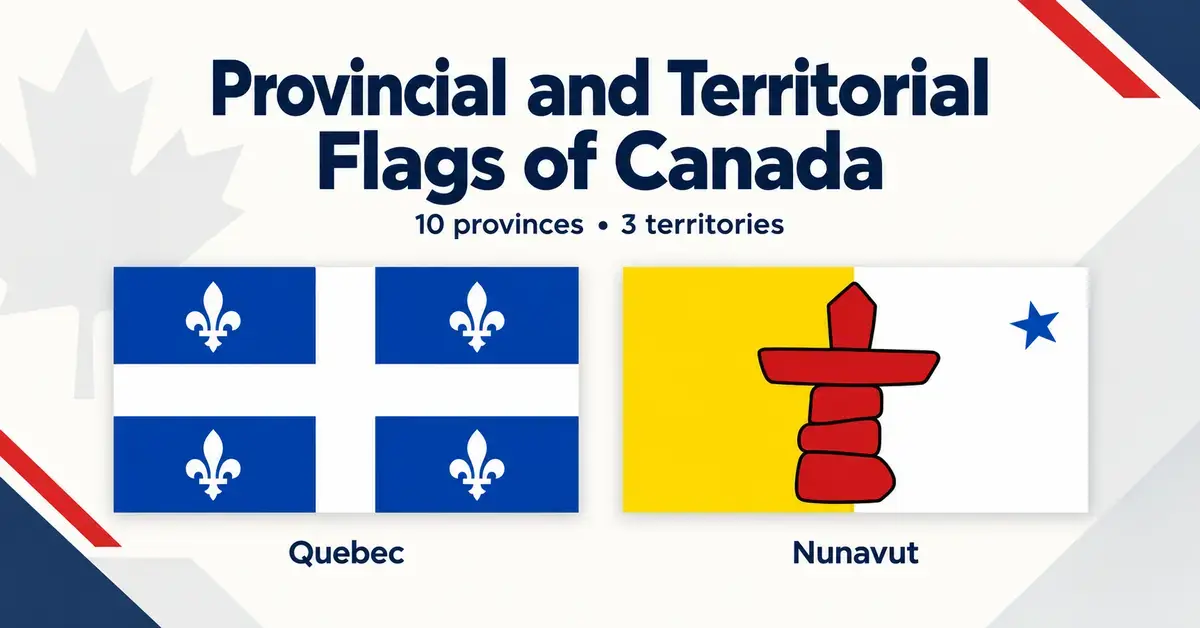
Canada has 13 subnational flags: one for each of its 10 provinces and one for each of its 3 territories. Each design carries its own history and meaning, from Quebec’s blue-and-white Fleurdelise to the red inuksuk on the flag of Nunavut. This guide lists every Canadian provincial and territorial flag, explains what its colours and symbols stand for, and shows how a handful of shared design ideas connect them. All dates and meanings here are drawn from official Canadian and heraldic sources.
Key Points
- Canada has 13 subnational flags: 10 provinces and 3 territories, each with its own design and meaning.
- Quebec adopted the first provincial flag, the Fleurdelise, in 1948.
- Nova Scotia has the oldest arms (granted 1625) but only confirmed its flag officially in 2013.
- Nunavut has the newest flag, adopted in 1999 with Inuit cultural symbolism.
- Ontario and Manitoba both use the Red Ensign layout, told apart by their shields (maple leaves vs. bison).
All 13 Canadian provincial and territorial flags at a glance
The table below summarises every flag, the year it became official, its basic design and its core meaning. Provinces are listed first, then the three territories. Dates refer to when each flag was formally adopted as the official provincial or territorial flag.
| Province / Territory | Year adopted | Design in brief | Core meaning |
|---|---|---|---|
 | 1965 | Red Ensign: red field, Union Jack in the canton, provincial shield in the fly | British heritage plus three gold maple leaves for Canada |
 | 1948 | Blue field, white cross, a white fleur-de-lis in each quarter (the Fleurdelise) | French heritage and the historic Catholic and royal French symbol |
 | Officially confirmed 2013 (in use since 1858) | Blue St Andrew’s cross on white with the royal shield of Scotland at centre | Scottish roots; colours reversed from Scotland’s flag |
 | 1965 | Gold lion on red above a gold field with a sailing ship on blue-and-white waves | Ties to the British Crown and the province’s shipping and Loyalist past |
 | 1965 (effective 1966) | Red Ensign with the provincial shield (a bison beneath St George’s cross) | Keeps the old Canadian Red Ensign tradition alive |
 | 1960 | Union Jack with a crown across the top; a setting sun over blue-and-white waves below | British origins, the Pacific coast and Canada’s most westerly province |
 | 1964 | Gold lion on red above an oak tree and three saplings on a green island | Britain (the large oak) protecting the island’s three counties (the saplings) |
 | 1969 | Green over gold with the provincial shield and the western red lily | Northern forests, southern grain fields and the floral emblem |
 | 1968 | Blue field with the provincial shield (mountains, foothills, prairie and wheat) | Alberta’s landscape, from the Rockies to the wheat fields |
 | 1980 | White field with blue, red and gold triangles forming an arrow | Snow and sea, British heritage, the two parts of the province and a hopeful future |
 | 1969 | White centre panel with the territorial shield between two blue panels | Snow, water, the Northwest Passage, tundra, forest, furs and minerals |
 | 1967 | Green, white and blue vertical panels with the coat of arms and fireweed | Forests, snow, rivers and lakes, with the territorial floral emblem |
 | 1999 | Gold and white field with a red inuksuk and a blue North Star | Inuit guidance and leadership, the land and sea, and the elders |
Flag images: Wikimedia Commons, public domain.
For the broader story of how national flags use these same devices, see our overview of what flag colours and symbols mean.
The 10 provincial flags of Canada
Canada’s provincial flags fall into a few families: three are “Red Ensigns” that echo the old Canadian merchant flag, several are “armorial banners” (a coat of arms stretched to fill the whole flag), and a few are modern original designs. Here is each province in turn.
Ontario
Ontario’s flag is a Red Ensign: a red field with the Union Jack in the upper corner nearest the staff and the provincial shield of arms in the fly. It was adopted by the legislature in 1965 and first raised on 21 May 1965, deliberately resembling the Canadian Red Ensign that had just been replaced nationally by the Maple Leaf flag. The shield shows a red St George’s cross at the top and three gold maple leaves on green below; the maple leaves represent Canada.
Quebec
Quebec’s flag, the Fleurdelise, is a blue field divided by a white cross with a white fleur-de-lis in each of the four quarters. Adopted on 21 January 1948, it was the first provincial flag officially adopted in Canada. The fleur-de-lis is a historic French royal and religious emblem, and the blue-and-white colours recall France and the province’s French-speaking heritage.
Nova Scotia
Nova Scotia’s flag is a blue St Andrew’s cross (a diagonal saltire) on a white field, with the royal shield of Scotland — a red lion inside a red double border on gold — at the centre. The colours are the reverse of Scotland’s own flag, which is a white saltire on blue. The design comes from arms granted in 1625, the oldest provincial coat of arms in Canada, and the flag was flown from the 1850s but was only formally confirmed as the official provincial flag in 2013.
New Brunswick
New Brunswick’s flag is an armorial banner based on the provincial arms. The top third is a gold lion walking on a red background; the lower two-thirds show a gold field with an old sailing ship (a heraldic galley called a lymphad) riding on blue-and-white waves. Adopted on 24 February 1965, the lion reflects ties to the Crown and to the German duchy of Brunswick that gave the province its name, while the ship recalls shipbuilding and the Loyalists who arrived by sea.
Manitoba
Manitoba’s flag is a Red Ensign, closely matching Ontario’s: a red field with the Union Jack in the canton and the provincial shield in the fly. The shield shows a bison standing on a rock below a red St George’s cross. Passed by the legislature in 1965 and taking effect in 1966, it was chosen specifically to preserve the Canadian Red Ensign tradition after Canada adopted the Maple Leaf flag.
British Columbia
British Columbia’s flag places a Union Jack with a crown at its centre across the top half, and a golden half-sun setting over blue-and-white wavy stripes across the bottom. Adopted in 1960, the Union Jack marks the province’s origins as a British colony, the wavy stripes stand for the Pacific Ocean, and the setting sun reflects British Columbia’s position as Canada’s most westerly province.
Prince Edward Island
Prince Edward Island’s flag is an armorial banner with a red-and-white border running along the three edges away from the staff. The upper band shows a gold lion on red; the larger lower field is white with a green island bearing one large oak tree and three young oak saplings. Adopted on 24 March 1964, the imagery comes from the colony’s 1769 seal: the great oak represents Britain and the three saplings represent the island’s three counties, King’s, Queen’s and Prince.
Saskatchewan
Saskatchewan’s flag is horizontally divided, green over gold, with the provincial shield in the upper hoist and the western red lily, the province’s floral emblem, in the fly. Adopted on 22 September 1969 after a design competition that drew thousands of entries, the green band stands for the northern forests and the gold band for the southern grain-growing plains.
Alberta
Alberta’s flag is a blue field with the provincial shield in the centre. The shield shows a red St George’s cross on white at the top — an allusion to the Hudson’s Bay Company that once controlled the region — above a landscape of snow-capped Rocky Mountains, green foothills, rolling prairie and a field of wheat. It became the official flag on 1 June 1968.
Newfoundland and Labrador
Newfoundland and Labrador’s flag is a modern original design by the artist Christopher Pratt, approved on 28 May 1980 and first flown on Discovery Day, 24 June 1980. On a white field, blue triangles at the hoist pay tribute to the Union Jack and British heritage, while red triangles and a gold arrow in the fly form a trident pointing to the future. Pratt linked the colours to snow and ice (white), the sea (blue), human effort (red) and confidence in the future (gold); hung vertically, the arrow reads as a sword honouring military sacrifice.
The 3 territorial flags of Canada
Canada’s three northern territories — the Northwest Territories, Yukon and Nunavut — each have their own flag. Two centre on a coat of arms, while Nunavut’s 1999 design was created fresh for the new territory and draws on Inuit culture.
Northwest Territories
The flag of the Northwest Territories has a wide white centre panel between two blue vertical panels, with the territorial shield in the middle. Adopted in 1969, the blue panels stand for the territory’s lakes and waters and the white for snow and ice. The shield itself tells the northern story: a white top crossed by a wavy blue line for the Northwest Passage, a diagonal line marking the tree line between green forest and red tundra, and a fox mask with gold bars for the region’s furs and minerals.
Yukon
Yukon’s flag has three vertical panels — green, white and blue — with the territorial coat of arms and two stems of fireweed, the floral emblem, on the central white panel. Adopted in 1967 from a competition won by a local student, the green stands for Yukon’s forests, the white for snow, and the blue for its rivers and lakes. The arms above the panel carry a husky, mountains, gold discs for minerals and a wavy stripe for the Yukon River.
Nunavut
Nunavut’s flag is divided vertically into gold and white, with a red inuksuk — a traditional Inuit stone landmark — in the centre and a blue star in the upper fly. Adopted on 1 April 1999 when Nunavut became a territory, the inuksuk represents guidance and the markers that lead travellers and define sacred places. The blue star is the Niqirtsuituq, the North Star, a constant guide that also symbolises the leadership of community elders; the gold and blue stand for the riches of land, sea and sky, and the red is a reference to Canada.
How Canadian provincial and territorial flags are designed
Most Canadian subnational flags were created or confirmed in the 1960s, around the time Canada adopted the Maple Leaf flag in 1965. They share a small set of design approaches.
Red Ensigns
Ontario and Manitoba both use the Red Ensign format — a red field with the Union Jack in the canton and the provincial shield in the fly. Both provinces chose this layout to keep the old Canadian Red Ensign alive after it was replaced as the national flag, which is why the two look so similar at a glance.
Armorial banners
New Brunswick, Prince Edward Island and, in effect, Nova Scotia use an “armorial banner”: the provincial coat of arms spread across the whole flag rather than placed on a shield. This is why these flags read like a heraldic painting.
Shields on a plain field
Alberta, Saskatchewan and the two mainland territories centre a coat of arms or shield on a coloured background, letting the shield carry the local symbolism of mountains, forests, prairie or ice.
Modern original designs
Quebec, British Columbia, Newfoundland and Labrador, and Nunavut step away from a simple coat of arms toward bolder graphic designs — the Fleurdelise, the Pacific sunset, Christopher Pratt’s arrow, and the red inuksuk — that work well at flag scale and are easy to recognise.
Quick Facts
| Provinces | 10 (each with its own flag) |
|---|---|
| Territories | 3 (Northwest Territories, Yukon, Nunavut) |
| First provincial flag adopted | Quebec, 1948 (the Fleurdelise) |
| Newest flag | Nunavut, 1999 |
| Oldest coat of arms | Nova Scotia, granted 1625 |
| Red Ensign flags | Ontario and Manitoba |
| Flags created new in the 1960s | Most provinces and the mainland territories |
Common mistakes and misconceptions
A few errors come up again and again when people talk about Canada’s provincial flags.
- Confusing Ontario and Manitoba. Both are Red Ensigns with a shield in the fly. The quick way to tell them apart is the shield: Ontario shows three gold maple leaves and a St George’s cross; Manitoba shows a bison.
- Thinking Nova Scotia’s flag is just Scotland’s flag. The colours are reversed — a blue saltire on white rather than a white saltire on blue — and Nova Scotia adds the royal shield of Scotland at the centre.
- Assuming every flag is very old. Most date from the 1960s onward. Quebec’s 1948 Fleurdelise was the first provincial flag adopted, and Nunavut’s is the newest, from 1999.
- Calling the territories “provinces.” The Northwest Territories, Yukon and Nunavut are territories, not provinces; Canada has 10 provinces and 3 territories.
- Expecting a national rule for the colours. Each flag’s symbolism is specific to its own province or territory, so the same colour can mean different things from one flag to the next.
Which Canadian provincial flag is the oldest?
Nova Scotia has the oldest roots, but the answer depends on what you count. Nova Scotia’s coat of arms dates to 1625, the oldest provincial arms in Canada, and the flag was flown from the 1850s — yet it was only formally confirmed as the official provincial flag in 2013. If you count the first flag officially adopted by a province, that honour goes to Quebec, whose Fleurdelise was adopted in 1948. Nunavut’s flag, from 1999, is the most recent.
Where do Canada’s provincial flags come from historically?
Many Canadian provincial symbols trace back to British and French colonial heraldry, then were turned into flags in the modern era. Coats of arms were often granted by royal warrant decades or centuries before a province put them on a flag, and the wave of flag adoptions in the 1960s was closely tied to the national debate that produced the Maple Leaf flag. To see how these provincial designs fit into the wider world of national symbols, browse our guide to country flags of the world, and for quick answers to broader flag questions see our flag FAQs. You can also read how we research and verify flag facts.
Sources
- Government of Canada — Provincial and territorial symbols of Canada
- The Governor General of Canada — Public Register of Arms, Flags and Badges
- Legislative Assembly of British Columbia — The provincial flag
- Heritage Newfoundland and Labrador — The Provincial Flag
- CBC News — Nova Scotia’s provincial flag confirmed 155 years later
- Encyclopaedia Britannica — Flag of Alberta
- Flags of the World — Canadian provinces and territories
Frequently Asked Questions (FAQ)
How many provincial and territorial flags does Canada have?
Canada has 13 subnational flags: one for each of its 10 provinces and one for each of its 3 territories. Each is distinct, so there is no single “provincial flag” shared across the country.
Which Canadian province adopted its flag first?
Quebec was first. Its Fleurdelise — a blue flag with a white cross and four white fleurs-de-lis — was adopted on 21 January 1948, making it the first provincial flag officially adopted in Canada.
Why do the Ontario and Manitoba flags look so similar?
Both are Red Ensigns: a red field with the Union Jack in the corner and the provincial shield in the fly. The difference is the shield — Ontario shows three maple leaves and a St George’s cross, while Manitoba shows a bison.
What does the inuksuk on the Nunavut flag mean?
The red inuksuk is a traditional Inuit stone landmark that guides travellers across the land and marks important places. On the flag it stands for guidance and community, alongside a blue North Star representing the leadership of the elders.
Which Canadian provincial flag is the newest?
Nunavut’s flag is the most recent, adopted on 1 April 1999 when Nunavut officially became Canada’s third territory. It was designed with Inuit cultural input rather than adapted from an older coat of arms.
