

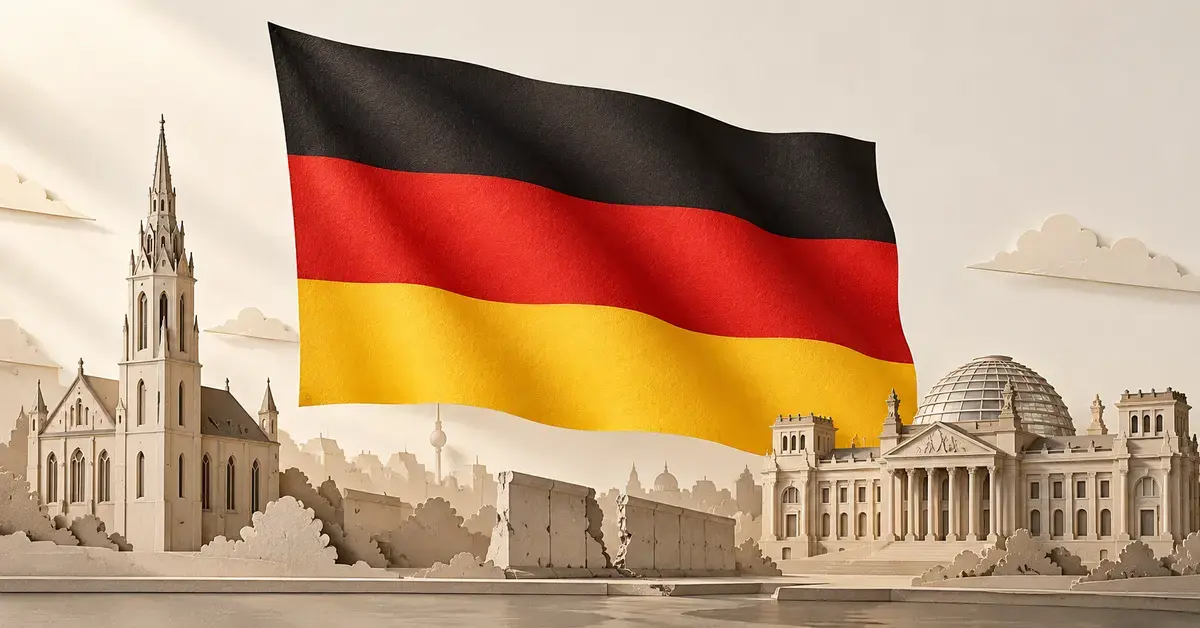
The flag of Germany is a horizontal tricolour of three equal bands — black on top, red in the middle and gold at the bottom. Known in German as Schwarz-Rot-Gold (“black-red-gold”), it flies over the Bundestag in Berlin, every federal building and millions of homes on match days. Yet for all its familiarity, the flag carries no official explanation of its colours, and its story runs through revolution, empire, dictatorship and division before it became the shared symbol of a reunified country. This profile explains what the flag of Germany looks like, the meaning usually given to its colours, where they came from, and how the design changed across two centuries of German history.
Key Facts
- Official name: Bundesflagge (federal flag); colours called Schwarz-Rot-Gold (black-red-gold)
- Design: three equal horizontal stripes — black (top), red (middle), gold (bottom)
- Proportions: 3:5 (height to length)
- Commonly used colour values: black RAL 9005, red RAL 3020, gold around RAL 1021–1028 (no single shade is fixed in law)
- Current flag adopted: 23 May 1949 (West Germany, Basic Law Article 22); all-Germany since 3 October 1990
- Official colour meaning: none; collectively a symbol of unity and freedom since the 1830s–1840s
- Variants: plain tricolour (civil/national) and a government flag bearing the federal eagle shield
What does the flag of Germany look like?
The flag of Germany is a tricolour of three equal horizontal stripes: black at the top, red in the centre and gold at the bottom. The federal-flag order defines it with a height-to-length ratio of 3:5, the same proportions you see on most flagpoles and football terraces. Unlike the vertical bands of the French tricolour, Germany’s bands are stacked horizontally, which is the single quickest way to place the design at a glance.
There is no single legally fixed shade of each colour. The Federal Ministry of the Interior has confirmed it never laid down technical colour prescriptions, because shades drift over the decades. In practice, printers and manufacturers commonly reproduce the flag with RAL colour values such as RAL 9005 (black), RAL 3020 (red) and a gold between RAL 1021 and RAL 1028 — the last of which is, strictly speaking, a shade of yellow. That gap between “gold” in name and yellow in appearance is a recurring point of confusion, and we return to it below.
Civil flag versus government flag
The plain black-red-gold tricolour is the national or civil flag (the Bundesflagge), the version any citizen may fly. There is also a government flag, the Bundesdienstflagge, which adds a shield bearing the black federal eagle (the Bundesschild) across the centre of the three stripes. Only federal authorities are entitled to use the government flag; the eagle shield is not part of the flag ordinary people hang out.
What do the colours of the German flag mean?
There is no official meaning assigned to the black, red and gold of the German flag. This is the most important and most often misstated fact about it. The German Bundestag, the country’s own parliament, states plainly that the origins of the colours “cannot be identified with any degree of certainty,” and no law attaches a symbolic meaning to any band.
What the colours are commonly said to represent
Many websites confidently list meanings — black for determination, red for the blood of those who fought, gold for generosity or a bright future. These are popular folk interpretations, not official definitions, and you should treat them as such. What can be said with confidence, because historians and the Bundestag agree on it, is what the colours came to symbolise collectively: during the 1830s and 1840s black-red-gold became a banner of national unity and civic (bourgeois) freedom, carried by Germans who wanted a single, constitutional nation. That association with unity and liberty — not a colour-by-colour code — is the meaning that genuinely sticks to the flag.
This is also a useful reminder that flag colours rarely carry one universal message. As our guide to flag colour meanings explains, the same colour can stand for different ideas in different countries, and reading a fixed meaning into every stripe usually says more about the writer than the flag.
Where did black, red and gold come from?
The origin of the German colours is genuinely uncertain, but the most widely cited source is a volunteer army unit from the Napoleonic Wars. Several strands feed into the story, and no single one is proven.
The Lützow Volunteer Corps
After the wars of liberation against Napoleon around 1813–1815, the colours were linked to the Lützow Volunteer Corps, a free corps of student and civilian volunteers. Their uniforms were black with red trim (piping) and gold-coloured buttons. Because recruits brought their own clothes, they dyed them black to match, and the black-red-gold combination stuck as a memory of that volunteer spirit. The Bundestag describes a black-and-red flag made for the corps as an early form of the tricolour.
Students, Hambach and the 1848 Revolution
The colours spread through the student fraternities (Burschenschaften). The Jena Original Student Fraternity, whose members included Lützow veterans, flew a black-and-red flag with gold ornament, and the colours became a rallying sign for a free and united Germany. By the Hambach Festival of 1832, thousands of demonstrators carried black-red-gold flags. During the Revolution of 1848, the Frankfurt Federal Diet and the German National Assembly declared black, red and gold the colours of the German Confederation — the first time they held official status, which they kept until 1866. Germans of the day widely, but mistakenly, believed the colours revived those of the old Holy Roman Empire (a black eagle on gold); the flag’s real roots are in the liberation and reform movements, not the medieval empire.
How the flag changed through German history
The black-red-gold flag was not continuous: it was adopted, abolished and restored several times as Germany itself was remade. The timeline below tracks the main turns.
Timeline
| Period | National flag | Note |
|---|---|---|
| 1813–1815 | Black-red-gold emerges | Linked to the Lützow Volunteer Corps’ black uniforms, red trim and gold buttons |
| 1848–1866 | Black-red-gold | Declared colours of the German Confederation during the 1848 Revolution |
| 1871–1918 | Black-white-red | Prussian-led Empire drops the liberal colours |
| 1919–1933 | Black-red-gold | Restored by the Weimar Republic (constitution, 1919) |
| 1933–1945 | Swastika flag | Democratic colours suppressed under the Nazi regime |
| 1949–1990 | Black-red-gold (both states) | West Germany plain; East Germany added a state emblem from 1959 |
| 1990–present | Black-red-gold | Plain tricolour of reunified Germany from 3 October 1990 |
The Empire’s black-white-red (1871–1918)
When Prussia unified Germany under Bismarck, the liberal black-red-gold was dropped in favour of black-white-red. Black and white were the Prussian colours and red represented the Hanseatic trading cities; the combination served the German Empire from unification until the end of the First World War in 1918.
The Weimar Republic (1919–1933)
The new republic restored black-red-gold as the national colours — Article 3 of the 1919 Weimar constitution named them — reconnecting Germany to the democratic tradition of 1848. The choice was bitterly contested: a 1922 compromise kept the old black-white-red for merchant and diplomatic ensigns, and the republican flag never won broad affection before democracy collapsed.
The Nazi era (1933–1945)
After the Nazi party took power in 1933 it pushed aside black-red-gold, and from 1935 the red flag with the swastika became the sole national flag. The democratic colours were suppressed for the duration of the regime until 1945.
Two Germanys (1949–1990)
After the Second World War both new German states returned to black-red-gold. West Germany (the Federal Republic) adopted the plain tricolour with the Basic Law, promulgated on 23 May 1949, whose Article 22 fixes the federal colours. East Germany (the GDR) used the same three colours but, from 1959, added its state emblem — a hammer and a pair of compasses within a wreath of grain — to the centre, which is the easiest way to tell the two apart in old photographs.
Reunification (1990)
When the two states reunited, the plain black-red-gold tricolour — without any emblem — became the flag of the whole country as the Basic Law took effect in the eastern states on 3 October 1990. The GDR emblem disappeared with the state that used it.
How to tell the German flag from similar flags
The flag most often confused with Germany’s is Belgium’s, because both use black, red and a yellow-gold. The difference is orientation: Germany’s stripes run horizontally (black-red-gold top to bottom), while Belgium’s run vertically (black-yellow-red from the hoist), and Belgium’s flag is close to square. A second lookalike is the black-red-gold of the former East Germany, distinguished only by the central emblem. If you enjoy these side-by-side puzzles, our roundup of flags that look alike walks through the trickiest pairs and the one detail that separates each.
Common mistakes and misconceptions
A few errors come up again and again around the German flag. Clearing them up is part of understanding it.
- Assuming the colours have an official meaning. They do not. Black-red-gold stands collectively for unity and freedom; the stripe-by-stripe “meanings” you see online are unofficial folklore.
- Calling the bottom stripe “yellow.” Officially it is gold (Gold), even though the printed shade is usually a yellow. Germans say Schwarz-Rot-Gold, never “black-red-yellow.”
- Thinking the colours come from the medieval empire. This was a popular belief in the 1800s, but the flag’s documented roots are the Napoleonic-era volunteers and the 1848 reform movement.
- Mixing it up with Belgium. Remember horizontal (Germany) versus vertical (Belgium), and the different colour order.
- Treating today’s flag as unbroken tradition. It was abolished under the Empire and the Nazis and only became the settled, uncontested national flag after 1949 and reunification in 1990.
Where does the German flag sit among world flags?
Germany’s flag belongs to Europe’s large family of horizontal tricolours, a design idea that spread across the continent and beyond after the French Revolution. You can see how it compares with its neighbours in our guide to the flags of Europe, and how single-country stories are told in our wider collection of national flag profiles. For the vocabulary used above — hoist, field, ratio and the rest — see our explainer on the parts of a flag.
Sources
Frequently asked questions (FAQ)
What do the colours of the German flag mean?
There is no official meaning for the individual colours. The German parliament itself says the origin of black, red and gold cannot be established with certainty. Collectively, the colours came to stand for national unity and civic freedom during the reform movements of the 1830s and 1840s, and that is the meaning most firmly attached to them today.
Why is the German flag “black-red-gold” and not “black-red-yellow”?
The bottom stripe is officially described as gold, which is why Germans say Schwarz-Rot-Gold. Printed on cloth it usually appears as a yellow shade, but the historical name and the legal wording both use gold, so “yellow” is considered incorrect.
When was the current German flag adopted?
The present flag was adopted for West Germany with the Basic Law promulgated on 23 May 1949, whose Article 22 names black, red and gold as the federal colours. After reunification, the same plain tricolour became the flag of the whole country on 3 October 1990.
What is the difference between the German and Belgian flags?
Both use black, red and a yellow-gold, but Germany’s stripes are horizontal (black-red-gold from top to bottom) while Belgium’s are vertical (black-yellow-red from the hoist). Belgium’s flag is also nearly square, whereas Germany’s uses a 3:5 ratio.
Does the German flag ever carry an emblem?
The everyday national flag is plain. A separate government flag adds a shield with the black federal eagle and may be used only by federal authorities. The former East Germany added a hammer-and-compasses emblem within a wreath of grain from 1959 until 1990; reunified Germany uses no emblem on its national flag.
