

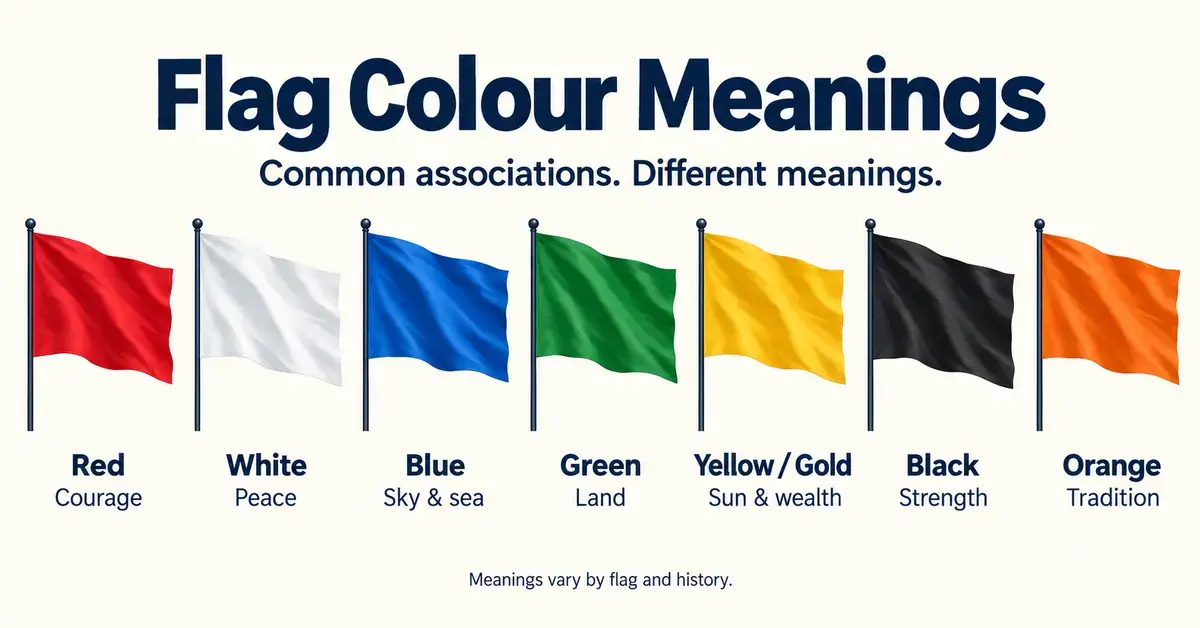
Flag colours carry meaning, but that meaning is rarely fixed. The same red can stand for revolution on one flag and sacrifice on another, and many governments never set down an official explanation at all. This guide to flag colour meanings works through the colours you see most often on national flags — red, white, blue, green, yellow and gold, black and orange — explains what each one commonly represents, and points to real flags that show the range. For the wider picture of how colours and emblems work together, see our overview of what flag colours and symbols mean.
Key Points
- Flag colours carry common associations, not fixed meanings — the same colour can mean different things on different flags.
- Red → blood, courage, sacrifice or revolution; white → peace, purity or truce; blue → sky, sea, loyalty or justice.
- Green → land, fertility or Islam; yellow/gold → sun or mineral wealth; black → the people, strength or mourning; orange → a specific tradition or faith.
- Shared palettes — Pan-African, Pan-Arab and Pan-Slavic colours — explain why so many flags look alike.
- Many governments assign no official meaning at all; South Africa and Ireland both say so directly.
- Prefer official national sources over spun or AI-generated colour-meaning lists.
Do flag colours have fixed meanings?
No — flag colours do not have single, official meanings that apply everywhere. A colour’s symbolism depends on the country, the era in which the flag was adopted, and the political or cultural story behind it. Because of this, the readings below are the ones most often cited by flag scholars and national authorities, not universal rules.
Two well-documented examples show how cautious you should be. South Africa’s government states plainly that its flag’s colours have no agreed symbolism: “no universal symbolism should be attached to any of the colours.” Ireland’s colours carry no meaning in the Constitution either; the only officially quoted reading is Thomas Francis Meagher’s 1848 description of the white as “a lasting truce” between the Orange and the Green. Treat colour meanings as useful interpretations, and check a specific country’s official description before stating one as fact.
What each flag colour commonly means
Each flag colour has a cluster of recurring associations rather than one definition. The table gives a quick reference; the sections below add the detail and the example flags.
Colour Meanings at a Glance
| Colour | Commonly associated with | Example flags |
|---|---|---|
| Red | Blood, courage, sacrifice, revolution | China, Canada, Pan-African flags |
| White | Peace, purity, honesty, truce | Japan, Ireland (centre stripe) |
| Blue | Sky, sea, loyalty, vigilance, justice | Greece, United States, Slavic nations |
| Green | Land, fertility, hope, Islam | Saudi Arabia, Pakistan, Ireland, Brazil |
| Yellow / gold | Sun, wealth, mineral resources | Brazil, many African flags |
| Black | The people, strength, heritage, mourning | South Africa, Pan-African & Pan-Arab flags |
| Orange | A specific tradition, resource or faith | Ireland, India (saffron) |
Red
Red most often represents blood, courage, sacrifice or revolution. It is one of the most common colours on world flags, and its exact meaning swings widely between them. On the flag of China, red carries the ideas of revolution and communism. On Canada’s flag the red is usually read as sacrifice and valour, though this is an interpretation rather than a meaning fixed in law. In the Pan-African tradition, red stands for the blood shed in the struggle against oppression.
White
White usually signals peace, purity, honesty or snow. Japan’s flag is a classic example of the purity and simplicity reading, with a red sun disc on a plain white field. In many European tricolours white sits between two stronger colours as a note of peace or unity. White also has a meaning that works across borders: a plain white flag is an internationally recognised request for a truce or to open negotiations, protected under the laws of war — it signals a wish to parley, not automatically surrender.
Blue
Blue commonly points to the sky, the sea, loyalty, vigilance or justice. Greece’s blue reflects its seafaring history and the surrounding Aegean. On the flag of the United States, the blue canton is traditionally associated with vigilance, perseverance and justice. Blue is also one of the three Pan-Slavic colours (see below), which is why it recurs across much of central and eastern Europe.
Green
Green typically represents land, agriculture, fertility, hope — and, on many flags, Islam. The religious association is strong: green has long been linked with paradise in Islamic tradition, and it appears on the flags of Saudi Arabia and Pakistan in that sense. But green does not always mean religion. Ireland’s green stands for the Gaelic nationalist tradition, Brazil’s green is usually tied to its forests, and in the Pan-African palette green represents the fertile land of Africa.
Yellow and gold
Yellow or gold most often suggests the sun, wealth or mineral riches. On Brazil’s flag the yellow rhombus is commonly read as the country’s mineral wealth, especially its gold. Across Africa, gold frequently represents natural resources or the savannah. On other flags yellow simply stands for sunlight and a bright future. Yellow and gold are usually treated as the same symbolic colour even where the printed shade differs.
Black
Black has the widest emotional range of any flag colour, from strength and determination to heritage, resilience and mourning. In the Pan-African tradition black represents the people of Africa and their shared history. In Pan-Arab flags black recalls specific historical caliphates. On South Africa’s flag black is one of several colours in a design that marks the country’s transition to democracy — though, as noted above, the government assigns no fixed meaning to it.
Orange
Orange is less common but distinctive, usually tied to a particular tradition, resource or faith. On Ireland’s flag orange represents the followers of William of Orange and the Protestant tradition, deliberately balanced against the green. India’s flag uses a related shade, saffron; India’s first Vice-President described it as standing for renunciation and selflessness, while popular readings link it to courage and sacrifice. The point holds across the whole guide: orange, like every flag colour, takes its meaning from its own flag.
Flag colour families: why so many flags share a palette
Many flags share the same colours because they draw on a handful of shared political traditions, not by coincidence. These “colour families” explain why large groups of flags look related, and each family carries its own broad symbolism. They are the main reason a quick glance at a flag can be misleading — the same three colours can signal very different movements.
Pan-African colours (red, black and green)
The Pan-African colours were set out by Marcus Garvey’s Universal Negro Improvement Association, which adopted a red, black and green triband in 1920. In the usual reading, red is the blood that unites people of African ancestry, black is the people themselves, and green is the rich land of Africa. A separate green-gold-red grouping, associated with Ethiopia, also spread widely across newly independent African states, which is why so many African flags combine those shades.
Pan-Arab colours (black, white, green and red)
The Pan-Arab colours trace back to a medieval Arabic poem and were first combined on the 1916 flag of the Arab Revolt. The four colours are traditionally linked to historic eras: black to the Abbasid caliphate, white to the Umayyad, green to the Fatimid, and red to the Hashemites. Modern flags using these colours include Jordan, Palestine, Kuwait, the United Arab Emirates and others; popular readings add sacrifice, peace, prosperity and strength.
Pan-Slavic colours (blue, white and red)
The Pan-Slavic colours — blue, white and red — were defined at the Prague Slavic Congress of 1848, based on the colours of the Russian flag. The Russian colours themselves have no single official explanation, with competing theories tracing them to heraldry, religious imagery or the Dutch tricolour. The 1848 choice is why many Slavic nations, including Slovakia, Serbia and others, share the same three colours in different arrangements.
Why the same colour means different things on different flags
A single colour can mean opposite things on two flags because meaning comes from each nation’s history, not from the colour itself. Red is “revolution” on one flag and “sacrifice” on another; green is “Islam” on one and “forests” on the next. This is why it is risky to decode a flag you do not know by colour alone, and why reliable flag references attribute meanings to specific countries rather than to colours in the abstract.
Official sources also disagree with popular lore surprisingly often. Many of the tidy colour meanings repeated online are later interpretations that a government has never endorsed — and some, like the “basil, mozzarella and tomato” story for Italy’s green-white-red, are simply myths. We explain how we handle contested and disputed symbolism in our editorial policy and sources, and you can browse the whole site from the country flags of the world homepage.
How to find out what a specific flag’s colours mean
To learn what a particular flag’s colours mean, start with the country’s own official source rather than a general colour chart. National governments, constitutions and heraldic authorities are the most reliable guide to intended meaning, and they will also tell you when no meaning was ever assigned. A quick, dependable approach:
- Check the official government or constitutional description first. Many states publish flag guidance; some, like South Africa and Ireland, state outright that the colours have no fixed symbolism.
- Look at the flag’s adoption date and history. A flag adopted during a revolution, independence struggle or religious movement usually reflects that context in its colours.
- Identify the colour family. If the flag uses a Pan-African, Pan-Arab or Pan-Slavic palette, the colours signal that tradition before anything country-specific.
- Separate official meaning from popular reading. If no authority has set a meaning, present it as a common interpretation, not a fact.
- Cross-check with an established flag reference. Vexillological bodies and long-running flag databases are more reliable than spun blog posts that repeat each other.
Common mistakes when reading flag colours
The most common mistake is assuming a colour has one meaning everywhere. A few others are worth avoiding:
- Treating interpretation as official. Unless a government publishes the symbolism, a colour meaning is a popular reading. Say “commonly represents,” not “means.”
- Ignoring colour families. Shared palettes (Pan-African, Pan-Arab, Pan-Slavic) explain many look-alike flags; the colours signal a tradition, not a fixed message.
- Confusing shade with meaning. Yellow and gold, or orange and saffron, are often treated as the same symbolic colour even when the printed shade differs.
- Forgetting the design. Colours work together with stripes, crosses, crescents and stars; the layout often carries more meaning than any one colour.
- Trusting spun or AI-generated lists. Many colour-meaning pages copy each other. Prefer official national sources and established flag institutes.
For more quick answers about world flags, including which colours appear most often, see our flag FAQs, and learn more about countryflags.ca and how we research.
Sources
- Government of South Africa — National flag
- Government of Ireland (gov.ie) — The National Flag
- W. Crampton, Flag Institute — Marcus Garvey and the Red, Black and Green
- WorldAtlas — What Are the Pan-Arab Colours?
- WorldAtlas — What Are the Pan-Slavic Colours?
- Romeing — The meaning of the Italian flag’s colours
- Flags of the World (FOTW) — Flag of India
Frequently Asked Questions
What do flag colours mean?
Flag colours carry symbolic associations rather than fixed definitions. Red commonly stands for blood, courage or revolution; white for peace or purity; blue for sky, sea or loyalty; green for land or faith; yellow and gold for the sun or wealth; and black for the people, strength or mourning. The exact meaning depends on the country and the flag’s history.
Do flag colours have official meanings?
Usually not. Most countries never publish an official explanation of their flag’s colours, so the meanings you read are interpretations by historians and commentators. Some governments say so directly — South Africa, for example, states that no universal symbolism should be attached to its flag’s colours.
What do red, white and blue mean on flags?
On many flags red, white and blue together echo revolution and liberty, a pattern that spread from the French tricolour. Individually, red is often courage or sacrifice, white peace or purity, and blue loyalty or justice. Across Slavic nations the same three colours mark the Pan-Slavic tradition rather than those ideas.
Why do so many flags share the same colours?
Because large groups of flags draw on shared political traditions known as colour families. The Pan-African colours (red, black, green), Pan-Arab colours (black, white, green, red) and Pan-Slavic colours (blue, white, red) each spread across many countries, which is why so many flags look related.
What does the colour green mean on a flag?
Green most often represents land, agriculture, fertility or hope, and on many flags it signals Islam, as with Saudi Arabia and Pakistan. But it is not always religious: Ireland’s green marks the Gaelic tradition and Brazil’s green is linked to its forests, so the meaning always depends on the individual flag.
