

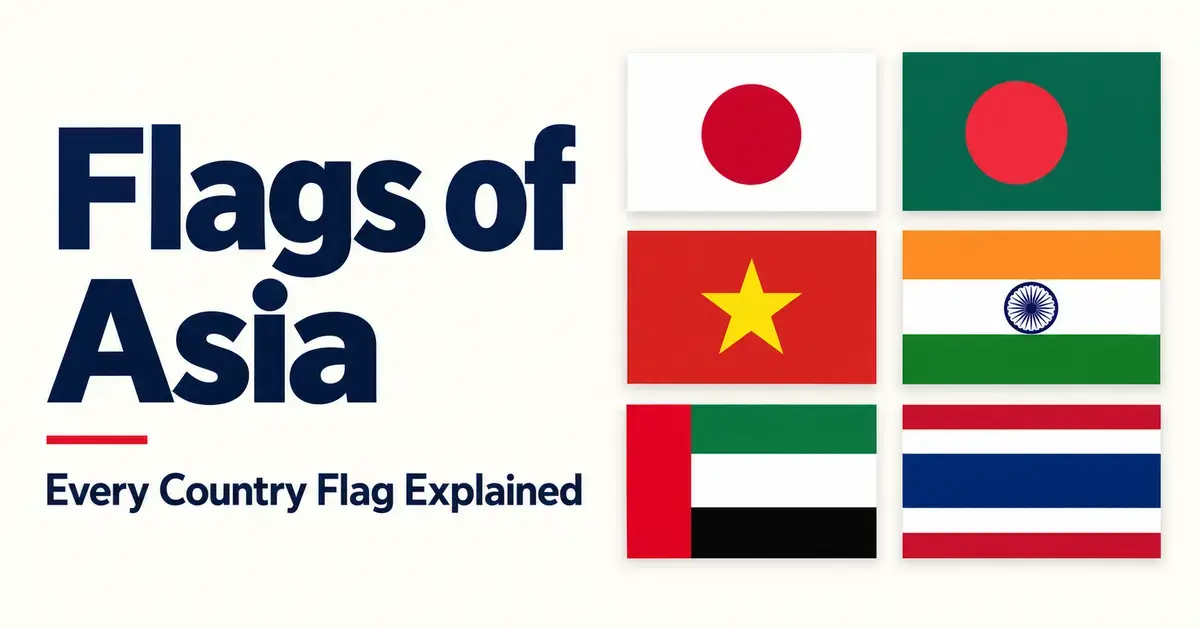
Asia is the world’s largest and most populous continent, and its national flags are every bit as varied as its geography — from the single red sun disc of Japan to the carpet patterns of Turkmenistan. This guide to the flags of Asia lists every country flag in one table, then explains the colours, symbols and history behind them. Because geographers place the Middle East within Asia, the flags of countries such as Saudi Arabia, Israel and the United Arab Emirates are covered here too, alongside those of East, South, Central and Southeast Asia. It forms part of our wider guide to country flags of the world.
Key Points
- Asia has 48 national flags, matching the UN’s 48 sovereign states across East, South, Central, Southeast and West Asia (the Middle East).
- Designs range widely: sun discs (Japan, Bangladesh), stars (China, Vietnam), religious inscriptions (Saudi Arabia, Afghanistan) and crescent-and-star emblems (Turkey, Pakistan, Malaysia).
- Nepal has the world’s only non-rectangular national flag.
- Cambodia has the only current national flag to show a recognisable building (Angkor Wat).
- Turkmenistan, with its carpet guls, is widely called the most intricate national flag.
- Two flags changed recently: Syria (official since March 2025) and Afghanistan (white shahada flag since 2021).
How many flags are there in Asia?
There are 48 national flags in Asia, matching the 48 sovereign states the United Nations counts on the continent. Those states fall into five subregions: Eastern Asia (5 countries), Southern Asia (9), Central Asia (5), South-Eastern Asia (11) and Western Asia (18) — the last of which is what most people call the Middle East.
A few borderline cases explain why you sometimes see a higher number. Russia is transcontinental but the UN counts it with Europe, so it is not included above. Taiwan is not a UN member and is listed internationally as part of China, so it does not add to the 48. The State of Palestine, a UN observer state, is included. For broader background, our common questions about world flags page answers how many national flags exist worldwide.
Every Asian country flag at a glance
The table below lists all 48 Asian national flags by subregion, with a short description of each design and its most recognisable feature. Two flags changed recently and are shown in their current, official form: Syria (the green-white-black tricolour with three red stars, official since March 2025) and Afghanistan (the white flag bearing the Islamic declaration of faith, used by the Islamic Emirate since 2021).
Quick Facts
| National flags in Asia | 48 (UN sovereign states) |
| Subregions | 5 — East, South, Central, Southeast and West Asia |
| Most countries in one subregion | Western Asia / Middle East (18) |
| Only non-rectangular flag | Nepal |
| Most intricate flag | Turkmenistan |
| Only flag with a recognisable building | Cambodia (Angkor Wat) |
| Most recent major change | Syria (official March 2025) |
| Country | Subregion | Flag design and main symbol |
|---|---|---|
| China | East Asia | Red field with one large and four smaller golden stars in the canton; red for the revolution, the big star for the Communist Party. |
| Japan | East Asia | White field with a central red disc (the Hinomaru, or “circle of the sun”); given legal status in 1999. |
| South Korea | East Asia | White field with the red-and-blue taegeuk (yin-yang) circle and four black trigrams; known as the Taegukgi. |
| North Korea | East Asia | Wide red central band with a white disc and red star, framed by thin white stripes and blue bands. |
| Mongolia | East Asia | Red-blue-red vertical bands with the golden Soyombo national emblem on the hoist band. |
| India | South Asia | Saffron-white-green horizontal bands with the navy-blue 24-spoke Ashoka Chakra (the “wheel of law”) in the centre. |
| Pakistan | South Asia | Dark green field with a white crescent and star and a white hoist stripe representing religious minorities. |
| Bangladesh | South Asia | Bottle-green field with a red disc set slightly toward the hoist. |
| Sri Lanka | South Asia | Crimson field with a golden lion holding a sword, a bo leaf in each corner, and green and orange hoist stripes (the “Lion Flag”). |
| Nepal | South Asia | Crimson double pennant with a blue border, bearing a white moon and sun; the world’s only non-rectangular national flag. |
| Bhutan | South Asia | Yellow and orange split diagonally, with a white thunder dragon (Druk) across the centre. |
| Maldives | South Asia | Red field with a large green rectangle and a white crescent. |
| Afghanistan | South Asia | White field with the black shahada (Islamic Emirate, since 2021); the former black-red-green tricolour is still used by some diplomatic missions and the diaspora. |
| Iran | South Asia | Green-white-red horizontal bands with the red national emblem centred and a stylised takbir repeated 22 times along the band edges. |
| Kazakhstan | Central Asia | Sky-blue field with a golden 32-ray sun above a steppe eagle, and a vertical “koshkar-muiz” ornament at the hoist. |
| Uzbekistan | Central Asia | Blue-white-green bands with red fimbriations, a white crescent and twelve white stars. |
| Turkmenistan | Central Asia | Green field with a vertical red carpet-gul stripe, a white crescent and five stars; often called the most intricate national flag. |
| Tajikistan | Central Asia | Red-white-green bands (white widest) with a golden crown beneath an arc of seven stars. |
| Kyrgyzstan | Central Asia | Red field with a yellow 40-ray sun and a stylised tunduk (the crown of a yurt) at its centre. |
| Indonesia | Southeast Asia | Two horizontal bands, red over white; near-identical to Monaco’s flag. |
| Philippines | Southeast Asia | Blue and red bands with a white hoist triangle bearing a golden sun and three stars; the bands reverse (red on top) in wartime. |
| Vietnam | Southeast Asia | Red field with a single large golden five-pointed star. |
| Thailand | Southeast Asia | Five horizontal bands of red-white-blue-white-red, the central blue band widest (the Thong Trairong). |
| Myanmar | Southeast Asia | Yellow-green-red horizontal bands with a large white five-pointed star in the centre. |
| Malaysia | Southeast Asia | Fourteen red and white stripes with a blue canton bearing a yellow crescent and 14-point star (the Jalur Gemilang). |
| Cambodia | Southeast Asia | Blue-red-blue bands with a white depiction of Angkor Wat; the only current national flag to show a recognisable building. |
| Laos | Southeast Asia | Red-blue-red bands with a white disc in the centre. |
| Singapore | Southeast Asia | Red over white with a white crescent and five white stars in the upper hoist. |
| Timor-Leste | Southeast Asia | Red field with a yellow and a black triangle at the hoist, the black one bearing a white star. |
| Brunei | Southeast Asia | Yellow field with black and white diagonal stripes and the red national emblem (which includes a crescent) in the centre. |
| Turkey | West Asia | Red field with a white crescent and star; the emblem traces to Ottoman heritage. |
| Iraq | West Asia | Red-white-black horizontal bands with the green takbir (“God is great”) in the white band. |
| Yemen | West Asia | Plain red-white-black horizontal bands (the Arab Liberation colours). |
| Saudi Arabia | West Asia | Green field with the white shahada and a sword; not flown at half-mast because of the sacred inscription. |
| Syria | West Asia | Green-white-black horizontal bands with three red stars; official since March 2025, reviving the 1930s independence flag. |
| Jordan | West Asia | Black-white-green bands with a red hoist triangle and a white seven-pointed star (Arab Revolt colours). |
| United Arab Emirates | West Asia | Red vertical hoist bar beside green-white-black horizontal bands (pan-Arab colours). |
| Azerbaijan | West Asia | Blue-red-green horizontal bands with a white crescent and eight-pointed star; blue for Turkic heritage, red for progress, green for Islam. |
| Israel | West Asia | White field with two blue stripes and a blue Star of David, echoing the tallit (prayer shawl). |
| Lebanon | West Asia | Red-white-red horizontal bands with a green cedar tree in the centre. |
| State of Palestine | West Asia | Black-white-green bands with a red hoist triangle (Arab Revolt colours). |
| Oman | West Asia | White, red and green panels with the national emblem (a khanjar dagger crossed with swords) at the upper hoist. |
| Kuwait | West Asia | Green-white-red horizontal bands with a black trapezoid at the hoist (pan-Arab colours). |
| Georgia | West Asia | White field with a central red cross and four smaller red crosses (the “Five Cross Flag”). |
| Qatar | West Asia | Maroon field with a white serrated band of nine points at the hoist. |
| Armenia | West Asia | Red, blue and orange horizontal tricolour. |
| Bahrain | West Asia | White and red divided by a five-point serrated edge, the points standing for the Five Pillars of Islam. |
| Cyprus | West Asia | White field with a copper silhouette of the island above two green olive branches; one of only two national flags to show a map of the country. |
What makes Asian flag designs so diverse?
Asian flags draw on a wider range of traditions than those of any other continent, because the region spans several of the world’s great cultural and religious spheres. Despite the variety, most designs fall into a handful of recognisable families. If you want the general meanings behind the colours and emblems first, our overview of what flag colours and symbols mean is a good companion to this section.
Crescent-and-star flags of West Asia and beyond
The crescent and star is the single most repeated emblem on Asian flags. In West Asia it appears on the flags of Turkey and Azerbaijan, and the symbol spreads across the continent to Pakistan and the Maldives in South Asia, Malaysia, Singapore and Brunei in Southeast Asia, and Uzbekistan and Turkmenistan in Central Asia. The pairing is usually read as a mark of Ottoman and Islamic heritage — the crescent became associated with Islam after the Ottomans took Constantinople in 1453 — though the meaning is not fixed. Azerbaijan’s eight-pointed star, for example, is variously explained as the eight letters of “Azerbaijan” in Arabic script or the eight branches of the Turkic peoples, while Singapore’s crescent and five stars are secular symbols of a young, rising nation and its ideals of democracy, peace, progress, justice and equality.
Pan-Arab colours across the Middle East
Many Middle Eastern flags share four colours — black, white, green and red — known as the pan-Arab colours. They were first combined on the flag of the 1916 Arab Revolt against the Ottoman Empire and are often linked to early Islamic dynasties: black to the Abbasids, white to the Umayyads, green to the Fatimids and red to the Hashemites. You can see the family resemblance across Jordan, Kuwait, the United Arab Emirates, Yemen, Iraq and the State of Palestine, each arranging the same palette differently. Some countries give the colours a local reading too: the designer of the UAE flag said its black stands for the oil that transformed the country, and its green for fertility.
National and religious emblems
A second group of flags centres on a single powerful emblem rather than stripes. Saudi Arabia’s green flag carries the shahada, the Islamic declaration of faith, above a sword; because the inscription is sacred, the flag is never flown at half-mast and is not printed on merchandise. India’s Ashoka Chakra, a 24-spoke navy wheel taken from an ancient lion capital, represents the “wheel of law”. Israel’s Star of David sits between two stripes modelled on the tallit prayer shawl, and Mongolia’s golden Soyombo is a Buddhist-rooted column of fire, sun, moon and geometric shapes.
Animals, plants and a temple
Living and built symbols give some Asian flags their character. Bhutan’s white thunder dragon, or Druk, names the country itself — Druk Yul, “the Thunder Dragon Kingdom”. Sri Lanka’s golden lion stands for courage, with four bo leaves from the sacred fig tree of the Buddha’s enlightenment in the corners. Lebanon’s green cedar is a symbol of resilience and longevity, and Cambodia’s flag is the only current national flag to depict a recognisable building, the temple complex of Angkor Wat.
Which Asian flags look most alike?
Several Asian flags are easy to confuse, which is one of the most common reasons readers search for them. Indonesia’s red-over-white flag is almost identical to Monaco’s; the two differ mainly in proportions. Within Asia, the red fields and golden stars of China and Vietnam can look similar at a glance, even though China’s canton holds five stars and Vietnam’s centre holds one. The pan-Arab flags of Jordan, Kuwait and the State of Palestine share the same four colours and a hoist triangle, so the arrangement of the bands is what tells them apart. Nepal’s double-pennant shape, by contrast, is unmistakable — no other country uses it.
Common mistakes and misconceptions about Asian flags
The most frequent mistake is treating every crescent-and-star flag as a purely religious symbol. While the emblem usually reflects Islamic or Ottoman heritage, Singapore’s crescent and stars are explicitly secular, and the number of stars or points often carries a national rather than religious meaning. A second common error is assuming flag meanings are universal and fixed; in reality they vary by country and by source, which is why reputable references describe colours as “commonly” meaning something rather than “universally”. Azerbaijan’s star, Nepal’s twin pennants and Mongolia’s Soyombo all have several competing explanations.
Other slips are factual. People often flip the Philippine flag without realising the reversed version (red band on top) signals a state of war. They assume the Middle East is a separate region from Asia, when geographers class it as Western Asia. And they sometimes repeat outdated designs: Syria’s official flag changed in 2025, and Afghanistan’s changed in 2021. We follow official and vexillological sources and flag contested symbolism rather than state it as settled — see our editorial policy for how we verify flag facts. If you spot an error, please tell us.
Sources
- Worldometers — How many countries in Asia (UN list)
- CIA World Factbook — country flag descriptions
- Encyclopaedia Britannica — Flag of China
- Nippon.com — Hinomaru: History of Japan’s National Flag
- Office of the Prime Minister, Republic of Korea — The National Flag (Taegeukgi)
- Saudipedia — The Saudi National Flag
- National Heritage Board, Singapore — National Flag
- Israel Ministry of Foreign Affairs — The Flag and the Emblem
- Ministry of Foreign Affairs of Azerbaijan — State Symbols
- Flags of the World — Flag of Bhutan
- Flags of the World — Flag of Cyprus
Frequently Asked Questions (FAQ)
How many flags are there in Asia?
There are 48 national flags, matching the 48 sovereign states the United Nations places in Asia. They span Eastern Asia (5), Southern Asia (9), Central Asia (5), South-Eastern Asia (11) and Western Asia (18). Russia is counted with Europe, and Taiwan is not a UN member, so neither adds to the total.
Which Asian flag is the only non-rectangular national flag?
Nepal’s. It is formed of two stacked crimson pennants with a blue border, carrying a white moon on the upper pennant and a white sun on the lower one. It is the only non-rectangular national flag in the world; every other country uses a rectangle.
Why do so many Asian flags have a crescent and star?
The crescent and star mostly signals Ottoman and Islamic heritage, which is why it appears on flags from Turkey and Pakistan to Malaysia and Uzbekistan. The exact meaning differs by country, however, and some uses are secular — Singapore’s crescent and five stars stand for a young nation and its civic ideals, not religion.
Are Middle Eastern flags part of Asia?
Yes. Geographers class the Middle East as Western Asia, so the flags of countries such as Saudi Arabia, Israel, Jordan and the United Arab Emirates are Asian flags. That is why this guide covers them alongside East, South, Central and Southeast Asia.
Which two Asian flags look almost identical to other countries’ flags?
Indonesia’s red-over-white flag is nearly identical to Monaco’s, differing mainly in proportions. Within Asia, China and Vietnam both use a red field with golden stars, but China has five stars in the canton while Vietnam has a single central star.
