

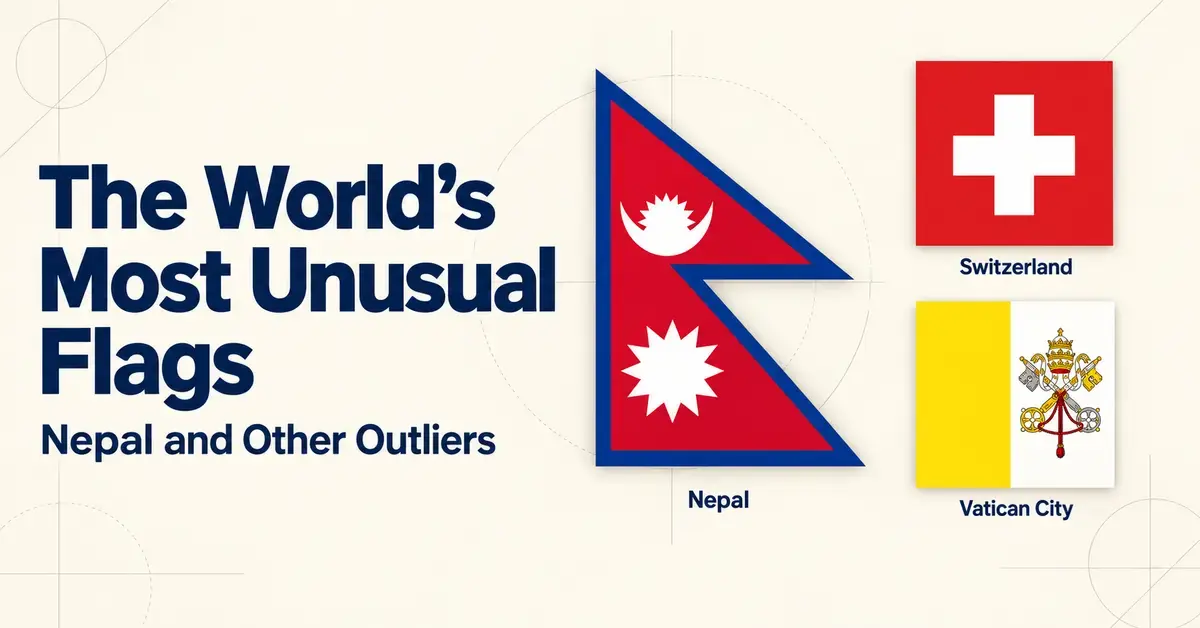
Most national flags are rectangles filled with simple stripes, crosses or stars. A small group breaks almost every one of those conventions: one is not even a four-sided shape, two are perfect squares, one shows a different picture on each side, and another carries an assault rifle. These outliers are some of the most interesting country flags of the world because each oddity encodes a piece of history, politics or geometry. This guide walks through the best-known unusual flags and explains, in plain terms, exactly what makes each one stand apart.
Key Points
- Nepal flies the world’s only non-rectangular national flag — a double-pennon of two triangles, with its exact geometry written into the constitution.
- Switzerland and Vatican City are the only two states with square national flags.
- Paraguay has the only national flag with a different emblem on each side.
- Mozambique is one of very few national flags to show a modern firearm — an AK-47 with a bayonet.
- Belize is widely cited as the only national flag depicting human beings.
- Libya’s plain green flag (1977–2011) was the only national flag with a single colour and no design.
What makes a flag “unusual”?
A flag counts as unusual when it departs from the shared template that almost every country follows. That template is remarkably consistent: a rectangle, usually in a ratio of about 2:3 or 1:2, filled with flat bands of colour and occasionally a central emblem. Against that backdrop, a handful of flags stand out for one of four reasons: an unexpected shape, a design that differs front-to-back, an object you would never expect to see on a flag, or a level of pictorial detail that most national banners deliberately avoid.
None of these choices is an accident. Flags are legal symbols, usually defined in a constitution or statute, so every exception had to be written into law on purpose. Understanding the reason behind each quirk is far more rewarding than simply listing them.
Nepal: the only non-rectangular national flag
Nepal flies the only national flag in the world that is not a four-sided shape. Every other sovereign state uses a rectangle (or, in two cases, a square). Nepal’s flag is a “double-pennon” — two stacked triangular pennants with a narrow blue border running around the whole outline. It is also the only national flag that is taller than it is wide.
Why two triangles?
The shape comes from two separate pennants that were flown for generations before they were joined. According to flag historians, the two triangles are linked to rival branches of the Rana dynasty, the family that effectively ruled Nepal for much of the 19th and early 20th centuries. The individual pennants had been in use for roughly two centuries, and the combined double pennant since the 1800s, long before it was formalised as the modern national flag.
The sun and the moon
The upper triangle carries a white moon and the lower triangle a white sun. Broadly, the moon is read as calmness and the cool of the Himalayas, while the sun stands for resolve and the heat of the lowlands; together they express the hope that the nation will endure as long as the sun and moon themselves. Both bodies also had dynastic meanings historically. One striking detail: until the 1962 redesign, the sun and moon were drawn with human faces, which were removed to modernise the emblem.
A flag defined by mathematics
What truly sets Nepal apart is that its constitution does not just describe the flag — it gives a step-by-step geometric construction for drawing it. The legal text lays out a sequence of lines and measurements so that anyone, anywhere, can reproduce the exact shape from scratch. No other national flag is specified in quite this way, which is why Nepal appears in nearly every list of the most unusual flags.
Switzerland and Vatican City: the only square flags
Switzerland and Vatican City fly the only two square national flags. Strictly speaking a square is a kind of rectangle, so these are not as geometrically radical as Nepal, but against a world of 2:3 and 1:2 banners a 1:1 flag is still a clear outlier.
Switzerland’s square white cross on red is one of the most recognised symbols on earth, yet even it bends to practicality. At the Olympic Games the Swiss use a rectangular version, because the International Olympic Committee requires every national flag to share the same dimensions, and the civil ensign flown by Swiss merchant ships and yachts at sea is also rectangular. Vatican City’s flag pairs a yellow and a white vertical band, with the crossed keys of Saint Peter and the papal tiara on the white half — a square flag for the world’s smallest state.
Paraguay: the flag with two different sides
Paraguay flies the only national flag whose two sides show different emblems. Both faces share the same red-white-blue horizontal tricolour, but the picture in the centre of the white band changes depending on which side you are looking at.
The front (obverse) carries the national coat of arms: a golden “Star of May”, recalling independence in May 1811, inside a wreath with the country’s name. The back (reverse) shows the seal of the treasury: a lion guarding a staff topped by a red liberty cap, above the motto Paz y Justicia (“Peace and Justice”). Because the two seals face in the correct direction on their respective sides, the flag has to be printed as a genuine two-sided object rather than a single design mirrored through the cloth. The current specification was tidied up by decree in 2013, which also fixed the proportions.
Mozambique: the flag that carries a rifle
Mozambique’s flag is one of very few national flags in the world to depict a modern firearm. In the centre, over a yellow star, sits an AK-47 assault rifle with a fixed bayonet, crossed by a hoe and laid on an open book. (Guatemala’s flag shows older rifles, so Mozambique is best described as one of a tiny handful rather than the absolute only example.)
The emblem grew out of the flag of FRELIMO, the liberation movement that led the country to independence. Each object is a message: the rifle for defence and vigilance, the hoe for agriculture, the book for education, and the star for internationalism. The flag was adopted in 1983, and there have been periodic debates inside Mozambique about removing the rifle — but it remains, which is exactly what keeps the flag on every list of unusual designs. For more on how such objects carry meaning, see our overview of what flag colours and symbols mean.
Belize: the only national flag with people on it
Belize flies what is widely regarded as the only national flag that depicts human beings. At the centre is a white disc containing the national coat of arms, in which two woodcutters — one of mestizo and one of African descent — stand on either side of a mahogany tree, holding the tools of the logging trade that first drew settlers to the territory.
The flag dates from independence in 1981 and came out of a public design competition. Two British overseas territories, Montserrat and the British Virgin Islands, also show people, but among fully sovereign states Belize stands alone. Guinness World Records recognises the Belize flag for the most people depicted on a national flag.
Flags built around detailed seals
Belize also belongs to a wider group of outliers: flags dominated by a highly detailed seal or coat of arms. Most countries keep their central emblem simple so it reads clearly from a distance and prints cleanly at any size. Belize’s arms, by contrast, pack in figures, a tree, tools, a scroll and a motto, which is why the government has had to publish precise colour codes to keep reproductions consistent.
The same challenge once plagued many United States state flags, several of which simply placed a complex state seal on a plain blue field. Fine-print seals look impressive up close but turn into an unreadable blob on a flag flapping in the wind — one reason vexillologists (people who study flags) generally argue that the simplest designs are the strongest.
Libya’s plain green flag (1977–2011)
For 34 years, Libya flew the only national flag that was a single colour with no design at all. From 1977 to 2011, under Muammar Gaddafi, the flag was a plain field of green — no emblem, no stripes, no coat of arms. The colour was tied to Islam and to the “Green Revolution” ideology Gaddafi promoted, and it was adopted after Libya broke politically with Egypt.
When the Gaddafi government fell in 2011, the country returned to its earlier red-black-green tricolour with a white star and crescent. No sovereign state today flies a truly one-colour flag, which makes Libya’s green banner a historical outlier rather than a current one.
The Philippines: a flag flown upside down in wartime
The Philippines has a rule no other country shares: its flag is deliberately flown upside down in wartime. In peacetime the blue band sits on top; when the nation is at war, the flag is inverted so that the red band is uppermost. The convention is written into Philippine flag law.
Because the change is so easy to make by mistake, it has caused real diplomatic embarrassment, including an occasion when the flag was displayed inverted at an international meeting and read, unintentionally, as a declaration of war. It is a reminder that a flag’s orientation can be as meaningful as its design.
Common misconceptions about unusual flags
Even famous flag facts are often repeated in slightly wrong forms. Keeping the details straight is part of why we publish a clear editorial and sourcing policy.
- “Nepal and a few others are non-rectangular.” Among sovereign national flags, Nepal is the only non-quadrilateral. Ohio’s “burgee” is a non-rectangular US state flag, not a national one, so it is a separate category.
- “Mozambique is the only flag with a gun.” It is one of very few, but Guatemala’s flag also shows firearms. “One of a handful” is the accurate phrasing.
- “Switzerland’s flag is always square.” The national flag is square, but rectangular versions are used at the Olympics and at sea.
- “Belize’s flag shows a man and a woman.” It actually shows two male woodcutters; descriptions of a man and a woman are incorrect.
- “Libya still has an all-green flag.” That flag ended in 2011; the current Libyan flag is a tricolour with a star and crescent.
If you enjoy untangling this kind of detail, our Flag FAQs page answers more quick questions about world flags.
Comparison
| Flag | What makes it an outlier | Key detail |
|---|---|---|
| Nepal | Only non-quadrilateral national flag | Two triangular pennants; taller than wide; geometry fixed in the constitution |
| Switzerland | One of only two square flags | Rectangular version used at the Olympics and at sea |
| Vatican City | One of only two square flags | Crossed keys of Saint Peter and the papal tiara |
| Paraguay | Different design on each side | National arms on the front, treasury seal on the back |
| Mozambique | Depicts a modern firearm | AK-47 with bayonet, crossed with a hoe over a book |
| Belize | Depicts human beings | Two woodcutters by a mahogany tree in the coat of arms |
| Libya (1977–2011) | Single colour, no design | Plain green field; replaced in 2011 |
Sources
Frequently Asked Questions (FAQ)
What is the only non-rectangular national flag?
Nepal’s. It is a “double-pennon” made of two stacked triangular pennants with a blue border, and it is the only national flag that is not a four-sided shape. It is also taller than it is wide.
Which national flags are square?
Only two: Switzerland and Vatican City. A square is technically a rectangle, but these are the two flags that use a 1:1 ratio, making them clear outliers. Switzerland still uses a rectangular version at the Olympics and at sea.
Which flag looks different on each side?
Paraguay’s. Both sides share the same red-white-blue tricolour, but the front shows the national coat of arms with the Star of May, while the back shows the treasury seal with a lion and a liberty cap.
Which national flag has a gun on it?
Mozambique’s flag shows an AK-47 with a bayonet, crossed with a hoe over an open book. It is one of a very small number of national flags to depict a firearm, alongside Guatemala.
Is Belize really the only flag with people on it?
Among sovereign states, yes. Belize’s coat of arms shows two woodcutters by a mahogany tree. A couple of British overseas territories also depict people, but no other independent country’s flag does.
