

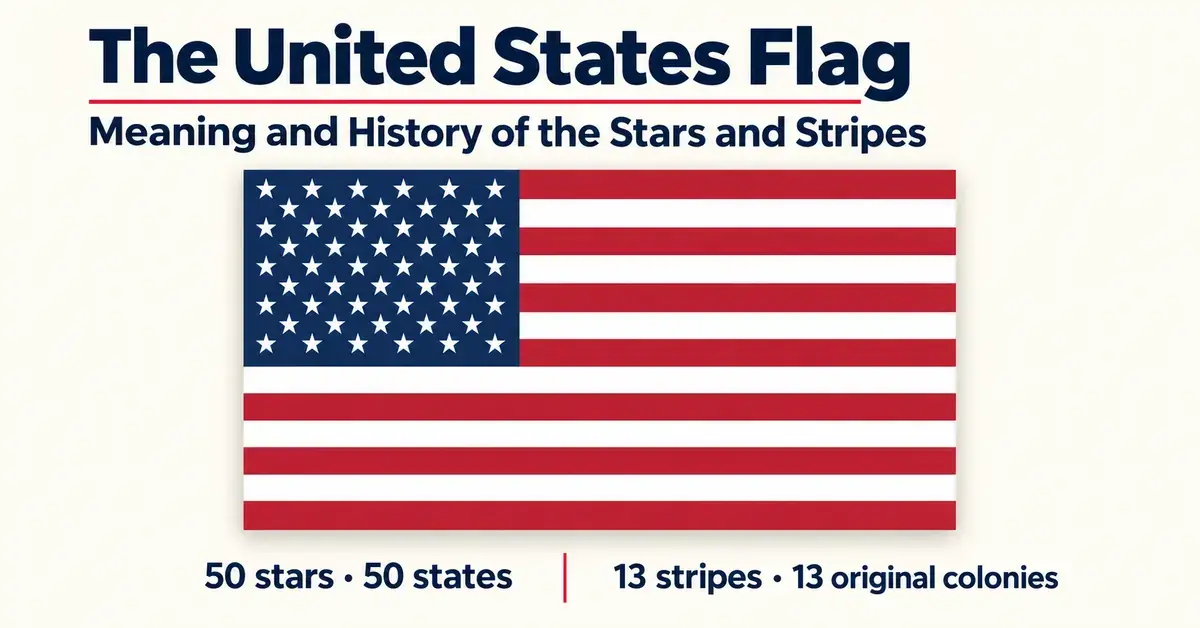
The flag of the United States — the Stars and Stripes — carries two simple ideas in its design: the 50 stars stand for the 50 states, and the 13 stripes stand for the 13 British colonies that declared independence in 1776. That basic meaning has stayed constant for almost 250 years, even as the flag itself changed shape more than two dozen times. This guide to US flag meaning and history explains what each part of the flag represents, where the famous red, white and blue colours come from, and how the design grew from 13 stars in 1777 to the 50-star flag flown today.
Key Facts
| Official name | Flag of the United States of America |
|---|---|
| Nicknames | The Stars and Stripes, Old Glory, The Star-Spangled Banner |
| Adopted | 14 June 1777 (first version); current 50-star design official 4 July 1960 |
| Stripes | 13 — for the 13 original colonies |
| Stars | 50 — one for each state |
| Colours | Red, white and blue |
| Proportions | Height to length 1 : 1.9 (Executive Order 10834, 1959) |
| Number of design changes | 26 changes since 1777 (today’s flag is the 27th version) |
| Flag Day | 14 June |
What does the US flag look like?
The modern US flag has 13 horizontal stripes and a blue rectangle in the upper-left corner holding 50 white stars. The stripes alternate red and white, starting and ending with red, so there are seven red stripes and six white ones. The blue rectangle, called the canton or union, sits against the top stripes on the side nearest the flagpole.
Inside the canton, the 50 stars are arranged in nine horizontal rows that alternate between six stars and five stars. Each star has five points, and one point faces straight up. This exact layout has been official since 1960, which makes it the version almost everyone alive today grew up with.
What do the stars and stripes mean?
The stars represent the states and the stripes represent the original colonies — but the two elements grew in very different ways. The number of stripes was fixed long ago, while the number of stars has changed every time a new state joined the country.
Why does the flag have 13 stripes?
The 13 stripes stand for the 13 original colonies that broke away from Great Britain. These were the founding members of the new nation: Delaware, Pennsylvania, New Jersey, Georgia, Connecticut, Massachusetts, Maryland, South Carolina, New Hampshire, Virginia, New York, North Carolina and Rhode Island.
Importantly, the stripe count has never grown. For a short period the flag did carry 15 stripes, but in 1818 Congress permanently set the number back to 13 so the stripes would always honour the founding colonies, no matter how large the country became.
Why does the flag have 50 stars?
Each of the 50 stars represents one US state. Unlike the stripes, the stars were always meant to grow with the country. The 1777 resolution that created the flag called the stars a “new constellation,” and later law set the rule that a star would be added for every new state that joined the Union.
That is why the flag reached 50 stars only in 1960, after Alaska and Hawaii became the 49th and 50th states. If the United States ever admitted a 51st state, a 51st star would be added under the same long-standing rule.
What do the red, white and blue colours mean?
The commonly accepted meanings are that red stands for hardiness and valour, white for purity and innocence, and blue for vigilance, perseverance and justice. It is worth knowing that these meanings were never written into any flag law. They come from a 1782 report by Charles Thomson, Secretary of the Continental Congress, describing the colours of the Great Seal of the United States — and were later applied to the flag because it uses the same three colours.
In other words, the colour symbolism is a respected tradition rather than an official legal definition. If you are interested in how colours carry meaning across many national flags, our overview of what flag colours and symbols mean puts the American reading in a wider context.
The history of the Stars and Stripes
The US flag did not appear fully formed in 1777. It grew out of earlier banners and was refined by law over several decades. Understanding that story explains why the flag looks the way it does today.
Before 1777: the Grand Union Flag
The first flag to resemble the modern design was the Grand Union Flag, also called the Continental Colors. It had the same 13 red-and-white stripes, but instead of a field of stars it carried the British Union Jack in the top-left corner. It was used from late 1775, during the early part of the Revolutionary War, before independence made a British symbol inappropriate.
The Flag Resolution of 14 June 1777
The Stars and Stripes was formally created on 14 June 1777, when the Second Continental Congress passed the Flag Resolution. The resolution stated that the flag should have 13 stripes alternating red and white, and a union of 13 white stars on a blue field representing a “new constellation.”
The wording was deliberately brief. It did not say how the stars should be arranged, how many points each star should have, or what the colours meant. Because of this, early American flags showed the stars in circles, rows and other patterns — all of them equally valid. The anniversary of the resolution, 14 June, is now observed as Flag Day.
Who designed the first flag?
The most famous story credits Betsy Ross, a Philadelphia seamstress said to have sewn the first flag with stars in a circle. However, there is no documentary evidence that she made the first Stars and Stripes; the account was popularised by her descendants decades later.
Historians generally give stronger credit to Francis Hopkinson, a signer of the Declaration of Independence from New Jersey, who claimed to have designed the flag and even asked Congress to pay him for the work. The honest answer is that no single designer can be named with certainty — the 1777 flag was the product of its era rather than one person.
The 15-star flag and the Star-Spangled Banner
When Vermont and Kentucky joined the country, Congress added both a star and a stripe for each, creating a flag with 15 stars and 15 stripes that became official in 1795. This is the flag that flew over Fort McHenry in 1814 and inspired Francis Scott Key to write the poem that became the US national anthem, “The Star-Spangled Banner.”
The Flag Act of 1818
The 15-stripe flag revealed a problem: adding a stripe for every new state would quickly make the flag unreadable. On 4 April 1818, Congress solved this with the Flag Act. It permanently reduced the stripes to 13 to honour the original colonies, kept the rule of one star per state, and set the timing: a new flag design would become official on the first 4 July (Independence Day) after a state was admitted. That 1818 framework still governs the flag today.
How the flag grew from 13 stars to 50
Between 1777 and 1960 the flag changed its star count many times as the country expanded westward. In total the flag has been modified 26 times, making today’s design the 27th official version. The timeline below traces the major milestones.
Flag Evolution Timeline
| Year | Stars | Stripes | What changed |
|---|---|---|---|
| 1775 | — | 13 | Grand Union Flag: 13 stripes with the British Union Jack in the canton |
| 1777 | 13 | 13 | Flag Resolution creates the first Stars and Stripes |
| 1795 | 15 | 15 | Vermont and Kentucky add a star and a stripe each (the Fort McHenry flag) |
| 1818 | 20 | 13 | Flag Act fixes stripes at 13 and adds one star per new state |
| 1912 | 48 | 13 | Arizona and New Mexico complete the 48-star flag (used until 1959) |
| 1959 | 49 | 13 | Alaska joins; 49-star flag official 4 July 1959 |
| 1960 | 50 | 13 | Hawaii joins; current 50-star flag official 4 July 1960 |
The 48-star flag (1912–1959)
The 48-star flag was the design that most Americans knew for the first half of the 20th century. It became official on 4 July 1912 after New Mexico and Arizona joined, and it arranged its stars in six neat rows of eight. It stayed in use for about 47 years — through both World Wars and eight presidencies — and held the record as the longest-serving US flag for decades.
Adding Alaska and Hawaii: the 49- and 50-star flags
The flag reached its current form in two quick steps. Alaska became a state on 3 January 1959, producing a 49-star flag that became official on 4 July 1959. Hawaii followed on 21 August 1959, and its star brought the total to 50. The 50-star flag became official on 4 July 1960 and has flown unchanged ever since.
A well-known story credits a 17-year-old Ohio student, Robert Heft, with designing the 50-star arrangement for a school project. The account is popular but disputed by researchers, so it is best treated as folklore rather than established fact. What is certain is that the government chose the nine-row layout of alternating six and five stars that we see today. On 4 July 2007 the 50-star flag quietly overtook the 48-star flag to become the longest-serving design in American history.
The official design and proportions today
The flag’s exact dimensions are set by law, not left to the maker. Executive Order 10834, signed in 1959, standardised the proportions and the star pattern. For government flags, the ratio of height (hoist) to length (fly) is 1 to 1.9, and the blue canton covers the height of the top seven stripes. This is why official US flags all look consistent, while decorative versions sold in shops sometimes use slightly different proportions.
Common misconceptions about the US flag
Several widely repeated “facts” about the flag do not hold up. Clearing them up helps you read the flag accurately:
- “Betsy Ross designed the flag.” There is no contemporary evidence for this; the claim appeared long after her death. Francis Hopkinson has a stronger documentary case.
- “The stripes stand for the 50 states.” The stripes stand for the 13 original colonies. The stars stand for the states.
- “The colours were legally defined to mean valour, purity and justice.” Those meanings describe the Great Seal and were applied to the flag by tradition, not by flag law.
- “The flag always had stars in a circle.” The 1777 resolution set no pattern, so early flags used many arrangements; the circle was just one of them.
- “The design has never changed.” The star count changed 26 times before settling at 50 in 1960.
For quick answers to questions like these across many countries, see our flag FAQs, and you can browse the rest of the site from the countryflags.ca homepage.
Nicknames and Flag Day
The US flag goes by several affectionate names. “The Stars and Stripes” describes its two main elements; “Old Glory” dates to a 19th-century sea captain’s personal flag; and “The Star-Spangled Banner” links the flag to the national anthem. Flag Day, on 14 June, marks the anniversary of the 1777 Flag Resolution and is the main day the country celebrates the flag itself. We verify dates and claims like these against primary sources, as explained in our editorial policy.
Sources
- American Battlefield Trust — Short History of the United States Flag
- U.S. National Archives — Design for American Flag with 50 Stars
- U.S. Department of State — The Great Seal (Charles Thomson’s colour symbolism)
- U.S. National Park Service — History of the United States Flag
- State Symbols USA — United States Flag
- Flags of the World — U.S. flag proportions and Executive Order 10834
Frequently Asked Questions (FAQ)
Why does the US flag have 13 stripes and 50 stars?
The 13 stripes represent the 13 British colonies that declared independence in 1776, and the 50 stars represent the 50 states in the country today. The stripe count was fixed at 13 in 1818, while a star is added each time a new state joins.
What do the red, white and blue of the US flag mean?
By tradition, red stands for hardiness and valour, white for purity and innocence, and blue for vigilance, perseverance and justice. These meanings come from a 1782 description of the Great Seal and were never written into flag law, so they are a widely accepted interpretation rather than an official definition.
Who really designed the first American flag?
No single designer can be confirmed. Francis Hopkinson has the strongest historical claim, as he asked Congress for payment for designing the flag. The popular Betsy Ross story is not supported by any contemporary records.
When did the US flag get 50 stars?
The 50-star flag became official on 4 July 1960, following Hawaii’s admission as the 50th state in August 1959. It has remained unchanged ever since and is the longest-serving version of the flag.
How many times has the US flag changed?
The flag has been officially modified 26 times since 1777, making today’s 50-star version the 27th design. Almost all of those changes simply added stars as new states joined the Union.
