

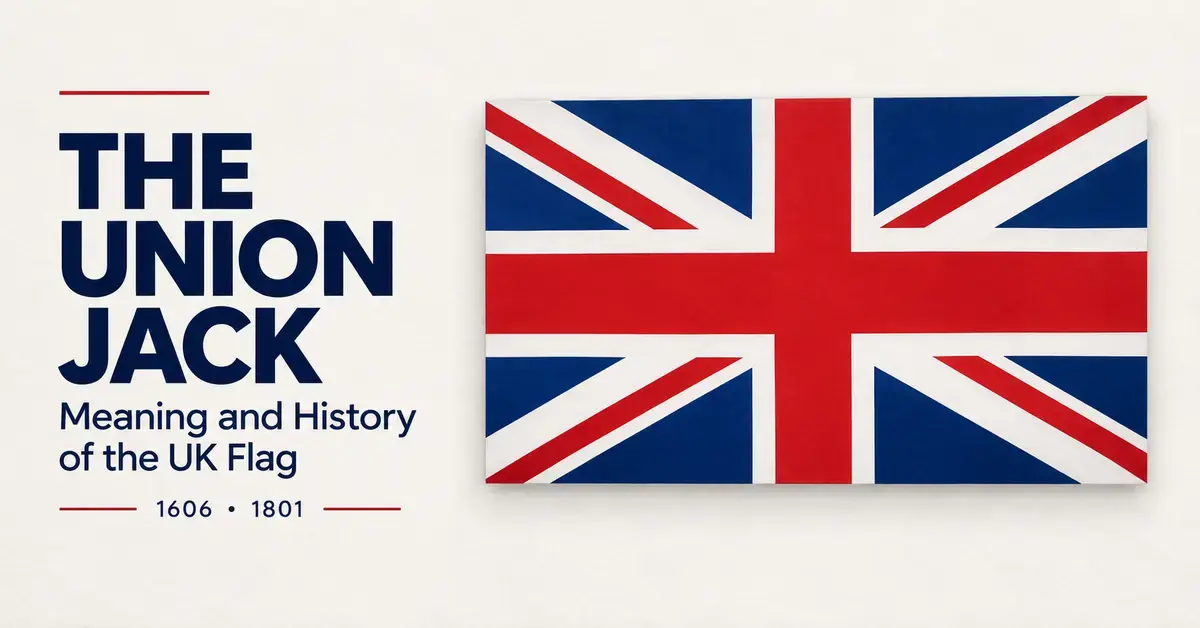
The Union Jack is the national flag of the United Kingdom, and its bold red, white and blue crosses are among the most recognised symbols in the world. Behind the familiar design lies a layered history: it is not one flag but three combined, built up over two centuries as England, Scotland and Ireland were joined under a single crown. This guide covers the Union Jack meaning and history: what the flag stands for, how its crosses came together in 1606 and 1801, why it is called a ‘jack’, and which other countries still carry it on their flags today.
Key Facts
- Formal name: Union Flag (commonly called the Union Jack)
- Represents: The United Kingdom — England, Scotland, Wales and Northern Ireland
- Design: Three combined crosses — St George (England), St Andrew (Scotland) and St Patrick (Ireland)
- First combined: 12 April 1606 (England and Scotland)
- Current design since: 1 January 1801 (addition of St Patrick’s cross)
- Colours: Red (Pantone 186 C), white and royal blue (Pantone 280 C), as recommended by the Flag Institute
- Proportions: 3:5 on land; 1:2 at sea
- Nation not shown: Wales, which was part of the Kingdom of England when the flag was designed
What is the Union Jack?
The Union Jack is the national flag of the United Kingdom of Great Britain and Northern Ireland — that is, of England, Scotland, Wales and Northern Ireland together. It is a combination flag, meaning it is built from the flags of more than one nation layered on top of one another rather than designed from scratch.
The flag has two correct names. Its formal name is the Union Flag, while Union Jack is the name most people use in everyday speech. Both are accepted today, a point we return to below. As a design it is one of the most studied and most copied among the country flags of the world, because so many other nations and territories once placed it on their own flags.
What does the Union Jack mean? The three crosses explained
The Union Jack’s meaning comes from combining the patron-saint crosses of three nations into one flag. Each element represents a kingdom that was joined to the British crown, so the flag is essentially a visual record of political unions. If you want the wider background on how crosses work as national symbols, see our overview of what flag colours and symbols mean.
The Three Crosses
| Cross | Nation | Design | Added to the flag |
|---|---|---|---|
| St George’s Cross | England | Upright red cross on white | Core element (before 1606) |
| St Andrew’s Cross (saltire) | Scotland | White diagonal cross on blue | 1606 |
| St Patrick’s Cross (saltire) | Ireland | Red diagonal cross on white | 1801 |
St George’s Cross (England)
St George’s Cross is the upright red cross on a white background — the vertical-and-horizontal cross you see running straight through the middle of the flag. St George is the patron saint of England, and this is the oldest component of the design, in use as an English flag long before the Union Jack existed.
St Andrew’s Cross (Scotland)
St Andrew’s Cross is the white diagonal cross, or saltire, on a blue background. A saltire is an X-shaped cross. St Andrew is the patron saint of Scotland, and his saltire forms the blue and white diagonals of the Union Jack. It was the first element added to England’s cross, in 1606.
St Patrick’s Cross (Ireland)
St Patrick’s Cross is the red diagonal saltire on white that was added for Ireland in 1801. It is counterchanged with Scotland’s white saltire — the two diagonal crosses are offset so that the white of St Andrew sits above the red of St Patrick on one side and below it on the other. This is why the diagonals look slightly lopsided rather than perfectly centred.
The St Patrick’s cross is the most debated element. Unlike the crosses of England and Scotland, it was never a widely used traditional flag of Ireland. The red saltire was drawn from the heraldry of the powerful Fitzgerald family and the Order of St Patrick (founded in 1783), and only became associated with the saint afterwards.
Why isn’t Wales on the Union Jack?
Wales is not shown on the Union Jack because, by the time the flag was designed, Wales was legally part of the Kingdom of England and so was already represented by St George’s Cross. Wales had been annexed to England centuries earlier, so when the crosses were combined there was no separate Welsh kingdom to add. This is why the red Welsh dragon — now a familiar national flag in its own right — does not appear on the UK flag.
The history of the UK flag: from 1606 to 1801
The UK flag was assembled in three stages that mirror the political unification of Britain and Ireland. Understanding the dates 1606, 1707 and 1801 is the clearest way to understand the flag.
1603–1606: the Union of the Crowns
The flag began with a shared monarch, not a shared country. In 1603, King James VI of Scotland also inherited the English and Irish thrones, becoming James I of England — a ‘union of the crowns’ in which the kingdoms stayed separate but shared one king. On 12 April 1606 a royal proclamation created the first combined flag, joining the crosses of St George and St Andrew, chiefly so that ships could display the new regal union at sea. On land, each nation kept its own flag.
1707: the Act of Union with Scotland
In 1707 the Acts of Union merged England and Scotland into a single state, the Kingdom of Great Britain, and the combined flag carried over as the flag of the new country. The design of the previous century — St George over St Andrew — was kept. (During the intervening decades the flag’s use had shifted more than once: Charles I restricted the combined crosses to royal and naval ships in 1634, and the flag fell out of use during the republican years before the monarchy was restored in 1660.)
1801: the Act of Union with Ireland
The flag reached its present form in 1801. A further Act of Union, effective 1 January 1801, merged the Kingdom of Ireland with Great Britain to create the United Kingdom. To mark this, the College of Arms added St Patrick’s red saltire, counterchanged with the Scottish saltire. The result is the three-cross design still flown today — unchanged in 1922 when most of Ireland left the union, and still carried over for Northern Ireland.
Why is it called the ‘Union Jack’?
The name comes from the sea: a ‘jack’ is a small flag flown from a short pole, the jackstaff, at the bow (front) of a ship. The nautical sense of the word dates to the 1630s. A ship’s jack indicated its nationality — useful when entering a foreign harbour — while the main national flag, the ensign, was flown at the stern. Because the union flag was flown as this bow jack on British vessels, it became known as the Union Jack.
You may have heard that ‘Union Jack’ is only correct at sea and that it should be called the ‘Union Flag’ on land. This is a relatively modern idea, and it is not the official position. The Admiralty used both names interchangeably from the 17th century onwards; an Admiralty circular in 1902 declared either name valid, and in 1908 a government minister told Parliament that ‘the Union Jack should be regarded as the National flag’. The Flag Institute, the UK’s national flag authority, confirms that either name is correct.
Colours, proportions and the right way up
The Union Jack is built from three colours and has a surprisingly precise geometry. The Flag Institute’s recommended colours are Pantone 280 C for the royal blue and Pantone 186 C for the red, with plain white — though these are guidance rather than a legally fixed standard, so shades vary between manufacturers.
The flag is made in two standard shapes. The proportion used on land is 3:5 (three units tall to five wide), while the longer 1:2 proportion developed in the 19th century for flags flown at sea. Neither is ‘wrong’; they simply suit different uses.
Because St Patrick’s and St Andrew’s saltires are counterchanged, the Union Jack is not symmetrical and has a correct way up. The broad white diagonal of St Andrew should be in the top-left corner, nearest the flagpole. Flying it the other way round is a well-known error, and historically an upside-down Union Jack has been used as a signal of distress.
Which flags feature the Union Jack?
Many flags still carry the Union Jack in their canton — the upper corner nearest the pole — as a legacy of the British Empire and Commonwealth. Several independent countries, especially in Oceania, keep it by choice. The table below shows the best-known national examples.
| Country / territory | How it uses the Union Jack | Current design |
|---|---|---|
| Australia | Union Jack canton on a blue field, with the Commonwealth Star and the Southern Cross | 1901 (standardised later) |
| New Zealand | Union Jack canton on a blue field, with four red Southern Cross stars | 1902 |
| Fiji | Union Jack canton on a light-blue field, with the national shield | 1970 (retained at independence) |
| Tuvalu | Union Jack canton on a light-blue field, with nine yellow stars | 1978 (restored 1997) |
| Cook Islands | Union Jack canton on a blue field, with a ring of 15 white stars | 1979 |
| Niue | Union Jack with added yellow stars, on a gold field | 1975 |
Beyond these, the Union Jack appears on the flags of many British Overseas Territories (such as Bermuda, the Cayman Islands and the Falkland Islands), on some sub-national flags such as the US state of Hawaii, and in countless regional and historical banners. For quick answers to questions like this, our flag FAQs page is a useful starting point.
Common mistakes and misconceptions
A few myths about the Union Jack come up again and again. Clearing them up is the fastest way to understand the flag correctly.
- ‘Union Jack is wrong on land.’ It is not. Both ‘Union Jack’ and ‘Union Flag’ are accepted names in all contexts, as confirmed by the Flag Institute.
- ‘The flag is symmetrical, so it can’t be upside down.’ It can. The counterchanged saltires give it a definite top and bottom; the wide white diagonal belongs uppermost at the hoist.
- ‘Wales was left off by mistake.’ No — Wales was legally part of the Kingdom of England when the flag was created, so it was already covered by St George’s Cross.
- ‘St Patrick’s cross is an ancient Irish flag.’ The red saltire was a heraldic device adopted for the 1801 union rather than a long-established national flag of Ireland.
Flags attract tidy stories that are not always accurate, which is why we verify every claim against primary sources — you can read more about that in our editorial policy and sources.
Sources
Frequently Asked Questions (FAQ)
Is it ‘Union Jack’ or ‘Union Flag’?
Both are correct. The formal name is the Union Flag and the popular name is the Union Jack. The idea that ‘Jack’ is reserved for use at sea is a modern notion, not an official rule; the UK’s Flag Institute accepts either name in any context.
What three crosses make up the Union Jack?
The flag combines St George’s Cross for England (an upright red cross on white), St Andrew’s Cross for Scotland (a white diagonal saltire on blue) and St Patrick’s Cross for Ireland (a red diagonal saltire on white). The English and Scottish crosses joined in 1606 and the Irish cross was added in 1801.
Why is Wales not on the UK flag?
Wales was already part of the Kingdom of England when the flag was designed, so it was represented by England’s St George’s Cross rather than by a separate emblem. That is why the Welsh dragon does not appear on the Union Jack.
Why is it called a ‘jack’?
A jack is a small flag flown at the bow of a ship from a short pole called a jackstaff, used to show the vessel’s nationality. Because the union flag was flown as this bow jack on British ships, it became known as the Union Jack.
Which way up does the Union Jack go?
The broad white diagonal stripe of St Andrew’s Cross should sit in the top corner nearest the flagpole. Because the flag is not symmetrical, flying it the other way up is a mistake and has historically signalled distress.
