

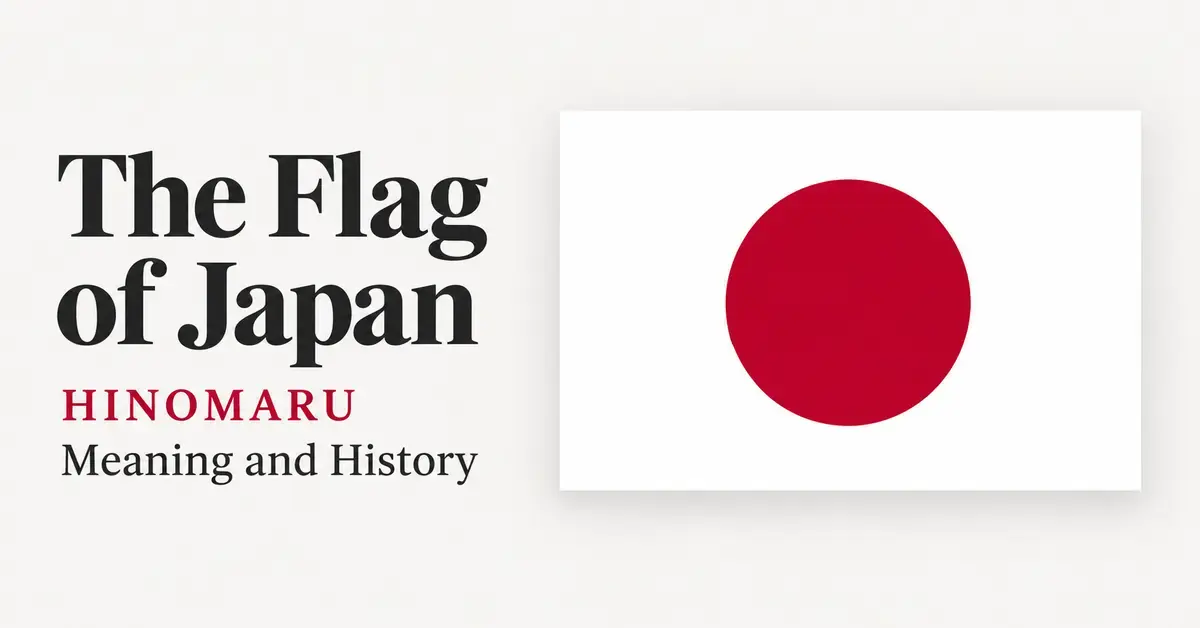
The flag of Japan is one of the most instantly recognisable national flags in the world: a single red disc centred on a plain white field. Known in Japanese as the Hinomaru (日の丸), meaning “circle of the sun,” the design turns Japan’s identity as the “Land of the Rising Sun” into a simple, striking image. This profile explains what the flag’s colours and sun disc commonly mean, where the names Hinomaru and Nisshoki come from, and how the flag travelled from early sun banners to full legal recognition in 1999.
Quick Facts
| Common name | Hinomaru (日の丸) — “circle of the sun” |
|---|---|
| Official name | Nisshoki (日章旗) — “sun-mark flag” |
| Design | A red disc centred on a plain white field |
| Proportions | 2:3 (width to length) |
| Disc diameter | Three-fifths (3/5) of the flag’s height |
| Colours | White field; crimson (beni-iro) disc |
| First official use | 1870 (Meiji merchant-ship proclamation) |
| Current legal basis | Act on National Flag and Anthem, effective 13 August 1999 |
What does the flag of Japan mean?
The flag of Japan represents the sun. The red disc in the centre stands for the sun, and the design ties directly to Japan’s traditional name, the “Land of the Rising Sun.” It is worth being precise about one point from the start: the 1999 law that governs the flag defines its design but does not assign official meanings to its colours. The explanations below are the common, widely accepted interpretations rather than legal definitions.
What does the red circle represent?
The red circle represents the sun. In most explanations it also carries ideas of warmth, energy and vitality, which is why it is often read as a symbol of the nation’s life and spirit. The link between the sun and Japan runs deep: the country’s name, 日本 (Nihon or Nippon), is written with the characters for “sun” and “origin,” literally “the sun’s origin” or “where the sun rises.”
What does the white background mean?
The white field is most commonly read as a symbol of purity, honesty and integrity. As with the red disc, this meaning is traditional rather than written into law. Practically, the white background also serves a clear visual purpose: it gives the red sun maximum contrast, so the flag reads cleanly from a distance and in almost any lighting. If you want a broader view of how colours work across the world’s flags, see our overview of what flag colours and symbols mean.
Hinomaru and Nisshoki: the two names explained
The flag has two Japanese names, and they are not interchangeable in tone. Hinomaru (日の丸) is the everyday, popular name and translates as “circle of the sun” or “sun disc.” It is descriptive — it simply names what you see. Nisshoki (日章旗) is the formal, official name and means roughly “flag bearing the mark of the sun” or “sun-mark flag.” When the 1999 law defines the national flag, it uses the word Nisshoki, while most Japanese people in daily conversation say Hinomaru.
Why a sun? Japan as the Land of the Rising Sun
The sun sits at the heart of Japanese identity, which is why it, rather than any other symbol, became the flag. From the perspective of mainland Asia, the sun appears to rise over Japan in the east, and the phrase “Land of the Rising Sun” has been attached to the country for well over a thousand years.
The sun also connects to Shinto belief. According to Japanese tradition, the sun goddess Amaterasu is regarded as a divine ancestor of Japan’s imperial line. Because of that association, the sun carries both national and religious weight. It is important to stay careful here: the Japanese government itself acknowledged in 1999 that the flag’s exact origins are not fully known, so the Amaterasu connection is best described as a traditional association with the sun motif rather than a documented, proven source of the flag’s design.
The history of the Japanese flag
The Hinomaru’s story stretches across more than a millennium, but it only became a single, legally fixed national flag in modern times. The timeline below follows the most reliable sources; note that some popular references disagree on exact dates, and the earliest examples are uncertain.
Early sun flags (before the 1600s)
Sun imagery on flags in Japan is very old. One often-cited example is a sun banner said to have been used at a New Year’s ceremony in the year 701, during the reign of Emperor Monmu, though that banner did not feature the familiar red circle. Flags showing a red disc on a light ground are generally thought to have appeared later, with the Genpei War of 1180–1185 frequently mentioned as an early period for the red-circle design. These early origins remain debated.
The 1854 maritime ensign
The design took a decisive step toward becoming a national symbol in the mid-19th century. As Japan reopened to foreign trade, the ruling Tokugawa shogunate needed a way to mark Japanese ships. In 1854 it declared the sun-disc flag the ensign to be flown by Japanese vessels, distinguishing them from foreign ships. This is the point at which the Hinomaru began to function as a stand-in for the country as a whole.
The 1870 proclamations
Under the new Meiji government, the flag received its first formal government recognition. In February 1870 (the third year of the Meiji era), a Council of State proclamation adopted the sun-disc flag as the national flag for merchant ships. A separate proclamation in 1870 set out the version used by the navy. The two decrees specified slightly different proportions and placement of the disc, which later led to a long-running question over which was the “official” design. During the brief period from 1870 to 1885, the Hinomaru functioned as the legal national flag.
From 1885 to the 1999 Act
From 1885 until 1999, Japanese law did not formally designate any specific flag as the national flag, even though the Hinomaru was used everywhere in practice as the de facto flag of the nation. That gap was finally closed on 13 August 1999, when the Act on National Flag and Anthem was promulgated and took effect. The law formally names the Nisshoki as the national flag and fixes its modern specifications — roughly 129 years after the 1870 proclamation first gave the design official status.
Design and specifications of the Hinomaru
The modern flag follows precise proportions set out in the 1999 law. The flag’s width-to-length ratio is 2:3, and the red disc is centred, with a diameter equal to three-fifths (3/5) of the flag’s height. In the earlier 1870 merchant-flag version the ratio was 7:10 and the disc sat very slightly toward the hoist (the edge nearest the flagpole); the 1999 specification uses the 2:3 ratio with the disc placed exactly in the centre.
On colour, the law describes the disc as crimson (beni-iro) on a white field but does not pin down an exact shade. A precise colour reference comes instead from a separate government (Ministry of Defense) specification, which defines the red using the Munsell value 5R 4/12 and the white as N9. In everyday digital reproductions the red is often shown as a deep red close to hex #BC002D, but because the statute itself does not fix a single code, you will see small variations between sources and manufacturers.
The Hinomaru vs. the Rising Sun Flag
The national flag of Japan is not the same as the Rising Sun Flag, and the two are frequently confused. The Hinomaru is the plain red disc on white described throughout this article. The Rising Sun Flag adds 16 red rays radiating outward from the sun and is a military design — historically a war flag, and today a service flag associated with Japan’s Self-Defense Forces, especially the Maritime Self-Defense Force. The comparison below sets out the key differences.
Comparison
| Feature | Hinomaru (national flag) | Rising Sun Flag |
|---|---|---|
| Design | Plain red disc on white | Red disc with 16 rays extending outward |
| Status | Official national flag of Japan | Military/service flag, not the national flag |
| Main use today | Government, citizens, all civilian contexts | Japan’s Self-Defense Forces (notably the Maritime Self-Defense Force) |
| Legal basis | Act on National Flag and Anthem (1999) | Defense service regulations |
Common mistakes and misconceptions
A few errors come up again and again when people describe the Japanese flag. Clearing them up helps you use and discuss the flag accurately.
- Confusing the Hinomaru with the Rising Sun Flag. The national flag has no rays. The rayed version is a separate military ensign and should not be called “the flag of Japan.”
- Treating the colour meanings as official. White for purity and red for the sun are widely accepted interpretations, but the 1999 law does not assign meanings to the colours. It is more accurate to say these meanings are “commonly” attached to the flag.
- Assuming a single exact red. The statute calls the disc crimson without fixing one colour code; the precise Munsell values come from a separate defense specification, so reproductions legitimately vary.
- Thinking the flag was legally defined long ago. Despite more than a century of use, the Hinomaru only became Japan’s statutory national flag in 1999.
- Stating the origin as certain. The deep origins of the sun-disc design are genuinely uncertain, and even the Japanese government has said so.
For quick answers to questions like these across many countries, you can also browse our flag FAQs, or start from the country flags of the world homepage to explore more flag profiles.
Sources
Frequently Asked Questions (FAQ)
What does the red circle on the Japanese flag mean?
The red circle represents the sun. It is commonly linked to ideas of warmth, energy and vitality, and it reflects Japan’s identity as the “Land of the Rising Sun.” These meanings are traditional interpretations; the 1999 law defines the flag’s design but not the symbolism of its colours.
What is the difference between the Hinomaru and the Rising Sun Flag?
The Hinomaru is the national flag: a plain red disc on a white field. The Rising Sun Flag adds 16 red rays around the disc and is a military design, used historically as a war flag and today as a service flag of Japan’s Self-Defense Forces. They are not interchangeable.
When did Japan officially adopt its flag?
The sun-disc flag was first given government recognition for merchant ships in 1870, under the Meiji government. However, it only became Japan’s statutory national flag with the Act on National Flag and Anthem, which took effect on 13 August 1999.
Why is Japan called the Land of the Rising Sun?
From mainland Asia, the sun appears to rise in the direction of Japan, in the east. Japan’s own name, 日本 (Nihon or Nippon), is written with the characters for “sun” and “origin,” meaning “where the sun rises,” which is the idea the flag’s sun disc captures.
What are the official colours of the Japanese flag?
The flag is a crimson (beni-iro) disc on a white field. The 1999 law does not fix an exact shade; a separate government specification defines the red as Munsell 5R 4/12 and the white as N9. Everyday reproductions often show the red near hex #BC002D, so minor variations are normal.
