

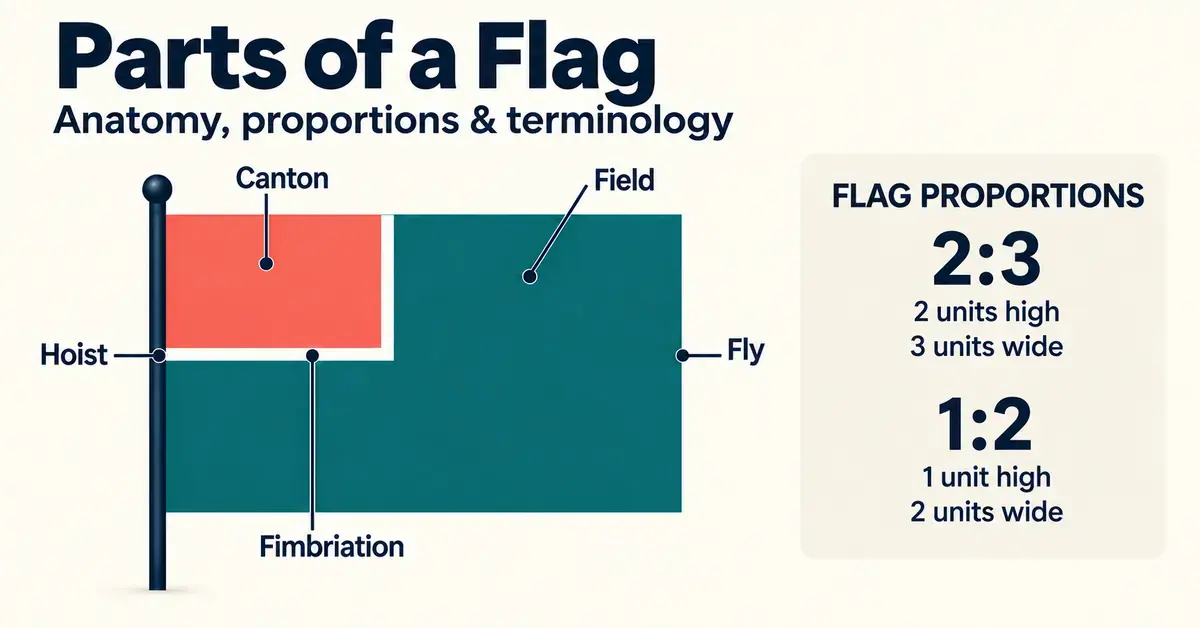
Every flag has a vocabulary of its own. The corner nearest the pole has a name, so does the free-flying edge, the little box in the top corner, the empty background and even the thin line that keeps two colours from touching. Learning these words — the parts of a flag — makes it far easier to read, describe and compare the flags of the world. This guide walks through the anatomy of a flag and its pole, explains how proportions such as 2:3 and 10:19 are written and what they mean, and finishes with a plain-language A–Z glossary of the terms used by flag scholars.
Key Points
- Hoist = the pole side of a flag (also means its height); fly = the free edge (also means its length).
- Canton = a box in a corner, usually upper hoist; field = the background; fimbriation = a thin dividing strip of colour.
- Ratios are written height:width — 2:3 is the most common national-flag shape, followed by 1:2.
- Only Switzerland and Vatican City fly square (1:1) flags; Nepal is the only non-rectangular national flag.
- Vexillology is the study of flags; its vocabulary lets any flag be described in words alone.
What are the parts of a flag?
The parts of a flag are the named areas of the cloth itself: the hoist, the fly, the canton, the field and features such as fimbriation. These terms describe where something sits on a flag, independent of its colours or symbols. Flag scholars — people who practise vexillology, the study of flags — use them so that any flag can be described precisely in words alone.
Hoist
The hoist is the half of a flag nearest the pole, and the word is also used as a synonym for a flag’s height or width measurement. The Government of Canada’s official flag glossary defines the hoist as “the half of a flag nearest to the halyard,” the halyard being the rope that raises it. When a flag is drawn, the hoist is conventionally shown on the left. Anything described as being “at the hoist” sits on the pole side.
Fly
The fly is the half of a flag farthest from the pole — the part that flaps freely in the wind — and, like hoist, it doubles as a word for the flag’s length. Because the fly end takes the most wind, it is usually the first part to fray. The upper and lower fly corners are sometimes called the second and fourth quarters of the flag.
Canton
The canton is a rectangular or square area placed in a corner of a flag, almost always the upper hoist (the top corner nearest the pole), which is considered the place of honour. The star-filled blue box on the flag of the United States is a canton; so is the Union Jack in the corner of several Commonwealth flags, where it is also called the “union.” If a canton carries another flag’s design, it signals a historical or political link.
Field (or ground)
The field is the background of a flag — the main surface on which any stripes, crosses or emblems are placed. A flag with a single colour and nothing else is said to have a “plain field.” When vexillologists describe a design, they usually name the field first and then list the charges (added symbols) placed on it.
Fimbriation
Fimbriation is a narrow strip of colour inserted to separate two other colours, or to divide a canton from the field. Its job is practical as much as decorative: it stops two dark or two clashing colours from sitting directly against each other. The thin white lines around the red cross on South Africa’s former flags, and the white edging of the cross on several Nordic flags, are examples of fimbriation.
Obverse and reverse
The obverse is the “front” of a flag — the side you see when the hoist is on your left — and the reverse is the back. On most flags the reverse is a mirror image of the obverse. A handful of flags, such as Paraguay’s, carry different emblems on each side, which is why the two sides are named.
The parts of a flagpole and its fittings
The hardware that flies a flag has its own set of names, and they appear often in official flag etiquette. Knowing them helps when reading instructions on how a flag should be raised, lowered or flown at half-mast.
- Flagpole (staff, flagstaff): the upright pole, of wood or metal, to which a flag is attached or from which it is hoisted.
- Finial: the decorative ornament — often a ball, spearhead or eagle — fixed to the very top of the pole.
- Halyard: the rope that raises and lowers the flag.
- Pulley (truck): the grooved wheel at the top of the pole that the halyard runs over.
- Sleeve (heading): a tube of fabric along the hoist edge through which the staff or halyard is threaded; some flags instead use a rope with a wooden toggle at the top and a loop at the bottom to clip onto the halyard.
How do flag proportions and ratios work?
A flag’s proportion, or ratio, is the relationship between its height and its width, written as two numbers separated by a colon. The ratio is what makes a flag look “right” at any size, from a desk flag to one flown over a stadium, because it fixes the shape no matter the actual measurements.
What does ratio notation like 2:3 mean?
Ratio notation gives height first and width second, so 2:3 means that for every 2 units of height the flag is 3 units wide. The units are arbitrary — centimetres, metres or any other measure — because only the proportion matters. A 2:3 flag could be 20 cm by 30 cm or 2 m by 3 m and still have exactly the same shape. The same logic applies to 1:2 (twice as wide as it is tall) and to the United States’ 10:19.
Which flag ratios are most common?
The most common national-flag ratio is 2:3, followed by 1:2, with only a small number of other shapes in use. The 2:3 rectangle is the default for a large share of the world’s flags, including France and many others. The 1:2 rectangle, longer and lower, is used by countries such as Canada and the United Kingdom. Everything else — squares and unusual proportions — makes up a small minority.
Flag Proportions Compared
| Ratio (height:width) | Shape | Example flags |
|---|---|---|
| 1:1 | Square | Switzerland, Vatican City |
| 13:15 | Nearly square | Belgium (constitutional version) |
| 2:3 | Most common rectangle | France, Germany, Italy |
| 28:37 | Slightly long rectangle | Denmark (Dannebrog) |
| 1:2 | Long, low rectangle | Canada, United Kingdom |
| 10:19 | Long rectangle (fixed by law) | United States |
| 11:28 | Longest official ratio | Qatar |
| Non-rectangular | Double pennant | Nepal |
Which flags have unusual proportions?
A few national flags break the usual rectangular mould entirely. The clearest examples are worth knowing because they come up again and again in flag trivia:
- Square flags (1:1): only two sovereign states fly a square national flag — Switzerland and Vatican City. Switzerland’s civil and state ensign used at sea is a separate 2:3 flag, so only the land flag is square.
- Non-rectangular: Nepal is the only sovereign state whose national flag is not a rectangle. It is made of two stacked pennant shapes, giving a double-pennon outline unlike any other.
- Extremely long: Qatar’s flag has an 11:28 ratio, recognised by Guinness World Records as the longest official aspect ratio of any national flag, and it is the only national flag whose width is more than twice its height.
- Odd but official: the United States uses 10:19; Belgium’s constitutional flag is close to square at 13:15 (though a 2:3 version is far more commonly flown); and Denmark’s Dannebrog is set at 28:37.
Common flag design terms
Beyond the physical parts, vexillology borrows a set of design words from heraldry — the older craft of coats of arms. These terms describe the shapes and symbols on a flag rather than the cloth itself.
- Charge: any emblem or figure placed on the field, such as a star, animal or coat of arms.
- Defacement: a neutral term for adding a symbol to an existing flag to distinguish it — for example, a British Blue Ensign “defaced” with a territory’s badge. The word carries no negative meaning in flag study.
- Tricolour: a flag of three equal bands of different colours; a bicolour has two. A flag of three stripes where the outer two share a colour is often called a triband.
- Pale and fess: a pale is a vertical band down the centre of a flag; a fess is the horizontal equivalent. Canada’s central panel is a well-known pale.
- Bend and saltire: a bend is a broad diagonal band (as on Trinidad and Tobago); a saltire is a diagonal cross from corner to corner (as on Scotland and Jamaica).
- Badge: a small emblem, often a shield or seal, used to personalise or deface a flag.
How do you describe a flag correctly?
Flags are described by naming the field and its divisions first, then the charges, using a fixed reading order so two people describe the same flag the same way. The conventions used by flag scholars are simple once you know them:
- Vertical stripes are read from the hoist (pole side) outward to the fly.
- Horizontal stripes are read from the top down.
- Fields divided into quarters are read clockwise, starting from the upper hoist canton.
Following this order means a description such as “a vertical tricolour of blue, white and red from the hoist” leaves no doubt about which colour sits where. If you want the meaning behind those colours and emblems rather than their position, see our overview of what flag colours and symbols mean.
A mini A–Z glossary of flag terms
This short glossary gathers the most useful words in one place. Each term is defined in plain language; the physical parts and fittings above are not repeated here.
- Badge: a small emblem added to personalise or deface a flag.
- Bend: a broad diagonal band across the field.
- Bicolour / Tricolour: a flag of two / three equal bands of colour.
- Canton: a rectangular area in a corner, usually the upper hoist.
- Charge: any symbol or figure placed on the field.
- Defacement: adding a symbol to an existing flag to tell it apart; a neutral term.
- Ensign: a flag based on the national flag but flown on ships.
- Fess: a horizontal band across the centre of the field.
- Field: the background of the flag.
- Fimbriation: a narrow strip of colour separating two other colours.
- Finial: the ornament at the top of the flagpole.
- Fly: the free edge of a flag, farthest from the pole; also its length.
- Halyard: the rope that raises and lowers a flag.
- Hoist: the pole side of a flag; also its height.
- Obverse / Reverse: the front and back of a flag.
- Pale: a vertical band down the centre of the field.
- Pennant / Pennon: a tapering or triangular flag.
- Saltire: a diagonal cross reaching corner to corner.
- Sleeve: the fabric tube on the hoist edge for the pole or halyard.
- Vexillology: the study of flags; a vexillographer designs them.
Common mistakes when describing flags
The most frequent errors come from mixing up similar-sounding terms or reading a ratio the wrong way round. Watching for a few traps keeps descriptions accurate:
- Reversing the ratio. 2:3 is height-to-width, not width-to-height. Reading it backwards turns a normal flag into a tall, narrow one.
- Confusing hoist and fly. The hoist is always the pole side; the fly is the loose edge. “Hoist” can also mean the height measurement, which trips up beginners.
- Calling every corner box a canton. A canton sits in a corner — conventionally the upper hoist. A central emblem is a charge, not a canton.
- Treating “defacement” as damage. In vexillology it simply means a distinguishing symbol was added; nothing is defaced in the everyday sense.
- Assuming both sides match. Most reverses mirror the obverse, but a few flags carry different designs on each side, so check before assuming.
Who uses flag terminology?
Flag terminology is used by designers, officials and enthusiasts whenever a flag must be described without a picture. Graphic designers and manufacturers rely on the exact ratio and the position of each charge to reproduce a flag at any size. Governments write the same terms into law — the official United States proportions of 10:19, for example, are fixed by executive order. Flag hobbyists and members of vexillological associations use the vocabulary to catalogue and discuss designs, and teachers use it to make the world’s flags easier to learn. If you enjoy these details, our collection of answers to common flag questions and the wider library of country flags of the world go further into history and meaning. Every figure in this guide is checked against official and vexillological sources, as explained in our editorial policy.
Sources
- Government of Canada (Canadian Heritage) — Glossary of flag-related terms
- Flags of the World — Vexillological terminology and glossary
- FIAV — International Federation of Vexillological Associations
- Guinness World Records — Longest national flag official aspect ratio (Qatar)
- U.S. Code, Title 4 §1 (flag of the United States; Executive Order 10834 proportions)
Frequently Asked Questions (FAQ)
What is the part of a flag nearest the pole called?
The half of a flag nearest the pole is the hoist. The word also doubles as a term for the flag’s height. The opposite, free-flying edge is called the fly.
What does a flag ratio like 2:3 mean?
A ratio of 2:3 means the flag is 2 units tall for every 3 units wide, giving a fixed shape at any size. Height is written first and width second, so 1:2 is twice as wide as it is tall.
What is the box in the corner of a flag called?
A rectangular or square area in the corner of a flag is called a canton, usually placed in the upper hoist corner, which is the place of honour. The blue star field on the United States flag is a canton.
Which country has the only non-rectangular national flag?
Nepal has the only non-rectangular national flag among sovereign states. It is formed of two stacked pennant shapes rather than a single rectangle. Switzerland and Vatican City are the only two with square flags.
What is fimbriation on a flag?
Fimbriation is a narrow strip of colour placed between two other colours, or between a canton and the field. It is often used to keep two dark or clashing colours from touching, such as the thin edging around a cross.
