

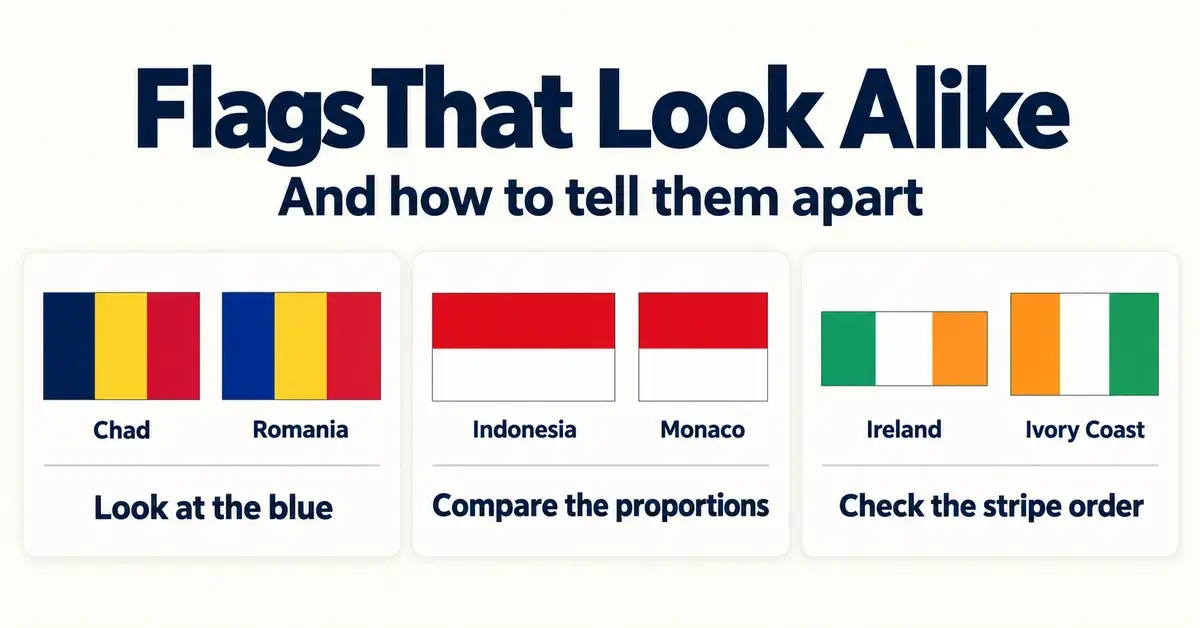
Dozens of national flags look so similar that even careful observers mix them up. Some pairs share the exact same colours in the exact same order and differ only in a shade of blue or the shape of the cloth; others are near-perfect mirror images. This guide walks through the flags that look alike and are most often confused with one another, explains why so many designs overlap, and gives you the single decisive detail that tells each pair apart. It is part of our wider reference on country flags of the world.
Key Points
- Chad & Romania are the closest match of any two national flags — identical blue-yellow-red verticals that differ only in the shade of blue.
- Indonesia vs Monaco comes down to shape: Indonesia’s flag is longer (2:3), Monaco’s is nearly square (4:5).
- Ireland vs Ivory Coast are mirror images — green at the pole means Ireland, orange at the pole means Ivory Coast.
- Netherlands, Luxembourg and Russia are all red-white-blue: a white top stripe means Russia; Luxembourg’s blue is lighter and its flag longer than the Netherlands’.
- Bahrain vs Qatar: count the serrated points (5 vs 9) and check the colour (red vs maroon).
- Slovenia vs Slovakia: a corner shield with a mountain and stars is Slovenia; a central shield with a double cross on hills is Slovakia.
Why do so many flags look alike?
Flags look alike mainly because many of them draw on shared colour families that carry cultural or political meaning across whole regions. When neighbouring or related nations reach for the same palette for the same reasons, the results end up looking remarkably similar. Three families explain a large share of the overlap, and colonial history explains much of the rest. For a broader primer on the palette, see our overview of what flag colours and symbols commonly mean.
Pan-Slavic colours (white, blue and red)
The white-blue-red combination spread across Slavic nations that looked to Russia as a cultural reference point, which is why Russia, Slovakia, Slovenia, Serbia, Croatia and the Czech Republic all share versions of it. The stripes are arranged differently from country to country, but the family resemblance is unmistakable.
Pan-Arab colours (red, white, black and green)
Pan-Arab flags reuse colours tied to historic Arab dynasties — black for the Abbasids, white for the Fatimids, green for the Umayyads and red for the Hashemites. Because the palette is inherited rather than invented for each state, many flags of the Arab world echo one another.
Pan-African colours
The red-black-green scheme was deliberately created in 1920 by Marcus Garvey’s Universal Negro Improvement Association as a symbol of unity for people of African descent, and green-yellow-red (the colours of Ethiopia, Africa’s oldest independent state) spread widely at independence. Many African flags therefore share a small set of colours.
Colonial and historical borrowing
Some resemblances are accidents of history. A country may remove an emblem from its flag and suddenly match a neighbour, or two unrelated states may land on the same simple tricolour independently. Those coincidences produce some of the hardest pairs to separate, which is where this guide becomes useful.
The flags most often confused — and how to tell them apart
Each pair below shares almost everything. The heading for each one points you straight to the detail that settles it. A quick note on terminology: the hoist is the side of a flag nearest the pole, the fly is the free edge, and a flag’s ratio (for example 2:3) is its height compared with its length.
Chad vs Romania — look at the shade of blue
Chad and Romania fly what is essentially the same flag: a vertical tricolour of blue, yellow and red in a 2:3 ratio. The only visible difference is the blue — Chad’s is a darker, indigo-leaning navy, while Romania’s is a brighter cobalt — and in practice the two are almost impossible to separate at a distance. The overlap became near-total in 1989, when Romania removed the socialist emblem from the centre of its flag after the fall of its communist government; Chad had used its plain tricolour since independence from France in 1959. Romania declined to change, and in 2004 Chad reportedly raised the duplication with the United Nations, which took no action. Both flags still fly today.
Indonesia vs Monaco — look at the shape
Indonesia and Monaco both use a simple horizontal bicolour of red over white, in the same colours, so the giveaway is the proportion of the cloth. Indonesia’s flag has a 2:3 ratio, making it noticeably longer than it is tall, while Monaco’s official 4:5 ratio is much closer to square. If the flag looks stout and almost square it is Monaco; if it looks longer and more rectangular it is Indonesia. (Watch out for Poland, too, which uses the same two colours in the reverse order — white over red.)
Ireland vs Ivory Coast — look at which colour touches the pole
Ireland and Ivory Coast are near mirror images: both are vertical tricolours of orange, white and green, but in opposite order. On Ireland’s flag the green stripe is at the hoist (the pole side) and orange is at the fly; on Ivory Coast’s flag orange is at the hoist and green is at the fly. The quickest test is to ask which colour sits against the pole — green means Ireland, orange means Ivory Coast. Ireland’s flag is also proportionally longer (1:2) than Ivory Coast’s (2:3). The colours mean different things, too: in Ireland they represent the Gaelic and nationalist tradition (green), the Protestant tradition (orange) and peace between them (white), while Ivory Coast reads them geographically as savanna (orange), forests (green) and unity (white).
Netherlands, Luxembourg and Russia — look at the top stripe and the blue
These three red-white-blue horizontal tricolours are the classic triple mix-up, and two separate clues separate them. First, check the top stripe: the Netherlands and Luxembourg both put red on top, whereas Russia puts white on top and red at the bottom, so a white top stripe means Russia. Second, to tell the Netherlands from Luxembourg, look at the blue and the length: Luxembourg’s blue (and red) are a lighter, sky-leaning tone and its flag is drawn longer, while the Dutch blue is a deeper cobalt and the flag is a standard 2:3. The difference is subtle enough that Luxembourg has at times debated switching to its alternative red-lion design partly to reduce confusion with the Dutch flag.
Bahrain vs Qatar — count the points and check the colour
Bahrain and Qatar both place a white band at the hoist, separated from a coloured field by a serrated (zigzag) line, so three details tell them apart. Bahrain’s field is a bright true red with five white points, said to represent the Five Pillars of Islam. Qatar’s field is a deep maroon with nine points, marking Qatar as the ninth of the reconciled Gulf emirates, and its flag is dramatically elongated (an 11:28 ratio) so it looks much longer and narrower than Bahrain’s 3:5. Qatar adopted the maroon shade in 1949 specifically to distinguish itself from Bahrain’s red.
Slovenia vs Slovakia — look at the emblem and where it sits
Slovenia and Slovakia are both white-blue-red horizontal tricolours carrying a shield near the hoist, so the emblem itself is the tell. Slovenia’s shield sits in the upper hoist corner, overlapping the white and blue stripes, and shows a single white mountain (Mount Triglav) with two wavy lines beneath it and three gold stars above. Slovakia’s shield sits lower, roughly at mid-height and shifted toward the hoist, and shows a silver double cross standing on three blue hills. In short: a small corner shield with a mountain and stars is Slovenia; a larger central shield with a double cross on hills is Slovakia.
Side-by-Side Comparison
| Flag pair | What they share | The detail that tells them apart |
|---|---|---|
| Chad & Romania | Vertical blue-yellow-red tricolour, 2:3 | Chad’s blue is a darker navy/indigo; Romania’s is a brighter cobalt |
| Indonesia & Monaco | Red over white, same colours | Indonesia is longer (2:3); Monaco is nearly square (4:5) |
| Ireland & Ivory Coast | Orange, white and green vertical bands | Hoist colour: green = Ireland, orange = Ivory Coast |
| Netherlands, Luxembourg & Russia | Red-white-blue horizontal stripes | White top stripe = Russia; Luxembourg’s blue is lighter and its flag longer than the Netherlands’ |
| Bahrain & Qatar | White hoist band + serrated line + coloured field | Bahrain: red, 5 points; Qatar: maroon, 9 points, much longer |
| Slovenia & Slovakia | White-blue-red tricolour with a shield near the hoist | Slovenia: corner shield, mountain + 3 stars; Slovakia: central shield, double cross on three hills |
Other flag pairs that confuse people
Beyond the headline six, several more pairs regularly trip people up. These are easier to separate once you know the one detail to look for.
- Norway vs Iceland: both are Nordic-cross flags in red, white and blue, but the colours are reversed. Norway has a red field with a blue cross outlined in white; Iceland has a blue field with a red cross outlined in white.
- Australia vs New Zealand: both are blue flags with the Union Jack in the upper hoist and the Southern Cross. New Zealand uses four red stars with white borders; Australia uses white stars, with more of them (the Southern Cross plus the large seven-pointed Commonwealth Star below the Union Jack).
- Senegal vs Mali: both are green-yellow-red vertical tricolours, but Senegal adds a green five-pointed star in the centre, while Mali’s centre band is plain.
How to tell similar flags apart: a quick method
The fastest way to identify a look-alike flag is to work through a short checklist rather than trusting your first impression. Run the clues in this order and most pairs resolve quickly.
- Stripe direction and order: are the bands horizontal or vertical, and which colour is on top or at the hoist? This alone separates the Netherlands from Russia, or Ireland from Ivory Coast.
- Emblems and symbols: a coat of arms, star, cross or crescent is usually the strongest single clue. Note both what it shows and where it sits.
- Shade: when colours and layout match, compare the exact tone — Chad’s navy against Romania’s cobalt, or Bahrain’s red against Qatar’s maroon.
- Proportion: a squarer or much longer shape can be the only difference, as with Indonesia and Monaco, or Bahrain and Qatar.
Common mistakes when identifying flags
The most common mistake is judging a flag by colour alone, which fails exactly on the hardest pairs because they share colours. A second frequent error is ignoring the hoist side: with mirror-image flags like Ireland and Ivory Coast, the colour nearest the pole is the whole answer, yet it is easy to overlook when a flag is shown flat. People also forget that proportion matters, so they treat Indonesia and Monaco as identical when the shape settles it. Finally, flag emoji are unreliable for close calls — each platform draws them slightly differently, and tiny distinctions in shade or emblem placement are often lost at emoji size. When precision matters, compare full-size official specifications rather than a phone’s rendering.
Which flags are the hardest to tell apart?
The hardest flags to tell apart are Chad and Romania, followed closely by Indonesia and Monaco. Those two pairs are the toughest because they are not merely similar but effectively identical in design: Chad and Romania differ only in a shade of blue that most people cannot judge without seeing the two side by side, and Indonesia and Monaco differ only in proportion. Every other famous look-alike — the red-white-blue tricolours, the Gulf serrated flags, the Slavic shield flags — carries at least one clear structural clue once you know to look for it. You will find more quick answers like this on our page of common questions about world flags.
All of the figures and histories above were checked against vexillological and reference sources rather than memory; you can read about how we research and verify flag facts if you want to know where our details come from.
Sources
- Flags of the World — Netherlands and Luxembourg (colour and proportion comparison)
- Flags of the World — Slovenia (emblem placement)
- Flags of the World — Qatar (maroon colour, nine points, 11:28 ratio)
- Flags of the World — Indonesia (design and 2:3 ratio)
- Flags of the World — FAQ on pan-Slavic, pan-Arab and pan-African colours
- Encyclopaedia Britannica — Flag of Slovenia
- LuxToday — Luxembourg flag meaning and the Dutch-flag confusion
- National Arms of Slovakia — double cross on three hills
Frequently Asked Questions (FAQ)
Are there any two national flags that are completely identical?
No two current national flags are officially identical, but Chad and Romania come closest. Both are vertical blue-yellow-red tricolours in the same proportions, and the only agreed difference is the shade of blue — darker on Chad’s flag, brighter on Romania’s. The distinction is so small that the two are often indistinguishable in photographs.
Why do Indonesia and Monaco have the same flag?
Indonesia and Monaco both use a red-over-white horizontal bicolour, but they arrived at it independently and for different reasons — Monaco’s colours come from the heraldry of the ruling Grimaldi family, while Indonesia’s red and white have long-standing national meaning. The flags differ only in proportion: Indonesia’s is longer (2:3) and Monaco’s is closer to square (4:5).
How can I tell Ireland’s flag from Ivory Coast’s flag?
Check which colour is next to the flagpole. Ireland’s flag has green at the hoist (pole side) and orange at the fly, while Ivory Coast’s has orange at the hoist and green at the fly — they are mirror images. Ireland’s flag is also proportionally longer than Ivory Coast’s.
What is the difference between the flags of Bahrain and Qatar?
Both have a white band at the hoist separated from a coloured field by a zigzag line, but Bahrain’s field is bright red with five points, while Qatar’s is deep maroon with nine points. Qatar’s flag is also much longer and narrower than Bahrain’s.
Why do so many flags share the same colours?
Many flags share colours because of regional colour families with shared meaning — pan-Slavic white, blue and red; pan-Arab red, white, black and green; and pan-African red, black, green and green-yellow-red. Colonial history and the reuse of simple tricolours add further overlap, which is why unrelated countries can end up with nearly matching flags.
