

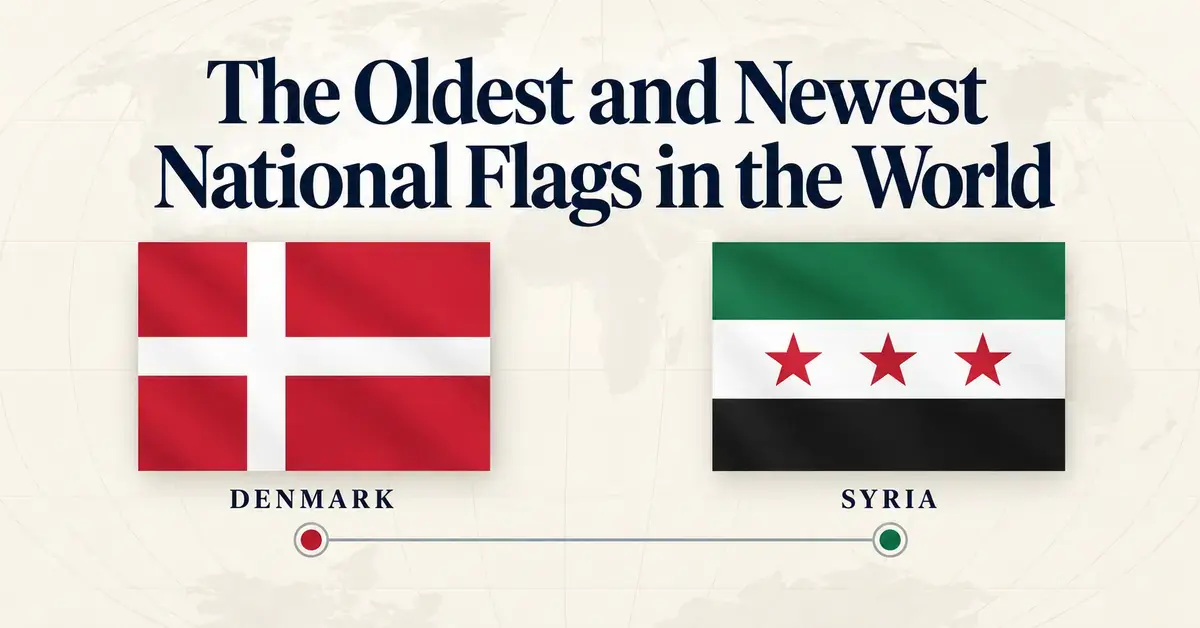
The oldest national flag still in use is Denmark’s Dannebrog, a white cross on red that has flown as a national symbol for roughly four centuries; the newest, as of October 2026, is Syria’s three-star green-white-black flag, raised after the fall of the Assad government in December 2024. Between those two extremes sit hundreds of flags of every age. This guide explains what “oldest” actually means, names the leading contenders, and tracks the most recent changes to the world’s national flags. Because flags are redesigned from time to time, the “newest” entries are reviewed periodically and dated so you can see exactly how current they are.
Key Points
- Oldest continuously used national flag: Denmark’s Dannebrog (white cross on red); continuous national use commonly counted from 1625.
- Oldest-flag legend vs fact: the 15 June 1219 sky-fall story is folklore; documented use dates to the 14th–17th centuries.
- Other old flags: Austria (seal of 1230), Latvia (chronicle c. 1279–1280), the Netherlands (Prince’s Flag c. 1572).
- Newest change (as of October 2026): Syria’s three-star flag, in official use after December 2024 and set in the March 2025 interim constitution.
- Newest country’s flag: South Sudan, adopted 9 July 2011.
- Recent redesigns: Kyrgyzstan (sun rays straightened, December 2023) and Mauritania (two red stripes added, 2017).
- Reviewed periodically — “newest” entries change whenever a country adopts a new flag.
What does it mean for a flag to be the “oldest”?
“Oldest” can mean two different things, and the answer changes depending on which you choose. Getting this distinction right is the single most important thing to understand about the topic.
- Oldest continuously used flag: the design that has served as a country’s national flag, without interruption, for the longest time. This is the measure most record-keepers use.
- Oldest design or first recorded use: the flag whose basic pattern was documented earliest, even if the country stopped using it for a period, changed its legal status, or only adopted it formally much later.
A flag can score highly on one measure and lower on the other. Latvia’s carmine-and-white banner, for example, is tied to a 13th-century chronicle reference, but the modern state only re-adopted it in 1990 — so its design is ancient while its continuous national use is recent. Keeping the two ideas separate avoids most of the arguments you will see online. If you want the background on what the colours and patterns themselves stand for, see our overview of what flag colours and symbols mean.
The oldest national flag in the world: Denmark’s Dannebrog
Denmark’s Dannebrog is widely recognised as the oldest continuously used national flag in the world. It is a white Scandinavian cross on a red field, and it is the model for every other Nordic cross flag.
The famous origin story is a legend, not documented history. Danish tradition holds that the flag fell from the sky on 15 June 1219 during a battle near Lyndanisse — present-day Tallinn, Estonia — turning the tide for King Valdemar II. That account first appears in writing only in the early 16th century, roughly three hundred years after the supposed event, so historians treat it as folklore rather than record.
The defensible history is later. A white-on-red cross is attested as a royal banner of Denmark from the 14th century, the design became established as a national flag in the early 16th century, and its status was formally recognised on 8 May 1625. That continuous national use — commonly counted from 1625 — is the basis for Denmark’s claim and for the Guinness World Records recognition it is often given. In short: the 1219 story is a well-loved legend; the roughly 400-year record of continuous use is the solid fact.
Other contenders for the oldest flag
Several countries hold flags with very old roots. None displaces Denmark on the continuous-use measure, but each has a strong historical claim.
Austria (recorded 1230)
Austria’s red-white-red triband is usually ranked second after Denmark. Its earliest documented use is traced to a seal dated 30 November 1230, and the colours derive from the arms of the medieval Babenberg dynasty. A popular legend links the design to Duke Leopold V at the Siege of Acre in 1191, but that story is not documented. The modern Austrian flag was re-established as the national flag after 1918 and again in 1945.
Latvia (chronicle reference c. 1279–1280)
Latvia’s carmine-white-carmine flag is tied to the Livonian Rhymed Chronicle, which describes soldiers from Cēsis fighting under a red banner with a white stripe around 1279–1280. That makes the design one of the oldest documented in Europe, but it is a reference to a military banner, not a record of continuous national use. Latvia adopted the flag for the modern state in 1918–1922 and re-adopted it on 27 February 1990 as independence from the Soviet Union approached.
The Netherlands (Prince’s Flag, c. 1572)
The Dutch flag descends from the Prinsenvlag (“Prince’s Flag”), an orange-white-blue tricolour linked to William of Orange and first mentioned around 1572 during the Dutch Revolt. A red-white-blue version was recorded from 1596, and red had displaced orange by about 1660. The red-white-blue flag was officially established on 14 February 1796 and confirmed by royal decree of Queen Wilhelmina in 1937. It is often called the oldest tricolour, and it influenced later tricolours worldwide.
A note on sub-national flags: Scotland’s Saltire and England’s St George’s Cross are older still as regional symbols, but they are not the flags of sovereign states, so they fall outside a strict ranking of national flags.
Comparison
| Flag | Key date | Why it matters |
|---|---|---|
| Denmark (Dannebrog) | Recognised 1625 (legend 1219) | Oldest continuously used national flag |
| Austria | Seal dated 1230 | Often ranked second oldest; Babenberg colours |
| Latvia | Chronicle c. 1279–1280; re-adopted 1990 | Ancient design, recent continuous use |
| Netherlands | Prince’s Flag c. 1572; official 1796 | Among the oldest tricolours |
| Myanmar | 21 October 2010 | New design under the 2010 Union Flag Law |
| South Sudan | 9 July 2011 | Newest sovereign country’s flag |
| Mauritania | 2017 (referendum 5 August) | Two red stripes added |
| Kyrgyzstan | December 2023 | Sun’s rays straightened |
| Syria | 2024–2025 | Most recent change as of October 2026 |
The newest national flags in the world
The newest national flags belong either to brand-new countries or to states that have recently replaced an old design. As of October 2026, the most recent change is Syria’s.
Syria (2024–2025): the most recent change
Syria’s three-star flag is the newest national flag in active use as of October 2026. After the Assad government fell on 8 December 2024, the green-white-black flag with three red stars — the country’s 1946 independence-era design — rapidly replaced the former two-star flag at home and at Syrian missions abroad. Its status was then set out in Article 6 of the interim constitution adopted on 13 March 2025, and the flag was raised at United Nations headquarters in New York on 25 April 2025. Because Syria’s political situation is still evolving, we review this entry periodically.
South Sudan (2011): the newest country’s flag
South Sudan has the newest flag tied to the founding of a new country. The world’s youngest widely recognised sovereign state adopted its black-red-green flag, with a blue triangle and gold star, on 9 July 2011, its independence day; the design had been used unofficially since the 2005 peace agreement.
Myanmar (2010)
Myanmar introduced its current flag — a yellow-green-red horizontal tricolour with a large white star — on 21 October 2010 under the 2010 Union Flag Law, replacing the socialist-era flag used since 1974. The change was set in motion by the 2008 constitution.
Recently changed and redesigned flags
Not every new flag comes from a new country. Several established states have tweaked or replaced their designs in recent years.
Kyrgyzstan (2023)
Kyrgyzstan straightened the sun’s rays on its flag in late 2023. Critics argued the wavy rays made the central sun look like a sunflower — a symbol of servility in Kyrgyz culture — so parliament passed the change on 20 December 2023 and President Sadyr Japarov signed it into law that month. The red field and 40-ray sun, representing the tribes united by the hero Manas, were kept.
Mauritania (2017)
Mauritania added two red stripes to its flag in 2017, placed along the top and bottom edges of the green field with its gold crescent and star. The change was approved in a national referendum on 5 August 2017 and formalised by parliament, which adopted the enabling bill on 12 October 2017. The red stripes are described as honouring the blood shed in the struggle for independence.
Reversals: Malawi and Libya
Some recent changes were reversals rather than new designs. Malawi adopted a redesigned flag in 2010, then reverted to its original 1964 independence flag in 2012. Libya dropped Muammar Gaddafi’s plain green flag during the 2011 uprising and restored the pre-1969 red-black-green design with a white crescent and star.
Why do countries change their flags?
Countries change flags for a handful of recurring reasons, and most recent changes fit one of them:
- New statehood: a new country needs a flag, as with South Sudan in 2011.
- Regime or political change: a new government signals a break with the past, as in Syria (2024–25), Libya (2011) and Myanmar (2010).
- Design refinement: small fixes to proportions, colours or emblems, as in Kyrgyzstan (2023).
- Symbolic additions: adding elements that carry new meaning, as with Mauritania’s red stripes (2017).
- Restoring an older flag: bringing back a historic design, as Malawi did in 2012.
Common mistakes and misconceptions
A few errors show up again and again in writing about old and new flags. Avoiding them keeps your facts straight.
- Treating the 1219 Dannebrog legend as fact. The sky-falling story is folklore; Denmark’s documented continuous use dates from around 1625.
- Confusing “oldest design” with “oldest in continuous use.” Latvia’s pattern is medieval, but its continuous national use is recent — both statements are true and they answer different questions.
- Counting sub-national flags. Scotland’s Saltire predates many national flags, but Scotland is not a sovereign state, so it is not a national flag in the strict sense.
- Assuming the “newest flag” is permanent. The newest-flag title changes whenever a country adopts a new design, which is why every entry here is dated and reviewed.
- Calling South Sudan’s flag the “newest” without qualification. It is the newest flag of a newly founded country, but more recent redesigns (Syria, Kyrgyzstan) came later.
Which is the most recently changed flag?
As of October 2026, the most recently changed national flag is Syria’s, whose three-star independence flag returned to official use after December 2024 and was defined in the March 2025 interim constitution. Before that, Kyrgyzstan’s straightened-sun redesign of December 2023 held the title. Because this can change at any time, we update this article when a country adopts a new flag; for more quick answers, see our flag FAQs, and you can read about how we verify and update facts in our editorial policy. You can also browse more about the study of country flags of the world on our home page.
Sources
- WorldAtlas — Which Is the Oldest Continuously Used National Flag?
- Flags of the World — History of the Flag of Denmark
- WorldAtlas — Flag of Austria
- The Flag Institute — Flag of Latvia
- DutchReview — The Dutch flag: red, white and blue
- Al Jazeera — Syria’s new three-starred flag raised at the UN
- NPR — Kyrgyzstan changes its flag
- Flags of the World — Mauritania
- Encyclopaedia Britannica — Flag of Myanmar
- WorldAtlas — The Newest Flags in the World
Frequently Asked Questions (FAQ)
Which is the oldest national flag in the world?
Denmark’s Dannebrog, a white cross on a red field. It is recognised as the oldest continuously used national flag, with continuous national use commonly counted from 1625. The well-known story that it fell from the sky in 1219 is a legend rather than documented history.
What is the newest national flag?
As of October 2026 it is Syria’s three-star green-white-black flag, which returned to official use after December 2024 and was defined in the interim constitution of March 2025. South Sudan, in 2011, has the newest flag tied to the founding of a new country.
Is Denmark’s flag really from 1219?
Not as documented fact. The 1219 battle legend appears in writing only in the early 1500s. The reliable record shows a white-on-red cross used by Danish kings from the 14th century and recognised as the national flag in 1625.
What is the most recently changed flag?
Syria’s, as of October 2026. Its independence-era flag replaced the previous design after the fall of the Assad government in December 2024. The most recent change before that was Kyrgyzstan’s, which straightened the rays of the sun on its flag in December 2023.
Why isn’t Scotland’s Saltire counted as one of the oldest flags?
Because Scotland is not a sovereign state. The Saltire is very old and widely flown, but a strict ranking of national flags covers the flags of independent countries, which is why Denmark’s Dannebrog leads instead.
