

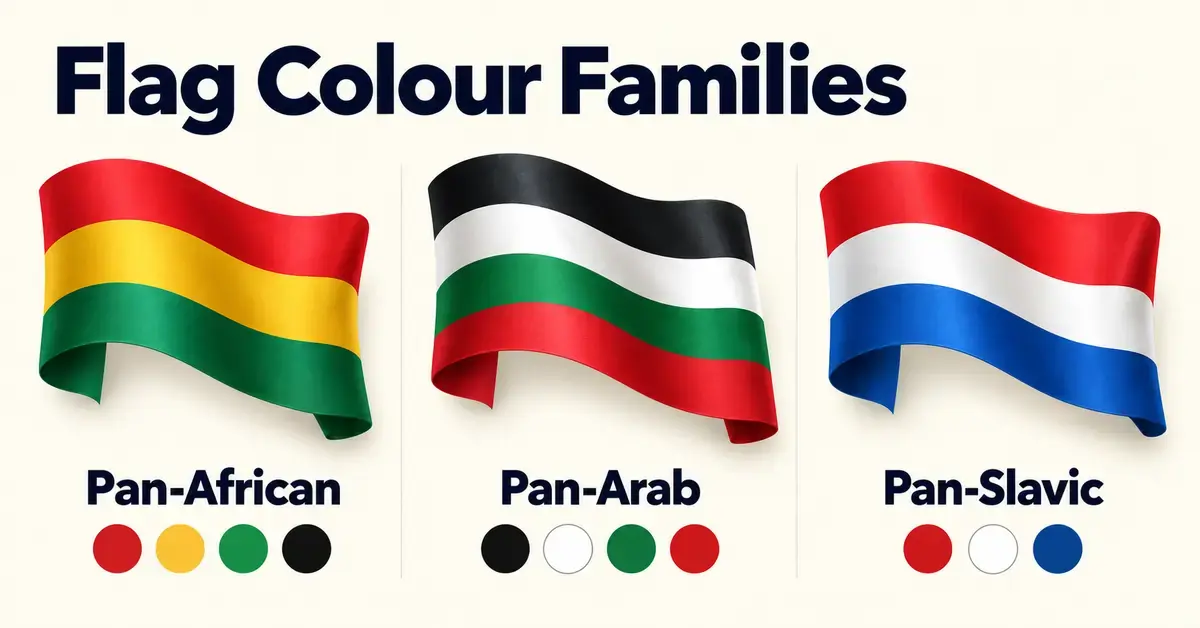
Line up the national flags of the world and you quickly notice that they are not a random scatter of colours. The same small palettes repeat again and again: red, gold and green across much of Africa; black, white, green and red across the Arab world; red, white and blue across the Slavic nations of Europe. These repeating palettes are called colour families, such as the Pan-African and Pan-Arab flag colours, and each one exists because a group of nations chose to signal a shared history, religion or political movement through the colours of their flags. This guide explains the three most important families — Pan-African, Pan-Arab and Pan-Slavic — where each set of colours came from, what the colours are commonly said to mean, and which flags belong to each group.
For the broader picture of how individual colours and symbols are read, see our overview of what flag colours and symbols mean. This article zooms in on one specific idea within that topic: why dozens of separate countries ended up using the same few colours.
Why do whole groups of flags share the same colours?
Flags repeat colours because colours carry shared meaning across borders. When a country wins independence or redesigns its flag, it rarely starts from a blank page. It often borrows a palette that already stands for something its people identify with — a continent, a culture, a faith, or a liberation movement. Adopting those colours is a quick, wordless way of saying “we belong to this larger story.”
That is why a colour family is a political and historical statement as much as a design choice. Red, gold and green on an African flag can announce solidarity with the rest of the continent; black, white, green and red on a Middle-Eastern flag can signal shared Arab identity; red, white and blue on a European flag can mark Slavic kinship. The colours themselves are ordinary, but the reason they keep appearing is what makes them a family.
Key Points
- Three big colour families explain most repeated flag palettes: Pan-African, Pan-Arab and Pan-Slavic.
- Pan-African has two sources — Ethiopia’s green, gold and red, and Marcus Garvey’s red, black and green (1920).
- Pan-Arab is black, white, green and red, first combined on the 1916 Arab Revolt flag; a red-white-black subset came from Egypt’s 1952 revolution.
- Pan-Slavic is red, white and blue, endorsed at the 1848 Prague Slavic Congress and drawn from the Russian tricolour.
- Colour meanings vary by country — the readings here are common interpretations, not a universal code.
What are the Pan-African colours?
There is no single set of Pan-African colours — there are two, and they come from different sources. One is the green, gold (yellow) and red of Ethiopia; the other is the red, black and green introduced by Marcus Garvey in 1920. Both are genuinely “Pan-African,” and some flags blend elements of both, which is why the term can be confusing.
The Ethiopian set: green, gold and red
The green-yellow-red palette comes from Ethiopia, the one African state that kept its independence through the colonial era apart from a brief Italian occupation. Ethiopia established an official flag in these three colours in the late 19th century, and because the country became a symbol of African resilience, newly independent nations adopted its colours as a mark of solidarity. Ghana, which in 1957 became the first sub-Saharan colony to gain independence, was the first to follow — its red, gold and green flag uses Ethiopia’s colours in a different order, with a black star added in the centre.
The Garvey set: red, black and green
The red-black-green palette comes from the Pan-African flag designed under the Jamaican-born activist Marcus Garvey. It was formally adopted at the 1920 convention of the Universal Negro Improvement Association (UNIA) in New York, through article 39 of the Declaration of the Rights of the Negro Peoples of the World on 13 August 1920. It was created to represent people of African descent everywhere, not one country, and from the 1960s it was taken up again as the Black Liberation Flag. Importantly, this red-black-green set is not the same as the Rastafari colours, which are the Ethiopian green, gold and red.
What the Pan-African colours are commonly said to mean
Colour meanings vary by source and by country, so these are widely cited interpretations rather than official definitions:
- Red — the blood and sacrifice of those who fought against slavery and colonial rule.
- Black — the people of Africa and the African diaspora.
- Green — the land, its forests and its fertility.
- Gold or yellow — the continent’s mineral wealth; on some flags it is also read as the sun.
Because different countries explain their own colours differently, we treat these as common readings rather than a universal code — a point of neutrality set out in our editorial policy.
Which flags use the Pan-African colours
The Ethiopian green-gold-red set appears on the flags of Ethiopia, Ghana, Senegal, Mali, Guinea, Cameroon, Benin, Togo, Burkina Faso, Guinea-Bissau and São Tomé and Príncipe, among others. The Garvey-influenced use of black, together with red and green, appears on flags such as Kenya, Malawi, South Sudan, Zimbabwe and Mozambique. Many African flags combine these ideas, which is why black, red, green and gold feel instantly “African” even on flags you have never seen before. For the continent-wide picture, see our guide to country flags of the world.
What are the Pan-Arab colours?
The Pan-Arab colours are black, white, green and red, and they appear together or in part on most flags of the Arab world. According to the newspaper The National, 10 of the 22 members of the Arab League use all four colours, and most of the rest use at least one of them. The palette is a visual shorthand for a shared Arab and Islamic heritage.
Where the four Pan-Arab colours come from
The origin of the four colours is debated, and two explanations are repeated most often. The first is poetic: a 14th-century verse by the Arab poet Safi al-Din al-Hilli pairs white with deeds, black with battles, green with fields and red with swords. The second is dynastic: each colour is linked to a period of Arab and Islamic history — black for the Rashidun and Abbasid caliphates, white for the Umayyads, green for the Fatimids and early Islam, and red for the Hashemites. Both are best understood as popular explanations rather than documented, settled origins; vexillology references such as Flags of the World present them as competing theories.
The Arab Revolt flag and the Arab Liberation subset
The four colours were first combined on a single flag in 1916, on the flag of the Arab Revolt against the Ottoman Empire — black, green and white horizontal stripes with a red triangle at the hoist. Modern flags including those of Jordan, Palestine, Kuwait and Sudan descend directly from it. In the 1950s a narrower set emerged: the red-white-black “Arab Liberation” colours, launched by Egypt’s 1952 revolution, which kept green only as a minor element or dropped it from the main stripes. This subset is why some Arab flags — Egypt, Syria, Iraq, Yemen — show only red, white and black bands.
What the Pan-Arab colours are commonly said to mean
As with the Pan-African set, readings differ by source. A frequently quoted interpretation runs as follows:
- Black — past centuries of oppression and the battles of Arab history.
- White — peace, a bright future and, in older readings, Arab generosity.
- Green — Islam and the fertility of Arab lands.
- Red — the blood and sacrifice of those who fought for liberation.
Which flags use the Pan-Arab colours
Flags using all four colours include Jordan, Palestine, Kuwait, Sudan, the United Arab Emirates and the Sahrawi Arab Democratic Republic (Western Sahara). Flags using the red-white-black Arab Liberation subset include Egypt, Syria, Iraq and Yemen. A few Arab states, such as Qatar and Bahrain, stand apart with maroon-and-white designs rooted in local tradition rather than the Pan-Arab palette.
What are the Pan-Slavic colours?
The Pan-Slavic colours are red, white and blue, and they appear across the flags of the Slavic nations of central and eastern Europe. They were formally endorsed at the Pan-Slavic Congress held in Prague in June 1848, which drew on the symbolism of the Russian white-blue-red tricolour. The aim was to give the Slavic peoples — then spread across several empires — a shared visual identity.
The 1848 Prague Slavic Congress
The congress, organised by the Czech historian František Palacký, brought together delegates from across the Slavic lands during the revolutionary wave of 1848. It selected red, white and blue as common colours, reportedly inspired by the Russian flag. It is worth being precise here: several Slavic nations were already using some combination of these three colours before 1848, so the congress is best seen as the moment the palette was formally adopted as a shared symbol rather than the moment it was invented.
What the Pan-Slavic colours are commonly said to mean
Unlike the Pan-African and Pan-Arab sets, the Pan-Slavic colours are usually explained by kinship rather than a fixed meaning for each colour. The three colours together signalled Slavic solidarity; individual nations then attached their own readings, often linking white to peace, blue to loyalty or the sky, and red to the blood of patriots. Because each country frames its own flag differently, there is no single agreed meaning for the set.
Which flags use the Pan-Slavic colours
Red, white and blue in various arrangements appear on the flags of Russia, Serbia, Slovakia, Slovenia, Croatia and the Czech Republic (whose flag adds a blue triangle to a white-over-red field). Their close resemblance is exactly why these flags are so often mixed up — the shared palette is doing its job of signalling a common Slavic identity.
Pan-African, Pan-Arab and Pan-Slavic colours compared
The three families are easiest to keep straight when you see their colours, origins and example flags side by side. The table below summarises the key differences.
Colour Family Comparison
| Family | Core colours | Origin | Example flags |
|---|---|---|---|
| Pan-African (Ethiopian set) | Green, gold/yellow, red | Flag of Ethiopia; spread after independence, from Ghana (1957) | Ethiopia, Ghana, Senegal, Mali, Cameroon, Guinea |
| Pan-African (Garvey set) | Red, black, green | UNIA flag adopted 13 Aug 1920 under Marcus Garvey | Kenya, Malawi, South Sudan, Zimbabwe, Mozambique |
| Pan-Arab (full set) | Black, white, green, red | Combined on the 1916 Arab Revolt flag | Jordan, Palestine, Kuwait, Sudan, UAE |
| Pan-Arab (Arab Liberation subset) | Red, white, black | Egypt’s 1952 revolution | Egypt, Syria, Iraq, Yemen |
| Pan-Slavic | Red, white, blue | Endorsed at the 1848 Prague Slavic Congress | Russia, Serbia, Slovakia, Slovenia, Croatia, Czechia |
Common mistakes and points of confusion
Colour families are intuitive, but a few recurring errors trip people up. Knowing them makes any flag easier to read.
- Treating “Pan-African” as one palette. There are two: the Ethiopian green-gold-red and the Garvey red-black-green. A flag can draw on either, or both.
- Confusing the Rastafari and Garvey colours. The Rastafari colours are the Ethiopian green, gold and red; the Garvey Pan-African flag is red, black and green. They look similar but come from different sources.
- Assuming shared colours mean a shared design. Jordan, Sudan and Palestine share the Pan-Arab palette yet are distinct flags. A family is about colours, not layout.
- Reading the colour meanings as fixed rules. Each country explains its own colours, so the meanings above are common interpretations, not a universal legend.
- Expecting every flag in a region to belong to the family. Qatar and Bahrain in the Arab world, and non-Slavic neighbours in Europe, show why region alone does not decide a flag’s family.
How can you tell which colour family a flag belongs to?
Start with the palette, then confirm with the region. Red, gold and green (or red, black and green) on an African flag points to the Pan-African family. Black, white, green and red — or just red, white and black — on a Middle-Eastern or North-African flag points to the Pan-Arab family. Red, white and blue on a central or eastern European flag points to the Pan-Slavic family. The palette narrows it down; the country’s location and history confirm it. You will find more quick identifications in our common questions about world flags.
Sources
- The National — Why are so many Arab flags red, green, black and white?
- Flags of the World — Pan-Arab Colours
- Encyclopaedia Britannica — Flag of Jordan
- Encyclopaedia Britannica — Arab Revolt Flag
- Encyclopaedia Britannica — Flag of Russia
- WorldAtlas — What Are the Pan-Slavic Colors?
- Permanent Mission of Ghana to the UN — Ghana Flag
- CIA World Factbook — Ethiopia (flag description)
Frequently Asked Questions (FAQ)
What are the three main flag colour families?
They are the Pan-African colours (red, gold and green, or red, black and green), the Pan-Arab colours (black, white, green and red) and the Pan-Slavic colours (red, white and blue). Each marks a shared history or identity across a group of nations.
Why do so many African flags use red, gold and green?
Those are the colours of Ethiopia, the African state that stayed independent through the colonial era. Newly independent countries adopted them as a symbol of African solidarity, beginning with Ghana in 1957.
Are the Rastafari colours the same as the Pan-African colours?
Partly. The Rastafari colours are Ethiopia’s green, gold and red, which are one version of the Pan-African colours. They are not the same as Marcus Garvey’s red, black and green Pan-African flag of 1920.
Why do so many Arab flags look alike?
Most draw on the Pan-Arab colours — black, white, green and red — first combined on the 1916 Arab Revolt flag. Sharing the palette signals a common Arab and Islamic heritage, even though each flag’s layout differs.
Which countries use the Pan-Slavic colours?
Red, white and blue appear, in different arrangements, on the flags of Russia, Serbia, Slovakia, Slovenia, Croatia and the Czech Republic, reflecting their shared Slavic identity.
