

An upside-down flag — one flown with its top edge at the bottom — is most widely understood as a signal of dire distress: a sign that the person or place displaying it faces extreme danger to life or property. The same gesture has a second life as a form of political protest, and the two meanings are often confused with each other and with a flag flown at half-mast. This guide explains where the distress meaning comes from, what the law actually says, how practice at sea has changed, and why turning a flag over says almost nothing on the many designs that look identical either way up.
Key Points
- Core meaning: a flag flown “union down” is a signal of dire distress — extreme danger to life or property.
- Second meaning: in civilian use, a widely understood symbol of political protest or alarm.
- The written rule: US Flag Code, 4 U.S.C. §8(a) — advisory etiquette, with no penalty for civilians.
- Not illegal: inverting your own flag is protected expression in the US (Spence v. Washington, 1974).
- Not a sea signal today: the inverted ensign is not in international or US inland navigation rules.
- Design matters: symmetric flags (Japan, Switzerland) look identical upside down, so the signal does nothing.
What does an upside-down flag mean?
An upside-down flag means its displayer is in serious trouble and wants that understood at a glance. The core idea is an emergency — a threat to life or property so pressing that normal etiquette is deliberately set aside to attract attention. In everyday use the same image also carries a message of protest, grief or alarm about a cause, which borrows the emotional force of the original distress meaning.
To invert a flag correctly you flip it top-to-bottom so that the union — the canton, the small rectangle in the upper corner nearest the flagpole, such as the blue star field on the United States flag — ends up at the bottom. This is why the rule is written as flying the flag “union down.” If you simply turn a flag so the back faces front, that is a different (and generally meaningless) mistake. Understanding the parts of a flag, especially the hoist and the canton, makes it clear why “union down” is the precise, intended signal and not just an accident.
What the US Flag Code says about flying a flag upside down
The clearest written rule anywhere sits in the United States Flag Code. Section 8(a) of Title 4 of the U.S. Code states:
“The flag should never be displayed with the union down, except as a signal of dire distress in instances of extreme danger to life or property.”
That single sentence is the origin of the whole idea for most English-speaking readers. It does two things at once: it tells people not to fly the flag union-down in normal circumstances, and it carves out the one situation where doing so is accepted — a genuine, extreme emergency. The code applies to the United States flag and is the reference point many other countries’ etiquette guides echo.
Is it illegal to fly the flag upside down?
No. The US Flag Code is advisory, not criminal — it sets out etiquette and contains no penalty for civilians who ignore it. Beyond that, displaying a flag upside down as a political statement is protected expression. In Spence v. Washington (1974), the Supreme Court sided with a student who had hung a privately owned flag upside down, with a peace symbol taped to it, from his Seattle apartment window to protest the 1970 invasion of Cambodia and the deaths at Kent State University. The Court reversed his conviction, treating the display as symbolic speech, and the case produced the “Spence test” courts still use to decide when conduct counts as expression. In short: flying your own flag upside down may be considered disrespectful by many, but it is not a crime.
Is an upside-down flag a real distress signal at sea?
Not under today’s rules. The popular belief that an inverted flag is a recognised maritime distress signal is largely a myth — or, at best, a description of an informal practice that fell out of use well over a century ago. Flag historians note that turning an ensign union-down was never a formal, universally agreed signal: a British draft of distress and pilotage signals had already dropped it by 1872, with the note that “the Ensign, Union down, has been advisedly omitted.”
Crucially, neither the international rules of the road (the collision-avoidance regulations known as COLREGs) nor US inland navigation rules list the inverted ensign among their official distress signals. The US Coast Guard actively discourages relying on it, because a vessel from another country may simply not recognise what you mean — and on a symmetrical ensign, nobody can tell it is upside down at all. For a flag to serve as a distress signal on the water, everyone needs to read it the same way, and the inverted flag fails that test.
Modern distress signals that actually count
International regulations recognise a specific set of distress signals, used together or in sequence, rather than an upside-down flag:
- Radio: a spoken Mayday call on VHF channel 16, or the historic SOS in Morse code.
- Code flags: the two-flag hoist “NC” from the International Code of Signals, meaning “I am in distress and require immediate assistance.”
- Visual shape: a square flag flown together with a ball (or anything resembling a ball) above or below it.
- Pyrotechnics: red hand-held flares, red parachute rockets and orange smoke.
- Electronic beacons: an EPIRB (Emergency Position-Indicating Radio Beacon) that transmits your position to rescue services.
- Manual: slowly raising and lowering outstretched arms on each side.
Distress Signals at a Glance
| Signal | How it works | Officially recognised? |
|---|---|---|
| Mayday / SOS | Spoken radio call on VHF ch. 16, or Morse code | Yes — standard international distress call |
| “NC” code flags | Two-flag hoist: “I am in distress and require immediate assistance” | Yes — International Code of Signals |
| Square flag + ball | A square flag with a ball-shaped object above or below | Yes — listed visual distress signal |
| Red flares / orange smoke | Hand flares, parachute rockets, smoke canisters | Yes — pyrotechnic distress signals |
| EPIRB beacon | Transmits position automatically to rescue services | Yes — modern electronic signal |
| Flag flown upside down | Ensign hoisted “union down” | No — informal only; not in current rules |
The upside-down flag as political protest
As a protest symbol, an upside-down flag reframes the “dire distress” idea at national scale: the country itself, the protester argues, is in grave danger. Because the gesture is instantly legible and emotionally charged, it has been used across the political spectrum — by anti-war demonstrators, by people angry at election results, by campaigners on issues from the environment to civil liberties. The specific grievance changes with who is flying it; the underlying message is always “something is badly wrong.”
This is where confusion sets in. Supporters read an inverted flag as heartfelt alarm and legitimate dissent; critics read it as disrespect to a national symbol. Both reactions are about interpretation, not law — and, as noted above, the display is constitutionally protected in the United States. Our aim here is descriptive: the inverted flag is a recognised rhetorical device for signalling emergency, and reasonable people disagree about when it is appropriate.
Do other countries treat the upside-down flag the same way?
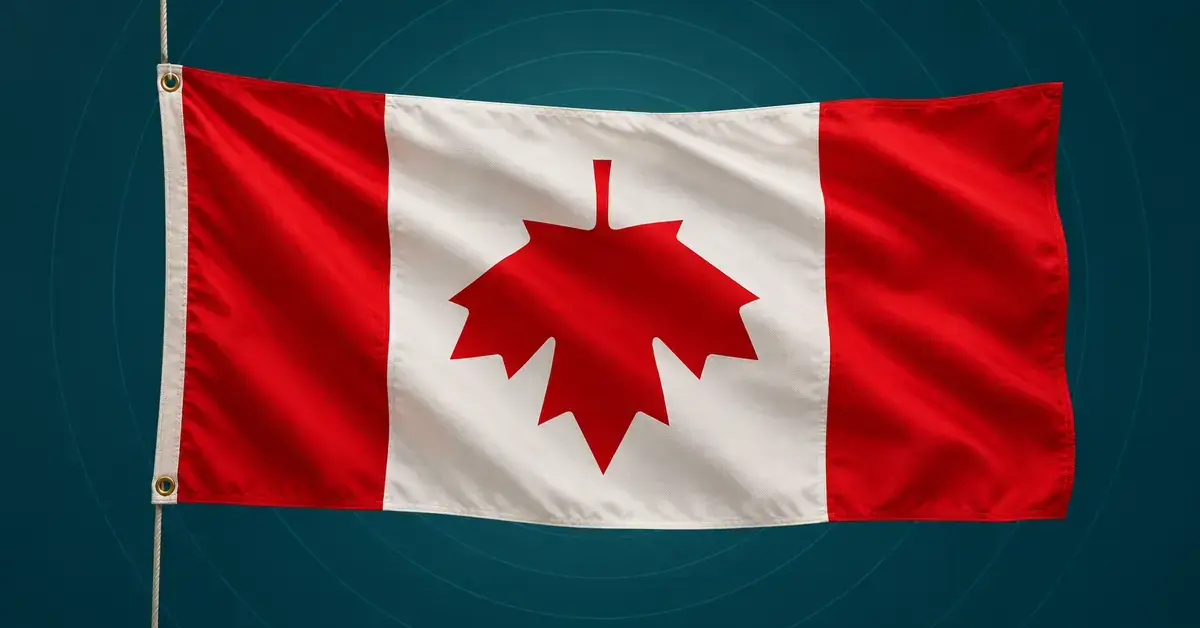
The distress-and-disrespect reading travels well beyond the United States, but the legal backing is usually weaker. In Canada, there are no laws dictating how the Maple Leaf must be treated; the federal government publishes etiquette — a set of dos and don’ts for preserving the flag’s dignity — rather than binding rules. An inverted Canadian flag is therefore not illegal, but it is widely read either as poor etiquette or, in a real emergency, as a cry for help, mirroring the maritime idea. You can read more about respectful display in our guide to Canadian flag etiquette.
The United Kingdom and most other nations have no statute on inverting the flag either; the convention is cultural and inherited largely from the same seafaring tradition. In practice, across countries, the meaning tracks two things: whether the design even looks different upside down, and whether onlookers are primed to read it as distress or as protest.
Which flags look the same upside down?
On many flags, turning them over changes nothing visible — which is exactly why the inverted-flag signal only works on asymmetric designs. Flags that are rotationally symmetric read identically either way up, so an upside-down version carries no message at all. Well-known examples include:
- Japan — a centred red disc on white.
- Switzerland — a centred cross.
- Austria and Latvia — symmetrical horizontal bands (red-white-red and red-white-red style arrangements) that mirror top to bottom.
A related quirk is that inverting one flag can accidentally produce another. Turn Poland (white over red) upside down and you get red over white — very close to the flag of Indonesia, give or take the proportions. The resemblance is coincidental, with no shared history, but it shows how fragile the “upside-down” signal is when a design is nearly symmetrical. These look-alike and mirror-image puzzles are a favourite corner of vexillology, the study of flags, and we cover more pairings in our piece on flags that look alike.
Common mistakes and misconceptions
A few errors come up again and again around the upside-down flag:
- Confusing it with half-mast. An inverted flag signals emergency or protest; a flag lowered to half-mast signals mourning. They are different gestures with different meanings — don’t read one as the other.
- Assuming it is illegal. In the US, Canada and the UK, inverting your own flag breaks etiquette, not the law.
- Treating it as an official sea signal. Modern international and US navigation rules do not list the inverted ensign; use a Mayday call, flares or the “NC” hoist instead.
- Flying it upside down by accident. On a complex flag it is easy to hoist union-down without noticing — check that the canton sits in the top corner nearest the pole.
- Expecting the signal to work on any flag. On symmetric designs like Japan’s or Switzerland’s, “upside down” is invisible and communicates nothing.
Sources
Frequently Asked Questions (FAQ)
What does it mean when a flag is upside down?
It is traditionally a signal of dire distress — a warning that the person or place displaying it faces extreme danger to life or property. In modern civilian use it is also a form of political protest, signalling that the protester believes the nation is in serious trouble.
Is flying the flag upside down illegal?
No. In the United States, Canada and the United Kingdom there is no criminal penalty for inverting your own flag. The US Flag Code is advisory etiquette, and displaying a flag upside down as a protest is protected expression under the First Amendment.
Is an upside-down flag a recognised distress signal at sea?
Not today. It was only ever an informal practice and is not listed in the international or US inland navigation rules. Official distress signals include a Mayday radio call, the “NC” code-flag hoist, red flares, orange smoke and an EPIRB beacon.
What is the difference between an upside-down flag and a flag at half-mast?
An upside-down flag signals emergency or protest, while a flag flown at half-mast signals mourning or respect after a death. They are separate conventions and should not be confused.
Why do some flags look the same upside down?
Because they are rotationally symmetric. Designs like Japan’s centred red disc or Switzerland’s centred cross look identical either way up, so inverting them sends no signal. The upside-down meaning only works on asymmetric flags such as the United States’ Stars and Stripes.
