

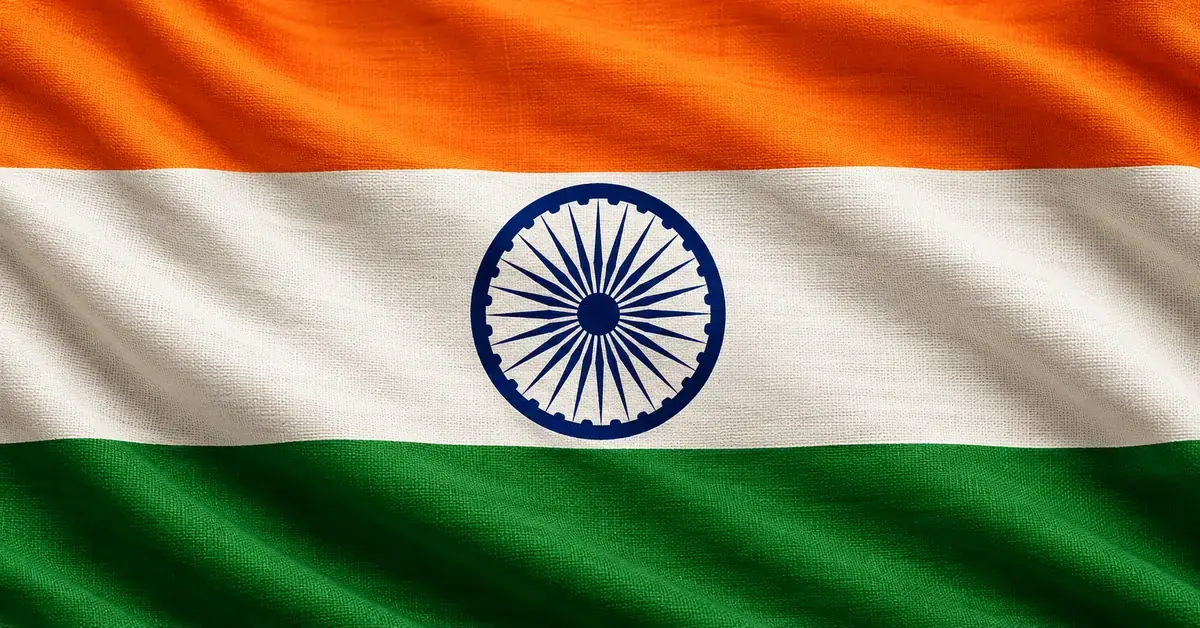
The flag of India is a horizontal tricolour of saffron at the top, white in the middle and green at the bottom, with a navy-blue 24-spoke wheel called the Ashoka Chakra in the centre of the white band. Indians commonly call it the Tiranga, which simply means “tricolour”. It was adopted in its present form by the Constituent Assembly of India on 22 July 1947, just weeks before independence, and each part of the design carries a meaning that was set out at the time by the leaders who chose it. This profile explains what the colours and the wheel stand for, who designed the flag, how it evolved over four decades, and the rules that govern how it is made and flown today.
Quick Facts
| Country | India (Republic of India) |
|---|---|
| Local name | Tiranga (“tricolour”) |
| Adopted | 22 July 1947 (flew from 15 August 1947) |
| Designer | Pingali Venkayya (tricolour concept, 1921) |
| Proportions | 2:3 (height to width) |
| Colours | India saffron, white, India green |
| Central emblem | Ashoka Chakra — navy-blue wheel, 24 spokes |
| Emblem source | Lion Capital of Ashoka, Sarnath (3rd century BCE) |
| Traditional material | Khadi (hand-spun, hand-woven cloth) |
What does the flag of India look like?
The flag is a rectangle divided into three equal horizontal bands. India saffron (a deep orange, sometimes written kesari) runs across the top, white across the middle and India green across the bottom. Centred on the white band is the Ashoka Chakra, a navy-blue wheel with 24 evenly spaced spokes. The official width-to-length proportion is 2:3, so the flag is half as tall as it is wide, and the wheel’s diameter roughly matches the height of the white band.
Because the three bands are equal and the wheel sits exactly in the centre, the design looks the same whether the flag is hanging or flying. Only the order of the colours matters: saffron must always be at the top. Flying the flag upside down, with green on top, is treated as a sign of distress or disrespect rather than a valid way to display it.
What do the three colours of the Indian flag mean?
The clearest official account of the colours comes from Sarvepalli Radhakrishnan, a philosopher who later became India’s first Vice President and second President. Speaking in the Constituent Assembly when the flag was adopted, he explained the symbolism the leaders intended. His reading, not the many popular versions, is the one that carries authority.
Saffron
Saffron, the top band, stands for renunciation and disinterestedness. Radhakrishnan said it should remind the country’s leaders to be indifferent to material gain and to dedicate themselves to their work. The colour has long associations with sacrifice and with spiritual life in India, which is why it was chosen for the leading band.
White
White, the middle band, represents light and the path of truth to guide conduct. It also serves as the bright background against which the navy-blue wheel stands out clearly. In popular descriptions white is often linked more simply to peace and honesty.
Green
Green, the bottom band, represents India’s relationship with the soil and the plant life on which all other life depends. Radhakrishnan tied it to the land itself. Everyday explanations frequently describe green as standing for fertility, growth and prosperity.
It is worth knowing that no single list of colour meanings is legally fixed. The Radhakrishnan explanation is the authoritative one, but you will see other readings — saffron for courage, white for peace, green for faith — repeated across books and websites. These are popular interpretations rather than official definitions, and they differ from source to source, so treat them as commonly held rather than settled fact. The same caution applies to flag colours worldwide; our guide to what flag colours mean explains why the same colour can mean different things from one country to the next.
What is the Ashoka Chakra in the centre?
The Ashoka Chakra is the navy-blue wheel with 24 spokes at the heart of the flag, and it is the feature that makes India’s tricolour instantly recognisable. It is taken from the Lion Capital of Ashoka, a sculpture that sat atop a pillar erected by the Mauryan emperor Ashoka at Sarnath in the 3rd century BCE. The same Lion Capital is also India’s national emblem.
The wheel is often called the Dharma Chakra, the “wheel of law” or “wheel of righteousness”. Radhakrishnan described it as representing dharma — virtue and moral law — and as a wheel of motion. His point was that there is death in stagnation and life in movement: India should keep moving forward and not resist peaceful, dynamic change. The 24 spokes are commonly read as the hours of the day, a reminder that the nation should be active at every hour, though the spoke count comes from the ancient sculpture rather than from a modern decision to depict time.
The wheel replaced an earlier symbol — Mahatma Gandhi’s charkha, or spinning wheel — when the flag was adopted in 1947. That change is the key to understanding the flag’s history, below. The wheel is a strong example of how a single device can carry layered meaning; our overview of what the symbols on national flags mean places it alongside the stars, crescents and crosses used elsewhere.
Key Points
- The flag is a horizontal tricolour: saffron on top, white in the middle, green at the bottom.
- The navy-blue Ashoka Chakra has 24 spokes and stands for dharma and continuous motion.
- Saffron is official India saffron (kesari), not generic orange; saffron must always be uppermost.
- The wheel replaced Gandhi’s spinning wheel (charkha) when the flag was adopted on 22 July 1947.
- Radhakrishnan’s Constituent Assembly explanation is the authoritative one; other colour meanings are popular but unofficial.
- Under the Flag Code of India, 2002, citizens may fly the flag; since 2022 it may be flown day and night.
The history: how the Indian tricolour evolved
The flag adopted in 1947 was the result of roughly forty years of experiment during the independence movement. Several earlier flags fed into the final design.
The early flags (1906–1917)
One of the first flags of the national movement was raised in Calcutta (now Kolkata) on 7 August 1906. It had three horizontal bands with symbols and the words Vande Mataram across the centre. A variant associated with Bhikaiji Cama was shown in Europe in 1907. These early banners were unofficial rallying flags rather than agreed national designs, and their colours and emblems varied.
The Swaraj flag and Pingali Venkayya (1921)
Around 1921 a freedom fighter named Pingali Venkayya, from the Machilipatnam area of present-day Andhra Pradesh, worked on a unifying flag and presented a design to Gandhi. At Gandhi’s suggestion a white band and a charkha — the spinning wheel that had become the symbol of self-reliance and the swadeshi movement — were central to it. This became known as the Swaraj (“self-rule”) flag or charkha flag, and it was widely used by the Indian National Congress even though it had no formal legal status.
The 1931 tricolour
In 1931 the Congress adopted a modified version as its official flag: saffron, white and green bands with the charkha in the centre. This is the direct ancestor of today’s flag. The band colours and their order were now essentially fixed; only the central emblem would later change.
Independence and the 1947 adoption
As independence approached, a committee decided that the national flag should not carry the charkha, which was closely tied to one party and one leader. The spinning wheel was replaced with the Ashoka Chakra, giving the flag a symbol rooted in India’s ancient history rather than in party politics. The Constituent Assembly adopted this design on 22 July 1947, and it flew as the flag of independent India from 15 August 1947.
Who designed the flag of India?
Pingali Venkayya is credited as the designer of the flag of India. His 1921 design established the saffron-white-green tricolour with a central emblem that the final 1947 flag followed closely. He is usually remembered for the overall concept and the colour scheme rather than for every later refinement, because the design passed through Congress committees and an independence-era committee before adoption. The single biggest change after his work was the swap from the charkha to the Ashoka Chakra in 1947.
Official dimensions, shades and material
The flag’s exact look is standardised so that every official flag is identical. The specification is maintained by the Bureau of Indian Standards (BIS), and the main points are straightforward.
- Proportions: a width-to-length ratio of 2:3.
- Bands: three equal horizontal bands — India saffron, white and India green from top to bottom.
- Chakra: a navy-blue wheel of 24 equally spaced spokes, centred on the white band, with a diameter that approximates the width (height) of that band.
- Material: the flag is traditionally made of khadi, the hand-spun, hand-woven cloth tied to Gandhi and the swadeshi movement.
For decades, regulation flags could only be hand-spun and hand-woven from cotton, silk, wool or khadi. That rule was eased by an amendment dated 30 December 2021, which allowed flags to be machine-made and made of polyester as well, partly so that enough flags could be produced for mass public campaigns.
The Flag Code of India: how the flag may be used
The Flag Code of India, 2002 brings together the laws and conventions on displaying the national flag. It took effect on 26 January 2002 and, importantly, confirmed that ordinary citizens may fly the flag, not just government bodies. That change followed a long legal campaign by the industrialist Naveen Jindal, and the Supreme Court recognised flying the flag as part of the right to expression. Two later amendments modernised the rules:
- December 2021: machine-made and polyester flags were permitted alongside hand-made khadi and cotton ones.
- July 2022: a flag displayed in the open or on a member of the public’s house may now be flown day and night. Previously, display was generally limited to the hours between sunrise and sunset.
Alongside these permissions, the Code sets out respectful handling: the flag should never touch the ground or water, should not be flown in a damaged or dirty state, and should not be used as drapery, clothing or packaging. Saffron must always be uppermost. These etiquette rules are similar in spirit to those for other national flags — the same ideas of half-masting and precedence appear in our note on Canadian flag etiquette.
How India’s flag compares with similar flags
India’s tricolour is frequently mixed up with the flag of Niger, which also uses orange, white and green horizontal bands with an orange circle in the centre. The differences are clear once you know them: India’s bands are saffron-white-green from top to bottom with a navy-blue spoked wheel, while Niger’s are orange-white-green with a plain orange disc. The table below sets out the main points of comparison with a few flags that share colours or a central device.
| Flag | Bands (top to bottom) | Central feature | Quick tell-apart |
|---|---|---|---|
| India | Saffron, white, green | Navy-blue 24-spoke Ashoka Chakra | Spoked blue wheel, not a solid disc |
| Niger | Orange, white, green | Plain orange circle | Solid disc, no spokes |
| Ireland | Green, white, orange (vertical) | None | Vertical bands, no emblem |
| Ivory Coast | Orange, white, green (vertical) | None | Vertical bands, orange at the hoist |
India is also one of many countries whose flag is a tricolour, a format popularised by the French Revolution and now used around the world. You can see where India sits among its neighbours in our guide to the flags of Asia, and compare its design approach with other famous flags in our national flag profiles, including the closely related story of the flag of Japan.
Common mistakes and misconceptions
A few errors come up again and again when people describe the flag of India.
- Calling the top colour “orange”. The official shade is India saffron (kesari), a specific deep orange tone, not generic orange.
- Confusing the Ashoka Chakra with the charkha. The current flag has the 24-spoke Ashoka Chakra. The spinning wheel (charkha) belonged to the earlier Swaraj flag and was replaced in 1947.
- Treating the popular colour meanings as official. The authoritative explanation is Radhakrishnan’s; readings such as “saffron for courage” or “green for prosperity” are common but not formally fixed.
- Assuming citizens could always fly it. Routine display by private individuals was only clearly established with the 2002 Flag Code, and flying it at night was broadly allowed only from 2022.
- Getting the spoke count wrong. The wheel has 24 spokes, not 12 or any other number, and that count comes from the ancient Lion Capital of Ashoka.
Sources
Frequently Asked Questions (FAQ)
What do the colours of the Indian flag mean?
In the authoritative explanation given when the flag was adopted, saffron stands for renunciation and selflessness, white for light and the path of truth, and green for the soil and plant life of the land. Popular versions link the colours to courage, peace and prosperity, but those readings vary by source and are not officially fixed.
What is the Ashoka Chakra and how many spokes does it have?
The Ashoka Chakra is the navy-blue wheel in the centre of the flag. It has 24 spokes and is taken from the Lion Capital of Ashoka at Sarnath, a sculpture from the 3rd century BCE. It represents dharma — moral law — and the idea of continuous, peaceful motion.
Who designed the flag of India?
The design is credited to Pingali Venkayya, who created the saffron-white-green tricolour with a central emblem around 1921. The final flag followed his scheme, with the spinning wheel replaced by the Ashoka Chakra when it was adopted in 1947.
When was the Indian national flag adopted?
The Constituent Assembly of India adopted the flag in its present form on 22 July 1947. It became the flag of independent India on 15 August 1947.
Can private citizens fly the Indian flag at home?
Yes. The Flag Code of India, 2002 confirmed that ordinary citizens may display the flag, and a 2022 amendment allows it to be flown day and night when displayed in the open or on a person’s house, provided it is handled respectfully and flown with saffron at the top.
