

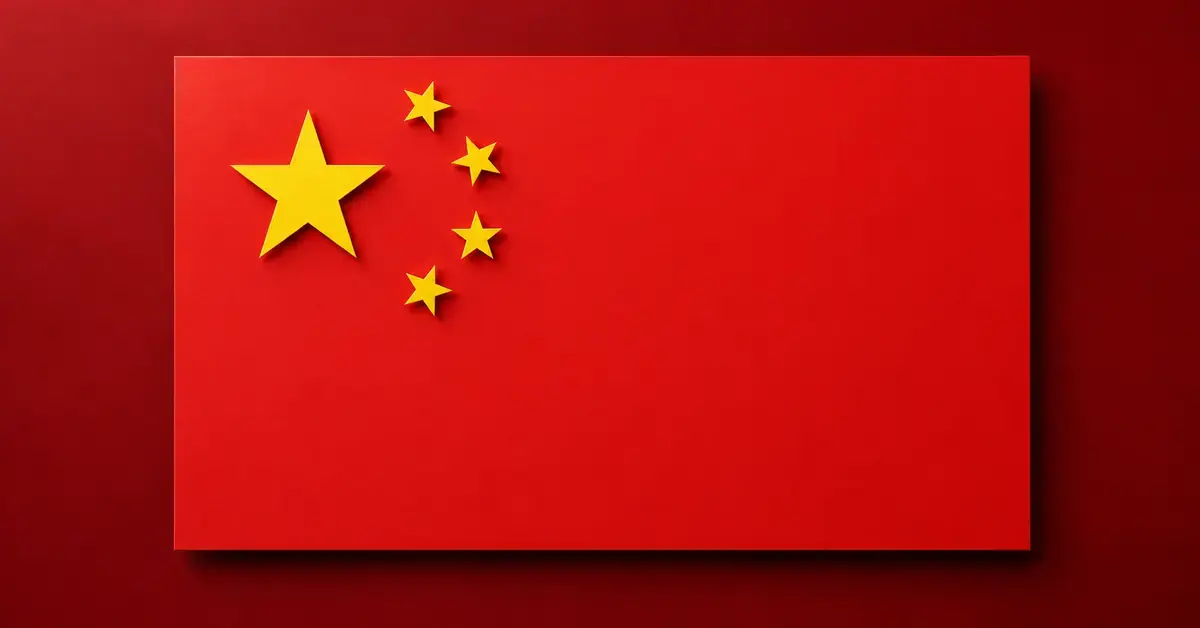
The flag of China is a bright red banner with five golden stars grouped in the upper corner nearest the flagpole: one large star and four smaller ones arranged in an arc beside it. Known in China as the Five-star Red Flag (五星红旗, Wǔxīng Hóngqí), it has flown over the People’s Republic of China since 1 October 1949. This guide to the flag of China and its meaning explains exactly what the stars and the red field stand for, who designed the flag, when it was adopted, and why one of the most repeated claims about the five stars is actually a myth.
Quick Facts
| Official name | Five-star Red Flag (五星红旗, Wǔxīng Hóngqí) |
|---|---|
| Country | People’s Republic of China |
| Adopted | Approved 27 September 1949; first raised 1 October 1949 |
| Designer | Zeng Liansong (Wenzhou, Zhejiang) |
| Proportions | 2:3 |
| Colours | Red field with golden-yellow stars |
| Design | One large star and four smaller stars in the canton |
What does the flag of China look like?
The flag of China is a red rectangle with a cluster of five golden-yellow stars in the canton — the upper section next to the hoist (the edge attached to the pole). The design has a width-to-length ratio of 2:3, meaning the flag is one and a half times as wide as it is tall.
The cluster has a clear structure:
- One large star, placed closest to the hoist.
- Four smaller stars, set in a curved arc to the right of the large star.
- Each small star is turned so that one of its points aims directly at the centre of the large star, giving the impression that the four smaller stars are facing the larger one.
All five stars are five-pointed and the same golden-yellow colour; only their size and position differ. This precise arrangement is laid down in national standards, so the stars are not scattered randomly — their exact centres are defined on an official grid.
What do the five stars on China’s flag mean?
The large star stands for the Chinese Communist Party, and the four smaller stars were originally meant to represent four social classes united under its leadership. This was the explanation given by the flag’s designer in 1949.
Drawing on Mao Zedong’s essay On the People’s Democratic Dictatorship, the four small stars were said to represent:
- the working class;
- the peasantry;
- the urban petite bourgeoisie (small business owners and traders); and
- the national bourgeoisie (patriotic business and professional classes).
The fact that each small star points toward the large one was meant to show these groups rallying around the Party. Over time an official reading has become more common and more general: the red represents the revolution, the single large star represents the Communist Party, and the five stars together represent the unity of the Chinese people under the Party’s leadership. Both the original class-based meaning and the broader ‘unity’ reading are widely cited; the flag’s symbolism is political, and we describe it here rather than endorse it.
Key Points
- The large star stands for the Chinese Communist Party.
- The four small stars originally stood for four social classes; a broader reading is the unity of the people under the Party.
- Each small star is angled so one point faces the centre of the large star.
- Red represents the revolution; the stars are golden-yellow for contrast and tradition.
- The stars do not officially represent five ethnic groups — that is a myth from an earlier flag.
What does the red field mean?
Red stands for the Chinese Communist Revolution. It is the dominant element of the flag and, in the official account, represents the revolutionary struggle that led to the founding of the People’s Republic in 1949.
Red is also one of the most important colours in Chinese culture, long associated with good fortune, celebration and vitality, which made it a natural choice for a national banner. Red is by far the most common colour on the world’s flags — you can see just how common in our look at the most common flag colours — and its revolutionary meaning on the Chinese flag is one it shares with several other countries. For a broader breakdown of what the colour signals from flag to flag, see our guide to flag colour meanings.
Why are the stars gold instead of white?
The stars are golden-yellow to stand out boldly against the red field and to echo a traditional Chinese colour pairing. Gold (or yellow) has a long association with the emperor and with the Han Chinese heartland, and the warm gold-on-red combination is deeply familiar in Chinese design. Practically, yellow also gives the sharpest possible contrast on a red background, keeping the stars crisp and legible at a distance. Stars are one of the most widely used emblems in the world; our overview of what the symbols on national flags mean explains how differently they can be read from country to country.
Who designed the flag of China?
The flag was designed by Zeng Liansong, an economist and citizen from Wenzhou in Zhejiang province who was working in Shanghai in 1949. He submitted his entry in response to a nationwide public call for a new national flag.
By his own account, Zeng was inspired one night while looking at the stars, picturing the Communist Party as a guiding great star with the people gathered around it. His submission was one of nearly 3,000 entries, which a selection committee narrowed to a shortlist of around 38 finalists before his design was chosen.
There is one well-documented change between Zeng’s original drawing and the flag flown today: his version placed a hammer and sickle inside the large star, symbolising workers and farmers. That emblem was removed before adoption because it made the design look too much like the flag of the Soviet Union. Dropping it gave China a distinct national symbol rather than an echo of its then-ally. The flag adopted in 1949 is otherwise almost identical to Zeng’s proposal.
When was the flag of China adopted?
The flag was approved on 27 September 1949 and first raised on 1 October 1949. The approval came from the First Plenary Session of the Chinese People’s Political Consultative Conference (CPPCC), the body that organised the founding of the new state.
Just days later, on 1 October 1949, Mao Zedong proclaimed the People’s Republic of China from the Gate of Heavenly Peace (Tiananmen) in Beijing, and the Five-star Red Flag was raised over the square for the first time. That date is now celebrated as China’s National Day. The design process had been swift: a notice inviting flag submissions went out in mid-July 1949, and roughly 3,000 designs had arrived by the third week of August.
What did China’s flag look like before 1949?
Before 1949, mainland China flew the flag of the Republic of China — a red field with a blue canton containing a white sun, often called the ‘Blue Sky, White Sun, and a Wholly Red Earth’. It was used as the national flag from 1928 and remains in use today on Taiwan.
Earlier still, the first flag of the new republic after the 1911 revolution was the Five-Coloured Flag (1912–1928): five equal horizontal stripes of red, yellow, blue, white and black. Those five stripes represented five peoples of China — the Han, Manchu, Mongol, Hui (Muslim) and Tibetan. This older flag is the source of a common modern mix-up, explained next.
Do the five stars represent five ethnic groups?
No — this is a popular misconception. The five golden stars on the modern flag do not officially stand for five ethnic groups. That idea is a confusion with the earlier Five-Coloured Flag of 1912, whose five stripes did represent five peoples.
On the current flag, the large star stands for the Communist Party and the four small stars for the social classes (or, in the broader reading, the united people) — not for specific ethnicities. If you have heard the ‘five ethnic groups’ explanation, it is a well-meaning but inaccurate blend of two different flags from two different eras.
Is the number five significant?
Five is a meaningful number in Chinese tradition, which adds resonance to a flag built around five stars. Chinese thought has long organised the world into sets of five — such as the Five Elements (wood, fire, earth, metal and water) and the five classic virtues — so a group of five carries a sense of completeness.
That said, the flag’s official symbolism rests on what the stars represent (the Party and the people), not on numerology. The cultural weight of ‘five’ is best understood as a fitting backdrop rather than the stated reason for the design.
The official specification and colours
China’s flag is defined by a national standard, so its proportions and colours are fixed rather than approximate. The table below sets out the key technical details.
| Feature | Specification |
|---|---|
| Official name | Five-star Red Flag (五星红旗) |
| Proportions | 2:3 (width to length) |
| Field colour | Chinese red (approx. hex #EE1C25) |
| Star colour | Golden yellow |
| Stars | One large five-pointed star; four smaller five-pointed stars in an arc |
| Star placement | In the canton (upper hoist), each small star pointing to the centre of the large star |
The grid for the stars is officially defined: the flag is divided into a 10-by-15 unit field, the large star’s circle spans six units, each small star’s circle spans two units, and the centre of the large star sits five units in from the hoist and five units down from the top. This is why every correctly made Chinese flag looks the same.
Are there rules for flying China’s flag?
Yes. The display and protection of the flag are governed by the Law of the People’s Republic of China on the National Flag, which was passed in 1990 and took effect on 1 October that year. It sets out where and how the flag must be flown and treats the flag as a protected national symbol.
The law was amended in 2020, with the changes taking effect on 1 January 2021, tightening rules on respectful use and disposal of worn flags. In everyday practice the flag is flown daily over government buildings, raised each morning in a formal ceremony in Tiananmen Square, and displayed widely around National Day on 1 October.
How does China’s flag compare with other star flags?
Many national flags use stars, but each tells its own story, and China’s grouped-star design is distinctive. The comparison below places it alongside a few other well-known flags that feature stars.
| Flag | Stars | What they represent |
|---|---|---|
| China | One large, four small (golden) | The Communist Party and the people united under it |
| United States | 50 white stars | The 50 states |
| Brazil | 27 white stars | The states and Federal District, shown as the night sky over Rio in 1889 |
| Vietnam | One large yellow star | Leadership of the Communist Party; points often linked to classes of society |
| European Union | 12 gold stars | Unity and completeness (not the number of members) |
China sits firmly within its region’s visual traditions too; you can see how its banner fits among its neighbours in our round-up of the flags of Asia, and compare it with the striking simplicity of the flag of Japan. For more single-country breakdowns like this one, browse our national flag profiles.
Common mistakes and misconceptions
A handful of errors come up again and again when people describe China’s flag. Knowing them helps you get the details right.
- Saying the stars represent five ethnic groups. They do not — that is the 1912 Five-Coloured Flag being confused with the modern one.
- Thinking all five stars are the same size. There is one large star and four smaller ones; the difference in size is central to the meaning.
- Assuming the small stars point straight up. Each small star is tilted so one point aims at the centre of the large star.
- Calling the stars white. They are golden-yellow, not white.
- Confusing it with the Communist Party flag. The Party’s own flag is red with a yellow hammer and sickle; the national flag has five stars and no hammer and sickle.
- Mixing it up with Taiwan’s flag. The Republic of China (Taiwan) flag has a blue canton with a white sun, not golden stars.
Sources
Frequently Asked Questions (FAQ)
What do the five stars on the Chinese flag mean?
The large star represents the Chinese Communist Party, and the four smaller stars originally represented four social classes united under it. A broader official reading treats the five stars together as the unity of the Chinese people led by the Party.
Do the stars stand for five ethnic groups?
No. That is a common myth that confuses the current flag with China’s 1912 Five-Coloured Flag, whose five stripes did represent five peoples. The modern stars represent the Party and the people, not specific ethnic groups.
Who designed the flag of China?
Zeng Liansong, a citizen from Wenzhou in Zhejiang province working in Shanghai, designed it in 1949. His original drawing included a hammer and sickle in the large star, which was removed before adoption because it looked too much like the Soviet flag.
When did China adopt its flag?
The design was approved on 27 September 1949 and first raised on 1 October 1949, when Mao Zedong proclaimed the People’s Republic of China in Tiananmen Square. That date is now China’s National Day.
Why is the Chinese flag red?
Red officially represents the Chinese Communist Revolution. It is also a traditional colour of good fortune and celebration in Chinese culture, which made it a fitting choice for the national banner.
