

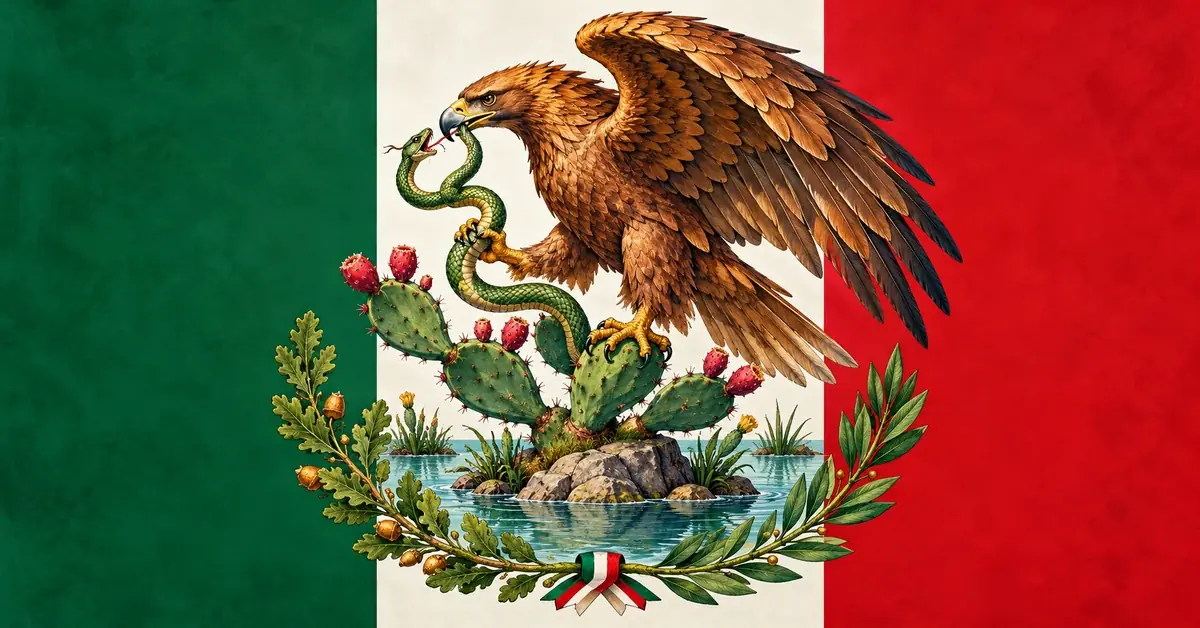
The flag of Mexico is a vertical tricolour of green, white and red with the national coat of arms — a golden eagle perched on a cactus, devouring a serpent — set in the centre. Its colours trace back to the 1821 fight for independence, while the eagle-and-serpent emblem reaches far deeper, into an Aztec legend about the founding of the city that is now Mexico City. This guide explains the meaning of each part of the flag of Mexico, where the design came from, and the questions people most often ask about it.
Key Points
- The flag of Mexico is a vertical green-white-red tricolour with the national coat of arms on the central white stripe.
- The emblem — a golden eagle on a cactus eating a serpent — depicts the Aztec legend of the founding of Tenochtitlán, now Mexico City.
- Original 1821 meanings: green for independence, white for religion, red for union (the Plan de Iguala’s Three Guarantees).
- Modern reinterpretation: green for hope, white for unity, red for the blood of national heroes.
- Mexican law assigns no official meaning to the colours.
- The current design dates to 1968 and is governed by the 1984 Law on the National Arms, Flag and Anthem.
What does the flag of Mexico look like?
The Mexican flag is a vertical tricolour divided into three equal stripes: green at the hoist (the edge next to the flagpole), white in the middle and red at the fly (the free edge). The official proportions are 4:7, meaning the flag is four units tall for every seven units wide. On the central white stripe sits the national coat of arms, with a diameter of three-quarters of the stripe’s width.
That coat of arms is what sets Mexico’s flag apart from other green-white-red tricolours. Without it, the design would be easy to confuse with the flag of Italy. The emblem is only ever shown on the obverse (front); on the reverse it appears mirrored. The same design serves as Mexico’s civil flag, state flag and naval ensign.
The exact shades are not fixed in law. In 2001 Mexico’s Interior Ministry suggested reference values — roughly Pantone 3425 C for the green and Pantone 186 C for the red — and those values were reused in later style guides, but no decree has ever made a single shade compulsory.
Key Facts
| Country | Mexico (United Mexican States) |
|---|---|
| Design | Vertical tricolour: green (hoist), white, red (fly) |
| Proportions | 4:7 |
| Central emblem | Golden eagle on a prickly pear cactus, devouring a serpent |
| Current version | Made official in 1968 |
| Governing law | Law on the National Arms, Flag and Anthem (in force since 1984) |
| Flag Day | 24 February (Día de la Bandera) |
| Also used as | Civil flag, state flag and naval ensign |
What do the colours of the Mexican flag mean?
Mexican law assigns no official meaning to the green, white and red — a fact that surprises many people. The Law on the National Arms, Flag and Anthem describes the layout precisely but leaves the symbolism open, so the meanings you read about are interpretations that have shifted over two centuries rather than legally fixed definitions.
The original 1821 meanings
When the tricolour first appeared, its colours stood for the three promises of the Plan de Iguala, the 1821 pact that secured independence from Spain. These were called the Three Guarantees, and the Army of the Three Guarantees carried the first version of the flag. In that reading:
- Green represented independence from Spain.
- White represented the Roman Catholic religion.
- Red represented union between Mexicans and the Europeans who stayed.
The modern reinterpretation
After the mid-19th-century reforms under Benito Juárez separated church and state, the religious reading no longer fit, and the colours were popularly reinterpreted. The version most Mexicans learn today is:
- Green for hope.
- White for unity.
- Red for the blood of the national heroes.
Both readings are widely repeated, and neither is “wrong” — they simply belong to different moments in Mexico’s history. If you want the broader picture of how the same colours carry different stories from country to country, see our guide to what flag colours mean.
What do the eagle, serpent and cactus mean?
The eagle eating a serpent on a cactus retells the Aztec legend of how Mexico City was founded. According to the story, the Mexica people wandered in search of a home until their god signalled where to settle: the sign would be a golden eagle perched on a prickly pear cactus (a nopal), devouring a serpent. They saw it on an island in Lake Texcoco and there founded Tenochtitlán in the 14th century — the city that became modern Mexico City.
Each element of the scene carries meaning drawn from Mexica cosmology:
- The eagle is linked to the sun and to Huitzilopochtli, the Mexica patron deity.
- The serpent and the eagle together have long been read as the triumph of good over evil, or of the sun over its enemies, though this “eagle devours snake” reading is partly a later interpretation.
- The cactus and its fruit grow from a rock in the water, marking the exact spot of the prophecy; in Mexica symbolism the red cactus fruit (tunas) has been associated with the human heart.
Mexico is one of a select group of countries that put a living creature at the heart of their flag. For more examples, from Bhutan’s dragon to Sri Lanka’s lion, see our round-up of animals and emblems on national flags.
The coat of arms up close
The full emblem is more detailed than the eagle and snake alone. The eagle stands in profile on the nopal, which itself rises from a rock surrounded by water. Below and around the base, a wreath of oak and laurel is tied with a ribbon in the national colours. The oak traditionally signals strength and the laurel victory — republican symbols added to the second national flag in 1823, after the short-lived empire fell and the crown was removed from the eagle’s head.
The version flown today was designed by the artist Francisco Eppens Helguera and made official in 1968, in the run-up to the Mexico City Olympic Games. It built on a 1916 presidential decree by Venustiano Carranza that turned the eagle to face sideways, and it emphasised pre-Hispanic elements such as the stylised water and the red cactus fruit. A special presidential variant adds an arched tricolour ribbon over the emblem. To see how emblems like this fit into flag design more broadly, our overview of what the symbols on national flags mean sets the context.
A short history of the Mexican flag
Mexico’s flag evolved through four main national designs, plus an earlier rebel banner. The colours and the eagle have been constant threads, but the details — the crown, the eagle’s pose, the surrounding wreath — changed with each era.
The Virgin of Guadalupe standard (1810)
Before any official flag existed, the priest Miguel Hidalgo raised a banner of the Virgin of Guadalupe after the Grito de Dolores on 16 September 1810, the cry that launched the War of Independence. Many historians treat this standard as the first symbol of the Mexican cause, though it was never adopted as a national flag.
The first flag (1821)
The green-white-red tricolour was created in 1821, when independence was won. Under Agustín de Iturbide and the First Mexican Empire, the eagle on the flag wore a crown to reflect the imperial monarchy.
The republican flags (1823 onward)
When the empire was abolished and Mexico became a republic in 1823, the crown was removed and the eagle was shown gripping the serpent, framed by the oak-and-laurel wreath. The Second Mexican Empire under Maximilian (1864–1867) briefly reintroduced a more elaborate, crowned design before the republic’s version returned.
The current flag (1968 and 1984)
The design in use today was made official in 1968 with Eppens’s coat of arms. It was then confirmed and codified by the Law on the National Arms, Flag and Anthem, which has been in force since 24 February 1984 and remains the governing legislation. For how Mexico sits among its neighbours’ banners, browse our guide to the flags of the Americas.
When is Mexican Flag Day?
Mexico celebrates Día de la Bandera (Flag Day) on 24 February. The date commemorates the 1821 Plan de Iguala and the founding of the Army of the Three Guarantees, which first carried the national colours. Flag Day was established as a national observance in 1937 under President Lázaro Cárdenas, and it is marked with ceremonies, school events and flag-raising across the country.
Display of the flag is tightly regulated. The 1984 law sets out how it may be flown, saluted and retired, and misuse can carry penalties — one reason the Mexican flag is treated with notable formality in public life.
Mexico vs Italy: telling similar flags apart
The quickest way to tell the Mexican flag from the Italian flag is the coat of arms: Mexico’s carries the eagle-and-serpent emblem in the centre, while Italy’s green-white-red tricolour is plain. There are other clues too. Mexico’s green is typically a darker shade, its proportions are 4:7 against Italy’s 2:3, and the two use different reference reds. Pairs like these are common in the flag world; our feature on flags that look alike walks through the trickiest look-alikes and the one detail that separates each pair.
Common mistakes and misconceptions
Several myths cling to the Mexican flag. Clearing them up makes the real meaning easier to understand.
- “The colours have fixed, official meanings.” They do not. Mexican law describes the design but assigns no legal symbolism to green, white and red; the familiar meanings are historical interpretations.
- “The modern meanings are the original ones.” The hope / unity / blood reading is a later reinterpretation. The first meanings, from 1821, were independence, religion and union.
- “Mexico’s flag is just the Italian flag.” They share the three colours and stripe layout, but the central coat of arms, the shades, the proportions and the history are all different.
- “The eagle is a bald eagle, like the United States symbol.” It is a golden eagle, and its meaning is rooted in Aztec, not North American, tradition.
- “The scene is purely mythical.” The legend is a founding story, but it is tied to a real place — the island site of Tenochtitlán in the former Lake Texcoco, beneath today’s Mexico City.
For more single-country breakdowns using the same approach, see our hub of national flag profiles.
Sources
Frequently Asked Questions (FAQ)
What do the three colours of the Mexican flag mean?
Originally, in 1821, green stood for independence, white for the Roman Catholic religion and red for union. Today many Mexicans read green as hope, white as unity and red as the blood of national heroes. Mexican law itself assigns no official meaning to the colours.
Why is there an eagle eating a snake on the Mexican flag?
It depicts the Aztec legend of the founding of Tenochtitlán. The Mexica were told to settle where they saw a golden eagle on a cactus devouring a serpent; they found the sign on an island in Lake Texcoco and built the city that became Mexico City.
What is the difference between the Mexican and Italian flags?
Both are green-white-red vertical tricolours, but Mexico’s flag carries the national coat of arms in the centre while Italy’s is plain. Mexico also uses a darker green, 4:7 proportions and different colour shades.
When was the current flag of Mexico adopted?
The current flag, with Francisco Eppens Helguera’s coat of arms, was made official in 1968. It was later confirmed by the Law on the National Arms, Flag and Anthem, which has been in force since 24 February 1984.
When is Mexican Flag Day?
Mexican Flag Day, Día de la Bandera, is celebrated on 24 February. It was established as a national observance in 1937 and marks the 1821 Plan de Iguala, when the national colours were first carried.
