

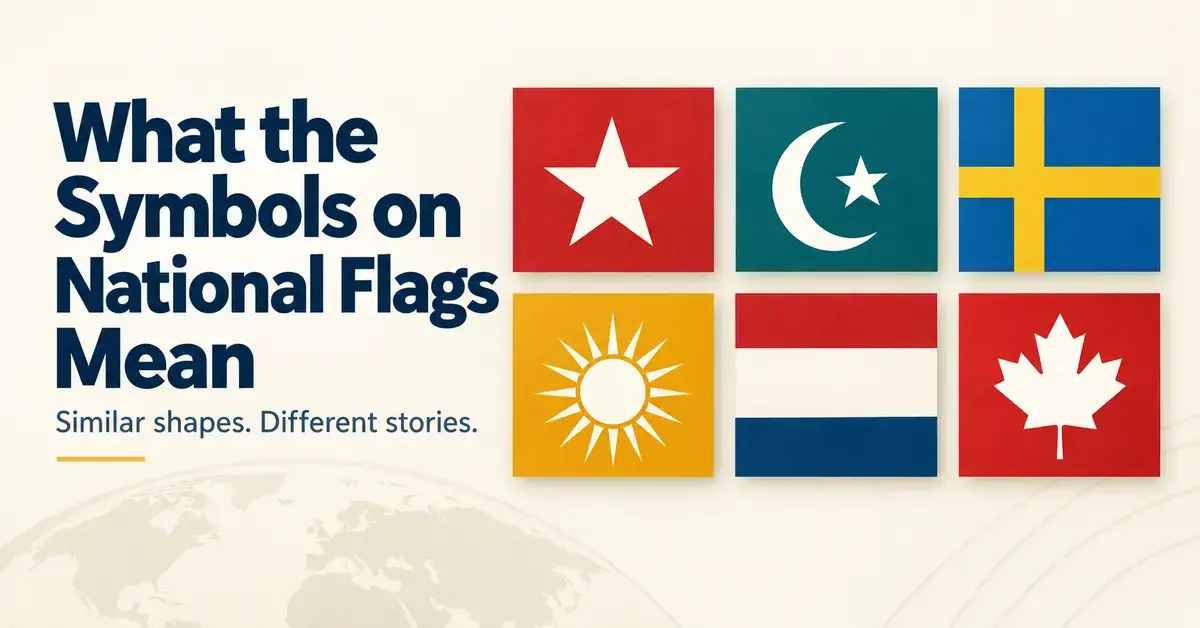
National flags are packed with symbols — stars, crescents, crosses, suns, stripes and emblems — and each one carries a story. The single most important thing to understand before you read any of them is this: flag symbols rarely have one fixed, universal meaning. A star on one flag counts states; on another it stands for independence or a single guiding ideal. This guide explains what the most common flag symbols generally represent, with real examples, and shows why the same shape can mean very different things from one country to the next. For a broader look at how colours work alongside these shapes, see our overview of what flag colours and symbols mean.
Key Points
- The same symbol can mean different things on different flags — flag symbolism is country-specific, not universal.
- Stars often count a nation’s parts (the US flag’s 50 stars are 50 states; Brazil’s 27 are its states and Federal District) or stand for unity and independence.
- The crescent and star predates Islam; the Ottomans used it well before 1453, and it signals Turkic as well as Islamic identity depending on the flag.
- The Nordic cross is a Christian symbol; Denmark’s Dannebrog is the oldest continuously used national flag, in use since 1625.
- Suns appear as Argentina and Uruguay’s Sun of May, Japan’s red disc, and Nepal’s symbol of national endurance.
- Many colour and symbol “meanings” are popular interpretations added later, not official definitions.
Do flag symbols have one universal meaning?
No — flag symbols almost never have a single universal meaning. The same symbol is given different stories by different countries, and many of those stories were attached long after the flag was designed. A five-pointed star, for example, counts the 50 states on the flag of the United States, but on other flags a lone star signals independence, unity or a guiding ideal. A crescent reads as a historic Turkic emblem on Turkey’s flag, yet on Nepal’s flag it is a symbol of longevity with no Islamic meaning at all.
Two habits will keep you accurate. First, treat a symbol’s meaning as country-specific: always ask “what does this flag’s own government or founding story say?” rather than assuming a global rule. Second, separate official explanations from popular ones — a surprising number of widely repeated “meanings” are later folk interpretations, not definitions written into law. Because reputable sources sometimes disagree, especially on contested or ancient symbolism, we flag meanings as “commonly” rather than “universally”; you can read how we handle that in our editorial policy and sources.
Symbol Legend
| Symbol | What it commonly suggests | Examples (and the country-specific twist) |
|---|---|---|
| Single star | Unity, freedom or independence | Many flags; meaning set by each nation’s founding story |
| Cluster of stars | Counts states, regions or constellations | USA (50 states), Brazil (27 states and district), Southern Cross nations |
| Crescent and star | Historic Middle Eastern or Turkic emblem; later linked to Islam | Turkey, Pakistan, Algeria; Nepal’s crescent means longevity, not Islam |
| Cross | Christian tradition | Nordic cross (Denmark, Sweden); Union Jack’s three crosses |
| Sun | New beginnings, identity, endurance | Argentina and Uruguay (Sun of May), Japan, Nepal, Kyrgyzstan |
| Stripes / colour family | Shared heritage (pan-African, pan-Arab, pan-Slavic) | Tricolours worldwide; orientation carries no fixed meaning |
| Animal or coat of arms | A specific national story from history or myth | Mexico (eagle and snake), Kenya (Maasai shield), Sri Lanka (lion) |
Stars on flags: what they mean
Stars are the most common emblem on national flags, and they usually do one of two jobs: they either count something or they stand for an idea. Which job a star is doing depends entirely on the country, so the shape alone never tells you the answer.
A single star
A lone star most often represents unity, freedom or independence — a single guiding light for a nation. It appears on flags from several continents, usually centred or set in the canton (the upper hoist-side corner). Because the meaning is tied to each country’s own history, a single star is best read through that nation’s founding story rather than as a fixed code.
Clusters of stars
When stars appear in a group, they frequently enumerate the parts of a nation. The clearest example is the flag of the United States: each of its 50 stars represents one state, and its 13 stripes represent the original colonies. With 50 stars, it carries more than any other national flag.
Brazil has the second-most, with 27 stars representing its 26 states and the Federal District. Unlike the US flag, Brazil’s stars are different sizes and are arranged to mirror the night sky over Rio de Janeiro on 15 November 1889, grouped within the Southern Cross and nearby constellations; the flag was adopted on 19 November 1889. The count has grown over time — it began with 21 stars in 1889 and reached 27 only in 1992 — a reminder that a flag’s symbols can change as the country does.
Clusters can also carry constellation symbolism directly: the Southern Cross appears on the flags of Australia, New Zealand, Papua New Guinea and Samoa, marking the southern sky those nations share.
The crescent and star
The crescent and star is older than Islam, and that history is the key to reading it correctly. Middle Eastern civilisations from ancient Egypt and Phoenicia used crescent-moon standards, and the symbol was long associated with the city of Byzantium (later Constantinople). According to Encyclopaedia Britannica, the Ottoman Turks were using the crescent for at least a century before they captured Constantinople in 1453, so the common story that they adopted it from the city in 1453 is a myth.
The symbol became linked to Islam far later, largely because of the Ottoman Empire’s prominence, and it now appears on the flags of many Muslim-majority countries — among them Turkey, Pakistan, Algeria, Tunisia, Malaysia, the Maldives, Mauritania, Azerbaijan and the Comoros — as well as on the Red Crescent emblem. Even here the details are country-specific: Azerbaijan’s eight-pointed star is explained as the eight Turkic peoples, while Malaysia’s star has 14 points for its states and federal territories. And on Nepal’s flag the crescent is not an Islamic symbol at all, but part of a sun-and-moon pairing about the nation’s endurance.
Crosses on flags
A cross on a national flag is usually a Christian symbol, though its exact form points to a particular tradition or history. The most recognisable family is the Nordic (or Scandinavian) cross — an upright cross shifted toward the hoist — shared by Denmark, Sweden, Norway, Finland and Iceland.
Denmark’s flag, the Dannebrog, is the model for the rest and holds the Guinness World Record as the oldest continuously used national flag, in use since 1625. Its origin legend — a cross falling from the sky during the Battle of Lindanise in 1219 — is a story rather than documented history, and Denmark itself does not assign official meanings to the flag’s colours, a good example of how much flag symbolism is tradition rather than decree.
Crosses take other forms too. The Union Jack of the United Kingdom combines three crosses — St George’s for England, St Andrew’s for Scotland and St Patrick’s for Ireland — which is why it carries into the flags of several Commonwealth nations. Switzerland and Greece use crosses of their own. As always, the shape signals a tradition, but the specific meaning belongs to each country.
Suns on flags
A sun on a flag usually represents a new beginning, national identity or a link to the natural world, and several of the best-known examples are tied to a specific story. Argentina and Uruguay share the Sun of May, a golden sun with a face and 16 rays, linked to the Inca sun god Inti and first used as a symbol around the May Revolution of 1810 that began Argentina’s path to independence.
Japan’s flag is a red disc on white — the Hinomaru, or sun disc — reflecting the country’s name as the “Land of the Rising Sun.” Kyrgyzstan’s red flag carries a 40-rayed sun crossed by the tunduk, the roof-ring of a traditional yurt; the rays are popularly said to represent 40 tribes. Nepal pairs a sun and a crescent moon as emblems of permanence, expressing the hope that the nation will endure as long as those bodies in the sky. A word of caution for readers: Taiwan’s flag shows a white sun with 12 rays, not a star — a frequent mix-up.
Stripes, bands and colour families
Stripes are the structural backbone of flag design, and groups of nations often share a colour scheme to signal a common identity. The orientation itself — horizontal or vertical — carries no fixed meaning; what matters is the colours and the family they belong to.
The three-colour “tricolour” format spread from the 17th-century Dutch flag and, most influentially, revolutionary France. The popular reading of the French blue-white-red as “liberty, equality, fraternity” was applied after the fact and was never fixed by a single decree — another case of meaning added later. Three colour families recur across many flags:
- Pan-African colours. Red, black and green, introduced by Marcus Garvey in 1920, commonly read as the blood of struggle, the African people, and the land. A separate set — green, gold and red from Ethiopia’s flag — also signals pan-African solidarity because Ethiopia resisted colonisation.
- Pan-Arab colours. Black, white, green and red, first flown together on the flag of the Arab Revolt in 1916 and often linked to early Islamic dynasties and to a medieval poem by Safi al-Din al-Hilli. They appear on the flags of Jordan, Palestine, Kuwait, the United Arab Emirates and others.
- Pan-Slavic colours. Blue, white and red, chosen at the Pan-Slavic Congress of 1848 and inspired by the Russian flag; they recur on the flags of several Slavic nations such as Croatia, Serbia, Slovenia and Slovakia.
In every case the colours mark a shared heritage, but the precise meaning each country assigns to its stripes differs — and many of those meanings are popular tradition rather than official definition.
Emblems, animals and coats of arms
When a flag carries a detailed emblem — an animal, a shield or a full coat of arms — it is usually telling a specific national story drawn from history, myth or landscape. These devices are the most country-specific symbols of all.
Mexico’s flag places a coat of arms on the white band: a golden eagle perched on a cactus, devouring a snake. The image comes from the Aztec founding legend of Tenochtitlan (modern Mexico City), where the people were told to settle where they saw exactly that scene; the current flag was adopted in 1968. Kenya’s flag shows a Maasai shield with two crossed spears, symbolising the defence of freedom — note that the lions people associate with Kenya belong to its separate coat of arms, not the flag itself. Sri Lanka’s flag fills its maroon field with a golden lion holding a sword, surrounded by four bo (fig) leaves; the lion represents the Sinhalese people and courage, which is why it is nicknamed the Lion Flag.
Common mistakes when reading flag symbols
The biggest error is assuming a symbol means the same thing everywhere. Keep these pitfalls in mind:
- Treating the crescent as automatically Islamic. It is also an ancient Middle Eastern and Turkic emblem, and on Nepal’s flag it is a longevity symbol with no religious meaning.
- Assuming colour and symbol meanings are official. Many are folk interpretations added later; Denmark, for one, assigns no official meaning to its flag’s colours.
- Confusing a sun with a star. Taiwan’s emblem is a 12-rayed sun, not a star, and Japan’s disc is the sun, not a dot.
- Mixing up a flag and a coat of arms. Kenya’s flag has a shield and spears; its lions appear only on the national arms.
- Reading modern politics into ancient symbols. Crosses, crescents and suns predate today’s nations by centuries, so their origins and their current use are two different questions.
When in doubt, go back to the country’s own founding story. If you enjoy these puzzles, our flag FAQs page answers more quick questions, and the country flags of the world homepage links to detailed profiles of individual nations.
Sources
- Encyclopaedia Britannica — crescent, symbol
- Encyclopaedia Britannica — flag of Brazil
- Encyclopaedia Britannica — flag of the United States of America
- Encyclopaedia Britannica — flag of Japan
- Encyclopaedia Britannica — flag of Denmark
- Encyclopaedia Britannica — flag of Argentina
- Flags of the World (FOTW) — vexillological database
- WorldAtlas — What Are the Pan-African Colors?
- WorldAtlas — What Are the Pan-Arab Colors?
Frequently Asked Questions (FAQ)
Do flag symbols mean the same thing in every country?
No. The same symbol is given different meanings by different nations, and many of those meanings were attached after the flag was designed. A crescent means a Turkic emblem on Turkey’s flag but longevity on Nepal’s, so you should always read a symbol through its own country’s history.
What do stars on flags usually represent?
Stars usually either count something or stand for an idea. A group of stars often enumerates a nation’s parts — the 50 stars of the United States are its 50 states — while a single star commonly represents unity, freedom or independence.
Does a crescent on a flag always mean Islam?
No. The crescent is far older than Islam and was used in ancient Egypt, Phoenicia and Byzantium long before the Ottomans. Its link to Islam developed later through Ottoman prominence, and on some flags, such as Nepal’s, the crescent has no Islamic meaning at all.
Which national flag has the most stars?
The United States, with 50 stars for its 50 states. Brazil is second with 27 stars for its 26 states and Federal District, arranged to mirror the sky over Rio de Janeiro on the night its republic was proclaimed in 1889.
Are flag colour and symbol meanings official?
Often they are not. Many popular readings — such as the French tricolour meaning “liberty, equality, fraternity” — were applied after the fact rather than fixed by law, and some countries, like Denmark, assign no official meaning to their flag’s colours at all.
