

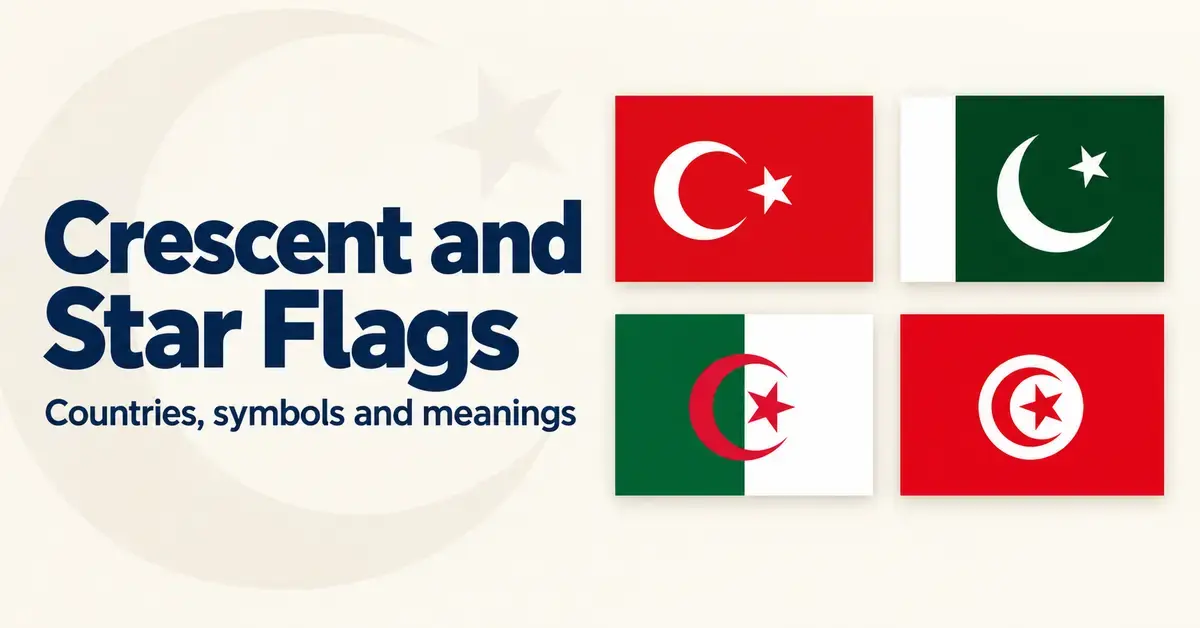
A crescent paired with a star is one of the most recognisable emblems in vexillology (the study of flags), appearing on the national flags of more than a dozen countries from North-West Africa to South-East Asia. This guide to crescent and star flags lists every national flag that carries the pair, explains what the symbol is commonly said to mean on each one, and traces where it came from — including why it is far older than Islam and, strictly speaking, not an official religious symbol at all. It builds on our overview of what flag colours and symbols mean and zooms in on this single symbol family in detail.
Key Points
- What it is: a crescent moon paired with one or more stars, usually white or gold on a solid field.
- Who uses it: around a dozen national flags, among them Turkey, Pakistan, Algeria, Tunisia, Libya, Mauritania, Azerbaijan, Turkmenistan, Uzbekistan, Malaysia, Singapore and Comoros; the Maldives uses a crescent with no star.
- Religious framing: widely linked to Islam, but not an official symbol of the faith and not mentioned in the Quran.
- Older than Islam: the moon-and-star motif goes back to the ancient Near East, Byzantium and Sasanian Persia before the Ottomans made it a Muslim state emblem.
- Not always religious: on some flags it signals Turkic heritage (Turkey, Azerbaijan), a young nation (Singapore) or national rebirth (Uzbekistan).
- The stars vary: points range from five to fourteen, and extra stars often count islands, provinces or ideals rather than repeating a religious message.
What is the star and crescent?
The star and crescent is a symbol that combines a crescent moon with one or more stars, usually placed so the moon’s open “cup” faces the star. On flags it is most often white or gold and sits against a solid field of colour. The crescent is a thin, waxing-moon shape rather than a full or half disc, and the accompanying star can have anywhere from five to fourteen points depending on the country.
There is no single, fixed version of the emblem. The number of star points, the direction the crescent opens, and whether a star appears at all vary from flag to flag. That variety is the first clue that the symbol carries different meanings in different places rather than one universal message.
Is the crescent and star an Islamic symbol?
The crescent and star is widely associated with Islam today, but it is not an official symbol of the religion and does not appear in the Quran or the Hadith. Many Muslim scholars point out that Islam’s emphasis on the oneness of God discourages fixed religious imagery, and some reject the idea that any emblem can stand for the faith. The link between the symbol and Islam is relatively modern and grew largely out of the Ottoman Empire’s use of it and European writers who, from the 19th century onward, treated it as Islam’s equivalent of the Christian cross.
At the same time, the association is real and meaningful for many nations. A number of Muslim-majority countries chose the crescent and star precisely to express an Islamic identity, and relief movements such as the Red Crescent adopted it as a culturally appropriate alternative to the Red Cross — Iran, for example, formally switched to the Red Crescent emblem in 1980. So the honest summary is this: the crescent and star is not a doctrinal symbol of Islam, but it has become a widely recognised cultural marker of Muslim heritage, and several states use it deliberately in that spirit.
It is also important to note the symbol is not exclusively religious. On some flags it signals Turkic heritage, a young and rising nation, or simply continuity with an older banner, as the sections below show.
Where did the star and crescent come from?
The star and crescent is far older than Islam, with roots stretching back thousands of years to the ancient Near East. Historians trace several overlapping stages, though the exact origins are hard to pin down and specific dates vary between sources.
The ancient Near East
Both elements appear in the iconography of the ancient Near East, where the crescent is often linked to a moon deity (such as Sin in Mesopotamia) and the star frequently represents the planet Venus or the sun. These are the earliest recorded uses of the moon-and-star pairing, long before any modern state existed.
The Greek city of Byzantium
The best-documented early user is Byzantium, the Greek city later rebuilt as Constantinople and today’s Istanbul. The crescent appears on the city’s coins from around the 4th century BCE and was connected to goddesses such as Artemis or Hecate. A popular legend credits a crescent moon with helping the city repel a night attack, but that is a story rather than verified history.
Sasanian Persia and early Islam
In Sasanian Persia (224–651 CE) the crescent and star became a common feature on royal crowns and on silver coins. After the Islamic conquest of Persia, early Muslim coinage initially kept these Sasanian design elements — so the motif appeared on early Islamic coins before it was ever thought of as an Islamic symbol.
The Ottoman Empire
The Ottoman Empire is where the symbol became firmly tied to a Muslim state. A traditional account says the Ottomans adopted the crescent after capturing Constantinople in 1453, though historians are cautious about that story. What is clearer is that the star and crescent came into official Ottoman use later, during the 18th and 19th centuries, and that European observers increasingly read it as the emblem of Islam itself. The crescent alone also has a long history among Turkic peoples, which is why it still signals Turkic as well as Islamic identity on some flags.
Which countries have a crescent and star on their flag?
At least a dozen sovereign states fly a national flag featuring a crescent and star, concentrated in North Africa, the Middle East, the Caucasus, Central Asia and South-East Asia. The table below is a quick reference; the sections beneath it explain each flag and the meaning most commonly attached to it. Remember that these meanings are usually interpretations recorded by flag historians rather than official government statements.
Crescent and Star Flags at a Glance
| Country | Flag field | Crescent & star | Commonly represents |
|---|---|---|---|
| Turkey | Red | White crescent, one 5-point star | Ottoman and Turkic heritage; Islam |
| Pakistan | Green with white hoist stripe | White crescent and star | Progress, light, Muslim majority |
| Algeria | Vertical green and white | Red crescent and star | Islam, purity, independence |
| Tunisia | Red with white disc | Red crescent and star | Islam; Husainid and Ottoman heritage |
| Libya | Red-black-green, emblem on black | White crescent and star | Islam; Senussi dynasty heritage |
| Mauritania | Green with two red stripes | Gold crescent and star | Islam, the Sahara, sacrifice |
| Azerbaijan | Blue-red-green, emblem on red | White crescent, one 8-point star | Turkic identity; Islam |
| Turkmenistan | Green with carpet stripe | White crescent and five stars | Islam; five provinces |
| Uzbekistan | Blue-white-green | White crescent and twelve stars | National rebirth; zodiac and months |
| Malaysia | Red-and-white stripes, blue canton | Yellow crescent, one 14-point star | Islam; unity of states and federation |
| Singapore | Red over white | White crescent and five stars | Young nation; democracy, peace, progress, justice, equality |
| Comoros | Four stripes, green triangle | White crescent and four stars | Islam; four main islands |
| Maldives | Red with green rectangle | White crescent, no star | Islam; sacrifice and prosperity |
Turkey
Turkey flies a white crescent and a five-pointed star on a red field, the flag Turks call Ay Yıldız (“moon star”). The basic design took shape under Sultan Selim III around 1793, when red flags gained a white crescent and a multi-pointed star; the five-pointed version dates from roughly 1844. The red field is popularly tied to martyrs’ blood, but that is national narrative rather than documented fact, and the crescent itself has pre-Islamic and Turkic roots far older than the modern republic.
Pakistan
Pakistan’s flag places a white crescent and five-pointed star on a dark-green field, with a white vertical stripe at the hoist (the edge nearest the pole). The green is commonly read as representing the Muslim majority and the white stripe as representing religious minorities. The crescent is often said to stand for progress and the star for light and knowledge, while some sources link the star’s five points to the five pillars of Islam.
North African flags
Four North African states use the symbol, each in a distinctive setting:
- Algeria — a vertical green-and-white field with a red crescent and red five-pointed star at the centre, adopted on 3 July 1962. Green is commonly linked to Islam and white to purity or peace; the star is sometimes tied to the five pillars of Islam.
- Tunisia — a red field with a white disc containing a red crescent and five-pointed star. Its origins go back to the Husainid dynasty around 1831, and it was modelled partly on the Ottoman flag; it became the republic’s flag in 1959 and was fixed in law in 1999.
- Libya — a white crescent and star sit on the central black band of a red-black-green tricolour, a 1951 design revived in 2011 that comes from the banner of the Senussi dynasty of Cyrenaica. The crescent and star here are traditional symbols of Islam.
- Mauritania — a gold crescent and five-pointed star on a green field, with two red stripes added at the top and bottom after a 2017 referendum. Green and the gold emblem are linked to Islam, the gold also to the Sahara’s sands, and the red stripes to the blood and sacrifice of those who defended the country.
The Caucasus and Central Asia
Three post-Soviet states carry the crescent with differing star counts, and their meanings are often national rather than purely religious:
- Azerbaijan — a white crescent and an eight-pointed star on the red band of a blue-red-green tricolour. The most common explanation links the eight points to the eight letters of “Azerbaijan” in Arabic script; others read them as the branches of the Turkic peoples. Historians remain divided.
- Uzbekistan — a white crescent with twelve white stars on a blue-white-green field. Here the crescent is officially read as a symbol of national rebirth rather than religion, and the twelve stars are linked to the signs of the zodiac and the months of the year.
- Turkmenistan — a white crescent and five white stars beside an ornamental carpet stripe on a green field. The five stars are commonly tied to the country’s five provinces, and the carpet designs honour Turkmen weaving traditions.
South-East Asia
Two neighbouring states use the symbol very differently:
- Malaysia — the Jalur Gemilang carries a yellow crescent and a 14-point star in a blue canton above red-and-white stripes. The crescent represents Islam as the state religion, the yellow is the colour of the Malay rulers, and the star’s 14 points stand for the unity of the states and federal government.
- Singapore — a white crescent with five stars in the upper red band. Singapore’s authorities describe these as secular: the National Heritage Board says the crescent represents a young nation on the rise and the five stars stand for democracy, peace, progress, justice and equality.
Island nations
- Comoros — a green triangle at the hoist bears a white crescent and four white stars, set against four coloured stripes. Both the four stars and the four stripes stand for the country’s four main islands, while the crescent and the green represent Islam.
- Maldives — a red field surrounds a green rectangle containing a white crescent, and crucially there is no star. Unusually, the crescent opens toward the fly (the free edge) rather than the hoist. The crescent represents Islam, red the sacrifice of the nation’s heroes and green peace and prosperity.
Crescent flags without a star, and flags with several stars
Not every crescent flag follows the single-crescent-and-one-star pattern, and this is where casual readers slip up. The Maldives uses a crescent with no star at all. Comoros, Turkmenistan, Uzbekistan and Singapore pair a crescent with several stars — four, five, five and five respectively — where the extra stars count islands, provinces, zodiac signs or civic ideals rather than repeating a religious message. Malaysia’s single star has 14 points and Azerbaijan’s has eight, while most others use a five-pointed star. The lesson is that the stars are often the “local” part of the design, carrying a meaning specific to that nation.
Common mistakes and misconceptions
The biggest mistake is assuming every crescent-and-star flag is a religious statement. It often is a marker of Muslim heritage, but Singapore’s crescent is explicitly secular, Uzbekistan’s stands for national rebirth, and Turkey’s traces back to pre-Islamic and Turkic roots. Other frequent errors:
- Treating it as “the Islamic flag.” There is no single official flag of Islam, and the symbol itself is not mentioned in the Quran.
- Confusing similar designs. Turkey (white on red) and Tunisia (white disc on red) look alike at a glance but differ in the white circle and the crescent’s position.
- Assuming the crescent always faces the same way. The Maldives flag opens its crescent toward the fly, the opposite of most crescent flags.
- Expecting a five-pointed star everywhere. Malaysia uses 14 points and Azerbaijan eight, each with its own explanation.
- Taking colour meanings as official. Most of the “red means sacrifice, green means Islam” readings are interpretations by flag historians, not statements in national law.
How to tell crescent and star flags apart
The quickest way to identify a crescent flag is to read three things in order: the field colour, the number and colour of stars, and the position of the emblem. A plain red field with a white crescent and one star is Turkey; the same colours but with a white disc around them is Tunisia. A green field with a gold emblem points to Mauritania; a vertical green-and-white split with a red emblem is Algeria. Several stars usually mean the flag is counting something local — islands for Comoros, provinces for Turkmenistan, ideals for Singapore. For a broader walk through other emblems and colour families, see our answers to common questions about world flags, and you can browse the full reference from our country flags of the world homepage.
Sources
- Flags of the World — Turkey
- Flags of the World — Malaysia
- Flags of the World — Algeria
- Encyclopaedia Britannica — Flag of Tunisia
- Encyclopaedia Britannica — Flag of Turkey
- National Heritage Board, Singapore — The National Flag
- WorldAtlas — Flag of Azerbaijan
- WorldAtlas — Flag of Mauritania
- ICRC Casebook — Iran and the Red Crescent emblem
Frequently Asked Questions (FAQ)
How many countries have a crescent and star on their flag?
Around a dozen sovereign states use a crescent and star on their national flag, including Turkey, Pakistan, Algeria, Tunisia, Libya, Mauritania, Azerbaijan, Turkmenistan, Uzbekistan, Malaysia, Singapore and Comoros. The Maldives uses a crescent but no star. Exact counts differ slightly depending on whether crescent-only flags and partially recognised states are included.
Is the crescent and star a symbol of Islam?
It is widely associated with Islam but is not an official religious symbol and does not appear in the Quran or Hadith. The link grew mainly through the Ottoman Empire and 19th-century European usage. Many Muslim-majority states nonetheless chose it to express their heritage, and relief bodies such as the Red Crescent adopted it as a culturally appropriate emblem.
Did the star and crescent exist before Islam?
Yes, by many centuries. The moon-and-star pairing appears in the ancient Near East, on the coins of the Greek city of Byzantium from around the 4th century BCE, and on the crowns and coins of Sasanian Persia. It only became tied to a Muslim state under the Ottomans, long after these earlier uses.
Why do crescent-and-star flags have different numbers of stars?
Because the stars usually carry a local meaning. Comoros has four stars for its four main islands, Turkmenistan has five for its provinces, Uzbekistan has twelve for the zodiac and months, and Singapore has five for its national ideals. Malaysia’s single star has 14 points for its states and federal government, while Azerbaijan’s has eight.
Which country’s flag has a crescent but no star?
The Maldives. Its flag shows a white crescent on a green rectangle inside a red border, with no star, and the crescent unusually opens toward the fly rather than the hoist. The crescent represents Islam, the state religion, while red and green are read as sacrifice and prosperity.
