

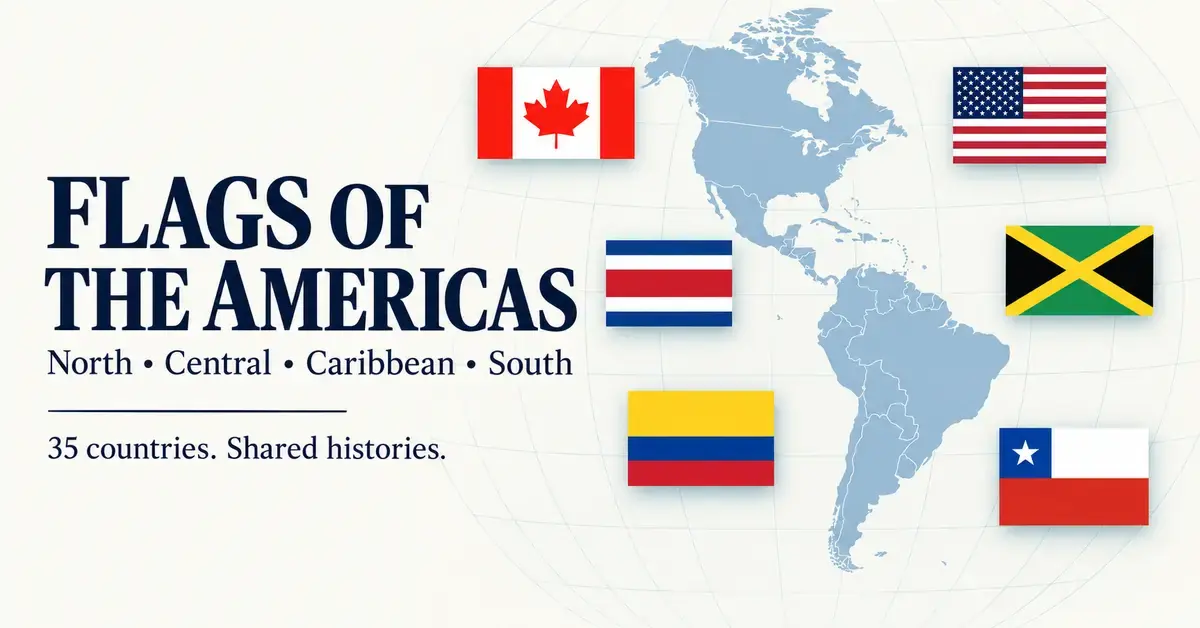
The Americas stretch from the Arctic coast of Canada to the southern tip of Chile, and across that huge span 35 sovereign countries each fly their own national flag. Many of those flags look strikingly alike, because the nations of North, Central and South America won their independence in overlapping waves during the late 1700s and 1800s and borrowed one another’s colours and symbols. This guide walks through every national flag of the Americas region by region, sets out the full list in one table, and explains the shared design families that tie the continent together.
Key Points
- The Americas have 35 sovereign countries, each with its own national flag.
- They divide into four groups: North America (3), Central America (7), the Caribbean (13) and South America (12).
- Many flags share independence-era roots — the US stars and stripes, the Central American blue-white-blue triband (from Argentina), and the Gran Colombia yellow-blue-red tricolour.
- Blue, white and red are the most common colours across the region.
- Paraguay’s flag is the only national flag with different designs on its two sides.
How many flags are there in the Americas?
There are 35 national flags in the Americas, one for each sovereign state. All 35 are members of the United Nations and of the Organization of American States. Dozens of other territories in the region fly flags too — places such as Puerto Rico, Bermuda and the French overseas departments — but these are not independent countries, so they are not counted among the 35.
Geographers usually split those 35 states into four groups. Keeping the groups in mind makes the flags far easier to learn, because countries in the same group tend to share a design heritage.
- North America (3): Canada, the United States and Mexico.
- Central America (7): Belize, Costa Rica, El Salvador, Guatemala, Honduras, Nicaragua and Panama.
- The Caribbean (13): Antigua and Barbuda, the Bahamas, Barbados, Cuba, Dominica, the Dominican Republic, Grenada, Haiti, Jamaica, Saint Kitts and Nevis, Saint Lucia, Saint Vincent and the Grenadines, and Trinidad and Tobago.
- South America (12): Argentina, Bolivia, Brazil, Chile, Colombia, Ecuador, Guyana, Paraguay, Peru, Suriname, Uruguay and Venezuela.
Mexico sits on the North American landmass but is culturally part of Latin America, so you will sometimes see it grouped with Central America instead. Either way the total stays at 35.
Flags of North America
North America’s three flags are among the most recognisable in the world, and no two of them resemble each other. The United States flag carries 13 red-and-white stripes for the original colonies and 50 white stars for the current states; the 50-star version has been official since 4 July 1960, after Hawaii joined the union. Canada’s red-and-white flag, with its single 11-pointed maple leaf, was proclaimed in 1965 and replaced earlier ensigns based on the British flag. Mexico’s green-white-red tricolour places a golden eagle perched on a cactus and devouring a snake at its centre, an image drawn from an Aztec founding legend.
Each of these flags anchors a wider story of national symbolism. For the United States and Canada specifically, dedicated profiles go far deeper into their stars, stripes and the maple leaf than a continental overview can.
Flags of Central America
Central America is the clearest example of a shared flag family in the Americas. Five of its seven nations — El Salvador, Guatemala, Honduras, Nicaragua and Costa Rica — descend from the blue-white-blue flag of the former United Provinces of Central America, a federation that existed in the 1820s and 1830s.
El Salvador and Nicaragua keep the design closest to the original: a blue-white-blue horizontal triband with a national coat of arms in the central white band. Honduras uses the same triband but adds five blue stars in the middle, representing the five federation members and the hope of reuniting them. Guatemala turned the stripes upright, producing a vertical blue-white-blue flag with its national emblem and a resplendent quetzal bird. Costa Rica is the outsider of the group: in 1848 it inserted a wide red band through the centre, so its flag reads blue-white-red-white-blue. The two remaining countries stand apart — Belize carries the most detailed national emblem in the Americas, including two human figures, while Panama uses a quartered red, white and blue field with two stars.
Flags of the Caribbean
The Caribbean has the most varied flags in the Americas, reflecting independence movements that arrived later, mostly in the 20th century. Cuba and the Dominican Republic broke away from Spain in the 1800s and show older, European-influenced designs; Cuba’s five stripes and white star in a red triangle were themselves modelled on the United States flag. Most of the English-speaking islands became independent from Britain in the 1960s, 1970s and 1980s, and their flags lean on bold geometry and local nature rather than inherited tricolours.
Jamaica’s gold saltire on green and black is one of the few national flags in the world to use no red, white or blue. Barbados features a black trident head, a nod to the sea and a deliberate break from the colonial past. Dominica’s flag is one of the only national flags to include the colour purple, in the plumage of its endemic Sisserou parrot. The Bahamas, Trinidad and Tobago, Saint Lucia and Saint Kitts and Nevis all build their designs around a single strong diagonal or triangle, making them easy to tell apart at a glance.
Flags of South America
South America’s twelve flags fall mostly into two design families plus a handful of distinctive outliers. The first family is the blue-and-white banner of Argentina and Uruguay, both carrying a golden “Sun of May” that marks the month of the 1810-11 independence movements. The second is the yellow-blue-red tricolour shared by Colombia, Ecuador and Venezuela, inherited from the short-lived republic of Gran Colombia.
The outliers are memorable. Brazil’s green field, yellow rhombus and blue celestial globe carry 27 white stars — one for each state and the federal district — beneath the motto “Ordem e Progresso” (“Order and Progress”); it has more stars than any other flag in the Americas. Chile pairs a white-over-red field with a blue canton and a single white star. Guyana’s “Golden Arrowhead” uses layered triangles in green, gold, red, black and white. Peru’s vertical red-white-red flag, Bolivia’s red-yellow-green tricolour and Suriname’s green-white-red design with a central yellow star round out the continent. Brazil in particular rewards a closer look, since its stars map the night sky over Rio de Janeiro on a single historic date.
All flags of the Americas at a glance
The table below lists every sovereign national flag in the Americas, grouped by region, with its main colours and the feature that sets it apart. Use it as a quick reference when you are trying to identify a flag or compare designs across the region.
Flags of the Americas
| Country | Region | Main colours | Distinctive feature |
|---|---|---|---|
| Canada | North America | Red, white | Single red maple leaf on a white square |
| United States | North America | Red, white, blue | 13 stripes and 50 stars |
| Mexico | North America | Green, white, red | Eagle on a cactus eating a snake |
| Belize | Central America | Blue, red, white | Detailed emblem with two woodcutters |
| Costa Rica | Central America | Blue, white, red | Blue-white-red-white-blue bands |
| El Salvador | Central America | Blue, white | Blue-white-blue triband with central emblem |
| Guatemala | Central America | Blue, white | Vertical blue-white-blue with quetzal emblem |
| Honduras | Central America | Blue, white | Blue-white-blue with five central stars |
| Nicaragua | Central America | Blue, white | Blue-white-blue with triangle and rainbow emblem |
| Panama | Central America | Red, white, blue | Quartered field with two stars |
| Antigua and Barbuda | Caribbean | Red, black, blue, white, gold | Rising golden sun on black |
| Bahamas | Caribbean | Aquamarine, gold, black | Black triangle at the hoist |
| Barbados | Caribbean | Blue, gold | Black trident head in the centre |
| Cuba | Caribbean | Red, white, blue | Five stripes with a white star in a red triangle |
| Dominica | Caribbean | Green, red, yellow, black, white | Central Sisserou parrot (uses purple) |
| Dominican Republic | Caribbean | Blue, red, white | White cross with central coat of arms |
| Grenada | Caribbean | Red, gold, green | Nutmeg symbol and seven stars |
| Haiti | Caribbean | Blue, red | Central coat of arms with a palm |
| Jamaica | Caribbean | Green, gold, black | Gold saltire (no red, white or blue) |
| Saint Kitts and Nevis | Caribbean | Green, red, yellow, black | Diagonal black band with two white stars |
| Saint Lucia | Caribbean | Blue, gold, black, white | Central triangles for the Pitons |
| Saint Vincent and the Grenadines | Caribbean | Blue, gold, green | Three green diamonds |
| Trinidad and Tobago | Caribbean | Red, white, black | Diagonal black band edged in white |
| Argentina | South America | Light blue, white | Blue-white-blue with the Sun of May |
| Bolivia | South America | Red, yellow, green | Central coat of arms |
| Brazil | South America | Green, yellow, blue | Blue globe with 27 stars and “Ordem e Progresso” |
| Chile | South America | Red, white, blue | Blue canton with a single white star |
| Colombia | South America | Yellow, blue, red | Double-width yellow band, no emblem |
| Ecuador | South America | Yellow, blue, red | Horizontal tricolour with central condor emblem |
| Guyana | South America | Green, gold, red, black, white | “Golden Arrowhead” triangles |
| Paraguay | South America | Red, white, blue | Different emblems on each side (unique) |
| Peru | South America | Red, white | Vertical red-white-red with central emblem |
| Suriname | South America | Green, white, red, yellow | Central yellow star |
| Uruguay | South America | Blue, white | Nine stripes and the Sun of May |
| Venezuela | South America | Yellow, blue, red | Horizontal tricolour with an arc of eight stars |
Shared independence-era motifs across the Americas
The reason so many flags of the Americas look related is history, not coincidence. Three design motifs spread from country to country during the independence era, and recognising them explains most of the look-alikes on the continent.
The stars-and-stripes influence
The United States flag became a template for several independence movements that admired the young republic. The clearest cases are in the Caribbean. Cuba’s flag borrowed the idea of stripes, a contrasting triangle and a single white star; when Puerto Rican exiles in New York designed their own flag in 1895, they simply swapped Cuba’s red and blue as a gesture of solidarity, which is why the two look like mirror images. Chile’s lone star and Uruguay’s blue-and-white stripes are often compared to the US flag as well, though historians treat those as parallel resemblances rather than proven copies, since both designs have their own local roots.
The blue-white-blue group
The blue-white-blue triband began in Argentina. General Manuel Belgrano created a blue-and-white banner in 1812, and the colours travelled north through the independence wars — carried, according to Britannica and the Flags of the World project, by the privateer Louis Aury to the Caribbean coast and then taken up for the flag of the United Provinces of Central America, adopted in 1823. When the federation dissolved, El Salvador, Guatemala, Honduras, Nicaragua and Costa Rica each kept a version of the triband. That single Argentine design therefore lives on in six national flags across two sub-regions today.
The yellow-blue-red group
Colombia, Ecuador and Venezuela share a yellow-blue-red horizontal tricolour inherited from Gran Colombia, the union these three countries formed under Simón Bolívar in the 1820s. The design is credited to the revolutionary Francisco de Miranda, who first raised a yellow-blue-red flag for the First Republic of Venezuela in 1811. After Gran Colombia broke apart around 1830, each successor state kept the colours and added its own distinguishing mark: Colombia widened the yellow band, Ecuador and Venezuela added coats of arms, and Venezuela arranged eight white stars in an arc.
Common colours and symbols on flags of the Americas
Blue, white and red are the most common colours on flags of the Americas, a direct result of the independence-era families described above and of European influence on the oldest designs. Green and gold are far more common in the Caribbean and the Guianas, where flags lean on tropical nature rather than inherited tricolours.
Recurring symbols tell the same story of shared history. Stars stand for states, provinces or guiding ideals, from Brazil’s 27 to Honduras’s five. Suns — especially the radiant Sun of May on the flags of Argentina and Uruguay — mark the dawn of independence. Coats of arms in the centre of a flag, seen on Mexico, the Central American states, Ecuador and others, usually pack in national emblems such as birds, mountains and liberty caps. For a broader explanation of how these elements work, see our overview of what flag colours and symbols mean.
Common mistakes when identifying flags of the Americas
Even careful readers trip over a few predictable things when they try to tell these flags apart.
- Confusing the three yellow-blue-red flags. Colombia, Ecuador and Venezuela share the same colours. The quickest tells: Colombia’s plain flag has a double-width yellow band and no emblem; Ecuador and Venezuela add a coat of arms, and Venezuela has a visible arc of stars.
- Mixing up El Salvador, Nicaragua and Honduras. All three are blue-white-blue tribands. Honduras has five blue stars in the centre; Nicaragua’s emblem contains a triangle and a rainbow; El Salvador’s shows a triangle with volcanoes and the federation name.
- Assuming Mexico’s flag is Italy’s. Both are green-white-red vertical tricolours, but Mexico carries the eagle-and-snake emblem in the centre, which Italy’s flag does not.
- Treating Puerto Rico as a country. Its flag appears in many “flags of the Americas” charts, but Puerto Rico is a US territory, not one of the 35 sovereign states.
- Counting the stars wrong. People often guess the US flag has the most stars in the Americas; Brazil’s 27 actually outnumber the United States’ 50 only in meaning, not in count — the US flag does carry the most stars in the region, while Brazil carries the most that each stand for a single state.
Who this guide is for
This overview is written for students, quiz fans, travellers and anyone curious about why the flags of a whole hemisphere rhyme with one another. It is a free informational reference — country flags of the world explained, not a shop — and it is designed to send you onward to the detailed profiles of individual countries and symbols. If you have a quick factual question instead, our flag FAQs answer the most common ones, and our editorial policy explains how we verify every flag fact.
Sources
- Encyclopaedia Britannica — Flag of El Salvador (Argentine influence on Central American flags)
- Encyclopaedia Britannica — Flag of Puerto Rico (derived from the Cuban and US flags)
- Flags of the World — United Provinces of Central America
- Flags of the World — Flag of Gran Colombia
- Flags of the World — Flag of Paraguay (two-sided design)
- WorldAtlas — Flag of Brazil (27 stars; current design 1992)
- Nations Online Project — Flags of the Americas
Frequently Asked Questions (FAQ)
How many national flags are there in the Americas?
There are 35, one for each sovereign country in the region: 3 in North America, 7 in Central America, 13 in the Caribbean and 12 in South America. All 35 are members of the United Nations and the Organization of American States. Territories such as Puerto Rico are not counted because they are not independent states.
Why do so many Latin American flags look alike?
Because they share independence-era roots. Argentina’s blue-white-blue banner spread through Central America, Gran Colombia’s yellow-blue-red tricolour was inherited by Colombia, Ecuador and Venezuela, and the United States flag influenced Cuba and Puerto Rico. Neighbouring nations deliberately echoed one another’s colours to show common cause.
Which flag in the Americas has the most stars?
Among flags whose stars each represent a state, Brazil leads with 27 — one for every Brazilian state plus the federal district. The United States flag carries 50 stars, the highest raw number of any flag in the region, with each star standing for a US state.
Which flag of the Americas is unique for having two different sides?
Paraguay’s. It is widely described as the only national flag whose front and back carry different emblems: the obverse shows the national coat of arms with the Star of May, while the reverse shows the treasury seal with a lion and a liberty cap above the motto “Paz y Justicia” (“Peace and Justice”).
What are the most common colours on flags of the Americas?
Blue, white and red appear most often, carried over from the independence-era design families and the oldest European-influenced flags. Green and gold are especially common in the Caribbean and the Guianas, where designs draw on tropical landscapes rather than inherited tricolours.
