

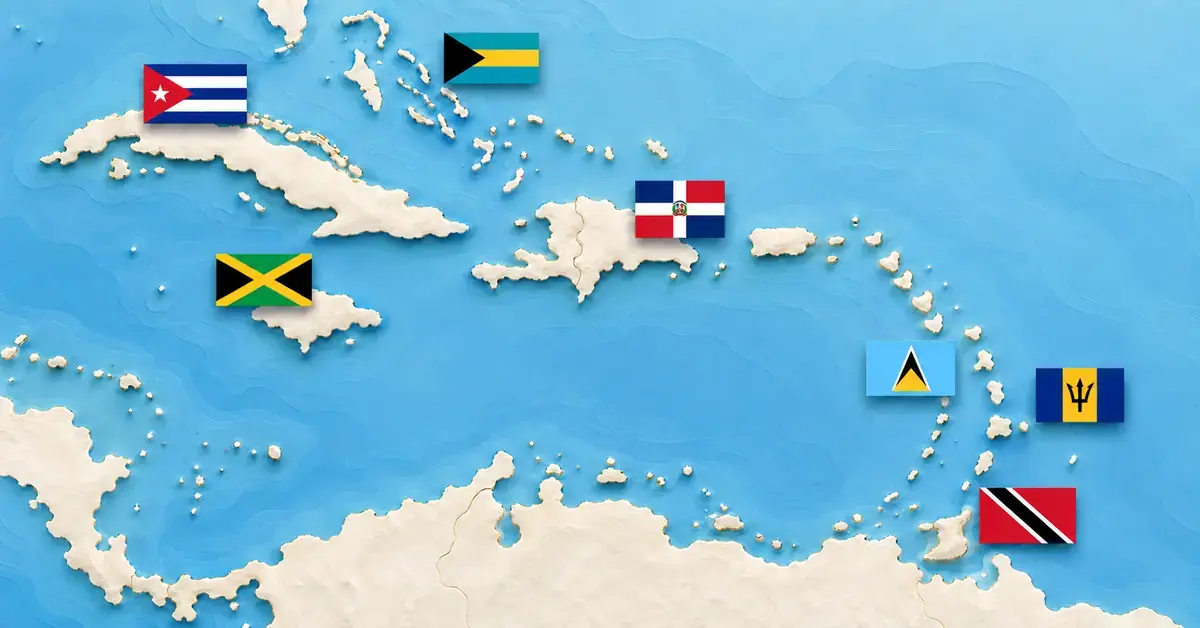
The Caribbean packs more national flags into a small stretch of sea than almost anywhere else on Earth. Thirteen independent island nations stretch from Cuba in the north-west to Trinidad and Tobago off the South American coast, and each one flies a flag shaped by a distinct colonial past — Spanish, French, British or Dutch — and a hard-won independence. This guide explains all thirteen flags of the Caribbean: their colours, their symbols and the history behind them, plus the design themes that tie the region together and the details that set each island apart.
Key Points
- 13 flags: The Caribbean has 13 sovereign island nations, each with its own national flag.
- Independence era: Most were adopted between 1962 and 1983 as the islands gained independence.
- Shared palette: Blue for the sea, gold for sand and sun, green for vegetation and black for African heritage recur across the region.
- Jamaica is unique: it is the only national flag with no red, white or blue.
- Easy mix-up: Dominica and the Dominican Republic are different countries with very different flags.
How many Caribbean countries have their own flag?
Thirteen sovereign island nations in the Caribbean fly their own national flag. They are Antigua and Barbuda, the Bahamas, Barbados, Cuba, Dominica, the Dominican Republic, Grenada, Haiti, Jamaica, Saint Kitts and Nevis, Saint Lucia, Saint Vincent and the Grenadines, and Trinidad and Tobago. Every one of them except Cuba and the Dominican Republic belongs to the Caribbean Community (CARICOM), the regional bloc.
Many more Caribbean islands have flags of their own but are not independent countries. Puerto Rico and the US Virgin Islands are United States territories; Martinique and Guadeloupe are part of France; Curaçao, Aruba and Sint Maarten sit within the Kingdom of the Netherlands; and the Cayman Islands, the British Virgin Islands and Montserrat are British Overseas Territories whose flags still carry the Union Jack. This guide focuses on the thirteen fully independent nations.
Caribbean flags at a glance
The table below summarises all thirteen national flags — their main colours, the year each current flag was adopted, and the single feature that makes each one recognisable. Detailed explanations follow underneath.
Caribbean Flags at a Glance
| Nation | Main colours | Current flag adopted | Standout feature |
|---|---|---|---|
| Antigua and Barbuda | Red, black, blue, white, gold | 1967 | Golden rising sun over a V |
| The Bahamas | Aquamarine, gold, black | 1973 | Black triangle at the hoist |
| Barbados | Blue, gold | 1966 | Black broken trident |
| Cuba | Blue, white, red | 1902 | Red triangle with a lone white star |
| Dominica | Green, yellow, black, white, red | 1978 | Purple Sisserou parrot and ten stars |
| Dominican Republic | Blue, red, white | 1844 | White cross and coat of arms with a Bible |
| Grenada | Red, gold, green | 1974 | Nutmeg and seven stars |
| Haiti | Blue, red (white panel on state flag) | 1803 (restored 1986) | Palm and liberty cap on the coat of arms |
| Jamaica | Black, gold, green | 1962 | Gold saltire; no red, white or blue |
| Saint Kitts and Nevis | Green, red, yellow, black | 1983 | Diagonal black band with two white stars |
| Saint Lucia | Blue, gold, black, white | 1967 | Triangles evoking the Pitons |
| Saint Vincent and the Grenadines | Blue, gold, green | 1985 | Three green diamonds in a V |
| Trinidad and Tobago | Red, black, white | 1962 | White-edged black diagonal band |
The 13 Caribbean flags, explained one by one
Here is each national flag in alphabetical order, with its design, the meaning of its colours and symbols, and the date it was adopted.
Antigua and Barbuda
Antigua and Barbuda’s flag was adopted on 27 February 1967 and designed by artist Sir Reginald Samuel. A golden rising sun sits on a black band, framed by a red field that forms a downward-pointing V of white, blue and black. The sun marks the dawn of a new era; black honours the islanders’ African heritage; blue stands for hope and the Caribbean Sea; red for the energy of the people; and the V itself for victory. The gold, blue and white beneath the sun are read as the sun, sea and sand.
The Bahamas
The Bahamian flag, raised at independence on 10 July 1973, is a horizontal band of aquamarine, gold and aquamarine with a black equilateral triangle at the hoist. The two aquamarine stripes represent the sea surrounding the islands, the gold the sun and sandy shores, and the black triangle the strength and enterprise of the Bahamian people, pointing toward the land and sea resources they are determined to develop. It replaced the colonial Blue Ensign that had carried the Union Jack.
Barbados
Barbados first flew its flag on 30 November 1966, the day it became independent. Two ultramarine-blue bands frame a golden centre, with a black broken trident in the middle. The blue represents the sea and sky, the gold the island’s sand. The trident head comes from the figure of Britannia on the old colonial badge; its broken shaft signals a clean break from Barbados’s colonial and constitutional past, and its three prongs are linked to the principles of democracy.
Cuba
Cuba’s flag, nicknamed La Estrella Solitaria (the Lone Star), has three blue stripes, two white stripes and a red triangle at the hoist bearing a single white five-pointed star. Designed in 1849 by exiled independence leaders and officially adopted on 20 May 1902, the three blue stripes are usually said to represent the island’s colonial districts, the white the purity of the independence cause, and the red triangle liberty, equality and the blood shed for freedom. The lone star stands for independence.
Dominica
Dominica flies one of the world’s most distinctive flags, adopted on 3 November 1978 with small refinements made in 1981, 1988 and 1990. On a forest-green field, a cross of yellow, black and white bands carries a red disc at its centre, and on that disc stands a purple Sisserou parrot ringed by ten green stars. The parrot is found only in Dominica; the ten stars represent the island’s ten parishes; the cross stands for Christian faith; and the yellow, black and white evoke sunshine and the Kalinago people, fertile soil and African heritage, and the island’s rivers. It is one of only two national flags in the world to use purple.
Dominican Republic
The Dominican Republic’s flag, first raised in 1844 when the country won independence from Haiti, places a white cross over four rectangles — blue and red — with the national coat of arms at the centre. The white cross stands for faith and salvation, the blue for liberty, the red for the blood of those who fought for independence. Its coat of arms is unique among national flags in featuring an open Bible, alongside a cross, laurel and palm and the motto Dios, Patria, Libertad (God, Fatherland, Liberty).
Grenada
Grenada’s flag, adopted on 7 February 1974, combines red, gold and green. A red border holds six yellow stars, a seventh star sits on a red disc in the centre, and a small nutmeg pod appears on the hoist-side green triangle. Red stands for courage and vitality, gold for sunshine and wisdom, green for the island’s farmland. The seven stars represent Grenada’s seven parishes, and the nutmeg recalls the island’s status as one of the world’s leading nutmeg producers.
Haiti
Haiti’s flag is two horizontal bands, blue over red; the state version adds a white panel bearing the coat of arms — a royal palm topped by a liberty cap, with the motto L’Union fait la force (Unity makes strength). Tradition holds that in 1803 Jean-Jacques Dessalines tore the white from the French tricolour and that Catherine Flon stitched the remaining blue and red together, an act marked each 18 May as Flag Day. The blue and red are commonly read as the union of the country’s Black and mixed-heritage populations. After a black-and-red interlude under the Duvalier governments, the blue-and-red flag was restored in 1986.
Jamaica
Jamaica’s flag, adopted on 6 August 1962, is a golden saltire — a diagonal cross — dividing the field into green triangles top and bottom and black triangles at the sides. Today black is said to represent the strength and creativity of the people, gold the sunshine and natural wealth, and green the land and its vegetation. It is the only national flag in the world that uses none of red, white or blue, a result of the design committee switching from stripes to a saltire to avoid clashing with the then-flag of Tanganyika.
Saint Kitts and Nevis
Saint Kitts and Nevis adopted its flag at independence on 19 September 1983, from a design chosen in a national competition. A black band edged in yellow runs diagonally from the lower hoist to the upper fly, carrying two white stars, with a green triangle above and a red one below. Green stands for the islands’ fertile land, red for the struggle against slavery and colonialism, black for African heritage, and yellow for year-round sunshine. The two stars stand for the two islands and for hope and liberty.
Saint Lucia
Saint Lucia’s flag, designed by Dunstan St Omer and first flown on 1 March 1967, sets a golden triangle in front of a larger black triangle edged in white, all on a cerulean-blue field. The blue represents the sky and the waters around the island, the gold its sunshine and prosperity. The triangles echo Saint Lucia’s twin Pitons, the volcanic peaks near Soufrière, while the black and white are read as the harmonious blend of the island’s cultures. The proportions were refined in 1979 and again in 2002.
Saint Vincent and the Grenadines
Saint Vincent and the Grenadines flies a flag nicknamed “The Gems”, adopted in 1985 to replace an earlier independence-era design. It is a vertical triband of blue, gold and green with three green diamonds arranged in a V at the centre. Blue stands for the sky and sea, gold for the warm sand and the islanders’ bright spirit, green for the lush vegetation. The three diamonds form a “V” for Vincent and nod to the country’s nickname, the “Gems of the Antilles”.
Trinidad and Tobago
Trinidad and Tobago’s flag, adopted at independence on 31 August 1962 and designed by Carlisle Chang, is a red field crossed by a white-edged black diagonal band running from the upper hoist to the lower fly. Red stands for the warmth of the people and the sun, black for the nation’s strength, unity and wealth, and white for the surrounding sea and the purity of the country’s aspirations. The three colours are also linked to the elements of earth, water and fire.
What do Caribbean flags have in common?
Caribbean flags share a visual vocabulary drawn from the same landscape and history. Blue almost always means the sea or sky, while gold or yellow stands for sand and sunshine — you see the pairing in the Bahamas, Barbados, Saint Lucia and Saint Vincent. Green signals the islands’ farmland and forests, and black frequently honours African heritage, a legacy of the transatlantic slave trade that shaped the region’s population.
Two design devices recur. Many Caribbean flags use triangles or bold diagonals — Cuba, the Bahamas, Antigua, Saint Kitts and Trinidad among them — a family explored in our guide to flags with triangles. Stars are the other common motif, standing for islands, parishes or independence, as on the flags of Cuba, Dominica, Grenada and Saint Kitts; see what stars on national flags represent. For the wider picture of why nations pick the colours they do, our overview of what flag colours commonly mean covers each shade.
Why do several Caribbean flags share a story?
Most Caribbean flags were born in a single generation of independence. Jamaica and Trinidad and Tobago led the way in 1962, followed by Barbados (1966), the Bahamas (1973), Grenada (1974), Dominica (1978), Saint Lucia and Saint Vincent in the late 1970s and 1980s, and Saint Kitts and Nevis (1983). Before those dates the British islands flew colonial Blue Ensigns bearing the Union Jack and a local badge, so their modern flags were deliberately designed to look nothing like the old colonial standard.
Cuba (with its Spanish colonial past), the Dominican Republic (Spanish, then Haitian rule) and Haiti (French) took different routes, which is why their flags — crosses, stripes and coats of arms — stand apart from the former British islands. The Caribbean is part of the wider flags of the Americas, and you can place the region in global context through our flags of the world by continent directory.
Which Caribbean flag is the most unusual?
Several Caribbean flags are genuine outliers. Jamaica’s is the only national flag on Earth without any red, white or blue. Dominica’s is one of just two national flags to feature purple, thanks to its endemic Sisserou parrot. The Dominican Republic’s is the only national flag to display an open Bible. Barbados’s broken trident and Trinidad and Tobago’s single diagonal band are both rare designs. And Haiti and the Dominican Republic are among the countries whose flags change depending on whether the plain civil version or the government version with a coat of arms is flown.
Common mistakes people make with Caribbean flags
The most frequent mix-up is between Dominica and the Dominican Republic — two different countries with completely different flags. Dominica (the small island with the parrot) uses a green flag with a cross and a central red disc; the Dominican Republic (which shares the island of Hispaniola with Haiti) uses a blue-and-red flag with a white cross and coat of arms.
A second trap is Haiti’s plain blue-and-red civil flag, which is almost identical to Liechtenstein’s. The two nations only noticed the clash at the 1936 Berlin Olympics; Liechtenstein added a crown to its flag the following year to tell the two apart.
Readers also wrongly assume every Caribbean nation was a British colony. Haiti was French, while Cuba and the Dominican Republic were Spanish, and their flags reflect those different histories. Finally, Trinidad and Tobago sits just off the coast of Venezuela rather than deep in the island chain, so it is sometimes left off Caribbean lists even though it is firmly part of the region.
Sources
- Encyclopaedia Britannica — Flag of Haiti
- Encyclopaedia Britannica — Flag of the Bahamas
- CIA World Factbook — Dominica (Flag)
- CIA World Factbook — Saint Kitts and Nevis (Flag)
- Government of Dominica — The National Flag
- WorldAtlas — Flag of Grenada
- Flags of the World — Trinidad and Tobago
- Flagmakers — Flag of Barbados: A Brief History
Frequently Asked Questions (FAQ)
How many countries are in the Caribbean?
There are 13 sovereign island nations in the Caribbean, each with its own national flag: Antigua and Barbuda, the Bahamas, Barbados, Cuba, Dominica, the Dominican Republic, Grenada, Haiti, Jamaica, Saint Kitts and Nevis, Saint Lucia, Saint Vincent and the Grenadines, and Trinidad and Tobago. Dozens of other islands are territories of the United States, France, the Netherlands or the United Kingdom and are not counted as independent countries.
Which Caribbean flag has no red, white or blue?
Jamaica’s. Its gold saltire on black and green triangles makes it the only national flag in the world that uses none of the three most common flag colours. The design started out as horizontal stripes but was changed to a diagonal cross so it would not resemble the flag of Tanganyika.
What is the difference between the Dominica and Dominican Republic flags?
They belong to two separate countries. Dominica is a small island nation whose green flag carries a yellow-black-white cross and a red disc with a purple parrot. The Dominican Republic is a larger country on the island of Hispaniola whose flag has a white cross dividing blue and red rectangles, with a coat of arms at the centre.
Which Caribbean flag is the oldest?
Among the independent island nations, the Dominican Republic’s flag is the oldest still in use, dating to 1844. Cuba’s was designed in 1849 and officially adopted in 1902, while Haiti’s blue-and-red is older in origin — traced to 1803 — but was altered and only restored in its current form in 1986.
Why do so many Caribbean flags use blue and gold?
Blue and gold capture the region’s defining features: blue for the Caribbean Sea and sky that surround every island, and gold or yellow for the sunshine and sandy beaches. The pairing appears on the flags of the Bahamas, Barbados, Saint Lucia and Saint Vincent and the Grenadines, among others.
