

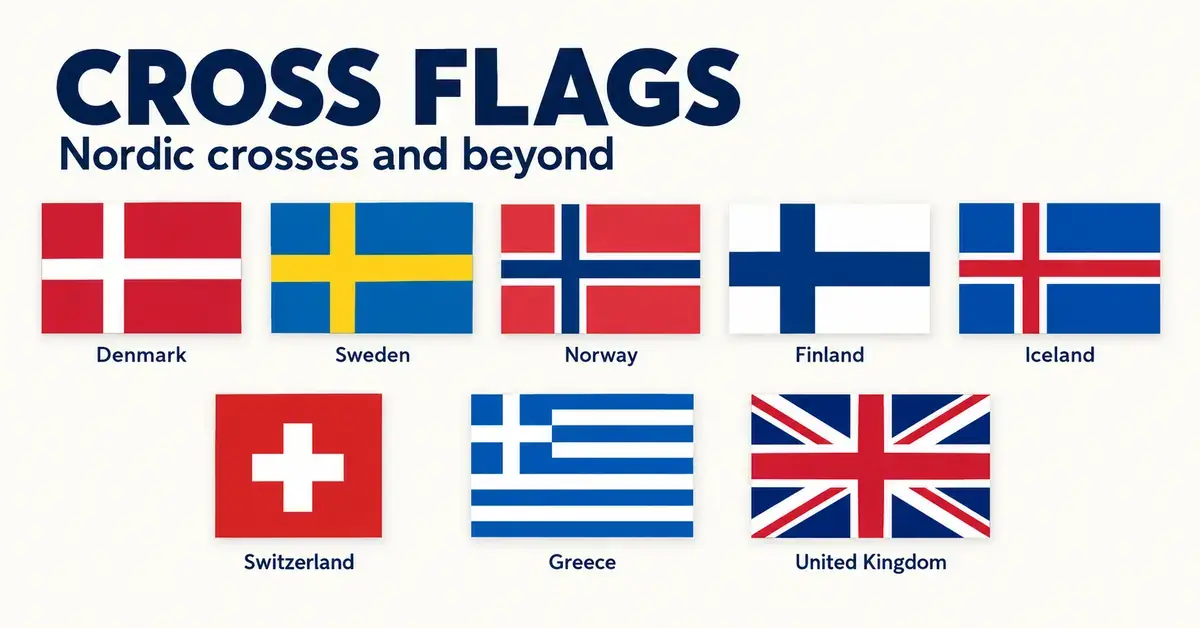
A cross flag is any flag whose main design is a cross — two bars, one horizontal and one vertical, crossing each other on a coloured field. It is one of the oldest and most widespread symbols in flag design, and it appears in two very different styles: the upright cross you see on the flags of Denmark, Switzerland and Greece, and the diagonal, X-shaped cross (called a saltire) hidden inside the Union Jack. This guide to cross flags explains the Nordic cross family that unites the five Scandinavian and Nordic countries, the other national flags that carry a cross, and what the symbol has come to mean. For the bigger picture of how symbols work on flags, see our overview of what flag colours and symbols mean.
Key Points
- A cross flag shows a cross as its main design; the two families are the upright cross and the diagonal saltire (an X shape).
- The Nordic cross is an upright cross shifted toward the hoist, shared by Denmark, Sweden, Norway, Finland and Iceland.
- Denmark’s Dannebrog (white cross on red) is the original and the oldest continuously used national flag, counted from 1625.
- Switzerland uses an equal-armed white cross on a square red field; it and Vatican City are the only square national flags.
- Greece places a white cross in a blue canton; the Union Jack layers three saints’ crosses — one upright and two saltires.
What is a cross flag?
A cross flag places a cross as the dominant element of the design, usually running the full width and height of the flag so that it divides the field into four rectangles. The cross can be any colour, and it does not have to sit in the centre. Historically the symbol is Christian, which is why so many cross flags belong to countries with a long Christian tradition, but today the motif is often read as a national and cultural emblem rather than a strictly religious one.
There are two broad families. The first is the upright (Greek or Latin) cross, with vertical and horizontal bars — this covers the Nordic flags, Switzerland and Greece. The second is the saltire, a diagonal cross shaped like the letter X, best known from Scotland and Ireland and preserved inside the flag of the United Kingdom. Keeping the two apart is the single most useful thing to understand about cross flags.
What is a Nordic cross flag?
A Nordic cross flag is a flag with an upright cross whose vertical arm is shifted toward the hoist — the side nearest the flagpole — rather than sitting in the centre. That off-centre cross is the signature of the family, and it is shared by all five sovereign Nordic countries: Denmark, Sweden, Norway, Finland and Iceland. The style is also called the Scandinavian cross, although strictly speaking Scandinavia means only Denmark, Norway and Sweden, while “Nordic” adds Finland and Iceland.
The family grew outward from one flag. Denmark’s Dannebrog is the model that every other Nordic flag copied, adapting the colours while keeping the off-centre shape. Because of that shared root, the five flags look like variations on a single idea rather than five unrelated designs.
Denmark — the original Dannebrog
Denmark’s flag is a white cross on a red field, and it is the direct ancestor of every Nordic cross flag. According to legend the Dannebrog fell from the sky during a battle near present-day Tallinn in 1219, but that story is tradition rather than documented history. The flag is attested in use from the 14th century and was recognised as the national flag in 1625 — the date behind its Guinness World Record as the oldest continuously used national flag. Whichever date you prefer, it is the senior member of the family.
Sweden — yellow cross on blue
Sweden’s flag is a yellow (gold) cross on a blue field. The blue-and-yellow colours are far older than the modern flag and go back to Swedish royal arms used in the Middle Ages; the current flag, with its fixed proportions and colours, was settled by a flag law in 1906 around the time Sweden’s union with Norway ended. The colours are commonly linked to the blue shield and three gold crowns of Sweden’s coat of arms.
Norway — the cross-within-a-cross
Norway’s flag adds a third colour: a blue cross outlined in white on a red field. The current design was introduced in 1821, combining Denmark’s red and white (Norway’s long union with Denmark) with the blue that the colours of liberty of the era were associated with. For much of the 19th century the flag carried a union mark in the canton; that mark was removed toward the end of the 1890s, leaving the clean cross-within-a-cross used today.
Finland — the Blue Cross Flag
Finland’s flag is a blue cross on a white field, adopted on 28 May 1918 shortly after the country became independent. It is often called the Siniristilippu, or “Blue Cross Flag.” The colours are popularly explained as the blue of Finland’s thousands of lakes and the white of its winter snow, though like most such readings this is a traditional interpretation rather than an official one.
Iceland — red cross within white
Iceland’s flag is a red cross bordered in white on a blue field — essentially the Norwegian colour scheme reversed. Its path to official status came in stages: the design was approved as a regional flag by royal decree in 1915, became the national flag when Iceland gained sovereignty in 1918, and was codified in the flag law of 1944 when Iceland became a republic. The colours are usually read as the island’s landscape: blue mountains seen from the sea, white snow and ice, and red volcanic fire.
Beyond the five countries
The Nordic cross also appears on sub-national flags such as those of the Åland Islands, the Faroe Islands and several Scandinavian regions and cities. These are not sovereign states, but they use the same off-centre construction to signal a shared Nordic identity.
Why is the Nordic cross off-centre?
The vertical bar is shifted toward the hoist mainly for visual balance. When a flag hangs or flies, the half nearest the pole is seen more clearly and the fly end tends to droop or furl, so placing the cross’s intersection closer to the hoist makes the design read well from a distance and in motion. The result is a cross that looks centred to the eye even though it is measurably off-centre. Every Nordic flag follows this rule, which is why the five flags share a family resemblance no matter their colours.
Which other national flags have a cross?
Plenty of countries outside the Nordic region put a cross on their flag, and they use it in strikingly different ways — as a full field cross, as a small emblem in the corner, or as a diagonal saltire combined with others.
Switzerland — a white cross on a square
Switzerland’s flag is a bold white cross on a red field, and it is unusual in two ways. First, its arms are of equal length (an equilateral or “Greek” cross) rather than the long-tailed Nordic shape. Second, the flag is square — Switzerland and the Vatican City are the only two countries that use a square national flag. The familiar Red Cross emblem is the Swiss flag with its colours reversed, a deliberate tribute to the movement’s Swiss origins.
Greece — a cross in the canton
Greece’s flag combines nine blue-and-white horizontal stripes with a white cross on a blue square in the upper hoist corner (the canton). The cross stands for the Greek Orthodox Church, which many Greeks credit with preserving national identity through centuries of foreign rule. The nine stripes are traditionally said to match the nine syllables of the revolutionary motto “Freedom or Death,” though that link is popular tradition rather than documented fact.
The Union Jack — three crosses in one
The flag of the United Kingdom, the Union Jack, is the most famous combination of crosses anywhere. It layers three saints’ crosses: the red upright cross of Saint George on white (England), the white diagonal saltire of Saint Andrew on blue (Scotland), and the red diagonal saltire of Saint Patrick on white (Ireland). England’s and Scotland’s crosses were first combined in 1606; Saint Patrick’s saltire was added in 1801. Because the Union Jack blends an upright cross with two saltires, it is a perfect illustration of both cross families at once. (A dedicated Union Jack profile is planned on this site; see the notes.)
Georgia — the Five Cross Flag
Georgia (the country) flies the Five Cross Flag: a large red cross reaching all four edges of a white field, with a smaller red cross in each of the four corners. Adopted in 2004, the design revives a medieval banner of the Kingdom of Georgia, and the five crosses are sometimes interpreted as the Five Holy Wounds or as Christ and the four evangelists.
The Dominican Republic — a cross that quarters the flag
The Dominican Republic’s flag uses a white cross to divide the field into four rectangles, alternating blue and red. The state version places the national coat of arms — which includes an open Bible — where the cross intersects, a detail often cited as making it the only national flag to depict a book of scripture. The flag was adopted in 1863.
Other crosses worth knowing
- England flies the red Saint George’s Cross on white on its own, outside the Union Jack.
- Tonga carries a bold red cross inside a white canton on a red field.
- Malta shows the George Cross — a British award — as an emblem in the corner, rather than a cross-shaped field.
What is the difference between a cross and a saltire?
A cross has upright bars, one vertical and one horizontal, meeting at right angles like a plus sign. A saltire has diagonal bars meeting in the shape of the letter X. Both are “crosses” in everyday speech, but in flag design and heraldry they are distinct shapes with distinct names. Scotland’s flag is a saltire (Saint Andrew’s), Ireland’s historic Saint Patrick emblem is a saltire, and the Union Jack contains two saltires overlaid on one upright cross. Every Nordic flag, by contrast, uses an upright cross.
What does a cross on a flag mean?
On most national flags the cross is rooted in Christianity, reflecting the religion that shaped the country’s history. The Nordic cross traces back to the medieval conversion of Scandinavia; Greece’s cross names the Orthodox Church; Switzerland’s and Georgia’s crosses carry Christian associations too. That said, meanings are rarely fixed or official. Many people in the Nordic countries today see their cross as a cultural and historical emblem more than a religious statement, and interpretations of the colours around the cross vary from one source to another. We describe these meanings as commonly understood rather than universally agreed — you can read more about how we verify facts and stay neutral on contested symbols.
Cross Flags Compared
| Flag | Cross type | Colours | Notable fact |
|---|---|---|---|
| Denmark | Nordic (off-centre upright) | White cross on red | Oldest continuously used national flag (from 1625) |
| Sweden | Nordic (off-centre upright) | Yellow cross on blue | Current flag law dates to 1906; colours far older |
| Norway | Nordic (cross within a cross) | Blue cross edged white on red | Introduced 1821; union mark removed in the 1890s |
| Finland | Nordic (off-centre upright) | Blue cross on white | Adopted 28 May 1918 after independence |
| Iceland | Nordic (cross within a cross) | Red cross edged white on blue | Regional flag 1915; codified as a republic in 1944 |
| Switzerland | Equal-armed upright | White cross on red | One of only two square national flags |
| Greece | Upright cross in canton | White cross on blue, with stripes | Cross stands for Greek Orthodoxy |
| United Kingdom | Upright cross plus two saltires | Red, white and blue | Combines the crosses of England, Scotland and Ireland |
| Georgia | Five upright crosses | Red crosses on white | Revives a medieval banner; adopted 2004 |
| Dominican Republic | Quartering upright cross | White cross on blue and red | State version shows an open Bible in the arms |
Common mistakes and misconceptions
- Calling every Nordic flag “the Scandinavian flag.” There is no single Scandinavian flag; there are five national cross flags plus several regional ones, each with its own colours.
- Assuming the cross is centred. On Nordic flags it is deliberately shifted toward the hoist. A truly centred upright cross points instead to Switzerland or a saltire-free design.
- Treating the 1219 Dannebrog date as fact. The sky-falling story is legend; the record as the oldest continuously used national flag rests on 1625.
- Confusing a cross with a saltire. Scotland and Ireland use diagonal saltires, not upright crosses — a key distinction when reading the Union Jack.
- Mixing up Switzerland and the Red Cross. They are colour-reverses of each other: a white cross on red is Switzerland; a red cross on white is the Red Cross emblem.
Who should care about cross flags?
Anyone trying to tell the Nordic flags apart, students of flag design (vexillology), travellers in Europe, and quiz enthusiasts all benefit from recognising the cross as a design family rather than a set of lookalikes. Once you know to look for the off-centre upright cross, the five Nordic flags sort themselves out by colour alone, and the wider world of cross flags — Switzerland, Greece, Georgia and the layered Union Jack — becomes easy to read. For more quick answers about world flags, browse our flag FAQs or start from the country flags of the world homepage.
Sources
- The Royal Family — The Union Jack
- WorldAtlas — Oldest continuously used national flag
- CIA World Factbook — Flag of Georgia
- Encyclopædia Britannica — Flag of Iceland
- Norden.org — The Icelandic flag
- Greece Index — The Greek flag and its symbolism
- The Local — Why the Swiss flag is square
- Evangelical Focus — The flag with a Bible on it
Frequently Asked Questions (FAQ)
What is a Nordic cross flag?
It is a flag with an upright cross whose vertical arm is shifted toward the hoist (the pole side) instead of the centre. Denmark, Sweden, Norway, Finland and Iceland all use this design, along with several Nordic regions such as the Åland and Faroe Islands.
Which countries have a cross on their flag?
The five Nordic countries (Denmark, Sweden, Norway, Finland, Iceland), Switzerland, Greece, Georgia, the Dominican Republic, Tonga and the United Kingdom all feature a cross. England flies the Saint George’s Cross on its own, and Malta carries the George Cross as a corner emblem.
Why is the cross on Scandinavian flags off-centre?
The cross is shifted toward the hoist for visual balance. The half of a flag nearest the pole is seen most clearly, so moving the intersection there makes the design look centred and read well when the flag is flying.
What is the difference between a cross and a saltire?
A cross has upright bars meeting like a plus sign; a saltire has diagonal bars meeting in an X shape. Nordic flags and Switzerland use upright crosses, while Scotland and the historic Saint Patrick emblem use saltires. The Union Jack combines both.
Which is the oldest cross flag?
Denmark’s Dannebrog — a white cross on red — is the oldest, holding the record as the oldest continuously used national flag, counted from its recognition in 1625. It is the model every other Nordic cross flag was based on.
