

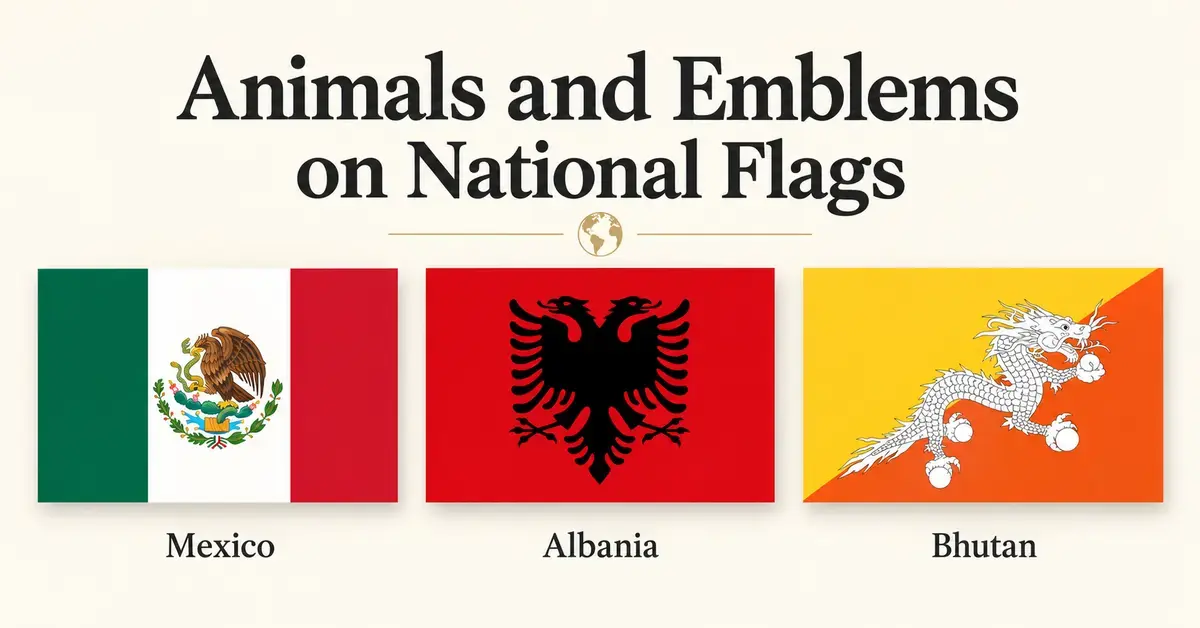
Animals and heraldic emblems turn up on dozens of national flags, from the eagle devouring a serpent on Mexico’s flag to the white dragon that gives Bhutan its name. These creatures are rarely decorative. Most arrive on a flag through one of two routes: a country chooses a native bird or beast that stands for its land and people, or it inherits a heraldic animal from a coat of arms, a royal standard or a centuries-old founding legend. This guide explains which national flags feature animals, where each creature sits on the design, and what it commonly means. For a broader overview of flag imagery, see our pillar guide to what flag colours and symbols mean.
Key Points
- Animals reach flags in two main ways: as a chosen native bird or beast, or as a heraldic emblem from a coat of arms, royal banner or founding legend.
- The eagle is the single most common flag animal, often as a Byzantine double-headed eagle (Albania, Serbia, Montenegro).
- Mexico’s golden eagle devouring a serpent on a cactus recalls the Aztec legend of the founding of Tenochtitlan in 1325.
- Bhutan’s white dragon, the Druk, gives the country its name, Druk Yul, the “Land of the Thunder Dragon.”
- Birds such as Papua New Guinea’s bird of paradise, Dominica’s sisserou parrot and Uganda’s grey crowned crane celebrate unique native wildlife.
- Most meanings are traditional or popular interpretations, not official government doctrine, and sources often differ on the detail.
Why do so many flags feature animals and emblems?
Flags use animals because a single creature can carry a large idea in an instant. A lion reads as courage, an eagle as power and far-sight, a dove as peace. These associations come from heraldry, the medieval European system of coats of arms, and from older religious and folk traditions in Asia, Africa and the Americas. When a nation wants a symbol that feels ancient and self-evident, an animal does the work faster than words ever could.
There are two broad families of animal flags. The first draws on native wildlife: a country picks a bird or animal found only within its borders, making the flag a statement of biodiversity and homegrown identity. The second draws on heraldry and legend: the animal comes from a royal banner, a national coat of arms or a founding myth, and often predates the modern state. Many flags mix both ideas. Keep in mind that the meanings attached to these creatures are usually traditional or popular readings rather than official government doctrine, and sources frequently differ on the fine detail.
Which national flags have animals on them?
At least a dozen sovereign states place a recognisable animal directly on the national flag, and many more carry one inside a coat of arms on the flag. The clearest examples include Mexico (golden eagle and serpent), Bhutan (dragon), Albania (double-headed eagle), Egypt (Eagle of Saladin), Sri Lanka (lion), Papua New Guinea (bird of paradise), Dominica (parrot), Uganda (crane), Zambia (fish eagle), Kiribati (frigatebird) and Kazakhstan (steppe eagle). The table below sets them side by side so you can compare at a glance where each animal appears and what it is commonly taken to mean.
Animals on National Flags at a Glance
| Country | Animal or emblem | Where it appears | Common meaning or legend |
|---|---|---|---|
| Mexico | Golden eagle with rattlesnake | Coat of arms, centre of the white stripe | Aztec founding of Tenochtitlan (1325) |
| Bhutan | White dragon (Druk) | Across the diagonal field | “Land of the Thunder Dragon”; purity and prosperity |
| Albania | Black double-headed eagle | Centre of the red field | Byzantine heritage; Skanderbeg tradition |
| Egypt | Eagle of Saladin | Central white band | Arab identity, strength and unity |
| Sri Lanka | Gold lion with sword | Main crimson field | Kandyan royal standard; Sinhalese heritage |
| Papua New Guinea | Raggiana bird-of-paradise | Upper fly, above the Southern Cross | Emergence as a nation |
| Dominica | Sisserou parrot | Red disc at the centre | Endemic wildlife and national identity |
| Uganda | Grey crowned crane | White disc at the centre | Neutral national symbol; moving forward |
| Zambia | African fish eagle | Upper fly | Rising above the nation’s problems |
| Kiribati | Frigatebird | Over a rising sun and waves | Pacific Ocean setting and culture |
| Kazakhstan | Steppe eagle | Beneath the sun on a blue field | Independence, power and freedom |
Eagles: the most common creature on flags
The eagle is by far the most frequent animal in flag design, prized across cultures as a symbol of power, sovereignty and keen sight. It appears in several distinct traditions.
The double-headed eagle (Albania, Serbia, Montenegro)
The double-headed eagle is a Byzantine emblem that Orthodox-Christian and successor states across the Balkans adopted as a mark of continuity with that empire. Albania’s flag is the purest example: a black double-headed eagle on a red field, linked by tradition to the 15th-century national hero Skanderbeg, who fought the Ottomans under a similar banner. Serbia’s coat of arms shows a silver double-headed eagle above a shield bearing four Cyrillic letters that stand for the motto “Only unity saves the Serbs.” Montenegro’s eagle is gold and carries a small lion on its breast, a nod to historic Venetian influence along the coast. The idea that the two heads represent church and state, or earthly and heavenly authority, is a popular interpretation rather than documented medieval intent.
The Eagle of Saladin (Egypt)
Egypt’s flag carries a golden Eagle of Saladin in the centre, an emblem associated with the 12th-century ruler Saladin and widely read as a symbol of Arab identity, strength and unity. The same eagle has served as the basis for the arms of several Arab republics. Its exact zoological identity is debated among references, and strictly speaking Egypt uses a state emblem rather than a traditional European-style coat of arms, with the eagle holding a shield in the flag’s colours and a Kufic inscription reading “Arab Republic of Egypt.”
The steppe eagle (Kazakhstan) and the fish eagle (Zambia)
Kazakhstan’s flag shows a golden steppe eagle soaring beneath a 32-rayed sun on a sky-blue field. Its government describes the eagle as a sign of the state’s independence, power and the freedom of the nomadic tradition. Zambia’s flag places an orange African fish eagle in the upper fly, above three vertical stripes; it is officially read as the people’s ability to rise above the nation’s problems, and the same bird appears on the national coat of arms.
Mexico’s eagle and serpent: a flag built on a founding legend
Mexico’s flag carries the country’s coat of arms in the centre of the white stripe: a golden eagle perched on a prickly-pear cactus, grasping a serpent. The image illustrates the Aztec (Mexica) legend of the founding of Tenochtitlan. According to the story, the god Huitzilopochtli told the wandering Mexica to settle where they saw an eagle on a cactus growing from a rock in a lake. They found the sign and founded their capital in 1325, on the site of modern Mexico City, which marked its 700th anniversary in 2025.
The modern emblem was designed by Francisco Eppens Helguera and approved in 1968, with its formal description later fixed in a 1984 law. The cactus grows from a rock set in water, both rendered as Aztec glyphs, and oak and laurel branches frame the base. The serpent has been shown as a rattlesnake since a 1917 revision, reflecting pre-Hispanic depictions. Few national flags tie their central image so directly to a single founding myth.
The Thunder Dragon of Bhutan
Bhutan’s flag is divided diagonally in saffron-yellow and orange, with a large white dragon straddling the centre. The dragon is the Druk, the “thunder dragon” of Himalayan Buddhist tradition, and it gives the country its own name for itself: Druk Yul, the Land of the Thunder Dragon. Thunder, in local belief, is the voice of dragons roaring across the mountains.
Each element carries a conventional meaning drawn from flag references. The dragon’s white colour is read as purity, and the jewels clutched in its claws as prosperity and wealth. The diagonal division is taken to separate the spiritual and the temporal: the orange lower half is linked to the Buddhist monastic tradition, and the saffron-yellow upper half to the secular authority of the monarchy. The current design was adopted in 1969, developing from a flag first used in the late 1940s. As with most such flags, these readings come from descriptive references rather than an official government statement.
Birds on flags: Papua New Guinea, Dominica, Uganda and more
Several nations chose a bird found only on their territory, turning the flag into a celebration of native wildlife. These are among the most distinctive animal flags in the world.
Papua New Guinea’s bird of paradise
Papua New Guinea’s flag shows a golden Raggiana bird-of-paradise in flight in the upper fly, with the stars of the Southern Cross below. The bird, known locally as the kumul, was commonly understood to mark the country’s emergence as a nation, and the red, black and yellow are traditional colours used by its peoples. The species is named after the Marquis Francis Raggi of Genoa.
Dominica’s sisserou parrot
Dominica is the only national flag with a parrot. A red central disc carries the sisserou parrot (Amazona imperialis), an endangered species found nowhere else on Earth, ringed by ten green stars for the island’s ten parishes. The parrot stands for Dominica’s unique biodiversity and national identity, and its purple plumage is one reason purple is so rare on world flags.
Uganda’s grey crowned crane
Uganda’s flag places a grey crowned crane in a white central disc over bands of black, yellow and red. The crane is the national bird; it is often said to have been chosen under colonial rule because it was seen as neutral among the territory’s kingdoms, and the country kept it after independence in 1962. The bird is frequently described as standing on one raised leg, looking forward, a posture read as the nation moving ahead.
Guatemala’s quetzal and Kiribati’s frigatebird
Guatemala’s resplendent quetzal is a special case: it sits at the top of the national coat of arms on the central white band, not loose on the field. The brilliant green-and-red bird was sacred to the ancient Maya, lends its name to the national currency, and is a traditional symbol of liberty because of the folk belief that it cannot survive in captivity. Kiribati’s flag shows a golden frigatebird flying above a rising sun and stylised ocean waves, evoking the country’s Pacific setting.
Sri Lanka’s lion: heraldry that became a nation’s symbol
Sri Lanka’s flag is dominated by a golden lion holding a sword, set on a crimson field with four stylised bo (fig) leaves at the corners and two stripes of orange and green. The lion traces back to the royal standard of the Kingdom of Kandy, the last independent Sinhalese kingdom, which fell to the British in 1815. The oldest surviving royal lion flag is one captured in the early 1800s and long kept at the Royal Hospital, Chelsea, in London; its rediscovery helped fuel the island’s independence movement.
The lion is widely linked to the Sinhalese people, whose name shares the root “sinha” (lion), while the sword is popularly read as the defence of the homeland and the rule of law. The four bo leaves represent Buddhism, and the orange and green stripes, added when the modern flag took shape around independence, represent the Tamil and Muslim communities. The detailed meanings sometimes given for the lion’s eyes, mane and paws are traditional readings rather than documented official explanations.
Coats of arms: heraldic animals hiding on flags
Many animals reach a flag not on their own but inside a coat of arms, a legacy of European heraldry. Fiji’s flag carries a shield with a British lion holding a cocoa pod and a dove of peace, both inherited from its colonial arms. Spain’s flag bears a quartered shield that includes a golden castle for Castile and a lion for León, kingdoms united in the 13th century. These heraldic creatures follow strict colour conventions: Spain’s lion, for instance, is formally purple, not red. Spotting them is a useful reminder that a flag can feature an animal without putting it front and centre.
Common mistakes people make about animals on flags
A few misunderstandings come up again and again, and they are worth clearing up directly.
- Assuming every meaning is official. Most symbolic readings of flag animals are traditional or popular interpretations. Official laws usually fix the design, not the meaning, and references often disagree on the details.
- Confusing a flag animal with a coat-of-arms animal. Guatemala’s quetzal, Fiji’s lion and Spain’s lion sit inside a coat of arms, not loose on the field. That is a different kind of “animal flag” from Dominica’s parrot or Bhutan’s dragon.
- Treating the eagle as one symbol. Albania’s Byzantine double-headed eagle, Egypt’s Eagle of Saladin and Kazakhstan’s steppe eagle come from completely separate traditions and mean different things.
- Calling the dragon a Chinese dragon. Bhutan’s Druk is a distinct Himalayan thunder dragon tied to the country’s name and Buddhist tradition, not a borrowing from Chinese imagery.
- Expecting the animal to be lifelike. Flag animals are stylised emblems. Colours like the white dragon or purple lion follow symbolic or heraldic convention, not nature.
If you want to test yourself on this and other flag trivia, our flag FAQs page answers the questions people ask most. You can also read how we check and source these claims in our editorial policy, part of our wider reference on country flags of the world.
Sources
- Flags of the World – Bhutan
- Flags of the World – Historical flags of Sri Lanka
- The Sunday Times (Sri Lanka) – The history of flags in Sri Lanka
- State Library of New South Wales – Papua New Guinea: Forty Years of Independence
- Encyclopædia Britannica – Flag of Dominica
- Religion News Service / Associated Press – Mexico’s eagle-and-serpent myth
- Heraldry of the World – National Arms of Egypt
- eGov.kz – State symbols of the Republic of Kazakhstan
- Embassy of the Republic of Zambia – The Flag of Zambia
Frequently Asked Questions (FAQ)
How many national flags have animals on them?
At least a dozen sovereign states show a clear animal directly on the national flag, including Mexico, Bhutan, Albania, Egypt, Sri Lanka, Papua New Guinea, Dominica, Uganda, Zambia, Kiribati and Kazakhstan. Many more carry an animal inside a coat of arms displayed on the flag, so the exact count depends on whether you include heraldic shields.
Which animal appears most often on flags?
The eagle is the most common, appearing in several separate traditions: the Byzantine double-headed eagle of Albania, Serbia and Montenegro, the Eagle of Saladin on Egypt’s flag, Kazakhstan’s steppe eagle and Zambia’s African fish eagle. Lions are the next most frequent, largely through heraldry.
What does the eagle and snake on the Mexican flag mean?
It illustrates the Aztec legend of the founding of Tenochtitlan. The god Huitzilopochtli told the Mexica to settle where they saw an eagle on a cactus eating a serpent; they founded their capital on that spot in 1325, where Mexico City now stands.
Why is there a dragon on Bhutan’s flag?
The dragon is the Druk, or thunder dragon, of Himalayan Buddhist tradition, and it gives Bhutan its own name for the country, Druk Yul, meaning Land of the Thunder Dragon. The dragon’s white colour is traditionally read as purity and the jewels in its claws as prosperity.
Is the quetzal actually on Guatemala’s flag?
Yes, but not on the field itself. The resplendent quetzal perches at the top of the national coat of arms, which sits on the central white band of the flag. It is Guatemala’s national bird and a traditional symbol of liberty.
