

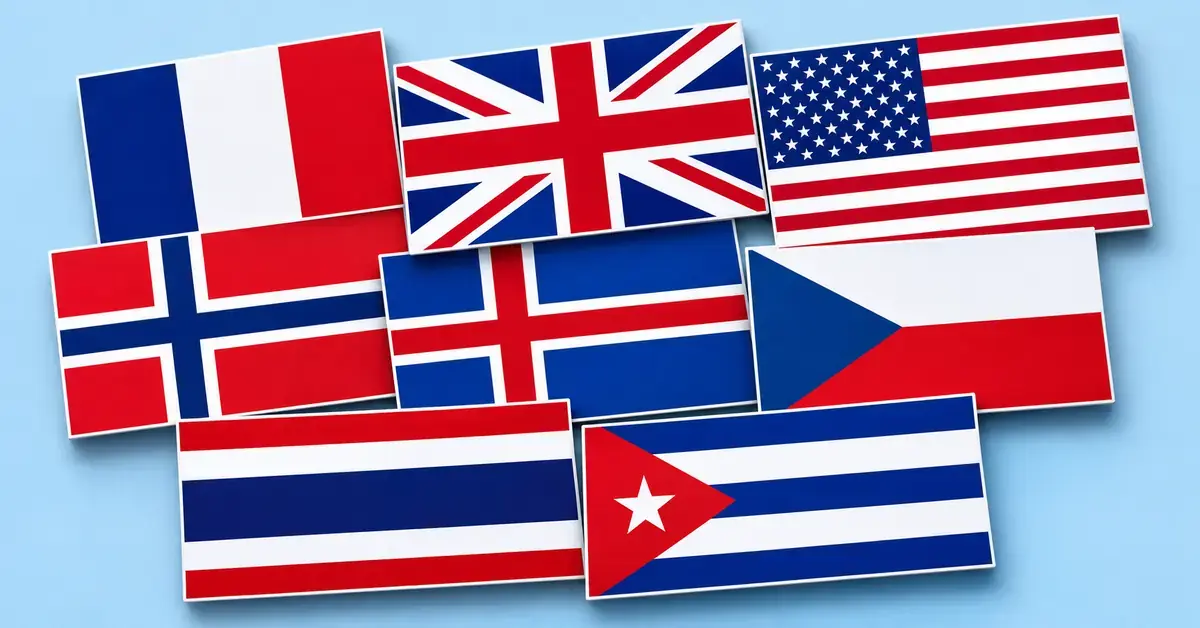
Red, white and blue are the three most common colours on the world’s national flags. The counts of red, white and blue flags below are current to November 2026.
Key Points
- Red, white and blue are the three most common colours on national flags; in a 1999 survey of flag colours, red appeared on about 74%, white on 71% and blue on 50%.
- Roughly two dozen sovereign states use only red, white and blue — among them France, the United States, the United Kingdom, Russia, the Netherlands and Thailand.
- Many more flags combine the three with other colours; a WorldAtlas tally last updated in December 2020 counted 29 national flags that contained all three.
- The palette spread through four influential flags — the Netherlands, France, the United Kingdom and Russia — plus the United States, and through the pan-Slavic colours adopted in 1848.
- Only one sovereign flag uses none of red, white or blue: Jamaica.
Which countries have red, white and blue flags?
Roughly two dozen sovereign states use only red, white and blue on their flags, with no fourth colour, and many more combine the three with other colours such as gold or green. It helps to keep those two groups separate, because a question like “which flags are red, white and blue?” means something stricter than “which flags contain red, white and blue.”
- Only red, white and blue. The design uses no other colour at all. France, the Netherlands, Russia, the United Kingdom, the United States and Thailand are examples.
- Red, white and blue plus other colours. The three colours are present, but a coat of arms, emblem or extra band adds gold, green or another colour. Croatia, Serbia, Slovenia and Cape Verde fall here.
The table below lists the main national flags in both groups, with each flag’s design and whether it uses any colour beyond red, white and blue. A WorldAtlas tally published in November 2018 and last updated in December 2020 counted 29 national flags that contained all three colours, and we found no newer count (checked November 2026); the precise number shifts as flags are redesigned and depends on whether you count flags that merely include the three colours among others.
At a Glance
| Country | Flag design | Colour arrangement | Uses only red, white & blue? |
|---|---|---|---|
| France | Vertical tricolour | Blue – white – red | Yes |
| Netherlands | Horizontal tricolour | Red – white – blue | Yes |
| Russia | Horizontal tricolour | White – blue – red | Yes |
| Luxembourg | Horizontal tricolour | Red – white – light blue | Yes |
| Czech Republic | Two bands with hoist triangle | White over red, blue triangle | Yes |
| Slovakia | Tricolour with arms | White – blue – red, red/white/blue shield | Yes |
| Iceland | Nordic cross | Red cross edged white on blue | Yes |
| Norway | Nordic cross | Blue cross edged white on red | Yes |
| United Kingdom | Combined crosses (Union Jack) | Red and white crosses on blue | Yes |
| United States | Stars and stripes | Red/white stripes, white stars on blue canton | Yes |
| Chile | Stripes with canton star | White over red, blue canton, white star | Yes |
| Cuba | Stripes with triangle | Blue/white stripes, red triangle, white star | Yes |
| Panama | Quartered field | White/red/blue quarters, blue and red stars | Yes |
| Liberia | Stars and stripes | Red/white stripes, blue canton, white star | Yes |
| Thailand | Five horizontal bands | Red – white – blue – white – red | Yes |
| North Korea | Bands with disc | Blue – red – blue, white disc with red star | Yes |
| Laos | Bands with disc | Red – blue – red, white disc | Yes |
| Cambodia | Bands with emblem | Blue – red – blue, white Angkor Wat | Yes |
| Nepal | Double pennon | Crimson field, blue border, white sun and moon | Yes |
| Australia | Blue ensign | Union Jack canton, white stars | Yes |
| New Zealand | Blue ensign | Union Jack canton, red stars edged white | Yes |
| Samoa | Canton of stars | Red field, blue canton, white Southern Cross | Yes |
| Taiwan (Republic of China) | Canton with sun | Red field, blue canton, white sun | Yes (disputed status) |
| Croatia | Tricolour with arms | Red – white – blue, chequy shield | No – adds other colours |
| Serbia | Tricolour with arms | Red – blue – white, eagle and crown | No – adds gold |
| Slovenia | Tricolour with arms | White – blue – red, crest with gold stars | No – adds gold |
| Costa Rica | Five bands (state flag + arms) | Blue – white – red – white – blue, coat of arms | Civil flag yes; state flag adds colours |
| Dominican Republic | Cross with central arms | Blue/red quarters, white cross, coat of arms | Civil flag yes; state flag adds colours |
| Paraguay | Tricolour with emblem | Red – white – blue, central emblem | No – adds other colours |
| Fiji | Light-blue ensign | Union Jack canton, shield | No – shield adds colours |
| Cape Verde | Bands with stars | Blue, white/red/white band, 10 yellow stars | No – adds yellow |
Tricolour flags in red, white and blue
Three-colour flags are the most popular type of national flag, and red, white and blue is a common palette for the tricolour — three equal bands of colour. These flags are the ones people most often picture when they think of a red, white and blue flag.
- France — three vertical bands of blue, white and red. The blue and red are traditionally the colours of Paris and the white the colour of the monarchy, combined during the French Revolution. The flag of France influenced tricolours across Europe, Africa and the Americas.
- Netherlands — horizontal red, white and blue. Often described as one of the oldest tricolours; it grew out of the orange-white-blue “Prince’s Flag” of the 16th-century Dutch revolt, with red later replacing the orange.
- Russia — horizontal white, blue and red, usually traced to Peter the Great in the late 17th century and modelled partly on the Dutch flag.
- Luxembourg — horizontal red, white and light blue; similar to the Dutch flag but with a lighter, longer band of blue.
- Czech Republic — white over red with a blue triangle at the hoist (the edge nearest the pole).
- Thailand — five horizontal bands, red-white-blue-white-red, with the central blue band double width.
- Laos — red-blue-red with a white disc in the centre.
- Costa Rica — blue-white-red-white-blue. The plain civil version uses only these three colours; the state flag adds a coat of arms with other colours.
Several Slavic tricolours belong here too but carry an emblem that adds a colour: Croatia, Serbia and Slovenia all use red, white and blue bands with a coat of arms, while Slovakia’s arms stay within red, white and blue. Paraguay and the Dominican Republic likewise use the three colours with a central emblem.
Flags built around the Union Jack
A whole family of red, white and blue flags grew out of the British flag. The Union Jack itself combines three crosses: the red cross of St George (England) on white, the white saltire of St Andrew (Scotland) on blue, and the red saltire later associated with St Patrick (Ireland). According to the Flag Institute, the two-cross flag dates from a 1606 proclamation by King James VI and I, and the third cross was added in 1801. The result is a flag of only red, white and blue.
Former British territories kept that canton on a blue field, producing the “blue ensign” group:
- Australia — blue field, Union Jack in the canton, white stars (the Commonwealth Star and the Southern Cross).
- New Zealand — blue field, Union Jack, and four red stars edged in white for the Southern Cross.
- Fiji — a lighter blue field with the Union Jack and a shield; the shield adds other colours, so Fiji sits in the “plus other colours” group.
Nordic crosses and other cross flags
Two Nordic flags reach red, white and blue through the off-centre Scandinavian cross rather than bands or cantons:
- Iceland — a red cross edged in white on a blue field.
- Norway — a blue cross edged in white on a red field.
Both use the cross shape shared by Denmark, Sweden and Finland, but only Iceland and Norway land on the red-white-blue trio; the others drop one of the three.
Stars, cantons and single emblems
Many red, white and blue flags place stars, a canton or one emblem on a striped or plain field. The Stars and Stripes of the United States is the best-known example: 13 red and white stripes for the original colonies and 50 white stars on a blue canton for the states. Others in this group include:
- Chile — white over red with a blue canton and a single white star.
- Cuba — blue and white stripes with a red triangle and a white star.
- Liberia — red and white stripes with a blue canton and one white star, modelled on the US flag.
- Panama — four quarters of white, red and blue with a blue star and a red star.
- North Korea — a broad red band between blue bands, with a white disc carrying a red star.
- Cambodia — blue and red bands with a white image of Angkor Wat; it is one of only four national flags to feature a building, alongside Portugal, San Marino and Spain.
- Samoa — a red field with a blue canton and white stars for the Southern Cross.
- Nepal — the world’s only non-rectangular national flag: a crimson double pennon with a blue border and white sun and moon emblems.
Taiwan (the Republic of China) also uses only red, white and blue — a red field, a blue canton and a white sun — although its status as a sovereign state is disputed. Among non-sovereign territories, Puerto Rico and the US state of Texas have well-known one-star red, white and blue flags that readers often search for.
Why are red, white and blue the most common flag colours?
Red, white and blue dominate because a handful of early, influential flags spread the palette worldwide. Red is the single most common colour on national flags, and white and blue follow close behind — see the data on the most common flag colours in the world for the full ranking.
The influence of four “Old World” flags and the United States
Flag historians at Flags of the World link the prevalence of red, white and blue to a small set of powerful nations — the United Kingdom, France, the Netherlands and Russia — together with the United States. Dutch, French and British designs travelled with trade, empire and revolution; newly independent states frequently borrowed the colours of a former ruler, an ally or an admired republic. The US flag, in turn, directly inspired Liberia and others.
Pan-Slavic colours
A second channel is the pan-Slavic colours. At the Prague Slavic Congress of 1848, red, white and blue were adopted as common colours for the Slavic peoples, drawing on the Russian flag. That is why so many Slavic states — Russia, Serbia, Croatia, Slovakia, Slovenia and the Czech Republic — share the same three colours in different arrangements.
What do red, white and blue mean on a flag?
There is no single, universal meaning: each country assigns its own, so the colours mean different things from flag to flag. That said, a few readings recur often enough to be worth knowing, as long as they are treated as common rather than fixed:
- Red — commonly linked to valour, sacrifice, blood shed for freedom, or hardiness.
- White — commonly linked to peace, purity, honesty or unity.
- Blue — commonly linked to justice, perseverance, vigilance, loyalty, or the sea and sky.
These are tendencies, not rules. North Korea’s official account, for instance, ties the red of its flag to the blood shed by Korean patriots and the struggle against Japanese occupation, while many other countries leave their colours officially undefined. Always check the individual country’s own account before stating what its colours “mean.”
Red, white and blue flags that are easy to confuse
Because so many flags share the palette, several are mistaken for one another. These are the pairs that trip people up most often; for more side-by-side comparisons, see our guide to flags that look alike.
- Netherlands vs Luxembourg vs Russia. All three are horizontal red/white/blue tricolours. The Netherlands and Luxembourg both run red-white-blue, but Luxembourg’s blue is lighter and its flag is longer. Russia reverses the order to white-blue-red.
- France vs the Netherlands. France’s bands are vertical; the Dutch bands are horizontal.
- Australia vs New Zealand. Both are blue ensigns with the Union Jack. New Zealand has four red stars edged in white; Australia has six white stars, including the large Commonwealth Star beneath the canton.
- Chile vs Texas. Both show a white star on blue beside red and white, but Chile’s blue is a small canton, while the Texas “Lone Star” flag has a full-height blue stripe.
Common mistakes and misconceptions
A few errors come up repeatedly with this colour combination.
- Treating red, white and blue as “American colours.” They belong to dozens of countries. The Dutch and French tricolours predate the US flag, and the pan-Slavic world uses the same three colours independently.
- Assuming the colours always mean the same thing. Meanings are country-specific and sometimes officially undefined.
Which flag uses none of these colours?
Exactly one sovereign national flag uses none of red, white or blue: Jamaica, with its gold saltire dividing green and black triangles. Since Mauritania changed its flag in 2017, Jamaica has stood alone in this respect — a neat illustration of just how dominant red, white and blue are across the world’s flags.
Sources
- Guinness World Records — Most commonly used colour in national flags
- Flags of the World (CRW Flags) — Colours in flags (VEXISTATS statistics)
- WorldAtlas — Countries With Red, White And Blue Flags
- WorldAtlas — What Are The Pan-Slavic Colors?
- The Flag Institute — Union Flag history
- The Flag Institute — The Union Jack or the Union Flag?
- Wikipedia — Flag of France (colours of Paris and the monarchy)
- Wikipedia — Flag of the Netherlands (Prince’s Flag; red replacing orange)
- Wikipedia — Flag of Russia (Peter the Great; modelled on the Dutch flag)
- Wikipedia — Flag of North Korea (symbolism of the red colour)
- Wikipedia — Flag of Cambodia (Angkor Wat; one of four flags with a building)
- Wikipedia — Flag of Nepal (only non-rectangular national flag)
- Wikipedia — Flag of Liberia (modelled on the US flag)
- Wikipedia — Flag of Jamaica (only flag without red, white or blue since 2017)
Frequently Asked Questions
Does the Canadian flag use red, white and blue?
No. The Canadian flag uses only red and white, with a red maple leaf on a white square between two red bands. It has no blue, so it is not a red, white and blue flag.
Which country has a blue, white and red vertical flag?
France. Its flag is three equal vertical bands of blue at the hoist, then white, then red. Vertical red, white and blue tricolours are unusual, so a vertical blue-white-red flag is almost always France.
Which red, white and blue flag has a single star?
Chile, Cuba and Liberia each place one white star on a red, white and blue flag. Among non-sovereign flags, Puerto Rico and the US state of Texas are the best-known single-star examples.
Which red, white and blue flag has a castle or building?
Cambodia. Its flag shows a white outline of Angkor Wat — the great temple complex — on a red band between two blue bands. It is one of only four national flags to feature a building, with Portugal, San Marino and Spain.
