

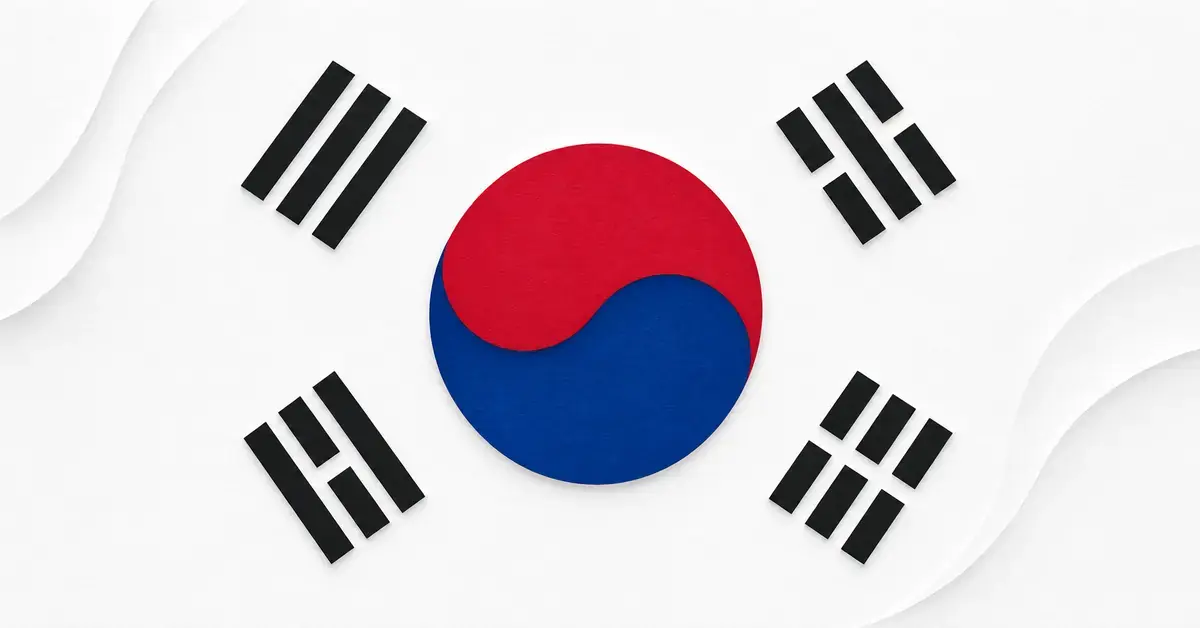
The flag of South Korea, known as the Taegukgi (also spelled Taegeukgi), means balance and harmony: a white field for peace, a red-and-blue circle — the taeguk — for the cosmic forces of yin and yang, and four sets of black bars, the trigrams, drawn from the ancient I Ching. Together they describe a worldview built on harmony between opposing but complementary forces.
Quick Facts
| Official name | Taegukgi / Taegeukgi (태꺍기), “supreme-ultimate flag” |
| Design | White field, central red-and-blue taeguk, four black trigrams |
| Designer | Design credited to Lee Eung-jun (1882); selected by Park Yeong-hyo and approved by King Gojong |
| Adopted | Royal proclamation 6 March 1883 (some sources give 27 January 1883); standardised by the Republic of Korea 15 October 1949 |
| Proportions | 2:3 (height to width) |
| Colours | White, black trigrams, red taeguk (Pantone 186C), blue taeguk (Pantone 294C) |
| Core meaning | Balance and harmony of yin and yang, and the continual creation of the universe |
What does the flag of South Korea represent?
The South Korean flag represents balance, harmony and the continual creation of the universe through opposing but complementary forces. Rather than commemorating a battle, a ruler or a single historical moment, the Taegukgi sets out a philosophy drawn from traditional East Asian thought.
It does this with three parts. The white background stands for peace and purity. The red-and-blue circle at the centre, called the taeguk, shows the balance of the cosmic forces often described as yin and yang. The four groups of black bars in the corners, the trigrams, extend that idea of balance to the elements and the seasons. Read together, they describe a people who, like the universe itself, seek continuous renewal.
What does the name “Taegukgi” mean?
“Taegukgi” means “supreme-ultimate flag.” The name joins two words: taeguk (태꺍, from the Chinese taiji), which means the “supreme ultimate” or the origin of all things, and gi (기), which simply means “flag.” The flag is therefore named after the red-and-blue emblem at its heart.
Why is the flag’s background white?
The white background of the Taegukgi stands for brightness, purity and peace. These were qualities long prized in Korean culture, and white also had a very concrete meaning: for centuries Koreans were known as the “white-clad people” (baegui minjok) because of their traditional preference for plain white clothing.
Choosing white as the field was a way of placing that cultural identity, and a stated love of peace, at the base of the flag. Everything else — the circle and the trigrams — sits on top of that peaceful ground.
What does the red and blue taeguk in the centre mean?
The red-and-blue taeguk symbolises the harmony between the two great cosmic forces, commonly called yin and yang. The upper red half represents yang: the positive, active and warm forces. The lower blue half represents eum, the Korean reading of yin: the negative, passive and cool forces.
“Positive” and “negative” here do not mean good and bad. They are complementary opposites, like day and night or summer and winter, each needing the other. The design expresses the idea that all things in nature are created and evolve through the interaction of yin and yang.
What do the four trigrams on the Korean flag mean?
The four black trigrams, collectively called geongongamri, represent heaven, earth, water and fire — the elements and forces that surround and act on the central taeguk. Each trigram is a stack of three bars. A solid bar stands for yang and a broken bar for eum, and the mix of solid and broken bars gives each trigram its identity. The set is taken from the I Ching, the ancient Chinese “Book of Changes.”
The government’s own description fixes the core meanings as heaven, earth, water and fire. Beyond that, each trigram is traditionally linked with a season, a compass direction and one of the classic Confucian virtues — cultural conventions rather than strict rules, so they are best read as what the trigrams “commonly” stand for. The seasons, directions and virtues in the table below follow the Gyeonggi provincial government’s flag guide; other sources arrange them differently — Wikipedia’s table, for instance, links Geon with summer and the south, and Ri with spring and the east. The table reads the corners in the order top-left, bottom-left, top-right, bottom-right.
| Trigram | Bars | Corner | Element | Commonly linked with |
|---|---|---|---|---|
| Geon (건) ☰ | Three solid | Upper hoist (top-left) | Heaven | Spring · East · Benevolence |
| Ri (리) ☲ | Solid–broken–solid | Lower hoist (bottom-left) | Fire | Autumn · South · Courtesy |
| Gam (감) ☳ | Broken–solid–broken | Upper fly (top-right) | Water | Winter · North · Wisdom |
| Gon (곘) ☷ | Three broken | Lower fly (bottom-right) | Earth | Summer · West · Righteousness |
The four trigrams form two opposing pairs. Geon (three solid bars, pure yang) sits in the corner opposite Gon (three broken bars, pure eum), framing the taeguk as heaven above and earth below; Ri (fire) sits opposite Gam (water), the two elements balancing across the flag. The pattern of solid and broken bars is what tells each trigram apart.
The history of the Taegukgi: when and why it was created
Korea first needed a national flag in the 1880s, when it began signing treaties with foreign powers and realised it had no emblem to fly. The push grew with the ratification of the Korea–United States treaty of 1882.
The design emerged from talks between Korean and Chinese officials. The Korean delegate Lee Eung-jun is credited with the first design — a “Taegeuk and Eight Trigrams” flag — which the Chinese official Ma Jianzhong endorsed. Park Yeong-hyo, sent by King Gojong as envoy to Japan in September 1882, drew a simplified version with a taeguk circle and only four trigrams while aboard the ship, and began using it from 25 September 1882. King Gojong then approved the design.
The government officially promulgated the flag in 1883. The Flags of the World history archive gives the date of King Gojong’s royal proclamation as 6 March 1883, though some sources, including Wikipedia, put the official adoption at 27 January 1883.
The flag outlasted the monarchy. Korea’s Provisional Government issued a style guide in 1942 — around the time the name taegukgi came into general use — and after the Republic of Korea was founded on 15 August 1948, the new state needed an exact standard. A National Flag Correction Committee was formed in January 1949 and announced the National Flag Construction Guidelines on 15 October 1949, the date usually given for the flag’s modern standardisation.
Two later steps tidied up the details. In 1997 the government fixed the official colours by presidential ordinance, and in 2007 the Act on the Flag of the Republic of Korea put the flag’s design, colours and use into law.
The official colours and proportions
The Taegukgi has a fixed ratio of 2:3, meaning the flag is half as tall as it is wide. The colours are also set by law. The red of the taeguk is specified as Pantone 186C and the blue as Pantone 294C, with the field pure white and the four trigrams black.
These exact shades were not standardised until the late 1990s. Before that, printed flags varied, which is one reason older South Korean flags can look slightly different in tone from the version flown today. The legal specification now defines the colours precisely so that every official flag matches.
How the Taegukgi compares with China’s and Japan’s flags
The Taegukgi is unusual among East Asian national flags for being built entirely on philosophy rather than politics or a single image. A quick comparison with its neighbours makes the difference clear.
The meaning of China’s flag is political: a red field with five gold stars representing the Communist Party and the people united behind it. The flag of Japan, the Hinomaru, is pared down to a single red sun disc on white, tied to the idea of the “Land of the Rising Sun.” South Korea’s flag, by contrast, uses an entire cosmological system — yin and yang plus the four trigrams — to express balance and harmony. You can see how varied the region’s designs are across the full range of flags of Asia, and the Taegukgi sits alongside other detailed country studies in our national flag profiles.
Common mistakes and misconceptions
The single most common mistake is mixing up the North and South Korean flags. South Korea flies the Taegukgi described here; North Korea uses a completely different flag with red and blue bands and a red star, which it adopted in July 1948. They are not two versions of the same flag.
A second mistake is getting the trigrams in the wrong corners, which happens when the flag is mirrored or rotated. A simple memory trick fixes it: counting each bar as one line and a gap as splitting a bar into two, the trigrams carry 3, 4, 5 and 6 line-marks, and they fill the top-left, bottom-left, top-right and bottom-right corners in that rising order. Geon (3) is always nearest the top of the pole.
Finally, it is easy to read the taeguk as a straightforward “good versus evil” symbol. It is not. Yang and eum are complementary, not rival, and the whole point of the flag is their balance. As with most national emblems, the meanings attached to the trigrams are country-specific conventions rather than one fixed, universal code — the same caution applies to reading symbols on national flags generally.
Sources
Frequently Asked Questions
Is the taeguk the same as the yin-yang symbol?
It comes from the same idea but is drawn differently. The familiar yin-yang circle has two small dots; the Korean taeguk has no dots and places red (yang) firmly above blue (eum), curved into a single swirl. Both express the balance of complementary cosmic forces.
What does the 🇰🇷 emoji show?
The 🇰🇷 flag emoji is the Taegukgi, the national flag of South Korea. It shows the white field, the red-and-blue taeguk in the centre and the four black trigrams in the corners.
