

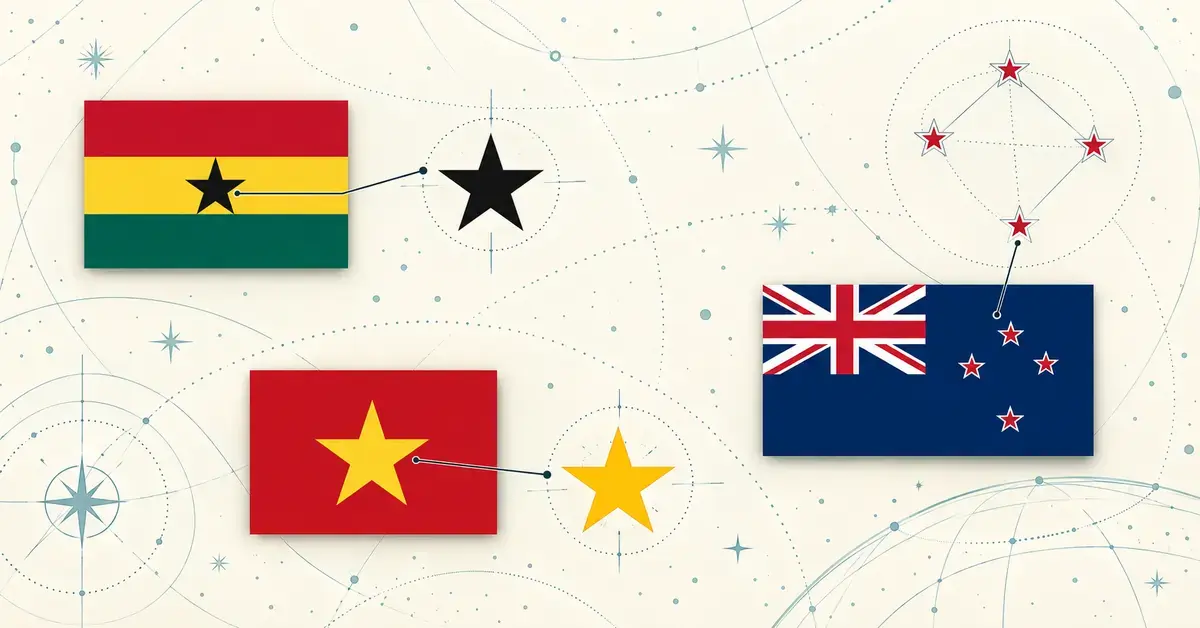
Stars are one of the most common symbols in the world of flags — a simple shape that can stand for a state, a province, a region, a political idea, a founding people or even a real constellation in the night sky. Yet the same five-pointed star means very different things from one country to the next. This guide explains what the stars on national flags represent, which countries use them, how many stars appear and why, and how to read the clues hidden in a star’s number, colour and shape.
Key Points
- Around 60 national flags carry at least one star; a single five-pointed star on a plain field is the most common design.
- Stars have no single meaning — they can count states (the USA’s 50), provinces (Venezuela’s 8) or regions (the Philippines’ 3).
- A lone star often stands for independence or national unity, as in Somalia, Vietnam, Chile, Ghana and Liberia.
- Some flags show a real constellation: the Southern Cross appears on the flags of Australia, New Zealand, Brazil, Papua New Guinea and Samoa.
- Most flag stars have five points, but Israel’s has six (the Star of David) and Jordan’s and Australia’s Commonwealth Star have seven.
- The European Union’s 12 stars stand for unity and completeness — not the number of member countries.
What do the stars on national flags represent?
Stars on flags carry no single, universal meaning — each country chooses its own reason. Reading a star correctly means looking at how many there are, what colour they are and how many points they have, then checking the individual country’s story. Across the world’s flags, stars fall into a handful of broad roles: they count the parts of a country, they mark independence or unity, they depict a real constellation, they sit beside a crescent as a cultural or religious emblem, or they stand for a guiding ideal. The star is one of the building blocks covered in our overview of what the symbols on national flags mean, and this article zooms in on that one shape.
How many national flags have stars?
Roughly 60 national flags carry at least one star, though the exact figure depends on how you count. The reference site WorldAtlas puts the number at 59 independent states. The total shifts depending on whether you include stars tucked inside a coat of arms, stars paired with a crescent, or the many-pointed suns that some lists treat as stars. What is clear is that the single five-pointed star on a plain field is the most common star design of all, used by countries on every continent.
The five main meanings of stars on flags
Almost every star on a national flag fits one of five patterns. Knowing the patterns makes it much easier to guess — and then verify — what a flag you have never seen before is trying to say.
1. Stars that count states, provinces or regions
Many flags use one star per internal unit, so the number of stars tells you how a country is built. The clearest example is the Stars and Stripes of the United States: its 50 white stars stand for the 50 states, while the 13 red-and-white stripes recall the original 13 colonies. The 50 stars sit in nine offset rows that alternate between six and five stars; that arrangement was fixed by executive order in 1959 after Hawaii became the 50th state and first flew on 4 July 1960. With 50 stars, the US flag has more than any other national flag.
Brazil comes second. The Brazilian flag shows 27 white stars inside its blue globe — one for each of the 26 states plus the Federal District. The stars are not placed at random: they map the night sky over Rio de Janeiro on 15 November 1889, the day the republic was proclaimed, as if seen from outside the celestial sphere. The flag was adopted four days later with 21 stars, and the count has grown with the country, reaching the present 27 on 11 May 1992.
Other counting flags include Venezuela, whose arc of eight stars represents the provinces that joined the 1811 struggle for independence (a seventh star was there from early on, and an eighth was added in 2006 to honour the historic province of Guayana); the Philippines, whose three stars stand for the main island groups of Luzon, the Visayas and Mindanao, with an eight-rayed sun for the first provinces to revolt against Spain; and Panama, whose two stars are usually read as the nation’s rival political traditions kept in balance.
China is a special case of counting. The five stars on China’s flag are one large golden star with four smaller ones arching toward it. In the original 1949 design the large star stood for the Communist Party and the four small stars for four social classes, with the small stars turned toward the big one to show the people united under the party. China’s flag law describes the stars simply as symbols of the People’s Republic and does not fix that meaning in statute, and later interpretations read the large star as China and the small ones as its many ethnic groups.
2. A single lone star for independence and unity
A single star — often called a “lone star” — usually represents national unity, freedom or the guiding light of independence. At least a dozen national flags are built around one star, and the idea travels across continents. Somalia carries a white five-pointed star on light blue, its five points standing for the regions where Somali people have historically lived. Vietnam’s large gold star on red represents the leadership of the people. Chile’s flag is nicknamed La Estrella Solitaria (“the lone star”). Liberia, Cuba, Senegal, Cameroon and Burkina Faso all use a single star in the same spirit of independence and nationhood.
Two lone stars carry extra history. Ghana’s black star, set on a gold stripe, is a symbol of African freedom; it is widely believed to come from the flag of Marcus Garvey’s Black Star Line shipping company, and it marks Ghana as the first country in sub-Saharan Africa to win independence in the 20th century. Morocco’s flag shows a green five-pointed star — an interlaced pentagram — on a deep red field.
3. Stars that map a real constellation
A few flags show an actual pattern of stars from the night sky, and the best-known is the Southern Cross (the constellation Crux). It appears on the national flags of Australia, New Zealand, Brazil, Papua New Guinea and Samoa — a reminder that each of these countries lies in the Southern Hemisphere, where the constellation has long guided navigators. The depictions differ in a telling way: New Zealand shows only the four brightest stars, as four red stars edged in white, while Australia adds a fifth, smaller star (Epsilon Crucis, known as Ginan). Australia also places a large seven-pointed Commonwealth Star beneath the Union Jack to represent its states and territories. Because several flags of Oceania combine the Southern Cross with a Union Jack canton, the constellation is one of the quickest ways to tell the region’s look-alike flags apart.
4. A star beside a crescent
When a star sits next to a crescent moon, it belongs to a separate and very large family of its own. Turkey, Pakistan, Algeria, Tunisia, Malaysia, Mauritania and others use the star-and-crescent, a pairing that is often associated with the Islamic world but that actually predates Islam and is used today as a national rather than a purely religious emblem. Because the meaning of the crescent changes the reading of the star, those designs are covered separately in our guide to crescent-and-star flags.
5. Stars with a specific number of points
Most flag stars have five points, but the number of points is sometimes a message in itself. Israel’s flag carries a six-pointed star, the Star of David (a hexagram), between two blue stripes. Jordan’s white star has seven points, often linked to the seven verses of the opening chapter of the Qur’an, and Australia’s Commonwealth Star also has seven. The European Union’s stars have five points each. Counting the points, then, is a useful habit: a six- or seven-pointed star almost always signals a specific national or cultural meaning rather than a generic star.
Flags with stars compared
The table below gathers the best-known star flags so you can compare the number of stars, their shape and what each set represents at a glance. Figures that change over time are dated in the main text above.
Flags with Stars Compared
| Flag | Number of stars | Star shape | What the stars represent |
|---|---|---|---|
| United States | 50 | Five-pointed | The 50 states (stripes recall the 13 colonies) |
| Brazil | 27 | Five-pointed | The 26 states and the Federal District, as the sky over Rio in 1889 |
| China | 5 | Five-pointed | Originally the Communist Party (large) and four social classes |
| Venezuela | 8 | Five-pointed | The provinces of the 1811 independence struggle, plus Guayana |
| Philippines | 3 | Five-pointed | Luzon, the Visayas and Mindanao |
| Panama | 2 | Five-pointed | The nation’s rival political traditions held in balance |
| Australia | 6 | Mostly seven-pointed | The Southern Cross plus a Commonwealth Star for the states and territories |
| New Zealand | 4 | Five-pointed (red) | The four brightest stars of the Southern Cross |
| Somalia | 1 | Five-pointed | The regions historically home to Somali people |
| Vietnam | 1 | Five-pointed | The leadership and unity of the people |
| Israel | 1 | Six-pointed (Star of David) | A long-standing Jewish emblem |
| Jordan | 1 | Seven-pointed | Often linked to the seven verses of the opening Qur’anic chapter |
| European Union | 12 | Five-pointed | Unity and completeness among Europe’s peoples (not member count) |
Why are five-pointed stars so common?
The five-pointed star dominates national flags because it is simple to draw, instantly recognisable and free of any single religious claim. A clean geometric shape reads well at a distance and at small sizes, which is one of the classic principles of good flag design. The five-pointed star also spread through history: it travelled with the American and Latin American independence movements, with socialist and republican symbolism in the 20th century, and with the Pan-African and Pan-Arab colour families, so new nations often reached for a star their neighbours would recognise. Six- and seven-pointed stars, by contrast, tend to appear only where a country wants to signal something specific, such as Israel’s Star of David or Jordan’s seven points.
Common mistakes when reading stars on flags
Even confident flag-spotters trip over the same few assumptions. Watching for them will keep your reading accurate.
- Thinking the European Union’s 12 stars count member countries. They do not. The official EU explanation is that the 12 gold stars in a circle stand for the ideals of unity, solidarity and harmony among the peoples of Europe; the number is fixed at 12 as a symbol of completeness and has never changed with the size of the Union. The flag was created by the Council of Europe in 1955 and adopted by the European Communities in the 1980s.
- Assuming every star means the same thing. A star is a container for a national story, not a fixed symbol. Vietnam’s star, Somalia’s star and Chile’s star look alike but mean different things.
- Expecting the star count to match today’s map. Counting flags are updated as countries change — the US flag has been revised many times, and Brazil added four stars in 1992 — so an old flag may show a smaller number.
- Confusing the Southern Cross flags. New Zealand’s four stars are red; Australia’s five are white and sit beneath a large seven-pointed Commonwealth Star. The star colour and the extra Commonwealth Star are the quickest tell.
- Treating every star as religious or Islamic. The star-and-crescent is a national emblem that predates Islam, and most lone stars have nothing to do with religion at all.
- Counting Nepal’s emblems as stars. Nepal’s flag shows a stylised sun and crescent moon, not five-pointed stars.
Sources
Frequently Asked Questions (FAQ)
Which national flag has the most stars?
The United States has the most, with 50 white stars for its 50 states. Brazil is second with 27 stars, one for each state and the Federal District.
What does a single star on a flag usually mean?
A lone star most often stands for independence, freedom or national unity. Somalia, Vietnam, Chile, Liberia, Ghana and Morocco all build their flags around one star, each with its own national story behind it.
Do the 12 stars on the European Union flag stand for 12 countries?
No. The 12 stars represent unity, solidarity and harmony among the peoples of Europe, and the number is a fixed symbol of completeness. It has never matched the number of member states and does not change as the Union grows.
Why do several flags show the Southern Cross?
The Southern Cross is a constellation visible in the Southern Hemisphere, so countries such as Australia, New Zealand, Brazil, Papua New Guinea and Samoa use it to show their place in the world and their shared southern skies.
Why do most flag stars have five points?
The five-pointed star is simple, easy to recognise at a distance and not tied to one religion, and it spread widely through independence and political movements. Stars with six or seven points, like Israel’s Star of David or Jordan’s star, usually carry a more specific meaning.
