

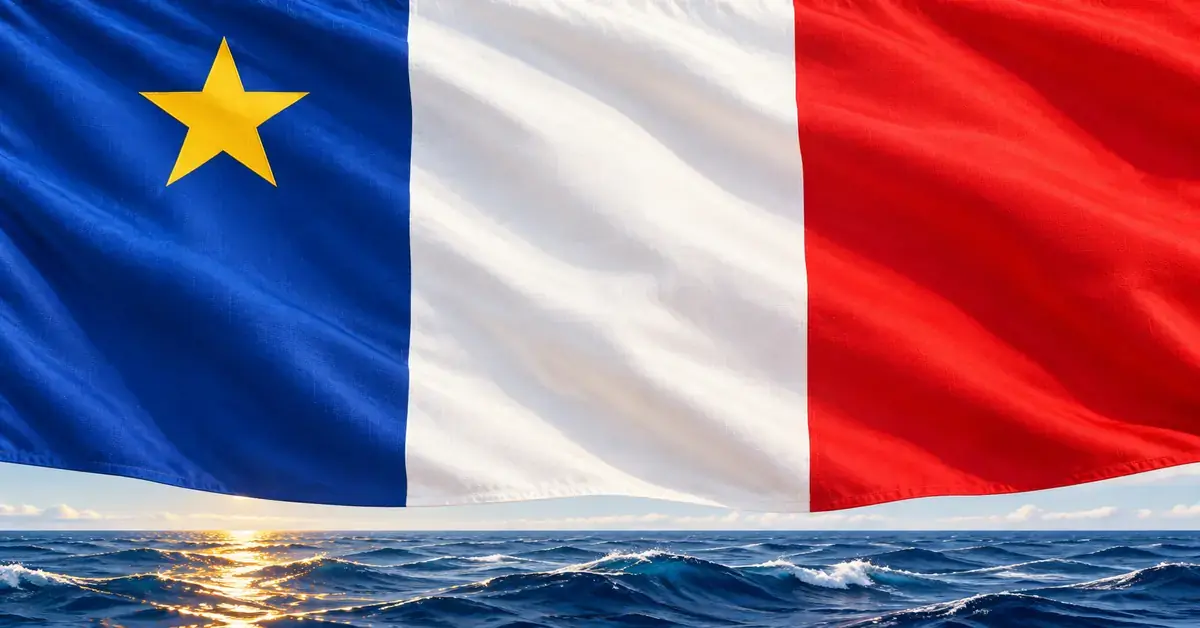
The Acadian flag is the French tricolour — three vertical bands of blue, white and red — with a single gold star added to the blue band near the top of the hoist. That star is the whole point of the design: it is what turns a borrowed French flag into the flag of the Acadian people, the French-speaking community of Canada’s Maritime provinces. This guide to the Acadian flag and its meaning focuses on the star: what it stands for, why it is gold, where it sits and who put it there, before explaining the rest of the flag, how it is used today, and how to tell it apart from the Louisiana Cajun flag it is often confused with.
Quick Facts
| Design | Vertical French tricolour (blue, white, red) with a single gold five-pointed star |
|---|---|
| Star | Stella Maris (“Star of the Sea”), symbol of the Virgin Mary / Our Lady of the Assumption |
| Star position | Upper corner of the blue band, on the hoist (flagpole) side |
| Star colour | Gold — the papal colour, for ties to the Catholic Church |
| Proposed by | Father Marcel-François Richard, priest of Saint-Louis-de-Kent, New Brunswick |
| Adopted | Second Acadian National Convention, Miscouche, Prince Edward Island, 15 August 1884 |
| Represents | The Acadian people of Atlantic Canada (not a sovereign country) |
| Flown on | National Acadian Day, 15 August (feast of the Assumption) |
| Heraldic status | Registered by the Canadian Heraldic Authority in 1995 as the national flag of Acadia |
What is the Acadian flag?
The Acadian flag is the flag of the Acadians, not of a country. Acadia (l’Acadie) is a historic region and a living cultural nation centred on New Brunswick, Nova Scotia and Prince Edward Island, with communities in parts of Quebec, Maine and beyond. Acadians are the descendants of French settlers who colonised the region from the early 1600s and who were deported by the British in the Grand Dérangement (the Expulsion of the Acadians, 1755–1764). Because Acadia has no borders or government of its own, the flag stands for a people and a culture rather than a state.
Visually, the flag is the blue-white-red vertical tricolour of France with one addition: a gold (yellow) five-pointed star placed in the upper corner of the blue stripe, on the hoist side nearest the flagpole. Everything else about the flag is simply the French tricolour. The star is the only element that is uniquely Acadian, which is exactly why its meaning matters so much.
What does the star on the Acadian flag mean?
The star on the Acadian flag represents the Virgin Mary under her title Stella Maris, the “Star of the Sea.” Mary, as Our Lady of the Assumption, is the patron of the Acadian people, and the star places her protection at the heart of the flag. For a seafaring, deeply Catholic community scattered by deportation, a star that guides sailors home was a fitting emblem of faith, identity and survival.
The choice was deliberate and was explained at the time the flag was created. The Acadians had already chosen the Assumption of Mary (15 August) as their national feast three years earlier, so adding her star to the flag tied the two symbols together. Where many flags use a star to count states or provinces, the Acadian star carries a single, religious meaning: it is a Marian symbol, a sign of the community’s spiritual mother.
Why is the star gold?
The star is gold because gold is the papal colour. Father Marcel-François Richard, who proposed the design, said the gold of the star stood for the Pope and the Acadians’ attachment to the Roman Catholic Church. Gold (with white) is the colour pairing associated with the Holy See, so a golden star on the flag signalled loyalty to Rome at a time when the Church was the central institution in Acadian life.
So the star carries two layers of meaning at once: its shape and title (Stella Maris) point to the Virgin Mary, while its colour (gold) points to the papacy. Together they frame Acadian identity as both national and Catholic.
Why is the star placed on the blue band?
The star sits on the blue band partly out of symbolism and partly out of design logic. Blue is the colour most associated with the Virgin Mary in Catholic tradition, so placing Mary’s star on the blue stripe reinforces the Marian message. Practically, the blue field also makes a gold star stand out clearly, and the upper-hoist position is the flag’s place of honour — the first part a reader’s eye reaches and the area that stays visible even when a flag hangs limp. If you want to see how differently stars function on other national flags, our guide to flags with stars and what they represent sets the Acadian star in wider context.
Why is the Acadian flag a French tricolour?
The Acadian flag uses the French tricolour to declare that Acadians are of French origin and that France is, in Father Richard’s words, their mother country. Rather than invent an entirely new design, the convention that adopted the flag took the blue, white and red of France and personalised it with the star. The message was straightforward: Acadians are a distinct people, but a French one.
The blue, white and red therefore carry their French associations first. The French tricolour and its history explain where those three colours come from and what they meant in revolutionary France. Beyond the link to France, Acadian commentators have offered their own readings of the colours — for example, red for the hardships and suffering of the past, white for peace and purity, and blue for the sea and sky that surround Acadia. These interpretations are meaningful to the community but are informal elaborations rather than part of the original, documented symbolism, which was simply “we are French.” For how flag colours pick up different meanings in different countries, see our guide to what flag colours mean.
Who designed the Acadian flag and when?
The Acadian flag was proposed by Father Marcel-François Richard, the parish priest of Saint-Louis-de-Kent in New Brunswick, at the Second Acadian National Convention in 1884. Richard was a leading figure in the late-19th-century Acadian cultural revival and argued that the Acadians needed their own symbols — a flag, a feast day and an anthem — distinct from those of French Canadians in Quebec.
The 1884 convention in Miscouche
The flag was adopted at a gathering in Miscouche, on Prince Edward Island, that drew close to 5,000 delegates from across the Maritimes. Sources differ slightly on the exact timing: the flag was proposed and adopted on 15 August 1884, and is generally recorded as first raised publicly the following day, 16 August. At the same convention the Acadians adopted the Latin hymn Ave Maris Stella (“Hail, Star of the Sea”) as their national anthem — a choice that echoes the Stella Maris star exactly — with Pascal Poirier credited for proposing its melody.
The 1884 convention was the second of its kind. The first, held in Memramcook, New Brunswick, in 1881, had already chosen 15 August, the Catholic feast of the Assumption of Mary, as the national day of the Acadians. The flag, the anthem and the feast day were therefore designed as a matching set, all pointing back to the Virgin Mary.
The first flag and where it is today
The first Acadian flag is traditionally said to have been made by Marie-Agathe Babineau, who sewed or assembled it at Father Richard’s request. By most accounts it was a commercially produced French tricolour to which the gold star was added, rather than a flag made entirely from scratch. The earliest surviving convention flag is preserved in the museum collection of the Université de Moncton in New Brunswick, where it remains an important artifact of Acadian history.
Is Acadia a country?
No, Acadia is not a country and has never been an independent state. It is a cultural nation without borders — a people defined by French language, Catholic heritage and shared history rather than by a government or territory. This is why the Acadian flag is sometimes called the “national flag of Acadia” even though Acadia is part of Canada: in this context, “national” refers to the Acadian people as a nation, not to a sovereign country.
Acadians live mainly in Canada’s Atlantic provinces, where they form a large French-speaking minority. New Brunswick, the only officially bilingual province in Canada, has the largest Acadian population. You can see how Acadia fits among Canada’s other flags in our overview of the flags of Canada, and compare it with the flag of Canada’s other major French-speaking community in our guide to the Quebec flag and its meaning. The Acadian and Quebec flags are often grouped together, but they are quite different in both design and symbolism.
The Acadian flag versus the Louisiana Cajun flag
The Acadian flag is frequently confused with the Louisiana Cajun flag, but the two are entirely separate designs. The Cajuns of Louisiana descend from Acadians who were deported in the 18th century and resettled in the southern United States, so the communities share a common ancestry — but their flags look nothing alike. Confusing them is one of the most common mistakes people make with this topic.
The Louisiana flag, officially the Flag of Acadiana, was designed in 1965 by Dr. Thomas J. Arceneaux and adopted by the Louisiana legislature in 1974. It divides into a blue section with three white fleurs-de-lis (for France), a red section with a gold castle (for Spain, which governed Louisiana when the Acadians arrived), and a white triangle at the hoist holding a single gold star for Our Lady of the Assumption. The gold Marian star is the one clear echo of the original Acadian flag; everything else is different. The table below sets the two side by side.
Comparison
| Feature | Acadian flag (Canada) | Louisiana Cajun flag (Flag of Acadiana) |
|---|---|---|
| Based on | The French tricolour | An original three-part design |
| Main elements | Blue, white and red vertical bands with one gold star | Three white fleurs-de-lis on blue, a gold castle on red, and a gold star in a white triangle |
| The star | Gold Stella Maris on the blue band | Gold star in a white triangle at the hoist |
| Star meaning | The Virgin Mary / Our Lady of the Assumption | Our Lady of the Assumption, patron of the Acadians |
| Designed | 1884, by Father Marcel-François Richard | 1965, by Dr. Thomas J. Arceneaux |
| Represents | Acadians of the Canadian Maritimes | The Cajuns of Acadiana, Louisiana |
How the Acadian flag is used today
The Acadian flag is flown year-round across Atlantic Canada and reaches its peak visibility each 15 August, National Acadian Day (Fête nationale de l’Acadie). On that day Acadian communities hold a tintamarre — a joyful, deliberately noisy parade in which people march through the streets dressed in blue, white and red, waving flags and making as much sound as possible with horns, pots and instruments. The word comes from an old French term for a din or racket, and the tradition is a public, unmissable declaration that Acadian culture is alive.
Beyond the one day, the flag’s colours and its gold star appear on the logos of countless Acadian organisations, schools, businesses and sports teams, and the design is painted on homes, boats and mailboxes throughout the region. The flag received formal heraldic recognition when the Canadian Heraldic Authority registered it in 1995, in an entry associated with the Société Nationale de l’Acadie, describing it as the national flag of Acadia.
Common mistakes and misconceptions about the Acadian flag
The most common error is treating the Acadian flag as just “the French flag,” overlooking the star. The star is not decoration — it is the single element that makes the flag Acadian, and removing it leaves you with the flag of France. Any image missing the gold star is simply the French tricolour.
A second mistake is confusing the star’s meaning with the state-counting stars on flags such as those of the United States or Brazil. The Acadian star does not count anything. It is a religious symbol — Stella Maris, the Star of the Sea, standing for the Virgin Mary — not a tally of provinces or regions.
A third is mixing up the Acadian flag with the Louisiana Cajun flag, or assuming Acadia is a country. As covered above, the two flags are different designs for related but separate communities, and Acadia is a cultural nation within Canada rather than a sovereign state. Finally, people sometimes assume the colour symbolism (red for suffering, and so on) is official; in reality the documented meaning of the tricolour is the link to France, with other colour readings being later, informal interpretations.
Sources
Frequently Asked Questions (FAQ)
What does the star on the Acadian flag mean?
The gold star represents the Virgin Mary under the title Stella Maris, the “Star of the Sea.” Mary, as Our Lady of the Assumption, is the patron of the Acadian people, so the star is a symbol of faith and protection rather than a count of regions.
Why is the star gold instead of white?
The star is gold because gold is the colour of the papacy. Father Marcel-François Richard, who proposed the flag, said the gold stood for the Pope and the Acadians’ loyalty to the Roman Catholic Church, giving the star a second layer of meaning alongside its Marian title.
Who created the Acadian flag and when?
Father Marcel-François Richard proposed it at the Second Acadian National Convention in Miscouche, Prince Edward Island, in 1884. It was adopted on 15 August 1884 and first raised publicly the next day, and the first flag is traditionally attributed to Marie-Agathe Babineau.
Is the Acadian flag the same as the French flag?
Almost, but not quite. The Acadian flag is the French blue-white-red tricolour with one gold five-pointed star added to the upper corner of the blue band. The star is the only difference, and it is what makes the flag specifically Acadian.
How is the Acadian flag different from the Louisiana Cajun flag?
They are completely different designs. The Acadian flag is the French tricolour with a gold star, while the Louisiana Flag of Acadiana (designed in 1965) has three white fleurs-de-lis on blue, a gold castle on red, and a gold star in a white triangle at the hoist. They share only the Marian gold star and a common ancestry.
