

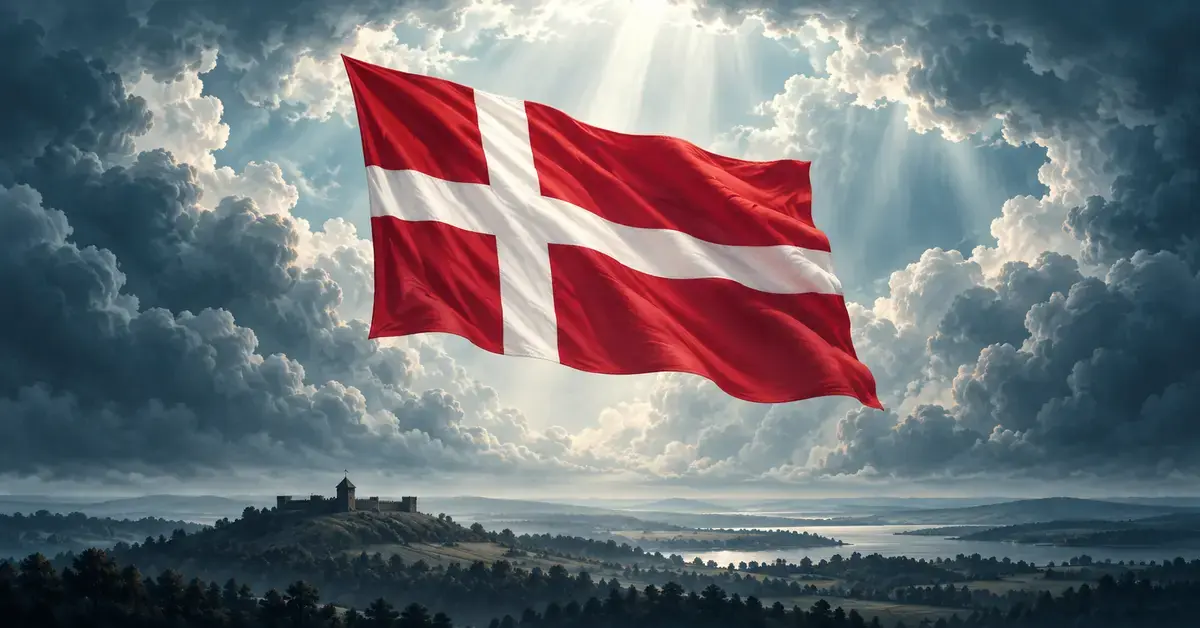
The oldest flag in the world that is still in national use is the Dannebrog, the red flag with a white cross flown by Denmark. It is a simple design with a long and genuinely unusual history: a flag that, by legend, fell out of the sky during a 13th-century battle, and that the Danes have carried ever since. This article tells the story of the Dannebrog — the famous legend, what the historical record actually proves, why it holds a Guinness World Record, how the flag is built, and which other flags try to claim the same title.
Quick Facts
| Flag | Dannebrog (the flag of Denmark) |
|---|---|
| Design | White Nordic cross on a red field, cross shifted toward the hoist |
| Record | Oldest continuously used national flag (Guinness World Records) |
| Continuous use from | 1625 (recognised as the national flag on 8 May 1625) |
| Earliest colour depiction | Gelre Armorial, c. 1340–1370 |
| Legend | Said to have fallen from the sky at the Battle of Lyndanisse, 15 June 1219 |
| Construction rule | Royal regulation of 11 June 1748; national proportion 28:37 |
| Flag day | Valdemarsdag, 15 June |
What is the oldest flag in the world?
The oldest flag still in continuous national use is Denmark’s Dannebrog. Guinness World Records recognises it as the oldest continuously used national flag, counting that continuity from 1625 — the year the design was formally adopted as Denmark’s flag. No other sovereign nation can point to the same flag in unbroken official use for as long.
It is worth being precise about the wording. Older banners, coats of arms and city or royal standards certainly exist, but “oldest national flag” means the same design used continuously by the same country as its flag. On that definition, Denmark wins, which is why the Dannebrog turns up again and again on lists of the oldest and newest national flags.
What is the Dannebrog?
The Dannebrog is a red flag bearing a white cross whose vertical arm is shifted toward the hoist — the edge next to the flagpole. That off-centre cross is the defining feature of the Nordic or Scandinavian cross, and the Danish flag is its original. The cross is traditionally read as a Christian symbol, in keeping with medieval Europe, while the red field has no single official meaning.
The name itself is old. “Dannebrog” is usually translated as “Danish cloth” or “the red cloth”: the element brog derives from an Old Norse word for a piece of cloth. Danes often simply call it “the splitflag” or just “Dannebrog” rather than “the flag of Denmark”.
The legend: a flag that fell from the sky
The most famous story about the Dannebrog is a legend, not documented fact. According to tradition, the flag fell from the sky on 15 June 1219 during the Battle of Lyndanisse (Lindanise), near present-day Tallinn in Estonia, while King Valdemar II — known as Valdemar the Victorious — was on a crusade in the Baltic.
As the tale goes, the Danes were losing until a red banner with a white cross drifted down from the heavens; the sight rallied the army, and Denmark won the day. A memorial in a Danish-themed garden in Tallinn marks the spot where the flag is said to have landed.
The problem is that the earliest written version of this story appears only in the 16th century, roughly 300 years after the battle, in the chronicle of Christiern Pedersen. A near-contemporary account of the 1219 campaign does not mention any flag falling from the sky. Historians therefore treat the sky-legend as national folklore — a powerful origin myth rather than evidence of when the flag was first used.
What the historical record actually shows
The documented history of the Dannebrog begins about a century after the legendary battle. Danish kings are recorded using a white-cross-on-red banner from the 14th century, and the earliest undisputed colour depiction appears in the Gelre Armorial, a heraldic manuscript dated to roughly 1340–1370.
From there the flag spread from royal and military use into a general national symbol during the 1500s. The decisive date for the record books is 8 May 1625, when the Dannebrog was recognised as Denmark’s national flag. Because official, continuous use can be traced in an unbroken line from that point, 1625 is the year Guinness uses to crown it the oldest continuously used national flag.
In short: the legend says 1219, the firm evidence says the 14th century, and the record counts from 1625. All three can be true at once, because they answer slightly different questions.
Which flags challenge Denmark’s claim?
Denmark is the most widely accepted answer, but a few flags are put forward as rivals, and the debate usually comes down to how you define “national” and “continuous”. The main contenders are compared below.
Oldest-Flag Contenders
| Flag | Earliest claim | Continuous national use? | Status today |
|---|---|---|---|
| Denmark — Dannebrog | Legend 1219; documented 14th century | Yes, recognised from 1625 | Holds the Guinness record as oldest in continuous use |
| Austria — red-white-red | Ducal seal of 1230 | No — not used continuously as the modern national flag | Ancient design, but national flag re-established in the 20th century |
| Scotland — Saltire (St Andrew’s Cross) | Traditionally very early; documented later | Disputed; evidence favours Denmark | Sub-national flag of Scotland within the UK |
| Netherlands — tricolour | Prince’s Flag, late 16th century | Design changed (orange to red) in the 17th century | Modern red-white-blue in settled use |
| Latvia — carmine-white-carmine | Referenced in a late-13th-century chronicle | No — adopted 1918, restored 1990 | Old design, but with a long gap in official use |
Austria’s red-white-red design is genuinely ancient — it appears on a ducal seal from 1230 — but it was not in continuous use as the modern national flag across the centuries, which is the standard the Dannebrog meets. Scotland’s Saltire is sometimes claimed to be older, yet the documented evidence for a white-on-blue national flag is later, and the UK’s Flag Institute has concluded that Denmark’s claim stands. For a wider sense of how European designs relate to one another, see our overview of the flags of Europe.
How the Dannebrog is built: colours, cross and proportions
The construction of the Danish flag is set by a royal regulation of 11 June 1748 that is still in force. It defines the white cross as one-seventh of the flag’s height and fixes the size of each coloured field, giving the ordinary national flag a proportion of 28:37 (height to length).
Several versions exist for different uses:
- Stutflag — the plain rectangular civil flag, the one private citizens fly.
- Splitflag — the swallow-tailed state flag used on land by public authorities; the royal standard is based on it.
- Orlogsflag — the naval ensign, a longer swallow-tailed flag in a deeper red, used at sea.
Interestingly, there is no legally fixed shade of red. A private Danish standard from 2005 matches the colour to Pantone 186 C, but the 1748 rules describe the design rather than a precise colour. If terms like hoist, fly and ratio are new to you, our guide to the parts of a flag explains how flag proportions are written and measured.
Valdemarsdag: Denmark’s flag day
Denmark marks its flag with an annual observance called Valdemarsdag, held on 15 June — the date of the legendary 1219 battle. It is named after King Valdemar, and the day has been celebrated in its modern form since 1913.
On Valdemarsdag the organisation Danmarks-Samfundet raises funds and distributes flags and banners to associations, scout groups and other bodies around the country. Until 1948 it was also a school holiday. The 800th anniversary in 2019 was marked nationwide, including a flypast by a specially painted Danish F-16.
How the Dannebrog shaped the Nordic flags
The Dannebrog did more than survive — it set a template. Its off-centre cross became the model for an entire Nordic cross family of flags: Sweden, Norway, Finland, Iceland and the Faroe Islands all use the same basic layout, and so do regional flags such as those of Shetland and Orkney.
Each country simply changes the colours while keeping the cross shifted toward the hoist. That shared design is one of the clearest examples of how a single flag can ripple outward across a whole region — a recurring theme in the study of flags, where designs are copied, adapted and re-used far beyond their country of origin.
Common mistakes and misconceptions
The biggest mistake is stating the sky-legend as fact. The Dannebrog did not provably fall from the sky in 1219; that is a 16th-century story, and careful sources always flag it as legend.
- “The flag dates to 1219.” The legend does, but documented use begins in the 14th century and the record counts from 1625.
- “It is the oldest flag ever made.” No — it is the oldest national flag in continuous use. Older banners and heraldic devices exist.
- “Austria or Scotland is older.” Both have old designs, but neither meets the same test of continuous national use.
- “The red has an official shade.” There is no legally defined red; the common Pantone 186 C figure comes from a private standard, not the 1748 law.
- Confusing the versions. The swallow-tailed Splitflag is for the state and navy; ordinary people fly the rectangular Stutflag.
Sources
- Guinness World Records — Oldest continuously used national flag
- Denmark.dk — Dannebrog: 800 years
- Naval History Denmark — History of the Flag
- Den Store Danske (lex.dk) — Valdemarsdag
- The Copenhagen Post — National flag’s dubious origins as a banner from heaven
- WorldAtlas — Which is the oldest continuously used national flag?
Vanliga frågor (FAQ)
What is the oldest flag in the world?
Denmark’s Dannebrog, a white cross on a red field, is the oldest flag still in continuous national use. Guinness World Records recognises it as the oldest continuously used national flag, counting from its adoption in 1625.
Did the Danish flag really fall from the sky?
No. The story that the flag fell from the sky at the Battle of Lyndanisse on 15 June 1219 is a legend first written down about 300 years later. It is a cherished origin myth, not documented history.
How old is the Dannebrog, really?
Danish kings are recorded using a white-cross-on-red banner from the 14th century, and the earliest colour depiction dates to roughly 1340–1370. It was recognised as the national flag in 1625, which is the date the “oldest” record is based on.
What does the Dannebrog look like and what does it mean?
It is a red flag with a white Nordic cross whose vertical arm sits closer to the pole. The cross is traditionally understood as a Christian symbol; the name “Dannebrog” is usually translated as “Danish cloth” or “red cloth”.
Is the Danish flag older than Scotland’s or Austria’s?
By the standard of continuous national use, yes. Austria’s red-white-red appears on a 1230 seal and Scotland’s Saltire is also old, but neither has been used continuously as the national flag for as long as the Dannebrog, which is why Denmark holds the record.
