

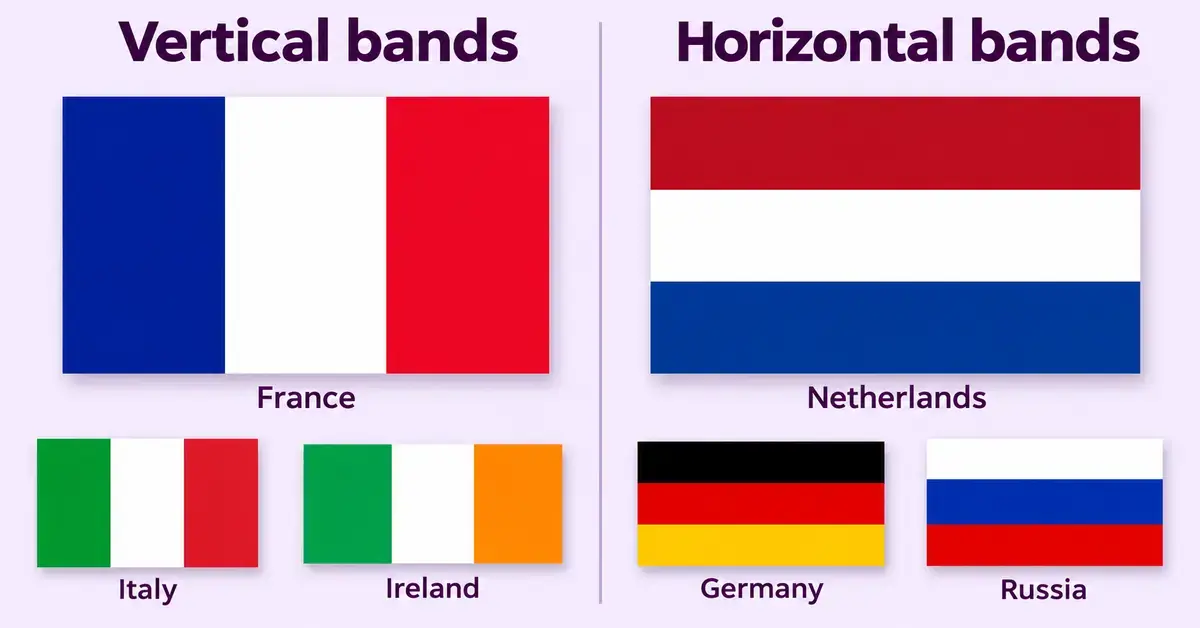
A tricolour flag is a national flag made of three bands of colour — either three vertical stripes or three horizontal ones — and it is the single most common layout in the world’s flags. France, Italy, Germany, the Netherlands, India, Russia, Ireland and dozens of other countries all fly a version of it. This guide explains what counts as a tricolour, which countries use vertical and which use horizontal designs, where the pattern came from, and why the same three bands can mean completely different things from one country to the next.
What is a tricolour flag?
A tricolour flag is a flag divided into three bands of different colours, set either as vertical stripes running from the hoist (the edge next to the pole) to the fly, or as horizontal stripes running from top to bottom. In most cases the three bands are equal in size. Vexillologists — people who study flags — call this basic layout a triband, and the tricolour is one of several recurring design families, alongside cross flags and flags with triangles.
The spelling tricolour is the British and Canadian form; American English writes tricolor. Both describe exactly the same design.
A tricolour can be plain — just the three bands, as on the flags of France and the Netherlands — or charged, meaning an emblem is added to the bands. The flag of India is a charged tricolour because it places a wheel in the centre band. Flags with more than three stripes, such as the thirteen stripes of the United States, are not tricolours, and neither are flags whose main feature is a cross, a diagonal or a corner canton rather than three full-width bands.
Vertical and horizontal tricolours
Tricolours come in two orientations, and the orientation is the quickest way to sort them. A vertical tricolour has three upright stripes read from the hoist to the fly; a horizontal one has three stacked bands read from top to bottom.
Vertical tricolours
Vertical tricolours have three side-by-side stripes. Well-known examples include France (blue–white–red), Italy (green–white–red), Ireland (green–white–orange), Belgium (black–yellow–red) and Romania (blue–yellow–red). Many vertical tricolours trace their design, directly or indirectly, back to Revolutionary France, which is why the style is sometimes called the “French” arrangement.
Horizontal tricolours
Horizontal tricolours have three stacked bands. Examples include the Netherlands (red–white–blue), Germany (black–red–gold), Russia (white–blue–red), Hungary (red–white–green) and Bulgaria (white–green–red). Horizontal three-band flags are especially common across central and eastern Europe, where several share the red, white and blue of the Pan-Slavic tradition.
Where the tricolour pattern came from
The tricolour has two great ancestors: the Dutch flag, which came first, and the French flag, which made the design famous worldwide.
The Dutch flag: the oldest tricolour
The oldest tricolour still in use is the flag of the Netherlands. The first reference to a Dutch flag dates from 1572, when its bands were orange, white and blue — colours tied to the principality of Orange. During the 17th century the orange was gradually replaced by red; one long-standing explanation is that orange was harder to see at sea than red. The modern red-white-blue flag was finally fixed by a royal decree of Queen Wilhelmina in 1937, which defined the three colours as bright vermilion, white and cobalt blue.
The French tricolour and the Revolution
The most influential tricolour is France’s blue-white-red flag. It grew out of the revolutionary cockade — a rosette worn from 1789 that combined the blue and red of Paris with the white associated with the French monarchy. A flag based on those colours appeared in 1790, and the National Convention standardised the design on 15 February 1794 as three equal vertical bands, blue at the hoist, in the arrangement painted by Jacques-Louis David. You can read the full story of the French flag in our profile of the French flag and its revolutionary origins.
How the tricolour spread
Napoleon carried the French tricolour across Europe, and 19th-century nationalist movements adopted the three-band idea as a clean, modern break from older royal and imperial banners. Italy modelled its green-white-red flag on the French design, first using it for the Cispadane Republic in 1797. The red, white and blue of Russia became the basis of the Pan-Slavic colours, agreed at the Prague Slavic Congress of 1848 and later echoed by many Slavic states. In the 20th century, newly independent nations in Africa, Asia and the Caribbean reached for the same simple layout, often filling it with their own colour families — for more on those shared palettes, see our guide to Pan-Slavic and Pan-African colour families.
What do the three bands mean?
There is no single meaning shared by all tricolours — this is the most important point to understand about them. The same red, white and blue can stand for revolution in one country, a royal house in another and Slavic solidarity in a third. Meanings are assigned nationally, they often draw on local history, and they can shift over time. A few well-documented examples show the range:
- France — blue and red are the traditional colours of Paris, while white was the colour of the king; the flag is also popularly linked to the motto “liberty, equality, fraternity.”
- Ireland — green represents the older Gaelic and Catholic tradition, orange the followers of William of Orange, and the white between them a lasting peace between the two.
- India — saffron sits at the top, white in the middle and green at the bottom, with a navy-blue 24-spoke Ashoka Chakra (a wheel drawn from an ancient Mauryan monument) in the centre band. See our full profile of the flag of India.
- Russia and the Slavic world — white, blue and red carry no fixed national meaning but mark a shared Slavic identity, which is why so many Slavic flags reuse the trio.
Notable tricolour flags at a glance
The table below sets out ten of the best-known tricolours, their orientation, the order of their bands and what those bands most commonly represent.
Tricolours at a Glance
| Country | Orientation | Bands in order | What the bands commonly represent |
|---|---|---|---|
| Netherlands | Horizontal (top to bottom) | Red, white, blue | The oldest tricolour; grew out of the orange-white-blue flag tied to the principality of Orange |
| France | Vertical (hoist to fly) | Blue, white, red | Blue and red of Paris with the royal white; later linked to liberty, equality and fraternity |
| Italy | Vertical (hoist to fly) | Green, white, red | Modelled on the French tricolour; first used by the Cispadane Republic in 1797 |
| Germany | Horizontal (top to bottom) | Black, red, gold | Colours of 19th-century nationalists; readopted in 1919 and by West Germany in 1949 |
| Ireland | Vertical (hoist to fly) | Green, white, orange | Green for the Gaelic tradition, orange for followers of William of Orange, white for peace between them |
| Belgium | Vertical (hoist to fly) | Black, yellow, red | Taken from the arms of the medieval Duchy of Brabant |
| Russia | Horizontal (top to bottom) | White, blue, red | Source of the Pan-Slavic colours reused by many Slavic nations |
| India | Horizontal (charged) | Saffron, white, green | A navy-blue Ashoka Chakra with 24 spokes sits in the white band |
| Romania | Vertical (hoist to fly) | Blue, yellow, red | Almost identical to the flag of Chad |
| Hungary | Horizontal (top to bottom) | Red, white, green | Long-standing Hungarian national colours |
A couple of these reward a closer look. Germany’s black-red-gold is an unusual horizontal tricolour in that its colours were championed by 19th-century nationalists and republicans before the modern state existed; they were adopted by the Weimar Republic in 1919 and again by West Germany in 1949. Belgium’s black-yellow-red, by contrast, is a vertical tricolour whose colours come straight from the medieval arms of the Duchy of Brabant rather than from the French model.
Tricolours that are easy to mix up
Because the tricolour is such a simple template, several national flags end up looking almost identical. The best-known near-twins are:
- Chad and Romania — both are vertical blue-yellow-red tricolours, and the two are so close that they are often cited as the hardest national flags to tell apart; Chad’s blue band is a slightly darker, more indigo shade.
- Ireland and Ivory Coast — these are mirror images. Ireland reads green-white-orange from the hoist, while Ivory Coast (Côte d’Ivoire) reads orange-white-green.
- Netherlands, Luxembourg and Russia — all three use red/white/blue horizontal bands. Luxembourg’s blue is lighter and its flag is more elongated than the Dutch one, while Russia stacks the colours as white-blue-red.
For more side-by-side pairs and the small details that separate them, see our guide to flags that look alike.
Sources
Frequently asked questions
How many countries use a tricolour flag?
The exact figure depends on how strictly you define the pattern, because some flags add an emblem or use unequal bands. Even so, three-band designs are the most common national-flag layout in the world, and dozens of countries fly either a plain or a charged tricolour.
Is the French flag the oldest tricolour?
No. France’s flag is the most influential tricolour, but the Dutch flag is older: a three-colour Dutch flag is recorded from 1572, well over two centuries before France standardised its design in 1794.
Are the three bands always equal in size?
Usually, but not always. The classic tricolour has three bands of equal width, yet some national flags keep the three-colour idea while making one band wider or adding a central emblem, which is why strict counts of “pure” tricolours vary.
Does a vertical tricolour always mean a country copied France?
Often, but not as a rule. Many vertical tricolours were inspired by Revolutionary France, yet others, such as Belgium’s, draw their colours and layout from older local heraldry rather than from the French flag.
