

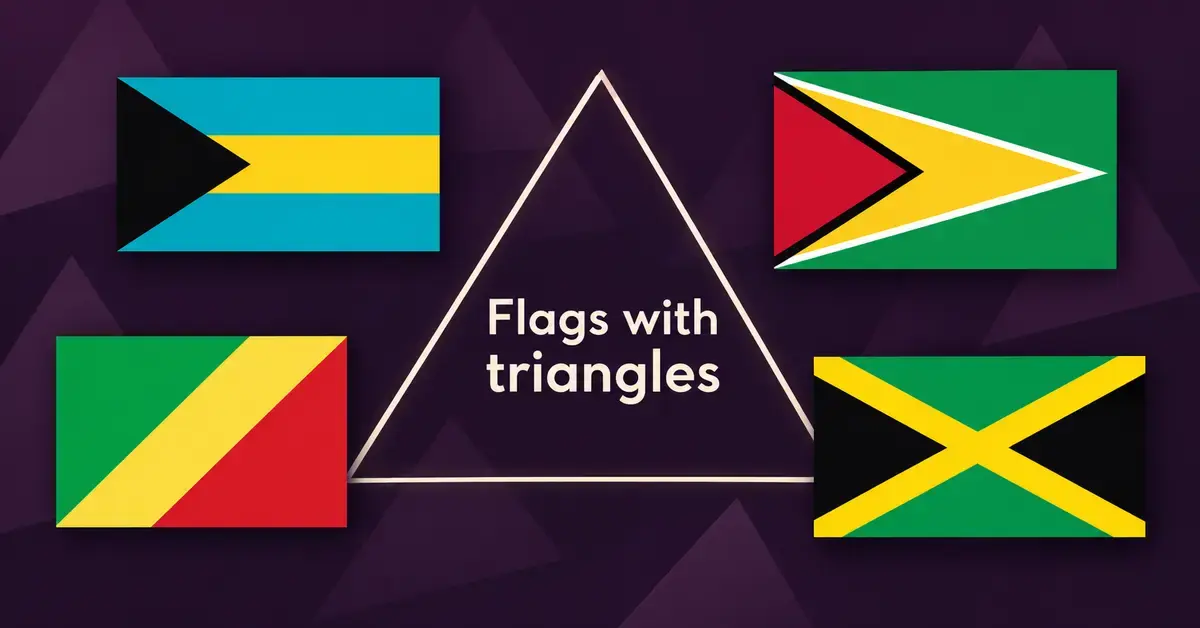
A triangle is one of the most common shapes on the world’s national flags, yet it almost never means the same thing twice. On some flags it is a wedge at the hoist (the edge nearest the flagpole); on others it is a chevron, a diagonal split that turns the whole flag into two triangles, or a cross that carves the field into four. This guide to flags with triangles lists which countries use a triangle, shows where each one sits, and explains what the shape is commonly said to represent — while being clear about where that meaning is official and where it is simply the popular reading.
Key points
- A triangle appears on national flags in four main ways: a hoist triangle, a chevron, a diagonally divided field, or a saltire that makes four triangles.
- More than twenty countries use one, clustered in the Caribbean, the Balkans, the Pacific and especially Africa.
- The shape has no single meaning: unity, revolution and sacrifice, equality, forward progress, and land or sea all recur.
- Most meanings are conventional, not written into law — governments rarely codify flag symbolism.
- The Czech blue wedge, the Philippine white triangle and the Cuban red triangle are the best-known single-triangle designs.
What counts as a flag with a triangle?
“A flag with a triangle” can describe several different designs, so it helps to separate them before naming countries. The triangle may be a distinct coloured element added to an otherwise striped flag, or it may be the result of how the field itself is divided. Knowing the type makes the long list of countries much easier to read, and it explains why some triangle flags look almost identical while others look nothing alike.
- Hoist triangle: a single triangle set against the pole-side edge, pointing toward the fly (the free end). The Czech, Philippine, Cuban, Bahamian and many African flags work this way.
- Chevron: a triangle that juts in from the hoist across horizontal stripes, most famously on the flags descended from the 1916 Arab Revolt flag (Jordan, Palestine, Sudan, South Sudan).
- Diagonally divided field: a single diagonal line splits the flag into two triangles, as on Papua New Guinea and Bhutan.
- Saltire or cross: a diagonal cross divides the field into four triangles, as on Jamaica.
If you want the vocabulary for these shapes — hoist, fly, canton and field — our guide to the parts of a flag lays out the anatomy and proportions. For a wider view of how shapes and emblems carry meaning, see what the symbols on national flags mean.
Which countries have a triangle on their flag?
More than twenty sovereign states carry a triangle in one of the forms above, and they cluster in a few recognisable families. The largest group is the single hoist triangle, used across the Caribbean, the Balkans, the Pacific and especially Africa. A second group is the Arab-Revolt chevron. A third is the diagonally divided flag. The table below gathers a representative selection with the triangle’s position, colour and the meaning most often attached to it.
Triangle flags at a glance
| Country | Triangle type | Colour | Commonly stated meaning |
|---|---|---|---|
 | Hoist wedge | Blue | Historically linked to Slovakia; no official meaning |
 | Hoist | White | Liberty, equality and fraternity |
 | Hoist | Red | Masonic equality; blood of independence |
 | Hoist | Black | Strength of a united people |
 | Chevron | Red | Hashemite dynasty and the Arab Revolt |
 | Full-width | Red | Blood of the independence struggle |
 | Field triangle | Yellow | Three peoples; shape of the country |
 | Two hoist triangles | Gold and red | Mineral wealth and nation-building energy |
 | Hoist | Black | Carries the boar’s tusk and fern emblem |
 | Diagonally divided | Red and black | Traditional colours; bird of paradise and Southern Cross |
Flag images: Wikimedia Commons, public domain.
The rest of this guide works through those families in turn, because the triangle’s story is different in each one.
Single hoist-triangle flags and what they mean
The hoist triangle is the classic “flag with a triangle”: a wedge of colour against the pole, usually carrying a star or emblem. Despite the shared shape, the meanings range from revolution and brotherhood to the sea and the people themselves.
Czech Republic — the blue wedge
The Czech flag adds a blue triangle to a white-over-red bicolour, and there is no official explanation of what its colours stand for. The design was created in 1920 for the new Czechoslovak state: white and red came from the historic arms of Bohemia, and the blue wedge was widely understood to represent Slovakia, whose 19th-century flags used blue. When Czechoslovakia split in 1993, the Czech Republic kept the flag unchanged. Popular “sky, blood and purity” readings exist, but they were never adopted officially. The blue element is technically a wedge rather than a perfect triangle, a detail flag scholars still note.
Philippines — liberty, equality and fraternity
The white triangle at the Philippine hoist stands for liberty, equality and fraternity, echoing the ideals of the French Revolution, and it holds a golden sun with eight rays and three stars. The flag is unusual for a feature that has nothing to do with the triangle’s shape and everything to do with its position: flown normally the blue band is on top, but when the flag is displayed with the red band up it signals that the country is in a state of war. First unfurled in 1898, it is the only national flag that formally changes meaning when flipped.
Cuba — the Masonic triangle
Cuba’s red triangle is drawn from Freemasonry, where the equilateral triangle symbolises liberty, equality and fraternity; on the flag it also stands for the blood shed in the fight for independence. Inside it sits a single white five-pointed star, La Estrella Solitaria (“the Lone Star”), a symbol of independence. The blue stripes are usually linked to the island’s historic regions and the white to the purity of the independence cause. The design dates to 1849 and was adopted as the national flag in 1902.
Bahamas — the strength of a united people
The black triangle on the Bahamian flag represents the vigour and strength of a united Bahamian people, and its inward point is read as their determination to develop the land and sea. The two aquamarine bands stand for the surrounding waters and the gold band for the sun and the islands’ resources. Adopted at independence in 1973, the flag combined several entries from a national design competition rather than a single winner.
Bosnia and Herzegovina — three peoples and a shape
Bosnia and Herzegovina’s yellow triangle has two widely accepted meanings: its three corners represent the country’s three constituent peoples — Bosniaks, Croats and Serbs — and the triangle also roughly echoes the shape of the national territory. The blue field with white stars links the country to Europe, and the blue-yellow-white palette is associated with neutrality and peace. The flag was imposed in 1998 by the international high representative precisely because it avoided symbols favouring any one group.
Vanuatu — the boar’s tusk and the fern
Vanuatu’s black hoist triangle carries a boar’s tusk curled around two crossed namele fern fronds. The tusk is a traditional symbol of prosperity, because raising a pig until its tusks grow in a full circle is a sign of wealth and status, while the fern fronds stand for peace. The red, green, black and yellow came from the flag of the Vanua’aku Party, and the design was chosen shortly before independence in 1980.
Guyana — the Golden Arrowhead
Guyana’s flag, nicknamed the Golden Arrowhead, is really two nested triangles pointing from the hoist across a green field. The long golden triangle stands for the country’s mineral wealth and its forward drive, and the red triangle in front of it, fimbriated (edged) in black, stands for the nation-building energy of the people and their endurance. Green represents the forests and farmland and white the many rivers. It was designed by the American vexillologist Whitney Smith and adopted at independence in 1966.
Eritrea — the red triangle of the struggle
Eritrea’s flag is built around a red triangle whose base runs along the hoist and whose point reaches the fly, dividing a green upper area from a blue lower one. The red is generally read as the blood of the long independence struggle, green as agriculture and livestock, and blue as the wealth of the sea. A gold olive wreath and branch sit inside the red, a motif carried over from the independence movement and associated with peace. The current flag was adopted in 1995.
African hoist triangles
Africa has the densest cluster of hoist-triangle flags, several of them designed around independence. The triangle usually frames an emblem or star:
- Mozambique — a red hoist triangle bearing a yellow star, a book, a hoe and a rifle, symbols of education, agriculture and defence.
- Zimbabwe — a white triangle edged in black, carrying a red star and the soapstone Zimbabwe Bird, the national emblem.
- Equatorial Guinea — a blue triangle representing the sea that links the mainland to the country’s islands.
- São Tomé and Príncipe — a red hoist triangle for the independence struggle, with two black stars for the two main islands.
- Comoros — a green triangle bearing a white crescent and four stars, reflecting Islam and the country’s islands. Because it blends a triangle with a crescent, it also appears among the crescent-and-star flags.
- Djibouti — a white triangle at the hoist with a red five-pointed star, the white standing for peace and the star for unity.
For the wider colour story behind these designs, see our overview of the flags of Africa.
The Arab-Revolt chevron family
A whole group of flags carries a triangle at the hoist that descends from a single source: the flag of the 1916 Arab Revolt against the Ottoman Empire, which combined black, white and green stripes with a red triangle. Jordan adopted this layout in 1928 and added a white seven-pointed star to the red Hashemite triangle; the star is usually read as the unity of the Arab people, with its seven points linked to the opening verses of the Qur’an. The same template, with the triangle recoloured, produced several modern flags:
- Jordan — red triangle with a white seven-pointed star.
- Palestine — red triangle, no star.
- Sudan — green triangle, adopted in 1970, the green linked to Islam, agriculture and prosperity.
- South Sudan — a blue triangle for the waters of the Nile, carrying a gold star of unity, added when the country became independent in 2011.
These flags share the pan-Arab black, white, green and red, which is why they look like a set. The repeated palette is a good example of how colour families, not just shapes, tie flags together.
Flags divided into triangles
On some flags the triangle is not an added element at all — the field itself is split so that the triangles are the flag. Two patterns do this: a single diagonal line, and a diagonal cross.
Diagonally divided flags
A diagonal division turns a flag into two triangles meeting corner to corner. Papua New Guinea is divided from the top-hoist to the bottom-fly, with a red upper triangle carrying a golden bird of paradise and a black lower triangle carrying the five white stars of the Southern Cross; red and black are traditional colours of many of the country’s peoples. Bhutan is split the other way, yellow above and orange below, with the white Druk (thunder dragon) straddling the line — the yellow for the civil monarchy and the orange for the country’s Buddhist tradition. Several other flags, such as those of the Democratic Republic of the Congo, Tanzania and Namibia, use a diagonal stripe that produces two triangular corners.
Saltires: four triangles from a cross
A saltire (a diagonal cross) divides a flag into four triangles. Jamaica is the clearest case: a gold saltire creates green triangles top and bottom and black triangles at the hoist and fly. The official reading is “the sun shineth; the land is green; and the people are strong and creative” — gold for sunlight and natural wealth, green for the land and hope, and black for the strength and creativity of the people. Saint Kitts and Nevis uses a black diagonal band edged in yellow that leaves a green triangle above and a red triangle below, with two white stars for the two islands. Jamaica is also notable for once being the only national flag using none of red, white or blue — a fact that comes up often among flags that look alike and their outliers.
What does a triangle on a flag usually mean?
There is no single meaning for a triangle on a flag; the shape is a frame that each country fills with its own story. Still, a few themes recur often enough to be worth naming:
- Unity and the people: the triangle’s three joined corners suggest coming together (Bahamas, Bosnia and Herzegovina).
- Revolution and sacrifice: a red triangle frequently marks the blood or struggle of independence (Cuba, Eritrea, São Tomé and Príncipe, the Arab-Revolt chevron).
- Equality and brotherhood: the equilateral triangle’s balanced sides lend themselves to ideals of equality (Philippines, Cuba’s Masonic origin).
- Direction and progress: a triangle pointing into the flag reads as forward movement (Guyana’s arrowhead, the Bahamas).
- Land, sea and sky: the triangle often holds a geographic meaning, such as the sea (Equatorial Guinea) or a river (South Sudan).
Importantly, most of these meanings are conventional rather than legally fixed. Governments rarely write symbolism into law, so the readings you find come from reference works, design competitions and official summaries. The colours inside a triangle usually carry as much meaning as the shape — our guide to what flag colours mean explains why the same colour can say different things in different countries.
Common mistakes and points of confusion
The triangle trips people up in a few predictable ways. Clearing them up makes these flags much easier to identify.
- Treating a chevron as the same shape as a hoist triangle. Jordan’s chevron cuts across stripes and is tied to the Arab-Revolt family; the Czech wedge sits against a plain bicolour. They are different design traditions even though both are “triangles at the hoist”.
- Assuming a triangle is religious. Comoros pairs its triangle with an Islamic crescent, but most triangle flags carry no religious meaning at all. The shape itself is secular.
- Confusing the Czech and Philippine flags with their neighbours. Drop the Czech blue triangle and you have the flag of Poland; the Philippine triangle is what separates that flag from several other red-white-blue designs. The triangle is the tell.
- Calling a diagonally split flag a “triangle flag” and expecting an added triangle. On Papua New Guinea or Bhutan there is no separate triangle — the division line creates two triangular halves.
- Thinking the Philippine flag is simply upside down when red is on top. That orientation is an intentional, legally recognised signal of a state of war, not an error.
Sources
- Encyclopaedia Britannica — Flag of the Bahamas
- Government of The Bahamas — national symbols
- CIA World Factbook — Jordan flag description
- CIA World Factbook — Bosnia and Herzegovina flag description
- CIA World Factbook — Papua New Guinea flag description
- U.S. Department of State — Comoros flag
- Jamaica Information Service — The Jamaican Flag
- Flags of the World — Guyana
- Flags of the World — Vanuatu
- Radio Prague International — Czech flag history
Frequently asked questions (FAQ)
Which countries have a triangle on their flag?
More than twenty do. The single-hoist-triangle group includes the Czech Republic, the Philippines, Cuba, the Bahamas, Bosnia and Herzegovina, Vanuatu, Guyana, Eritrea, Mozambique, Zimbabwe, Equatorial Guinea, São Tomé and Príncipe, Comoros and Djibouti. The Arab-Revolt chevron group adds Jordan, Palestine, Sudan and South Sudan, and diagonally divided or saltire flags include Papua New Guinea, Bhutan, Jamaica and Saint Kitts and Nevis.
What does the triangle on a flag symbolise?
It depends entirely on the country. Common themes are unity (the three joined corners), revolution or sacrifice (often a red triangle), equality and brotherhood, forward progress (a triangle pointing into the flag), and geography such as the sea or a river. Most of these meanings are conventional rather than written into law.
Why is there a blue triangle on the Czech flag?
The blue wedge was added in 1920 to distinguish the new Czechoslovak flag from Poland’s white-over-red, and it was widely understood to represent Slovakia. The Czech Republic kept the design after 1993. There is no official statement of what the colours mean.
What does it mean when the Philippine flag is flown with the red stripe on top?
It signals that the country is in a state of war. Flown in peacetime the blue band is uppermost; reversing the bands is an intentional, legally recognised change of meaning, not a mistake. The white hoist triangle stays in place either way.
Which national flag has the most triangles?
Jamaica’s gold saltire divides the flag into four triangles, the most of any national flag. Guyana’s Golden Arrowhead contains two nested triangles, while most other designs carry a single triangle at the hoist.
